
It is worthwhile to set out the facts in Sirros v. Moore in some detail, because they are essential to understanding the perpetually troublesome definition of the term “jurisdiction” which haunts any action involving public authorities. The plaintiff, an alien had been fined by a magistrate who then recommended deportation, but ordered that the alien not be detained pending the Home Secretary’s decision regarding deportation. The plaintiff appealed to the Crown Court, which in effect was empowered to conduct a rehearing and vary or affirm the order below in any respect. Specifically, the Crown Court was empowered to recommend deportation, and consequent upon that recommendation, to order, or not order, that the alien be detained. The judge of the Crown Court held — erroneously as it turned out — that he had no jurisdiction to hear the appeal against the recommendation for deportation. The judge announced that the appeal was dismissed, and then, seemingly as an afterthought, ordered that Sirros be detained. The effect of his dismissing the appeal was to leave the magistrate’s order intact; hence the Crown Court made no deportation recommendation, as was a condition precedent to a detention order.27 Whether this detention order, clearly invalid, was an error within or without the jurisdiction of the Crown Court, is a point of some nicety to which we shall return shortly.
An order of habeas corpus was granted on the ground that the judge was functus officio.28 Upon his release Sirros issued a writ claiming damages for trespass and false imprisonment against the judge and police officers involved. In the Court of Appeal all three judges upheld the defendant’s application to strike out the action on the ground that it disclosed no reasonable cause of action, but the reasons behind the decision differed. Lord Denning, with whom Ormrod L.J. essentially agreed, openly acknowledged that he was breaking from the rules established in the older cases, as he interpreted them. He held that any judge of any court should be immune from tort liability for any act done in his official capacity unless the judge knowingly exceeded his jurisdiction. Buckley L.J. interpreted the older authorities somewhat differently and arrived at a very complex set of immunity rules. His expression of these rules is obiter dicta because he decided the case on a relatively uncontroversial basis, holding that the judge had simply made a procedural error within his jurisdiction.
Their analysis of the older authorities, which was somewhat less detailed than that of Buckley L.J., led Lord Denning and Ormrod L.J. to conclude that the common law had always distinguished between superior and inferior courts for the purposes of special tort immunity.29 They seemed to agree that a superior court judge was immune from civil liability for anything said or done while acting judicially. This immunity extended to acts done within or without jurisdiction, and indeed “[n]o matter that the judge was under some gross error or ignorance, or was actuated by envy, hatred and malice, and all uncharitableness. . .”.30 Judges of inferior courts were personally liable for acts done outside their jurisdiction, except when they genuinely believed on the facts that they had jurisdiction. This would seem to protect the judge from almost any error of fact committed in interpreting the evidence, provided there was some evidence on point for his consideration.31 However, the judge of an inferior court was liable for innocent errors of law which caused him to exceed his jurisdiction. The cause of action arising from an order made outside jurisdiction would generally be trespass.32
In Lord Denning’s view, inferior court judges were also liable “for acts done within their jurisdiction if done maliciously and without reasonable and probable cause”.33 The basis of this type of action would not be trespass but case, and will be discussed herein.34 However, it is interesting to note that one author has argued most convincingly that it is not judges of inferior courts, but judges not acting as a court of record, who are potentially subject to this type of suit.35
After recognizing the dichotomy between superior and inferior courts, Lord Denning and Ormrod L.J. concluded that it ought to be abandoned for the purposes of tort law, and that the same liability rules ought to be applied to all judges and magistrates.36 They adopted the broader immunity recognized as applying to superior court judges as the general rule — essentially absolute immunity for all acts done while performing a judicial function, within or without jurisdiction. Buckley L.J., in a sense, began where they concluded, because in his view the case law did not support a distinction between superior and inferior court judges.37 Although agreeing that the same rules ought to apply to all judges, he disagreed significantly with the scope of that immunity. He expressed the possibilities, and their potential liability consequences as follows:38
So the following questions may arise:
(2) If the act was, or purported to be, a judicial act, was it within the judge's jurisdiction?
(3) If the act purported to be a judicial act in the exercise of a jurisdiction which the judge possessed and about the extent of which he was under no misapprehension, did the judge act as he did upon an erroneous judgment that the circumstances were such as to bring the case within the ambit of that jurisdiction?
(4) If the act was not in truth within the judge's jurisdiction, did he act in a conscientious belief that it was within his jurisdiction, and, if so,
(b) due to a careless ignorance or disregard of some such facts, or
(c) due to a mistake of law relating to the extent of his jurisdiction?
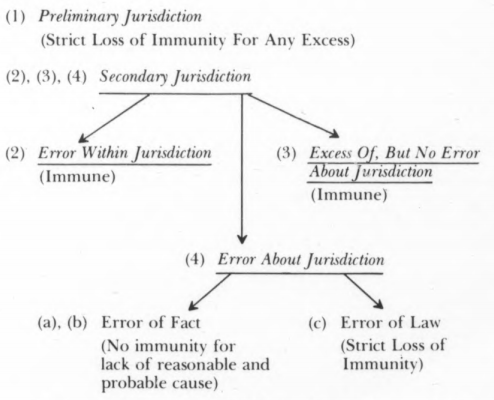
Although Buckley L.J. avoided the term “jurisdiction" in addressing the issue of whether or not the term was a judicial act, his test seems to amount to asking whether or not the judge had “preliminary jurisdiction”39 to perform the act in question, and he later uses the term jurisdiction in this context.40 But he also uses the term jurisdiction in questions (2), (3), and (4), and the term is then being used in a different sense from its use in question (1). For want of a better term, this may be called “secondary jurisdiction” as opposed to “preliminary jurisdiction”.
This slippery term has plagued administrative law for many years, and the distinction between jurisdictional and non-jurisdictional questions, as well as the distinction between the two types of jurisdictional questions, is extremely difficult to draw. Indeed, one of the advantages of the judgments of Lord Denning and Ormrod L.J. is that they make this difficult exercise unnecessary. However, these distinctions have been relied upon in tort cases involving other public authorities,41 and it is necessary to come to grips with them in order to understand Lord Justice Buckley’s views.
Using the facts in Sirros as an example, one might address the preliminary jurisdiction question by looking at the matter as it stood at the outset of the case, and asking whether the judge could (given certain findings of fact, conclusions of law, and procedural regularity) lawfully perform the act in issue. Buckley L.J. dealt with this issue simply by observing that the judge did have jurisdiction to detain the alien if the subsequent conditions were complied with.42 The matter would also have to be within the territorial competence of the court, within the limitation period, properly instituted by the proper party, and, in a civil matter, within the monetary jurisdiction of the court.43 Facts might also come to light during the course of the action which were relevant to preliminary jurisdiction; for example, the evidence might establish that an issue which initially appeared to be within the territorial competence of the court was upon further examination found to be beyond it.44 In the view of Buckley L.J., any error of preliminary jurisdiction would deprive a judge’s act of its judicial character, and hence deprive the judge of immunity.
Ormrod L.J. distinguished between the two meanings of the term jurisdiction as follows: “...a distinction must be drawn between questions which are strictly questions of jurisdiction [preliminary jurisdiction] and questions which relate to the powers which the court can exercise in the course of exercising its jurisdiction”.45 It is the latter type of jurisdictional question which Buckley L.J. refers to in (2), (3), and (4). It is tempting to use Sirros again as an example and say, as Lord Denning and Ormrod L.J. seem to,46 that although the Crown Court judge had preliminary jurisdiction to detain Sirros, that power was only exercisable after a recommendation for deportation, and hence, that the judge lacked jurisdiction in the second sense to make the order, having failed to satisfy the necessary precondition. Unfortunately — and this is a perfect illustration of the futility of attempting to distinguish jurisdictional and non-jurisdictional questions — Buckley L.J. classified the judge’s act as an error of procedure within his secondary jurisdiction, and hence immune.47 He went on to say that even if the decision in such a case were particularly perverse or irrational, the judge would still be immune from civil liability, although perhaps subject to removal from office.
It is no easier to distinguish question (3) from question (4) than it is to distinguish both from questions (1) and (2). Question (3) seems to posit a situation where the judge knows his jurisdiction, in the second sense, but erroneously concludes that the circumstances of a case bring it within that jurisdiction. Since the judge knows his jurisdiction, this is an error of judgment rather than an error of jurisdiction. As an example, he cites Hamond v. Howell48 where the judge knew he had jurisdiction to punish a misdemeanor, but made an error in judgment in concluding a misdemeanor had been committed. Question (4) appears to contemplate the situation where the judge is in error as to the scope of his power, or jurisdiction in the second sense. Questions (4)(a) and (c) are consistent with the rules which Lord Denning and Ormrod L.J. felt had applied previously to inferior courts, but (4)(b) seems to go somewhat further, suggesting that due care rather than genuine belief is the required standard.
Although the following chart will not resolve the classification difficulties, it may enable the reader to recognize the distinctions as seen by Buckley L.J.
 Although the views of Lord Denning and Ormrod L.J. represent the law as it now stands in England, the House of Lords has not yet ruled upon this new direction, and it is certainly open to other courts in other jurisdictions to reach an entirely different solution. Lord Justice Buckley’s views have been presented in detail mainly to illustrate the possible distinctions in the scope of judicial immunity. After a review of the relevant statutory provisions these possible solutions will be tested against the factors which support judicial immunity.
The Canadian statutes which deal with provincially appointed judicial officers are modelled upon the English The Justice's Protection Act 1848.54 The full title of the Act (An Act to protect Justices of the Peace from vexatious actions for Acts done by them in execution of their Office) suggests that it was passed for the purpose of limiting groundless actions. As does most of the Canadian legislation, it distinguishes between acts done with and without jurisdiction. Jurisdiction is not defined, so the same definitional problems present in the common law are also present under the legislative schemes.
Consistent with the English legislation, when the act in issue was within the officer’s jurisdiction six provinces specify no action will lie unless the act was done maliciously and without reasonable and probable cause.55 Neither “malice” nor the presumably equivalent term “bad faith” which appears in the British Columbia legislation,56 is defined. Interestingly, in British Columbia and Prince Edward Island the legislation reads “malice or without reasonable and probable cause,”57 and depending upon how that word is interpreted, those statutes may recognize a far narrower immunity rule than the others.58 In New Brunswick, there is no specific statutory reference to an action on the case. Instead there is a prohibition against any action being brought against an officer acting within jurisdiction.59 It is always possible to argue that a knowing or malicious error in itself takes the officer out of his jurisdiction, but the distinctive nature of the New Brunswick legislation suggests that this approach was not intended by the legislature.60
None of this legislation is as clear as it might be, because while at least eight provinces and England recognize an action on the case for errors committed within jurisdiction, none specifies clearly the elements of that action. Assuming one could determine the common law in the nineteenth century, were the Acts intended to change it or confirm it?61 Moreover, the Acts are worded in the negative, raising the possibility that malice and want of reasonable and probable cause are necessary, but not always sufficient, criteria of liability. It has been argued that the absolute immunity in the common law for errors within jurisdiction committed by justices acting as courts of record would protect an English justice of the peace from an action of malicious conviction, notwithstanding the legislation.62 Thus, much of the uncertainty of the common law remains with the legislation, and the same is true of the legislation governing errors of jurisdiction.
Dealing with errors committed without or in excess of jurisdiction, there are basically two different legislative schemes. In three provinces, the legislation requires proof of malice and reasonable and probable cause, just as for the error within jurisdiction.63 Interestingly, this creates broader judicial immunity than that which Buckley L.J. felt was available to superior court judges, or that which Lord Denning felt was available to certain inferior courts at common law,64 and may now be roughly similar to the immunity for all but knowing error expressed by Lord Denning and Ormrod L.J. in Sirros v. Moore.65
In three other provinces, the common law relating to jurisdictional error is affirmed and the legislation states that it is not necessary to prove malice or want of reasonable and probable cause.66 Therefore, unless these provinces adopt the decision in Sirros v. Moore, there will be strict liability in trespass for jurisdictional error. In New Brunswick, there is simply a prohibition against suing a judge for an act performed within jurisdiction, and presumably the effect is the same as in the three provinces noted immediately above.67 In Manitoba and Prince Edward Island the phrase “in the execution of his duties” appears in otherwise similar legislation.68 If that phrase is interpreted as meaning “within jurisdiction” there would either be strict liability in trespass, or liability for knowing error, depending upon whether or not Sirros v. Moore were adopted. But it can also be argued that the phrase is meant to include the purported exercise of jurisdiction, in which case the legislatures may have contemplated liability only when the act loses its judicial character, as where the judge knowingly exceeds jurisdiction.
It is interesting to note that the federal Criminal Code, and legislation in several provinces perm its the reviewing court, upon quashing a conviction, to issue an order immunizing the judge who made the error from tort liability.69 For example, the Ontario legislation reads as follows:
7.(1) Where an order is made quashing a summary conviction, the court may provide that no action shall be brought against the justice of the peace who made the convictionor against the informant or any officer acting thereunder or under any warrant issued to enforce the convictionor order. (2) Such an order may be made conditional upon payment of the costs of the motion to quash or upon such other condition as may be considered proper.It will be argued subsequently that the action on the case is preferable to the trespass basis of judicial liability. However, if trespass liability were to be maintained, then there is much to recommend such provisions whereby an action for an innocent error of jurisdiction may be precluded by the same judge who determines the error, hence eliminating the groundless suit at the earliest possible opportunity. The other advantage, which obtains equally if the trespass suit is abandoned altogether, is that the reviewing court may exercise its public duty without taking into account in any way the private liability which may otherwise flow from the decision to quash.70
Finally, in England there is statutory provision for indemnifying justices for costs and damages incurred in tort proceedings, with indemnity being mandatory if the justice acted reasonably and in good faith.71 Since these elements would be fatal to an action upon the case, the utility of the provisions depends largely upon the continued recognition of the trespass action. The provisions are, however, responsive to one72 but not all of the rationales for judicial immunity, and may reflect the government’s desire to treat justices more as other public authorities than as superior court judges or courts of record.
In summary, the common law before Sirros v. Moore imposed strict liability in trespass for jurisdictional errors committed by any court in the view of Buckley L.J., or by inferior courts in Lord Denning’s and Lord Justice Ormrod ’s view. The legislation in England, and in all but the three Canadian provinces which insist upon an action on the case, contemplates the application of the common law, with the precise interpretation of the common law being an open question at the moment in Canada. In England and all of the provinces except probably New Brunswick, the legislation appears to contemplate liability for any judicial error committed with malice and/or want of reasonable and probable cause. At common law it appears that superior court judges, or perhaps courts of record, were immune from this type of liability, although in Lord Justice Buckley’s view an error of fact committed without reasonable and probable cause would not allow immunity. Thus, although the legislation differs from the common law, the same factors — classification of court, classification or error, standard of care, and motive — are relevant to the determination of the scope of immunity.


