HomeAboutContact | ...loading...
Buy™.Sell™.Shop™.
iconWebsite
TBD Marketplace™
iconWebsite
TBD Marketplace™Shop™

LAW REVIEWS ON JUDICIAL IMMUNITY

CATHOLIC UNIVERSITY LAW REVIEW | VOL 29 ISS 4
THE JUDGE NEEDS A LAWYER

Cath. Univ. (80)

0 | INTRODUCTION

THE JUDGE NEEDS A LAWYER
Frank Q. Nebeker, Associate Judge, District of Columbia
Court of Appeals*


[I]t is a general principle of the highest importance to the proper administration of justice that a judicial officer, in exercising the authority vested in him, shall be free to act upon his own convictions, without apprehension of personal consequence to himself. Liability to answer to everyone who might feel himself aggrieved by the action of the judge would be inconsistent with the possession of this freedom and would destroy that independence without which no judiciary can be either respectable or useful.1
Despite our longstanding commitment to the above principle, a present day judge, particularly a trial judge, encounters a new personal and financial risk. I do not mean the diminished purchasing power of judicial salaries which often fail to keep pace with inflation. I refer to a job hazard brought about by the litigation explosion and its handmaiden - the redress neurosis. Whatever a judge does in the courthouse, he runs a substantial risk of becoming embroiled in litigation where he is no longer the dispute-resolver, but rather, the object of the complaint. When this occurs, serious problems arise respecting the nature and source of legal representation for the judge.

It has not been uncommon for judges to be the adversary when parties to a lawsuit have brought extraordinary writs from appellate courts concerning a ruling in their case pending before the judge.2 But increasingly, the judge is apt to be sued in separate private actions for damages or equitable relief.3 Moreover, with the advent of judicial disability and tenure commissions, the judge may be called upon to respond to complaints before these disciplinary bodies.4 The purpose of this article is to expose and explore the scope of the ethical and practical dilemmas created for the judge by the necessity of obtaining legal representation due to this rapidly growing phenomenon of suits and complaints against judicial officers.
Footnotes
* Judge Nebeker wishes to acknowledge the willing and able assistance of Mary Ellen Craig, Esq. and Cara Nebeker in the preparation of this article.
1 Bradley v. Fisher, 80 U.S. (13 Wall.) 335, 347 (1871).
2 See generally Note, Mandamus as a Means of Federal Interlocutory Review, 38 OHIO ST. L.J. 301 (1977); Comment, The Use of Extraordinary Writs for Interlocutory Appeals, 44 TENN. L. REV. 137 (1976).
3 See notes 8-38 and accompanying text infra. See generally Feinman & Cohen, Suing Judges: History and Theory, 31 S.C.L. REV. 201 (1980); Note, Immunity of Federal and State Judges from Civil Suit – Time for a Qualified Immunity?, 27 CASE W. RES. L. REV. 727 (1977).
4 See notes 39-53 and accompanying text infra. See generally Symposium - Judicial Discipline and Disability, 54 CHI.-KENT L. REV. 1 (1977).

I | SUITS AGAINST JUDGES AND THE IMMUNITY DOCTRINE

It is often believed that judges are absolutely immune from damage actions under the principles established by the Supreme Court in Bradley v. Fisher.5 In Bradley the Court held that, when a judge performs "judicial acts," he cannot be held personally liable for such acts in a civil action.6 The Court recognized that exposure to personal liability would destroy judicial independence, the hallmark of the administration of justice.7 Yet, despite this long-established precedent, there is no guarantee that claimants are not going to file suit for relief from alleged judicial wrongs. When a suit is filed, the judge must still defend the action and obtain counsel in order to apply the judicial immunity defense.

One traditional mechanism through which the acts of trial judges have been subject to appellate scrutiny has been the writ of mandamus.8 This remedy is used to confine the judge to the proper exercise of discretion or to order its exercise where it has been withheld.9 In Kerr v. United States District Court for the Northern District of California,10 the government had sought a writ of mandamus from the United States Court of Appeals for the Ninth Circuit to vacate a district court order granting the plaintiffs discovery motion for the production of prison documents. In upholding the Ninth Circuit's denial of the writ, the Supreme Court reaffirmed the long-established policy that a "writ will issue only in extraordinary circumstances."11 The Court recognized that an important reason for limiting the use of mandamus is that such actions "have the unfortunate consequence of making the [district court] judge a litigant, obliged to obtain personal counsel or to leave his defense to one of the litigants [appearing] before him in the underlying case."12 One could reason that, in most instances, the petition for writ of mandamus is only nominally against the judge. Consequently, it is appropriate to leave the matter of representation in the appellate court to counsel for the parties in the trial proceedings. However, the Supreme Court in Kerr acknowledged the anomalies in this situation and recognized that the judge may in fact have a personal stake in the outcome and thus may require personal representation. Moreover, the judge may believe that counsel for the parties in the case will not capably advocate his interests.13

Absolute judicial immunity is disappearing in favor of more limited immunity, depending on the nature of the judicial act involved.14 Classes of allegations where immunity from suit may not exist include:
acts evidencing a lack of good faith;
acts of a criminal nature;15
acts in the absence of authority or beyond jurisdiction;16 and
acts of an administrative or ministerial nature.17
Moreover, an increasing number of personal actions against judges are being brought under 42 U.S.C. § 1983 (1976),18 alleging denial of constitutionally protected rights under color of law.

The extent of judicial immunity under section 1983 was recently explored in Stump v. Sparkman.19 This suit was brought against a state judge who had approved a parent's petition for sterilization of her "somewhat retarded" fifteen-year-old daughter. In reversing the Seventh Circuit's determination that the judge had not acted within his jurisdiction, the Supreme Court recognized that judicial immunity from damage suits is crucial to the survival of an independent judiciary. Thus, the Court established an immunity rule for judicial acts performed within the court's competence to act.20 In barring the recovery of damages, the Court reasoned that judges must be able to act without fear of personal consequences, including the expenses incident to a suit, in controversial cases.21

The Court, in Stump, identified two factors to be considered in determining whether a judge's act is in fact "judicial." First, the nature of the act itself must be examined to see if it is a function normally performed by the judge. Second, the expectations of the parties should be scrutinized to determine whether they dealt with the judge in his official capacity.22 While this may be the legal rule, there will always be questions as to what constitutes "judicial acts" and what is within the court's competence to act. Thus, although the judge may ultimately prevail, doing so will be a long and expensive process requiring counsel every step of the way.

While the doctrine of judicial immunity bars damage actions under section 1983, it does not necessarily preclude suits under section 1983 for declaratory or injunctive relief.23 In one recent case, Consumers Union of the United States, Inc. v. ABA,24 suit was brought under section 1983 against the Virginia State Bar, the Supreme Court of Virginia, the court's chief justice, and several officials of the state bar association, seeking injunctive and declaratory relief respecting the publication of information concerning the practices and fees of attorneys. The three-judge court granted the relief sought and also awarded the plaintiffs attorney's fees under the Civil Rights Attorney's Fees Act of 1976.25

In awarding attorney's fees, the trial court held that the Act was intended by Congress to abrogate judicial immunity respecting the awarding of such fees.26 Thus, the court ruled that, while the judges would not be personally liable, they would be liable in their official capacity,27 implying that the attorney fee award would actually be paid by the state.28 On appeal, the Supreme Court held the attorney fee award improper where it was based upon the failure of the Virginia court to exercise its rulemaking authority. However, an award against the Virginia court when acting in its "direct enforcement role" in disciplining, suspending, and disbarring attorneys was approved by the Court, thereby, implying official liability of judges in similar circumstances.29

Suits against judges and challenges to the doctrine of judicial immunity arise in other contexts as well. For example, the Supreme Court recently denied certiorari in Rivera v. Cruz,30 a case in which an attorney alleged that the defendants, members of the Puerto Rico Supreme Court, could not participate in a hearing on his appeal. The trial court had summarily dismissed his complaint, which sought to void his suspension from practicing law, as not presenting a justiciable controversy.

Another and relatively new risk of exposure to suit is presented by what might be called a "constitutional tort action," where the immunity defense appears open to question. For example, in Davis v. Passman,31 the plaintiff alleged that a congressman had violated the fifth amendment by dismissing her from his staff solely on the basis of her sex. Damages were sought in the form of backpay, and jurisdiction was predicated only on the existence of a general federal question under 28 U.S.C. § 1331(a) (1976).32 Although Congress has historically exempted itself from coverage under the various civil rights acts, the Supreme Court held that a right of action against the congressman existed under the fifth amendment33 and that damages would be available if the plaintiff prevailed on the merits.34

The Davis Court recognized that all government officers are bound to obey the Constitution but noted that some "special concerns" arise in a "suit against a Congressman for putatively unconstitutional actions taken in the course of his official conduct...."35 Consequently, it may be argued that Davis, when coupled with the Supreme Court's decision in Bivens v. Six Unknown Named Agents,36 establishes a "constitutional tort" equally applicable to the judiciary for violations of fourth and fifth amendment rights.37 The existence or extent of judicial immunity from such suits is yet to be litigated. However, it is not difficult to imagine that a judge may find himself required to respond to a suit alleging similar discrimination in hiring policies or staff administration.38
Footnotes

5 80 U.S. (13 Wall.) 335 (1871). In an earlier case, Randall v. Brigham, 74 U.S. (7 Wall.) 523 (1868), the Court appeared to carve out an exception to the immunity doctrine "where the acts are palpably in excess of the jurisdiction of the judges, and are done maliciously or corruptly." Id at 537. Any such exception was expressly rejected in Bradley. 80 U.S. (13 Wall.) at 350-51.

6 Judicial immunity attaches only when the judge acts in a discretionary, rather than a ministerial, capacity. See Ex Parte Virginia, 100 U.S. 339, 348 (1879). Moreover, the judge must have subject matter jurisdiction over the action. The Court in Bradley distinguished acts in the absence of jurisdiction from acts in excess of jurisdiction as follows:

Where there is clearly no jurisdiction over the subject-matter, any authority exercised is a usurped authority, and for the exercise of such authority, when the want of jurisdiction is known to the judge, no excuse is permissible. But where jurisdiction over the subject-matter is invested by law in the judge, or in the court which he holds, the manner and extent in which the jurisdiction shall be exercised are generally as much questions for his determination as any other questions involved in the case, although upon the correctness of his determination in these particulars the validity of his judgments may depend.
80 U.S. (13 Wall.) at 351-52. See Stump v. Sparkman, 435 U.S. 349, 356-59 (1978).

7 80 U.S. (13 Wall.) at 348-49. See also Smith, An Independent Judiciary: The Colonial Background, 124 U. PA. L. REV. 1104 (1976).

8 The All Writs Act, 28 U.S.C. § 1651(a) (1976), provides: "The Supreme Court and all courts established by Act of Congress may issue all writs necessary or appropriate in aid of their respective jurisdictions and agreeable to the usages and principles of law." See 16 C. WRIGHT, A. MILLER, E. COOPER & E. GRESSMAN, FEDERAL PRACTICE AND PROCEDURE: JURISDICTION §§ 3932-3936 (1977); Note, Supervisory and Advisory Writs Under the All Writs Act, 86 HARV. L. REV. 595 (1973).

9 See, e.g., Will v. United States, 389 U.S. 90 (1967); Schlagenhauf v. Holder, 379 U.S. 104 (1964); La Buy v. Howes Leather Co., 352 U.S. 249 (1957).

10 426 U.S. 394 (1976).

11 Id at 403. See Will v. Calvert Fire Ins. Co., 437 U.S. 655 (1978).

12 426 U.S. at 402.

13 Under rule 21 of the Federal Rules of Appellate Procedure, all parties in the trial court, except for the petitioner, are deemed respondents for all purposes. As a further means of relieving the trial judge from responding, and in recognition that most petitions are denied, rule 21 also allows denial of the petition without an answer and provides for ordering an answer from the respondents if the appellate court is "otherwise" inclined. Fed. R. App. P. 21.

This is a partial answer to the trial judge's need for counsel but it does not solve the problem of the perceived less capable lawyer. Moreover, for the balance of the proceedings in the trial court, one party is in the unique position, for practical purposes, of having been the trial judge's lawyer. To the lay litigant, this surely appears suspect. The rule 21 provision of naming some parties as additional respondents does not remedy this seeming impropriety.

14 See Stafford, An Overview of Judicial Immunity, STATE CT. J. 3, 5 (Summer 1977). See also Comment, An Intolerable Accommodation: A Fresh Look at the Immunity Doctrine, 27 AM. U.L. REV. 863 (1978).

15 See, e.g., Gregory v. Thompson, 500 F.2d 59 (9th Cir. 1974). The court in Gregory held that "[t]he [judge's] decision to personally evict someone from a courtroom by the use of physical force is simply not an act of a judicial nature." Id at 64. Thus, the judge was not absolutely immune from a suit for assault and battery. See generally Alschuler, Courtroom Misconduct by Prosecutors and Trial Judges, 50 TEX. L. REV. 629 (1972). See also Strawbridge v. Bednarik, 460 F. Supp. 1171 (E.D. Pa. 1978); Luttrell v. Douglas, 220 F. Supp. 279 (N.D. Ill. 1963).

16 See, e.g., Zarcone v. Perry, 572 F.2d 521 (2d Cir. 1978). In Zarcone, the Second Circuit affirmed a district court's award of $80,000 in actual damages against a judge and a sheriff and $60,000 in punitive damages against the judge under 42 U.S.C. §§ 1983, 1988 (1976), because the judge had abused his official powers. See also Raitport v. Provident Nat'l Bank, 451 F. Supp. 522 (E.D. Pa. 1978); O'Bryan v. Chandler, 356 F. Supp. 719 (W.D. Okla. 1973), af'd, 496 F.2d 403 (10th Cir.), cert. denied, 419 U.S. 986 (1974); Wade v. Bethesda Hosp., 337 F. Supp. 671 (S.D. Ohio 1971); Rhodes v. Houston, 202 F. Supp. 624 (D. Neb.), aff'd, 309 F.2d 959 (8th Cir. 1962), cert. denied,383 U.S. 971 (1965).

17 See, e.g., Lynch v. Johnson, 420 F.2d 818 (6th Cir. 1970). The Lynch court found the defense of judicial immunity inapplicable when the judge was presiding over a county fiscal court which was actually a county legislative and administrative body. See also Atcherson v. Siebenmann, 458 F. Supp. 526 (S.D. Iowa 1978); Doe v. Lake County, Indiana, 399 F. Supp. 553 (N.D. Ind. 1975).

18 42 U.S.C. § 1983 (1976) provides:

Every person who, under color of any statute, ordinance, regulation, custom, or usage, of any State or Territory, subjects, or causes to be subjected, any citizen of the United States or other person within the jurisdiction thereof to the deprivation of any rights, privileges, or immunities secured by the Constitution and laws, shall be liable to the party injured in an action at law, suit in equity, or other proper proceeding for redress.
See Castro, Innovations in the Defense of Official Immunity Under Section 1983,47 TENN. L. REV. 47 (1979); Developments in the Law - Section 1983 and Federalism, 90 HARV. L. REV. 1133 (1977); Comment, Quasi-Judicial Immunity - Its Scope and Limitations in Section 1983 Actions, 1976 DUKE L.J. 95; Note, Liability of Judicial Officers Under Section 1983, 79 YALE L.J. 322 (1969).

19 435 U.S. 349 (1978). See Rosenberg, Stump v. Sparkman: The Doctrine of Judicial Immunity, 64 VA. L. REV. 833 (1978).

20 435 U.S. at 357 - 60. In an earlier case, Pierson v. Ray, 386 U.S. 547 (1967), the Supreme Court held that the common law principle of judicial immunity was not abrogated by the enactment of § 1983, noting that errors made by a judge respecting the judicial process could be corrected on appeal. In reaffirming the immunity principle espoused in Bradley, the Court stated that imposing liability on judges under § 1983 would result in intimidation and prevent "principled and fearless decision-making." Id at 554. See generally Kates, Immunity of State Judges Under the Federal Civil Rights Acts: Pierson v. Ray Reconsidered, 65 Nw. U.L. REV. 615 (1970).

21 435 U.S. at 363-64. Although this was the articulated justification for the Court's decision, other considerations such as preservation of judicial dignity, judicial authority, and finality of judicial decisions have been suggested as underpinnings for judicial immunity. See Nagel, Judicial Immunity and Sovereignty, 6 HASTINGS CONST. L.Q. 237 (1978). See generally Note, Judicial Immunity and Judicial Misconduct.: A Proposal for Limited Liability, 20 ARIZ. L. REV. 549, 579-88 (1978).

22 435 U.S. at 362.

23 See Jacobson v. Schaefer, 441 F.2d 127, 130 (7th Cir. 1971). The question of whether the immunity principle extends to actions against judges for declaratory or injunctive relief has been the subject of considerable dispute. One line of cases holds that the doctrine of judicial immunity is not a bar to such relief. See, e.g., Mills v. Larson, 56 F.R.D. 634 (E.D. Pa. 1972); Stambler v. Dillon, 288 F. Supp. 646 (S.D.N.Y. 1968). Other courts, however, maintain that the immunity doctrine bars suits for injunctive or declaratory relief. See, e.g., Woolbridge v. Virginia, 453 F. Supp. 1333 (E.D. Va. 1978); Smallwood v. United States, 358 F. Supp. 398 (E.D. Mo.), aff'd,486 F.2d 1407 (8th Cir. 1973); MacKay v. Nesbett, 385 F. Supp. 498 (D. Alaska 1968), affd, 412 F.2d 846 (9th Cir.), cert. denied,396 U.S. 960 (1969). Except for official action in respect to bar discipline, the Supreme Court left this issue open in its recent decision in Supreme Court of Va. v. Consumers Union of the United States, 48 U.S.L.W. 4620, 4624 (June 2, 1980).

24 470 F. Supp. 1055 (E.D. Va. 1979) (three-judge court), vacated and remanded, Supreme Court of Va. v. Consumers Union of the United States, Inc., 48 U.S.L.W. 4620 (June 2, 1980).

25 42 U.S.C. § 1988 (1976) provides in pertinent part: "In any action or proceeding to enforce a provision of Section... 1983... the Court, in its discretion, may allow the prevailing party, other than the United States, a reasonable attorney's fee as part of the costs." See Hutto v. Finney, 437 U.S. 678 (1978).

26 470 F. Supp. at 1061.

27 Id at 1059.

28 See id at 1061.

29 Supreme Court of Va. v. Consumers Union of the United States, Inc., 48 U.S.L.W. 4020, 4025 (June 2, 1980).

30 P.R. Sup. Ct. (Feb. 1, 1979) (summary at 48 U.S.L.W. 3134), cert. denied, 100 S. Ct. 143 (1979).

31 99 S. Ct. 2264 (1979).

32 Id at 2269.

33 Id at 2276.

34 Id at 2278. See generally Note, "Damages or Nothing," The Efficacy of the Bivens Type Remedy, 64 CORNELL L. REV. 667 (1979).

35 99 S.Ct. at 2277.

36 403 U.S. 388 (1971). In Bivens, the Court held that there was an implied right of action for damages against federal officials when fourth amendment rights are violated under color of law. Id at 397.

37 The concept of a "constitutional tort" was reaffirmed in Butz v. Economou, 438 U.S. 478 (1978). Butz is also significant, however, for its holding that the function of the public official's office controls the nature of the immunity. Id at 508.

38 See generally Davis v. Passman, 99 S. Ct. at 2279 (Burger, C.J., dissenting).

II | JUDICIAL DISCIPLINARY COMMISSIONS

There is currently an expanding effort to curb and discipline what is sometimes perceived as errant judicial behavior.39 This is no doubt the product of society's consuming quest to police all of its officers.40 Thus, judicial disciplinary commissions have become a popular vehicle for reviewing judicial behavior.41

Nothing could more personally involve a judge than a challenge to judicial behavior before a judicial disciplinary body.42 Such a challenge is akin in gravity to a charge of malpractice or sixth amendment ineffectiveness of counsel.43 Few persons would consider entering such a risky arena without counsel, but many judges do so, mainly for financial reasons. Moreover, it is questionable whether an attorney general or the equivalent is the appropriate defender of a judge whose actions are being challenged by another arm of the state - a disciplinary commission.44 The judge's remaining tolerable choices are to retain private counsel or to impose on a professional acquaintance for an indulgence. Faced with such a choice, the judge may well be tempted to appear pro se rather than face the cost of private counsel or the embarrassment of imposing on a friend.

Aside from inquiries into personal and private misconduct, there is the temptation in some quarters to subject decisions of trial judges to review by disciplinary bodies.45 While the line between bench misbehavior and trial error may be troublesome in a few cases, it is unthinkable that a judge should be called before a disciplinary body for asserted errors reviewable on appeal. Judicial disciplinary proceedings are not a substitute for or a corollary to an appeal, and bodies entrusted to conduct those proceedings must avoid being used in such a manner.46 Indeed, one could argue that judges have an obligation to preserve judicial independence by resisting, with the force of prohibitory process if necessary, any attempt by a disciplinary body to bring pressure to bear when it invades the appellate process or threatens judicial independence. By inference, the American Bar Association's approved draft of Standards Relating to Judicial Discipline and Disability Retirement (ABA Standards)47 recognizes this proposition by stating that "[c]laims of error should be left to the appellate process."48

It is disappointing to observe, however, that the ABA Standards have not recognized the judge's problem in securing legal representation in the disciplinary context. Yet, the ABA Standards state that a "judge's conduct on or off the bench" may be the subject of judicial discipline.49 Even more distressing is that, despite an acknowledgment that the judge has the right to counsel in a disciplinary proceeding,50 the ABA Standards state that a judge's "attorney's fees should not be at public expense." 51 Moreover, not only must the judge face the cost of retaining his own counsel, but he may be assessed the costs of the proceeding as a sanction.52

In contrast, under the ABA Standards, a judge appearing in a disability retirement proceeding not only has the right to counsel, but, if he appears before the commission without one, the commission is obligated to appoint an attorney at public expense to represent the judge.53 It is commendable that the ABA Standards recognize the public's responsibility to provide such representation if the judge does not. But why should this policy not be extended to disciplinary proceedings? Perhaps the reason is that an asserted disability does not involve presumed personal fault, which seems to be the case at the beginning of disciplinary proceedings.
Footnotes

39 See, e.g., W. BRAITHWAITE, WHO JUDGES THE JUDGES? (1971); Comment, Judicial Discipline, Removal and Retirement, 1976 Wis. L. REV.563. See also Traynor, Who Can Best Judge the Judges, 53 VA. L. REV. 1266 (1967).

40 As former Judge Marvin Frankel has noted: "Judicial bad manners is a critical problem which renders a disciplinary technique vital. Although circumstances will not normally permit or justify removal, the public needs a tool to assert the standards of decency." Frankel, Judicial Discipline and Removal, 44 TEXAS L. REV. 1117, 1123 (1966) (footnotes omitted). For an examination of cases decided under the Code of Judicial Conduct, see Thode, The Code of Judicial Conduct - The First Five Years in the Courts, 1977 UTAH L. REV. 395.

41 See, e.g., Gasperini, Anderson & McGinley, Judicial Removal in New York. - A New Look, 40 FORDHAM L. REv. 1 (1971); Gillis & Fieldman, Michigan's Unitary System of Judicial Discipline." A Comparison with Illinois' Two-Tier Approach, 54 CHI.- KENT L. REV. 117 (1977); Comment, Judicial Tenure in the District of Columbia, 27 CATH. U.L. REV. 543 (1978); Note, Discipline of Judges in Maryland,34 MD. L. REV. 612 (1974); Note, Judicial Discipline - The North Carolina Commission System, 54 N.C.L. REV. 1074 (1976); Note, The Chandler Incident and Problems of Judicial Removal, 19 STAN. L. REV. 448 (1967).

42 See generally Overton, Grounds or Judicial Discipline in the Context of Judicial Disciplinary Commissions, 54 CHI-KENT L. REV. 59, 61-65 (1977). See also Comment, The Procedures of Judicial Discipline, 59 MARQ. L. REV. 190 (1976).

43 Cf. In re Ruffalo, 390 U.S. 544, 551 (1968) (disbarment proceedings against lawyer are quasi-criminal in nature). See also Spevack v. Klein, 385 U.S. 511, 514-16 (1967) (disbarment of lawyer is a penalty such that right against self-incrimination attaches and person cannot be penalized for invoking it).

44 See notes 54-59 and accompanying text infra.

45 The resignation of Judge Charles W. Halleck from the Superior Court of the District of Columbia was inextricably intertwined with the disciplinary proceedings pending against him. See Comment, supra note 41, at 543, 561-77.

46 Chief Justice Ben F. Overton of the Supreme Court of Florida has noted:

To allow disciplinary proceedings to evaluate judicial decisions could force the judge to walk an ill-defined and standardless line between propriety and impropriety. Clearly, such a sword over a judge's head would have a tendency to chill his independence. A judge would have to be as concerned with what is proper in the eyes of the disciplinary commission as with what is the just decision.
Overton, supra note 42, at 66.

47 ABA STANDARDS RELATING TO JUDICIAL DISCIPLINE AND DISABILITY RETIREMENT (1978) [hereinafter cited as ABA STANDARDS].

48 ABA STANDARDS § 3.4.

49 Id § 1.2 commentary.

50 Id § 4.17. See In re Complaint Against "Judge Anonymous," 590 P.2d 1181, 1188 (Okla. 1978), where the court held that "fundamental fairness and fair play dictate that Judge Anonymous be permitted to appear as a witness with counsel" in a hearing before a disciplinary council on a complaint against him.

51 ABA STANDARDS § 5.29 commentary. For a defense of this provision, see Peskoe, Procedures for Judicial Discipline. Type of Commission, Due Process and Right to Counsel, 54 CHI.-KENT L. REV. 147, 164 (1977).

52 ABA STANDARDS § 6.7(g). In a disciplinary proceeding, the expense of witnesses are to be paid by the party calling the witnesses. If the judge is exonerated and can prove financial hardship, he may be relieved of the burden. Id § 5.26(b).

53 Id § 8.3.

III | DEFENDING THE JUDGE

Most states and the federal government provide judges with legal representation when they are sued in their official capacity.54 In 1977, the National Center for State Courts compiled data regarding state judicial representation. Samuel P. Stafford summarized the results of the study as follows:
[T]he data showed that the office of the attorney general serves as the official counsel for all but six states and one territory (The Virgin Islands have no provisions for legal representation). In the District of Columbia, corporation counsel handles legal representation of judges; in Kansas, local or private counsel provide legal representation; and in Montana, the Insurance and Legal Division. The legal department of the State Court Administrator's Office provides legal service for Pennsylvania judges; in South Dakota and Texas, judges challenged in their official capacity must choose a private attorney to represent them.

With two exceptions, local or state funds cover the costs of official counsel for judges. In South Carolina, either state money or the state's liability insurance finances any judicial representation. In Texas, the individual judge is personally responsible for securing and paying for counsel.

When substitute legal counsel is necessary, all but six of the states use private attorneys. The six exceptions are Illinois (special assistant), Kansas (attorney general when requested and if there is a conflict), Michigan (special or county attorney), Virginia (special counsel), and Wyoming (local or state bar association).

Six states have provisions requiring individual judges to pay for any substitute counsel if the official counsel declines. In Louisiana, Missouri, Oklahoma, and Texas, the challenged judge is personally responsible for funding substitute counsel. In Michigan and New York, judges who prefer private attorneys as substitute counsel must personally assume all costs.55
Although legal representation for judges presently exists, there are numerous difficulties and conflicts when a public attorney represents a judge defendant.56 The tremendous workload facing every state and federal legal officer is readily apparent. The judge's defense must wait its turn or, if given priority, other work will be neglected. Consider also that due to the nature of government service by lawyers, the judge's defense will generally be in the hands of less experienced, though dedicated, attorneys. Surely an overworked, understaffed, and less experienced public legal office is not the best source for a judge's defense where his reputation and monetary liability are at stake.

The appearances of impropriety and judicial bias that may result from the subsequent appearance before the judge of an attorney who defended him presents a more subtle, but insidious problem.57 This dilemma is not limited to the government's legal officers; it also applies to privately retained counsel.58 But the problem is exacerbated because the government appears much more regularly before the court.

Finally, the governmental legal officer cannot serve as a true personal counsel to the judge. His duties are first and foremost to the public and not to the judge as a client. Clearly, the government's attorney has a different relationship with the client-judge than a private lawyer would. Moreover, there are significant practical and ethical considerations extant if the judge is damaged by malpractice. Such a relationship also can be rife with conflict of interest questions.
Footnotes
54 In the federal system the United States Attorney, or a member of his staff, usually represents federal judges sued in their official capacity.
55 Stafford, supra note 14, at 37.
56 Both federal and state courts have rejected challenges to the legality of representation of judges by public legal officers. See, e.g., Weiss v. Bonsal, 344 F.2d 428 (2d Cir. 1965); Booth v. Fletcher, 101 F.2d 676 (D.C. Cir.), cert. denied, 307 U.S. 628 (1938); Moity v. Louisiana State Bar Ass'n, 414 F. Supp. 180 (E.D. La. 1976); Mundy v. McDonald, 216 Mich. 444, 185 N.W. 877 (1921); O'Regan v. Schermerhorn, 25 N.J. Misc. 1, 50 A.2d 10 (1946); Heath v. Cornelius, 511 S.W.2d 683 (Tenn. 1974).
57 See Peskoe, supra note 51, at 162-63.
58 ABA STANDARDS § 4.17 commentary states:
While the judge has an absolute right to counsel of his own choice at all stages of the proceeding, it is inappropriate for the judge, thereafter, to hear matters in which his counsel appears; at least until considerable time has passed between the commission proceedings and the appearance. When it happens, the judge should disqualify himself.

IV | CONCLUSION

In view of the problems created for judges by the existing forms of legal representation and their impact on the integrity of the judicial process, it may be that a publicly financed "judicial defender" is needed for judges.59 The busy workload of the state's attorneys' offices or their federal counterpart, combined with their inability to provide a true attorney-client relationship with the judge, makes them a less than appropriate personal counsel. Retaining private counsel is an option for the judge, but it poses a severe financial burden unless a publicly financed insurance plan is adopted. This is probably the ideal solution.

A judge should not be left to the benevolent dispensation of legal representation by either a lawyer friend or an executive branch lawyer. He is, like anyone else, entitled to have a professional relationship with all the attendant rights and obligations.
Footnotes
59 This idea was suggested by Allen Ashman, Assistant Executive Director of the American Judicature Society, at the Sixth National Conference for Judicial Conduct Organization in Phoenix, Arizona, on November 8-11, 1978. See Hoelzel, A Report on the Sixth National Conference for Judicial Conduct Organization,62 JUDICATURE 362 (Feb. 1979).

CATHOLIC UNIVERSITY LAW REVIEW
VOL 49 ISS 2 ART 4
THE PROBLEM OF “THE JUDGE WHO MAKES THE CASE HIS OWN”: NOTIONS OF JUDICIAL IMMUNITY AND JUDICIAL LIABILITY IN ANCIENT ROME

Cath. Univ. (00)

0 | INTRODUCTION*

Judicial misconduct has increasingly become the subject of public and legal scrutiny. The American Bar Association has promulgated rules that restrict judges' personal and professional conduct.1 Presumably, judges' personal and professional lives are inseverable because judges are neutral public servants. Society entrusts judges with the duty of providing an outcome based on fair and impartial evaluation of a given dilemma. If the outcome is unfair and partial, society expects the legal and political systems to provide a remedy. Judges, however, generally are not subject to civil liability for acts of misconduct because the doctrine of judicial immunity protects them.

In American jurisprudence, the doctrine of judicial immunity is very inclusive; therefore, any actual instance of civil liability for a judge is rare. Our society, however, has a very broad based system of judicial accountability for acts of misconduct, including appeal, criminal prosecution, and various kinds of discipline. Because these sanctions intend to correct the system rather than compensate individual loss, society views judicial misconduct primarily as an offense against the public and the legal system, rather than an offense against any individual member of society.

Ancient Roman culture experienced a remarkably similar phenomenon. In ancient Rome, the public held judges accountable under very limited circumstances, similar to the limited accountability of judges under the American doctrine of judicial immunity today. Initially, Roman judges were liable only for intentional conduct, such as bribery, that received a punishment of death. Eventually, the basis for judicial liability extended to unintentional conduct, such as negligence, which coincided with a less severe punishment - a fine as opposed to the death penalty. Concurrent with this growth of a more broad-based accountability for judicial misconduct was the development of an appeals system in Roman law.

This Article proposes that although the basis for judicial liability in Roman culture broadened to allow an aggrieved litigant to redress a wrong, the corresponding sanctions diminished in severity in an effort to define judicial misconduct as an offense to society rather than a personal wrong deserving of violent retribution. First, this Article discusses the American doctrine of judicial immunity and the legal system's response to the problem of judicial misconduct today. Then, this Article examines the basis of the American doctrine: the Roman approach to judicial misconduct, and the corresponding sanctions through the Republican, Classical, and post-Classical Periods.

Footnotes
* Assistant Professor of Law, The John Marshall Law School.
1 See generally MODEL RULES OF PROFESSIONAL CONDUCT (1983); MODEL CODE OF PROFESSIONAL RESPONSIBILITY (1980).

I | LIABILITY FOR JUDICIAL MISCONDUCT IN OUR LEGAL SYSTEM

A. Development of the Doctrine of Judicial Immunity

The doctrine of American judicial immunity has its immediate roots in English common law.2 Relevant to the origins of the doctrine in Roman law, the doctrine of judicial immunity developed in English law in historical and political symmetry with the development of an appeal system. Before an established system of appeal, litigants were limited to attacking the judgment as false and seeking a fine or amercement against the judge in question.3 Once the appellate process granted litigants a means of recourse, it was no longer procedurally necessary to seek relief from erroneous or unfounded judgments by attacking the source of those decisions: the judge. In a seminal decision during the development of the English doctrine, Lord Coke articulated one of the policy reasons underlying judicial immunity as the need for finality of judgments, an "end of causes.",4 Significantly, the historical development of an appeals system parallels the concept of judicial immunity as it expanded in both the American legal system and in Roman law.

In 1871, the United States Supreme Court decided Bradley v. Fisher,5 defining judicial immunity as it exists in the United States today. Under this doctrine, judges are immune from civil liability for judicial acts performed within the jurisdiction of the court, no matter how erroneous the act or how harmful its consequences.6 This immunity applies to state and federal judges of all levels,7 whether of general or specific jurisdiction.8

In addition to the need for finality of judgments, a primary purpose of the doctrine in the American legal system is to protect judicial independence.9 Underlying this policy is the assumption that in order for judges to be truly impartial, they must be free to exercise their authority without fear of personal consequences.10 In keeping with this policy, judges remain immune from civil liability for judicial acts regardless of their motive in performing such acts.11 If the law held judges liable upon a requisite showing of intent, disappointed parties could force judges into court merely by alleging partiality, malice, or corruption, and thereby defeat the goal of judicial independence.12 Thus, to ensure judicial independence, the doctrine must protect even the occasional corrupt judge.

Because the doctrine ensures that judges will decide cases impartially, rather than out of fear of being sued, it benefits society as a whole.

Commentators often criticize judicial immunity as a doctrine imposed by the judiciary for its own benefit to hide negligence and intentional misconduct. 13 Judicial immunity, however, is not for the protection of judges, but for the protection of the public, which has a strong interest in an independent judiciary.14 Although individually wronged litigants cannot collect damages for a judge's wrongful conduct, an alternative remedy through the appeal system protects them.15 Similarly, the impeachment process, the criminal system, and disciplinary proceedings protect the public from corrupt or inept judges.16

Under the doctrine as it exists today, two delimited requirements determine whether judges may incur civil liability.17 First, judges may be subject to civil liability when they perform a non-judicial act.18 Second, judges may be subject to civil liability for any act performed in complete absence of jurisdiction.19

To decide whether an act is judicial, courts look to "the nature of the act itself, i.e., whether it is a function normally performed by a judge, and to the expectations of the parties, i.e., whether they dealt with the judge in his judicial capacity."20 In making this determination, courts have relied on a number of factors, including whether "the events involved occurred in the judge's chambers [and whether] the controversy centered around a case then pending before the judge."21 As one scholar has noted, in ascertaining whether conduct constitutes a judicial act, courts generally construe the facts broadly in favor of immunity,22 and in fact, courts have found immunity to exist even where one or more of these factors is not present.23

Despite the tests formulated by the courts, authorities agree that it is still somewhat unclear what constitutes a judicial act.24 Although no precise definition of a judicial act exists, clearly the immunity attaches to the act itself, not the person performing the act.25 Thus, an act is not judicial merely because a judge performs it.

Legal scholars and jurists have characterized non-judicial conduct as 1) conduct not requiring judicial discretion, or 2) highly aberrational behavior.26 Conduct which commentators consider non-judicial because it does not require an exercise of judicial discretion or a determination of parties' rights includes ministerial, administrative, and legislative acts.27 As one court noted, a judge does not "utilize his education, training, and experience in the law" to perform such acts.28 Typically, a layperson could perform these non-judicial acts. 29 Because these acts do not involve any exercise of judicial discretion, the goal of judicial independence does not require that the law extend absolute immunity to them.30 Additionally, unlike traditional judicial acts, no alternative means of review exists for such non-judicial acts.31 Thus, the law would provide no remedy for a party wronged by a judge's administrative, ministerial, or legislative acts if judges were immune from liability for such acts.

Courts have also characterized acts as non-judicial when judges have engaged in "highly aberrational" behavior, such as performing arrests and summary trials.32 Other examples include intentionally misleading police officers as to the identity of a person named on an arrest warrant,33 physically evicting a person from the courtroom,34 and making derogatory comments about a defendant to the press and city officials.35

Finally, the judge's motive does not factor into determining whether an act is judicial.36 Even a prior agreement defining the outcome of a case, whether made out of malice or partiality, or pursuant to a bribe, will not transform a judicial act into a non-judicial one.37 The judicial act analysis focuses on the judge's ultimate act, such as rendering judgment in the case, rather than on any underlying motive, such as bribery.38

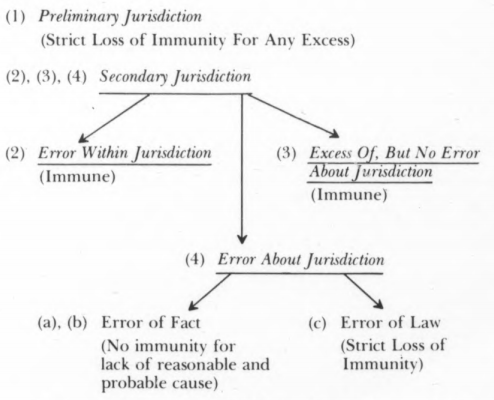
In addition to the judicial act requirement, the doctrine of judicial immunity has a jurisdictional component. The courts generally agree that if a judge does not lack subject matter jurisdiction completely, he is judicially immune.39 There is also a distinction between acts performed in excess of jurisdiction and those performed in complete absence of jurisdiction. Judicial immunity protects the former, but not the latter acts.40 In Bradley v. Fisher,41 the Court gave a helpful example to distinguish the two: a probate judge presiding over a criminal prosecution acts in complete absence of jurisdiction; however, a criminal court judge who convicts a person for a non-existent offense merely acts in excess of jurisdiction.42

In Bradley, the Court stated that a judge is not immune from civil liability when no subject matter jurisdiction exists and the judge is aware of its absence.43 Subsequently, some courts have held that a judge can only act in complete absence of jurisdiction when he is aware that he lacks jurisdiction or when he acts in the face of a clearly valid statute or case law that deprives him of jurisdiction.44 Other courts, however, have held that a judge's imputed knowledge plays no role in determining whether the judge acted in complete absence of jurisdiction.45

Some of the most difficult questions a judge must consider relate to his jurisdiction; therefore, courts broadly construe jurisdiction to achieve the purposes of judicial immunity.46 Even grave procedural errors will not deprive a judge of full jurisdiction for judicial immunity purposes.47 In fact, a judge of general jurisdiction has jurisdiction over any matter unless the law specifically denies jurisdiction.48 Given this broad construction of the jurisdictional requirement, lack of jurisdiction rarely breaches judicial immunity.49

B. Methods of Ensuring Judicial Accountability

Although judicial immunity is an absolute bar to recovering monetary damages against judges, the legal and political systems make judges accountable through other methods. First, judges are not immune from awards of injunctive relief.50 Because judges need not fear the personal consequences of an injunction, such immunity is not necessary to protect judicial independence.51 Further, the Supreme Court has ruled that parties may hold judges liable for attorneys' fees under the Civil Rights Attorney's Fees Awards Act.52 While such liability seems to threaten judicial independence, the Court found that Congress specifically intended to impose such liability upon the judiciary.53 As the Court noted, it is within Congress' authority and discretion to abrogate the common law doctrine.54

Although judges are generally not subject to civil liability, they are subject to criminal liability. Judges remain criminally liable for fraud, conspiracy, or any other crimes, even when they commit those crimes in pear in court); Ross v Arnold, 575 F. Supp. 1494, 1495 (E.D. Wis. 1983) (detailing how judge in a divorce proceeding ordered the husband to vacate the couple's residence, and upon the husband's refusal to vacate, ordered him incarcerated) connection with the judicial office.55 The courts have found that providing judges with immunity from criminal liability would pose too great a risk to the public interest in law enforcement.56 The limited exception to this rule is that the law will not hold judges criminally liable for erroneous judicial acts performed in good faith.57

In addition to liability for their criminal behavior, society can hold judges accountable for their misconduct through several other methods. These methods include impeachment or removal from office and sanctions imposed by organizations that regulate judicial conduct. For example, Article II, Section IV of the United States Constitution provides for removal of federal judges upon impeachment and conviction for bribery, treason, or other high crimes and misdemeanors.58 Most state constitutions have similar provisions for legislative impeachment of state judges.59

Some states provide additional methods of removing judges from office, although such methods are infrequently used.60 One procedure, "Address to the Executive," occurs where both houses of the state legislative body formally request that the governor remove a judge from office.61 A few states also provide for removal of judges by recall election.62 Under this procedure, only a designated number of voters' signatures will secure that the recall proposition is put on the ballot.63 The general voting population then determines whether to remove the judge from office.64 Finally, most states now have at least some elected judges, allowing the public to "remove" judges by choosing not to re-elect them.65

Commentators have criticized the above methods of impeachment and removal,66 labeling them cumbersome, time-consuming, and politically motivated. 67 Additionally, the methods provide only for the extreme penalty of removal from office, which is inappropriate in many cases.68 If the judge remains in office, he or she remains unpunished. Consequently, state lawmakers rarely use these methods of judicial removal, which contributes to their ineffectiveness.69

Recently, states have addressed the problem of judicial discipline by adopting codes of judicial conduct and creating judicial conduct organizations to enforce them. The Model Code of Judicial Conduct, promulgated by the American Bar Association, has been adopted in full or in part by forty seven states, the District of Columbia, and the Federal Judicial Conference.70 Thus, virtually all state and federal judges are subject to the Code,71 which provides that judges must uphold the integrity and independence of the judiciary,72 avoid impropriety and the appearance of impropriety,73 and perform their duties impartially and diligently.74

Finally, all fifty states and the District of Columbia have established judicial conduct organizations to investigate and adjudicate complaints of judicial misconduct.75 These organizations can compel sanctions or recommend sanctions to a higher body that imposes them.76 Possible sanctions include censure,77 suspension,78 and removal from office.79 In the federal system, a judicial council in each circuit imposes sanctions for judicial misbehavior80 Unlike the state judicial conduct organizations, these councils do not enjoy the power of removal, although they can recommend the initiation of impeachment proceedings.81 Other sanctions the council can enforce include recommendations to retire, suspending caseloads, and censuring judges privately and publicly.82 Commentators consider sanctions the most effective method of disciplining judicial misconduct.83

Society, therefore, holds judges accountable to the public in a number of ways. The legal system is designed to correct itself either through a system of appeals or through the few limited circumstances when litigants can hold a judge liable for his or her conduct through criminal prosecution or disciplinary proceedings. Elected judges are also subject to the political system, where opponents may expose judicial conduct in an effort to prevent his or her re-election. These accountability measures ensure that the legal system supports both individual and societal reliance on the judicial process. Therefore, while the doctrine of judicial immunity greatly protects judges from civil liability, limited practices of judicial accountability help to preserve the integrity and workability of our legal system.
Footnotes
2 For a thorough history of judicial immunity in our legal system and its origins in English law, see J. Randolph Block, Stump v. Starkman and the History of Judicial Immunity, 1980 DUKE L.J. 879, 881-96 (1980). See generally Jay M. Feinman & Roy S. Cohen, Suing Judges: History and Theory, 31 S.C. L. REV. 201 (1980); Jeffrey M. Shaman, Judicial Immunity from Civil and Criminal Liability, 27 SAN DIEGO L. REV. 1 (1990).
3 See Shaman, supra note 2, at 3.
4 Floyd v. Barker, 77 Eng. Rep. 1305, 1306 (K.B. 1907); see also Block, supra note 2, at 885-87; Shaman, supra note 2, at 3; Michael Robert King, Note, Judicial Immunity and Judicial Misconduct: A Proposal for Limited Liability, 20 ARIZ. L. REV. 549, 551-52 (1978).
5 80 U.S. (13 Wall.) 335 (1871). The Supreme Court first addressed the issue of judicial immunity in Randall v. Brigham, 74 U.S. (7 Wall.) 523, 537 (1868), where the Court suggested that judges might be liable for judicial acts performed both maliciously or corruptly and in excess of jurisdiction. In Bradley, however, the Court clearly rejected this notion. See Bradley, 80 U.S. (13 Wall.) at 350-51.
6 See Bradley, 80 U.S. (13 Wall.) at 347; see also Stump v. Sparkman, 435 U.S. 349, 355-56 (1978).
7 See Ammons v. Baldwin, 705 F.2d 1445, 1447 (5th Cir. 1983); Brewer v. Blackwell, 692 F.2d 387, 396 (5th Cir. 1982); Turner v. Raynes, 611 F.2d 92, 94-97 (5th Cir. 1980).
8 See Turner, 611 F.2d at 97. When the Supreme Court first adopted the doctrine of judicial immunity, it distinguished between courts of general and limited jurisdiction. See Randall,74 U.S. (7 Wall.) at 535-36. For an explanation of the abolishment of this distinction, see Block, supra note 2, at 892-96.
9 See Forrester v. White, 484 U.S. 219, 226-27 (1988); Bradley, 80 U.S. (13 Wall.) at 347; Randall,74 U.S. (7 Wall.) at 536. Some courts offer the need for finality of judgments as another policy reason justifying the doctrine of judicial immunity. See Pierson v. Ray, 386 U.S. 547, 564 & n.4 (1967) (Douglas, J., dissenting); Holloway v. Walker, 765 F.2d 517, 522 (5th Cir. 1985); Harper v. Merckle, 638 F.2d 848, 856 & n.10 (5th Cir. 1981); see also Shaman, supra note 2, at 4.
10 See Pierson, 386 U.S. at 564 & n.4; Holloway, 765 F.2d at 522; Harper, 638 F.2d at 856 & n.10.
11 See Forrester, 484 U.S. at 228; Stump, 435 U.S. at 355-56; Bradley, 80 U.S. (13 Wall.) at 347.
12 See Bradley, 80 U.S. (13 Wall.) at 349; Holloway,765 F.2d at 522; O’Neil v. City of Lake Oswego, 642 F.2d 367, 370 (9th Cir. 1981).
13 See Shaman, supra note 2, at 4.
14 See Pierson, 386 U.S. at 554; Bradley, 80 U.S. (13 Wall.) at 349; Randall, 74 U.S. (7 Wall.) at 536.
15 See Forrester, 484 U.S. at 227; Holloway, 765 F.2d at 522.
16 See Forrester, 484 U.S. at 227; Holloway, 765 F.2d at 522.
17 See Stump v. Sparkman, 435 U.S. 349, 356-57, 360 (1978).
18 See id. at 355-57; see also Bradley, 80 U.S. (13 Wall.) at 347.
19 See Stump, 435 U.S. at 356-57.
20 Id. at 362.
21 McAlester v. Brown, 469 F.2d 1280, 1282 (5th Cir. 1972). This case introduced a four-part test to determine whether:
(1) the precise act complained of, use of the contempt power, is a normal judicial function;

(2) the events involved occurred in the judge's chambers;

(3) the controversy centered around a case then pending before the judge; and

(4) the confrontation arose directly and immediately out of a visit to the judge in his official capacity.
Id. The Ninth and Eleventh Circuits have since used this test as well. See Ashelman v. Pope, 793 F.2d 1072, 1075-76 (9th Cir. 1986); Dykes v. Hosemann, 776 F.2d 942, 946 (11th Cir. 1985); Adams v. McIlhany, 764 F.2d 294, 297 (5th Cir. 1985); Brewer v. Blackwell, 692 F.2d 387, 396-97 (5th Cir. 1982).
22 See Ashelman, 793 F.2d at 1076; Adams, 764 F.2d at 297; Shaman, supra note 2, at 9.
23 See Harris v. Deveaux, 780 F.2d 911, 915 (11th Cir. 1986); Holloway v. Walker, 765 F.2d 517, 524 (5th Cir. 1985); Adams, 764 F.2d at 297; Shaman, supra note 2, at 9.
24 See Block, supra note 2, at 916-21; Shaman, supra note 2, at 8; Joseph Romagnoli, Note, What Constitutes a Judicial Act for Purposes of Judicial Immunity?, 53 FORDHAM L. REV. 1503, 1504 (1985).
25 See Shaman, supra note 2, at 8; see also Forrester v. White, 484 U.S. 219, 228-29 (1988).
26 See Shaman, supra note 2, at 9.
27 See Forrester, 484 U.S. at 228-30 (noting that hiring and supervising court personnel is an administrative duty not entitled to the protection of judicial immunity); Supreme Court of Virginia v. Consumers Union of the United States, Inc., 446 U.S. 719, 731 (1980) (recognizing that promulgating attorney disciplinary rules is a legislative rather than a judicial act); Ex Parte Virginia, 100 U.S. 339, 348 (1879) (concluding that jury selection is a ministerial act); see also Romagnoli, supra note 24, at 1508. For a discussion of the distinctions between ministerial, administrative, and judicial acts, see ABIMBOLA A. OLOWOFOYEKU, SUING JUDGES: A STUDY OF JUDICIAL IMMUNITY 34-38 (1993).
28 McMillan v. Svetanoff, 793 F.2d 149, 155 (7th Cir. 1986).
29 See Forrester, 484 U.S. at 229; Ex Parte Virginia, 100 U.S. at 348.
30 See McMillan,793 F.2d at 155.
31 See id.
32 See Shaman, supra note 2, at 9-10; see also Brewer v. Blackwell, 692 F.2d 387, 396-98 (5th Cir. 1982) (finding that a justice of the peace's alleged arrest of four men at a garbage dump, who then engaged in an automobile chase with one of the men and conducted a summary trial was not a judicial act); Harper v. Merckle, 638 F.2d 848, 859 (5th Cir. 1981) (concluding that a judge's jailing of a man for contempt when he entered the judge's chambers to make an alimony payment to a court employee was not a judicial act); Lopez v. Vanderwater, 620 F.2d 1229, 1235 (7th Cir. 1980) (determining that a judge's prosecutorial conduct in determining the charges against an arrested man was not a judicial act); Zarcone v. Perry, 572 F.2d 52, 53 (2d Cir. 1978) (describing how a traffic judge had a coffee vendor brought to his chambers handcuffed, and then interrogated and harassed the vendor about coffee the judge considered "putrid"); Krueger v. Miller, 489 F. Supp. 321, 329 (E.D. Tenn. 1977) (holding that a justice of the peace acted outside the limits of his lawful authority when he displayed a false badge and arrested a woman).
33 See King v. Love, 766 F.2d 962, 968 (6th Cir. 1985).
34 See Gregory v. Thompson, 500 F.2d 59, 64 (9th Cir. 1974).
35 See Harris v. Harvey, 605 F.2d 330, 336 (7th Cir. 1979).
36 See King, 766 F.2d at 968 (finding that judge deliberately misled police into believing the man named on an arrest warrant was a man who had filed a complaint against the judge); Harris,605 F.2d at 333-36 (reporting that judge made repeated derogatory and racially-based comments about police lieutenant to the press and city officials).
37 See Ashelman v. Pope, 793 F.2d 1072, 1078 (9th Cir. 1986) (holding that a conspiracy does not pierce judicial immunity); Dykes v. Hosemann, 776 F.2d 942, 946 (11th Cir. 1985) (concluding that judges who conspire are immune if performing a judicial act); Holloway v. Walker, 765 F.2d 517, 523 (5th Cir. 1985) (finding complaint alleging that harm was inflicted by judicial acts to which absolute immunity would apply, although caused by bribe or conspiracy, was insufficient to avoid judicial immunity); Sparks v. Duval County Ranch Co., 604 F.2d 976, 980-81 (5th Cir. 1979) (determining that the advantages of punishing those who subvert the judiciary outweigh any good conferred by a derivative judicial immunity rule).
38 See Ashelman, 793 F.2d at 1077-78.
39 See id. at 1076; Dykes, 776 F.2d at 948; Green v. Maraio, 722 F.2d 1013, 1017 (2d Cir. 1983). But see Rankin v. Howard, 633 F.2d 844, 849 (9th Cir. 1980) (holding that acts taken in the absence of personal jurisdiction are not protected by judicial immunity).20001 Judicial Immunity and Judicial Liability
40 See Bradley v. Fisher, 80 U.S. (13 Wall.) 335, 351-52 (1872); see also Stump v. Sparkman, 435 U.S. 349, 356 n.6 (1978) (quoting Bradley, 80 U.S. (13 Wall.) at 351-52).
41 80 U.S. (13 Wall.) 335 (1872).
42 See id. at 352.
43 See id.
44 See Rankin, 633 F.2d at 849; Turner v. Raynes, 611 F.2d 92, 95 (5th Cir. 1980). In Turner, the Fifth Circuit stated that one possible interpretation of Stump is that a judge is only liable if he exercised unconferred jurisdiction in such a crass manner as to indicate he did so either knowingly or recklessly. See Turner, 611 F.2d at 95. In the same year, the Ninth Circuit, in Rankin, clearly stated a judge was immune unless he was aware he lacked jurisdiction, or he acted in the face of a clearly valid law depriving him of it. See Rankin, 633 F.2d at 849. The Sixth and Eleventh Circuits also adopted this position. See Mills v. Killebrew, 765 F.2d 69, 71 (6th Cir. 1985); Dykes v. Hosemann, 743 F.2d 1488, 1497 (11th Cir. 1984).
45 See O’Neil v. City of Lake Oswego, 642 F.2d 367, 370 (9th Cir. 1981). In O’Neil, the Ninth Circuit contradicted its holding in Rankin by holding that a judge's intent does not factor into the jurisdictional analysis. See id. The court reasoned that the Stump court neither stated nor implied that a judge's knowledge of his jurisdiction affected his immunity. See id.
46 See Ashelman v. Pope, 793 F.2d 1072, 1076 (9th Cir. 1986).
47 See Stump v. Sparkman, 435 U.S. 349, 359 (1978); Bradley, 80 U.S. (13 Wall.) at 357; King v. Myers, 973 F.2d 354, 359 (4th Cir. 1992) (describing how judge ordered warrantless arrest); King v. Love, 766 F.2d 962, 965 (6th Cir. 1985) (explaining that judge jailed party for contempt when he was only authorized to impose fine); Lopez v. Vanderwater, 620 F.2d 1229, 1234 (7th Cir. 1980) (noting that judge conducted a trial in a police station that fell outside his jurisdiction); King v. Thornburg, 762 F. Supp. 336, 338 (S.D. Ga. 1991) (discussing how magistrate ordered the arrest of an attorney who failed to appear in court); Ross v Arnold, 575 F. Supp. 1494, 1495 (E.D. Wis. 1983) (detailing how judge in a divorce proceeding ordered the husband to vacate the couple’s residence, and the husband’s refusal to vacate, ordered him incarcerated).
48 See Stump, 435 U.S. at 358.
49 But see Maestri v. Jutkofsky, 860 F.2d 50, 53 (2d Cir. 1988) (denying judicial immunity when town judge issued an arrest warrant for persons who committed offenses outside his territorial jurisdiction); Hoppe v. Klapperich, 28 N.W.2d 780, 789 (Minn. 1947) (explaining that judge acted wholly without jurisdiction by issuing an arrest warrant when no written complaint had been made); State ex rel. Little v. United States Fidelity & Guar. Co., 64 So. 2d 697, 702-03 (Miss. 1953) (finding judge liable where he knowingly drafted an affidavit to state that an offense occurred within his jurisdiction when it clearly had not); Vickrey v. Dunivan, 279 P.2d 853, 855-56 (N.M. 1955) (detailing how judge tried person for an act performed outside the judge's territorial jurisdiction and which was not even an offense); Utley v. City of Independence, 402 P.2d 91, 94 (Or. 1965) (describing how judge completely lacked jurisdiction when he issued an arrest warrant without a written complaint).
50 See Pulliam v. Allen, 466 U.S. 522, 541-42 (1984).
51 See id. at 536-38. The Court noted that judges have never been held absolutely immune from injunctive relief and that there is no evidence that this policy has chilled judicial independence. See id. at 536. Furthermore, the stringent requirements for obtaining equitable relief minimize the risk that judges will be harassed and judicial independence compromised. See id. at 537-38.
52 See id. at 543-44.
53 See id. at 543.
54 See id.
55 See United States v. Chaplin, 54 F. Supp 926, 930, 933 (S.D. Cal. 1944).
56 See id. at 934 (quoting Anderson v. Dunn, 19 U.S. (6 Wheat.) 204, 226-27 (1821)).
57 See Braatelien v. United States, 147 F.2d 888, 895 (8th Cir. 1945).
58 "The President, Vice President and all civil Officers of the United States, shall be removed from Office on Impeachment for, and Conviction of, Treason, Bribery, or other high Crimes and Misdemeanors." U.S. CONST. art. II, § 4. It has never been disputed that judges are civil officers for purposes of impeachment. See Harry T. Edwards, Regulating Judicial Misconduct and Divining "Good Behavior" for Federal Judges, 87 MICH. L. REV. 765,773 (1989).
59 See Russell R. Wheeler & A. Leo Levin, Judicial Discipline and Removal in the United States (July 1979) (paper prepared for the Fed. Jud. Ctr.), available in 1979 WL 24794.
60 For a general discussion of these methods, see Wheeler & Levin, supra note 59, and Edward J. Schoenbaum, A Historical Look at Judicial Discipline, 54 CHI.-KENT L. REV. 1 (1977).
61 See Schoenbaum, supra note 60, at 4.
62 See Wheeler & Levin, supra note 59, at 4-5.
63 See Schoenbaum, supra note 60, at 8.
64 See id.
65 See Wheeler & Levin, supra note 59, at 5.
66 For an evaluation of several of the impeachment and removal methods discussed, see generally Wheeler & Levin, supra note 59, and Schoenbaum, supra note 60.
67 See Jeffrey M. Shaman, Judicial Ethics, 2 GEO. J. LEGAL ETHICS 1, 10 (1988).
68 See id.
69 See id.
70 See id. at 3; see also Yvette Begue & Candice Goldstein, How Judges Get Into Trouble: What They Need to Know About Development in the Law of Judicial Discipline, 26 JUDGES J. 8, 9 (1987). Montana, Rhode Island, and Wisconsin have not adopted the Model Code. See id. The ABA revised the Code in 1990, and since that time, nearly 20 jurisdictions have adopted new codes of judicial conduct modeled on the 1990 revision. See STEPHEN GILLERS & ROY D. SIMON, REGULATION OF LAWYERS: STATUTES AND STANDARDS, 573-75 (2000).
71 See Shaman, supra note 67, at 3.
72 See Begue & Goldstein, supra note 70, at 9.
73 See id.
74 See id.
75 See Shaman, supra note 67, at 11.
76 See id.
77 See generally In re Inquiry Concerning a Judge, 788 P.2d 716 (Alaska 1990) (privately reprimanding a judge for creating appearance of impropriety by self-validating reduced airline tickets); Quinn v. State Comm'n on Judicial Conduct, 430 N.E.2d 879 (N.Y. 1981) (censuring a judge in connection with convictions for public intoxication); In re Roth, 645 P.2d 1064 (Or. 1982) (censuring a judge in connection with conduct constituting criminal mischief); In re Larsen, 616 A.2d 529 (Pa. 1992) (publicly reprimanding an associate judge for ex parte communications).
78 See generally In re Schenck, 870 P.2d 185 (Or. 1994) (suspending judge from office for ex parte communications, failure to disqualify himself, and publishing comments on pending cases); West Virginia Judicial Inquiry Comm'n v. Dostert, 271 S.E.2d 427 (W. Va. 1980) (censuring and suspending judge for assisting officers with arrests and carrying a weapon without proper license).
79 See generally In re Peck, 867 P.2d 853 (Ariz. 1994) (removing justice of the peace for ex parte communications and failure to disqualify himself); In re Callanan, 355 N.W.2d 69 (Mich. 1984) (removing judge from office in connection with convictions for conspiracy to violate the Racketeer Influenced and Corrupt Organizations Act (RICO), aiding and abetting RICO violations and aiding and abetting mail fraud); In re Duncan, 541 S.W.2d 564 (Mo. 1976) (removing judge from office for breaking and entering); In re Coruzzi, 472 A.2d 546 (N.J. 1984) (removing judge from office after conviction for four counts of bribery).
80 See Shaman, supra note 67, at 16. These councils are authorized by the Judicial Councils Reform and Judicial Conduct and Disability Act of 1980, Pub. L. No. 96-458, 94 Stat. 2035.
81 See Shaman, supra note 67, at 16-17. Some question exists as to whether impeachment of judges, as provided in the Constitution, is the only constitutional method of removing judges from office. See id. at 17.
82 See 28 U.S.C. § 372(c)(6)(B) (1994); Shaman, supra note 67, at 17.
83 See generally Schoenbaum, supra note 60, at 1-2; Shaman, supra note 67, at 11.

II | JUDICIAL LIABILITY IN ROMAN LAW

In ancient Rome, the concept of judicial liability developed as one means of self-correction within the judicial process. Judges enjoyed a kind of immunity from acts of misconduct arising out of their official duties in an effort to protect the independence of the judiciary. Roman law, however, held judges liable for dishonest and wrongful conduct relative to their resolution of cases brought before them. Over time, a system of self-correction for judicial misconduct developed within the Roman judiciary.

In the Roman legal system, parties established liability based upon fault in a cause of action called the delict, which means "wrong." Generally, actions that arose ex delicto were civil as opposed to criminal wrongs and usually threatened the security of an individual's rights. Originally, a violent retribution requited a delictal wrong; eventually, less violent means, such as monetary recompense, satisfied requital for such a wrong. Significantly, the delict encompassed injury to an individual's rights as well as harm to the state, and thereby served both a civil and criminal function in society.

The ancient Romans also established tort-like judicial liability in actions that arose "as if from a delict" or quasi ex delicto. The quasi-delicts encompass liability for careless conduct including liability for judicial dishonesty. In Roman law, judicial liability was created by a quasi-delict termed the iudex qui litem suam facit, which translates as a judge who "make[s] a case his own.84 This legal action has garnered substantial scholarly recognition, but only in an attempt to reconcile it with the other three quasi-delicts.85 Scholars, however, have given less attention to a detailed study of the legal significance of the iudex qui litem suam facit, which merits a close examination. This Article analyzes this action as it developed from the Republican through the post-Classical Periods in Roman law. The scope of the iudex qui litem suam facit and its corresponding sanctions during each period will receive particular scrutiny.

A. Republican Period: A Focus on Intentional Misconduct

During the Republican Period, beginning in approximately the fifth century B.C. and extending to about 200 A.D., Rome defined itself as a strong political entity both in Italy and abroad.86 At this time, the Romans codified centuries-old legal customs and traditions into a formal written expression of the law known as the Twelve Tables. The Twelve Tables is the source for one of the few proceedings in the Republican Period that accomplished a limited type of judicial review.87 Roman law invoked this proceeding against the iudex qui litem suam facit. The Twelve Tables states:
Dure autem scriptum esse in istis legibus quid existimaripotest? nisi duram esse legem putas, quae iudicem arbitrumve iure datum, qui ob rem dicendam pecuniam accepisse convictus est, capitepoenitur...?88

How is it possible that these laws be considered harsh? Unless you think that a law is harsh that punishes a judge or arbiter with capital punishment, if he had clearly been shown to have accepted money to influence his decision.89
The tone of this passage implies that the Romans considered capital punishment a suitable penalty for a judge who accepted a bribe. An understanding of the Twelve Tables in their entirety clarifies the appropriateness of the sanction during the Republican Period. Many of the customs codified in the Twelve Tables reflected a primitive culture that often used the death penalty as a means of retributive vengeance.90 The sanction of capital punishment against a misbehaving judge preserves this retributive purpose. As a legal penalty, it formally gave a wronged litigant the opportunity to requite an injury caused by a judge's misbehavior.

Significantly, in the Twelve Tables, the sanction focuses on the manner in which the judge acted rather than the correctness of his opinion. The text does not discuss whether the decision of the corrupt judge is legally correct.91 Rather, the passage stresses the behavior of the judge by use of the Latin phrase ob rem dicendam accepisse convictus est. This phrase means that the judge took money "for the purpose of making a biased opinion." The Latin makes it very clear that the judge must have acted intentionally because the grammatical function of the gerundive clause, ob rem dicendam, indicates the purpose behind the verbal action of accepting money. Hence, by accepting the money with the purpose of favoring one party, the judge committed an intentional wrong.92 Thus, the Romans limited judicial liability during the Republican Period to the intentional deviation from judicial impartiality motivated by the acceptance of a bribe.

It is significant that the scope of judicial misbehavior subject to punishment during the Republican Period was so limited. No system of appeal existed during this period, and the alternative type of judicial review available was narrow in scope.93 The combination of these factors explains why a misbehaving judge endured such a severe sanction. By creating an action that harshly punished judicial misconduct, Republican Rome produced a strong deterrent against such misconduct while giving some means of recourse to litigants.

B. Classical Period: Judicial Liability Extended

The scope of judicial liability broadened during the Classical Period of Roman law.94 A review of the sources from this period reveals that during the Classical Period, a judge was liable for intentional, and perhaps unintentional, acts of judicial malfeasance. One of the Classical sources for the iudex qui litem suam facit is a passage in the Digest attributed to Ulpian:95
Iudex tunc litem suam facere intellegitur, cum dolo malo in fraudem legis sententiam dixerit (dolo malo autem videtur hoc facere,si evidens arguatureius vel gratia vel inimicitia vel etiam sordes), ut veram aestimationemlitispraestarecogatur.96

A judge makes the case his own when from evil intent, that is a bias due to friendship, hatred, or corruption, he gives a fraudulent judgment, and he is condemned to pay the market value of the thing in dispute.
Of central importance to this passage is the fraudamsentientiam or the "fraudulent judgment" rendered by the judge. In the context of this passage, a fraudulent judgment is not necessarily a legally incorrect opinion. Rather, the Latin word fraudam implies that the opinion was in some way tainted or cheated of honest and impartial deliberation by the judge.

Ulpian further clarifies the nature of the fraudulent judgment by stating that the judge must intentionally depart from his duty to judicial impartiality. Ulpian establishes this by the phrase dolo malo, which means injurious "evil intent."97 Dolus, a noun that refers to the judge's state of mind, is in the ablative case, which functions here to stress the conditions under which the fraud was committed. Thus, regardless of the legal correctness of the decision, the judge would incur liability if a deceitful or evil state of mind tainted his opinion.

To underscore the fact that the judge's perspective or evil intent is the gravamen of the offense, Ulpian lists particular circumstances that may have motivated the fraud: friendship (gratia),hatred (inimicitia),and corruption (sordes). For example, the judge's impropriety may have involved an affirmative action, such as the taking of a bribe. Under such circumstance, the presumption of dolus on the part of the judge would be great.98 Alternatively, the judge's behavior could involve a less obvious wrong, such as a narrow or harsh decision in a case due to a personal bias.99 Because Ulpian establishes dolus malus as the source of fault for the iudex qui litem suam facit, a number of different circumstances involving intentional judicial partiality may give rise to judicial liability. Consequently, the Classical Period witnessed a broader scope of judicial liability than the Republican Period, which limited the scope to intentional fraud, such as accepting a bribe of money.

Another passage of Ulpian speaks of the need for judicial liability due to the possibility of unfairness or unskillfulness of a judge.100 Still, Ulpian does not mention the necessity of dolus. This passage reveals that one should not read the foregoing passage of Ulpian as a definitional limitation upon the iudex qui litem suam facit as it was known during his lifetime. Rather the inconsistencies between the two passages evidence a transitional state of the law of judicial liability during the Classical Period.101

A passage in the Digest, attributed to Gaius, illustrates this fluctuation in the state of the law:
Debet autem iudex attendere,ut cum certaepecuniae condemnatio posita sit, neque maioris neque minoris summa posita condemnet, alioquin litem suam facit; item si taxatio posita sit, ne pluris condemnet quam taxatum sit; alias enim similiter litem suamfacit. Minoris autem damnareeipermissum est.102

When a certain sum is laid in the condemnatio, a judge must be careful not to condemn the defendant in a greater or lesser sum, else he makes himself liable to damages: and if there is a limitation he must be careful not to exceed the maximum, else he is similarly liable.
If a judge improperly set damages, the judge assumed liability for damages, which would be determined in accordance with the judge's degree of fault.103 Curiously, Gaius makes no mention of intent in this passage. Such silence as to the judge's state of mind would allow liability to attach whether the judge acted with dolus or mere negligence in the performance of his duty.

Another passage attributed to Gaius, further defines the scope of the iudex qui litem suam facit. It reads:
Si iudex litem suam fecerit, non proprie ex maleficio obligatus videtur. Sed quia neque ex contractu obligatusest, et utiquepeccasse aliquid intellegitur licet per imprudentiam: ideo videtur quasiex maleficio teneri infactum actione, et in quantum de ea reaequum religioniiudicantisvisum fueritpoenam sustinebit.104

If a judge make a case his own, the obligation he incurs is not created by delict, nor yet by contract, but as he commits a fault, though it may be without intention, he is liable in an action in factum for a quasi-delict to such damages as may be assessed.
The difficulty presented is that Gaius extends judicial liability to acts that occurred unintentionally (per imprudentiam). Because Ulpian and Gaius were contemporaries, it is unlikely that the former would limit judicial liability to intentional acts, while the latter would extend such liability to negligence. To reconcile this inconsistency, scholars have regarded the portion of Gaius' passage from "the obligation" to "quasidelict" as an interpolation, or an insertion of text from an outside source.105 Such reasoning is persuasive not only from a linguistic perspective, but also from an historical one.106

One scholar regards the interpolation itself as evidence of the transitional state of the law during the Classical Period.107 Nevertheless, even if one disregards the interpolated portions of the passage, Gaius still makes no specific reference to the necessity of dolus. The lack of such specificity leads to differing interpretations of the passage. One may read it with strict adherence to prior custom and argue that if the quasi-delict were to extend its liability to unintentional acts, the author would have mentioned it specifically. An alternative reading favors the trend of the law at that time and argues that because the quasi-delict broadened its scope over time, the vagueness of Gaius' passage intended to allow for broad interpretations including both intentional and unintentional acts.

Based on this passage of Gaius, however, the scope of judicial liability was probably the same during the lifetimes of Gaius and Ulpian because both authors of the Digest aimed to collect and interpret legal customs as they had developed up to the second century A.D. As the empire grew, a system of appeals began to emerge;108 Gaius and Ulpian wrote during a transitional period between the Republican Period, when there were no appeals, and the later empire, when a system of appeals was fully developed. A legal system that lacked a system of review, as in the Republican Period, posited greater power in the judiciary. Correspondingly, the legal system of that period provided an alternative to a right of appeal, the iudex qui litem suam facit, which provided a remedy for a specific judicial misbehavior, i.e., bribery. The death penalty sanction underscores the importance vested in this remedy during the Republican Period.

Similarly, during the Classical Period, the iudex qui litem suam facit existed as a remedy that served as an alternative to appeals. However, because a system of appeals began to emerge during the Classical Period, the pressure was not as great on that society to provide an alternative method of review. Thus, although the iudex qui litem suam facit was still a very viable action against a misbehaving judge, its symbolic value as the guardian of judicial integrity diminished. Reducing the sanction from the imposition of the death penalty to the assessment of a fine clearly illustrates this point.109

C. Post-Classical Period: Focus on Unintentional Misconduct

A final source of the iudex qui litem suam facit, which establishes judicial liability during the post-Classical Period, appears in the Institutes of Justinian.110 The text is almost identical to that of Gaius in the Digestand commentators have long agreed that Justinian relied heavily upon Gaius' work.111 It is certain, however, that by Justinian's time the scope of judicial liability extended to unintentional acts of the judge.112 A close reading of the Institutes elucidates what types of judicial misbehavior the Romans included within the ambit of the iudex qui litem suam facit during the later empire.

During that period, Roman law held the judge responsible for a maleficium although he was viewed as not having acted strictly from maleficium. The word maleficium is very close in meaning to delict, that is, a wrong or an evil deed. Because the "male" part of the word means evil, maleficium means a deed that is evil in and of itself. In the Institutes of Justinian, maleficium refers to judicial bias.113 Justinian introduces the idea of fault by use of the verb pecasse, which means to do amiss, to mistake, or to transgress. Thus, during the post-Classical Period, the judge was liable for an error that rose to the level of a maleficium even though he may have committed it through ignorance or imprudence.

Clearly, the scope of judicial liability broadened during the later empire. The phrase per imprudentiam (unintentionally), which is definitely a part of the Justinian passage and not an interpolation as it was during the time of Gaius, imposed additional liability on a judge for a good faith procedural error such as missing the day of trial or making a minimal error in setting damages.114 Because the law required neither proof of harmful intent (dolus) nor any mention of the degree of harm to a litigant, the judge's vulnerability to suit was great. Two developments during the later empire, however, balanced this vulnerability. First, litigants had recourse to an appellate court if they felt wronged by a decision.115 Such a development would reduce the number of actions for personal liability against a judge. Second, the sanction imposed upon the judge was a fine in the amount of the litigation (if caused by dolus) or set by the judge himself (if prompted by negligence).116 The lack of severity of this sanction is inversely related to the broadness of the judge's liability. Therefore, while the scope of judicial liability was broadest during the post-Classical Period, the penalty for judicial misbehavior was most lenient.
Footnotes
84 J. INST. 4.5. The Institutes of Justinian are the source for the term quasi-delict. According to Justinian's compilation, a quasi-delict imposes liability on a defendant regardless of whether that defendant caused the harm in question. See id.; see also BARRY NICHOLAS, AN INTRODUCTION TO ROMAN LAW 224-25 (1962); J.A.C. THOMAS, TEXTBOOK OF ROMAN LAW 377-79 (1976).
85 The four quasi-delicts are: iudex qui litem suam facit; res deiectaevel effusae; res suspensae; and nautae caupones stabularii. See J. INST. 4.5; see also WILLIAM W. BUCKLAND, A TEXTBOOK OF ROMAN LAW FROM AUGUSTUS TO JUSTINIAN, 598-99 (1950); R.W. LEAGE, ROMAN PRIVATE LAW 421 (1961); Peter Stein, The Nature of Quasi-delictal Obligationsin Roman Law, in 5 REVUE INTERNATIONAL DES DROITS DE L'ANTIQUITE' (1958); 8 DRAGONIR STOJCEVIC, SUR LE CHACTERE DES QUASI-DELITS EN DROIT ROMAIN 57-58 (1957).
86 For extensive treatments of ancient Roman history, see generally 2 DONALD KAGEN, PROBLEMS IN ANCIENT HISTORY (1966), CARL ROEBUCK, THE WORLD OF ANCIENT TIMES (1966), MICHAEL CORANT, HISTORY OF ROME (Prentice Hall 1978), and DAVID JOHNSTON, ROMAN LAW IN CONTEXT (Cambridge 1999). The historical background for this Article is derived from these sources.
87 Besides the iudex qui litem suam facit the only proceedings in the nature of review were the revocatio in duplum and a restitutio in integrum. Neither of these proceedings addressed the wrong of judicial misbehavior. See ROSCOE POUND, APPELLATE PROCEDURE INCIVIL CASES 7 (1941).
88 AULUS GELLII, NOCTES ATTICAE, 20.1.7.
89 All of the English translations in this text are from the following texts, with some modification: THEODOR MOMMSEN, DIGEST OF JUSTINIAN (Paul Krueger & Alan Waston eds., Univ. of Pa. Press 1985), and EDWARD POSTE, INSTITUTES OF ROMAN LAW BY GAIUS (Oxford 1890).
90 See HANS JULIUS WOLFF, ROMAN LAW, 57-58 (1951).
91 See J.M. KELLY, ROMAN LITIGATION 110 (1966); see also RUDOLPH SOHM, THE INSTITUTES, A TEXTBOOK OF THE HISTORY AND SYSTEM OF ROMAN PRIVATE LAW 424 (1907). See generally OTTO LENEL, DAS EDICTUM PERPETUUM 136 (1927).
92 See KELLY, supra note 91, at 108-112.
93 See SOHM, supra note 91, at 288-89, 300-01.
94 See WOLFF, supra note 90, at 103-17. The Classical Period of Roman Law extended from the coming of the Principate to around the middle of the third century B.C. See id. at 103.
95 See H.F. JOLOWICZ, HISTORICAL INTRODUCTION TO THE STUDY OF ROMAN LAW 398-99 (1932). Ulpian's works are dated around the third century B.C. See id.
96 DIG. 1.15.1 (Ulpian, Edict 21).
97 See A.M. HONORE, GAIUS 103 (1962).
98 For a full discussion of dolus type situations, see the chapter on The Misbehaving Judge in KELLY, supra note 91, at 102-17.
99 See id.
100 See DIG. 49.1.1. (Ulpian, Appeals 1).
101 See KELLY, supra note 91, at 111-13.
102 G. INST. 4.52; see POSTE, supra note 89, at 501-02.
103 See POSTE, supra note 89, at 510.
104 G. INST. 44.7.5; 50.13.6.
105 See Stein, supra note 85, at 569-70.
106 See KELLY, supra note 91, at 111-14.
107 See id. at 112-14.
108 See POUND, supra note 87, at 8; see also THOMAS, supra note 84, at 121 n.25.
109 For a discussion of the death penalty as an appropriate sanction, see KELLY, supra note 91, at 109. For the evolution of the sanction to a monetary penalty, see DIGEST OF JUSTINIAN 1.15.1, and POSTE, supra note 89, at 510.
110 The post-Classical Period begins with Diocletian and ends with Justinian's compilation in 534. See FRITZ SCHULTZ, HISTORY OF ROMAN LEGAL SCIENCE 262-65 (1946).
111 See WILLIAM W. BUCKLAND, THE MAIN INSTITUTIONS OF ROMAN PRIVATE LAW 341 (1931).
112 See KELLY, supra note 91, at 114-15; see also WILLIAM W. BUCKLAND, A MANUAL OF ROMAN PRIVATE LAW 330 (1925); JAMES MACKINTOSH, ROMAN LAW IN MODERN PRACTICE 169 (1934).
113 For a discussion of maleficium, see HONORE, supra note 97, at 101-04.
114 See SOHM, supra note 91, at 424.
115 See THOMAS, supra note 84, at 121; see also POSTE, supra note 89, at 632.
116 See POSTE, supra note 89, at 510; see also J.B. MOYLE, INSTITUTES OF JUSTINIAN 172-73 (Oxford 4th ed. 1906).

III | CONCLUSION

The scope of judicial liability in Roman law covered a range of activity including intentional and unintentional judicial misbehavior. The extension of judicial liability from clearly intentional acts of wrongdoing to imprudent error created a broader base of judicial accountability. Two other changes in the law accompanied this chronological development. As the judge incurred greater liability for judicial misbehavior, the sanctions imposed upon the judge became less severe and more compensatory in nature. During the Republican Period, the scope of the iudex qui litem suam facit was very narrow, yet its sanction was very harsh. Hence, its legal purpose during that time was deterrence and retribution. During the Classical and post-Classical Periods, its scope broadened, while its sanction diminished. Roman law increasingly directed the sanction at compensation of the litigant in an effort to preserve the integrity of the legal system.

This phenomenon in Roman law parallels the development of the doctrine of judicial immunity in the American legal system, where the availability of an appeal system gave rise to the concept of judicial immunity. Currently, the status of judicial immunity is rather broad, thus providing little recourse to litigants for misconduct arising from a judge's official duties. However, similar to the philosophical and historical underpinnings of Roman society, American legal and political systems provide numerous other measures of accountability in an effort to balance the judiciary's need for independence with society's duty to redress the wronged litigant.

CATO LAW JOURNAL | VOL 7 ISS 2
JUDICIAL IMMUNITY VS. DUE PROCESS: WHEN SHOULD A JUDGE BE SUBJECT TO SUIT?

Cato Journal

0 | INTRODUCTION

In the American judicial system, few more serious threats to individual liberty can be imagined than a corrupt judge. Clothed with the power of the state and authorized to pass judgment on the most basic aspects of everyday life, a judge can deprive citizens of liberty and property in complete disregard of the Constitution. The injuries inflicted may be severe and enduring. Yet the recent expansion of a judge-made exception to the landmark Civil Rights Act of 1871, chief vehicle for redress of civil rights violations, has rendered state judges immune from suit even for the most bizarre, corrupt, or abusive of judicial acts.1 In the last decade this “doctrine of judicial immunity” has led to a disturbing series of legal precedents that effectively deny citizens any redress for injuries, embarrassment, and unjust imprisonment caused by errant judges. Consider the following examples.
• In 1978, the Supreme Court in Stump v. Sparkman2 held that the doctrine forbade a suit against an Indiana judge who had authorized the sterilization of a slightly retarded 15-year-old girl under the guise of an appendectomy. The judge had approved the operation without a hearing when the mother alleged that the girl was promiscuous. After her marriage two years later, the girl discovered she was sterile.

• In 1980, the Seventh Circuit Court of Appeals in Lopez v. Vanderwater3 held a judge partially immune from suit for personally arresting a tenant who was in arrears on rent owed the judge’s business associates. At the police station, the judge had arraigned the tenant, waived the right to trial by jury, and sentenced him to 240 days in prison. Six days of this sentence were served before another judge intervened. The Seventh Circuit found the judge immune for arraigning, convicting, and sentencing the tenant but not for conducting the arrest and “prosecution.”

• In 1985, the Eleventh Circuit Court of Appeals held in Dykes v. Hosemann4 that the immunity doctrine required dismissal of a suit against a Florida judge who had awarded custody of a child to its father, himself the son of a fellow judge. This “emergency” order had been entered without notice to the mother or a proper hearing when the father took the boy to Florida from their Pennsylvania home after a series of marital disputes.

• In 1985, the Tenth Circuit Court of Appeals in Martinez v. Winner5 held a federal judge immune who, during a trial, had conducted a secret meeting with prosecutors without notifying the defendant or his attorneys. Expressing concern that the jury would be “intimidated” into a not-guilty verdict, the judge agreed to declare a mistrial after the defense had presented its case so the government could prosecute anew with full knowledge of the defense’s strategies.
In just 20 years, these precedents and others like them have established near-total judicial immunity as a settled feature of American law. Under the current doctrine, any act performed in a “judicial capacity” is shielded from suit.6 Thus, the simple expedient of disguising a corrupt act as a routine judicial function guarantees immunity from suit. In no other area of American life are public officials granted such license to engage in abuse of power and intentional disregard of the Constitution and laws they are sworn to defend. Those who are harmed, no matter how extensive and irreparable the injury, are deprived of any method of obtaining compensation. They are confined to disciplinary actions that only rarely result in the judge’s removal from office despite the troubling frequency of judicial abuses (see Alschuler 1972).

As will be shown below, this sweeping new immunity doctrine is at odds both with American legal history and the Constitution. Congress never intended to exempt state judges from suit when it passed the 1871 Civil Rights Act. Moreover, the judiciary is wrong when it asserts that immunity was a settled doctrine, incorporated into the 1871 Act by implication. To the contrary, the doctrine in its present form did not exist in the United States or England when the civil rights legislation was passed in 1871. Moreover, the immunity doctrine is inconsistent with the due process clause of the Fourteenth Amendment. Even if the doctrine had existed in common law, constitutional supremacy dictates that it must bow before the American idea of procedural justice embodied in the guarantee of due process.
Footnotes
Cato Journal, Vol.7, No.2 (Fall 1987). Copyright © Cato Institute. All rights reserved.
The author is Judicial Clerk to Justice Rosemary Barkett of the Florida Supreme Court.
1 The doctrine of judicial immunity from federal civil rights suits dates only from the 1967 Supreme Court decision in Pierson v. Ray, 386 U.S. 547(1967), which found a Mississippi justice of the peace immune from a civil rights suit when he tried to enforce illegal segregation laws. Until this time, several courts had concluded that Congress never intended to immunize state-court judges from federal civil rights suits. See, for example, McShane v. Moldovan, 172 F.2d 1016 (6th Cir. 1949).
2 435 U.S. 349 (1978).
3 620 F.2d 1229 (7th Cir.1980).
4 776 F.2d 942 (11th Cir. 1985) (rehearing en banc).
5 771 F.2d 424 (10thCir. 1985).
6 See Stump v. Sparkman 435 U.S. 349, 360 (1978).

I | THE AMERICAN CONCEPT OF DUE PROCESS

The Fourteenth Amendment was enacted soon after the Civil War as a reaction to abuses by Southern officials.7 Its effect was no less than a revolution in American law. For the first time, the states were obligated to observe a minimum standard of justice imposed by the federal courts. Previously, the Bill of Rights had bound only the federal government. Absent a direct affront to federal powers, the pre—Civil War Supreme Court had refused to interfere in the judicial proceedings of any state, even to preserve due process rights created by the Fifth Amendment.8 If state courts ignored personal liberties, no redress was possible in the federal courts.

When adopted in 1868, the Fourteenth Amendment expressly bound state officials to observe the minimum standards of justice being developed by the federal courts. In time, the Supreme Court held that the amendment’s due process clause obligated state courts to obey virtually every provision of the Bill of Rights. Under this evolving concept, due process embodied at least the specific liberties guaranteed by the Constitution.9 By the centennial of the Fourteenth Amendment in 1968, state courts were required at a minimum to provide adequate notice and a right to be heard through counsel before deciding the rights or liabilities of any person.

In effect, the Fourteenth Amendment integrated the federal and state courts into a single judicial system adhering to a uniform minimum standard. This new system immediately generated problems without precedent in American law. When state courts asserted jurisdiction over out-of-state residents or their property, the federal courts frequently found themselves called upon to decide the validity of such acts. Ignoring the underlying due process concerns at first, the Supreme Court tried to resolve the problem with a theory of jurisdiction based largely on pre—Civil War notions of state sovereignty. Under this conception, the right of a court to exercise its authority over specific persons — its “personal jurisdiction” — extended only as far as the state borders and were of no force beyond them.10

As the 20th century progressed, the Supreme Court soon found the state-sovereignty theory inadequate. New forms of transportation and communication blurred the significance of state boundaries. An increasingly integrated national economy soon made it possible for activities in one state to produce profound disruption in another. Moreover, the Supreme Court was unable to resolve a perplexing inconsistency in its theory: if state sovereignty was the only issue, then an out-of-state resident could never confer jurisdiction on a state court merely by giving consent. In theory, sovereignty could be waived only by the sovereign that possessed it.11 Yet the Supreme Court, bowing to a rule of practicality, consistently had held that a litigant could confer personal jurisdiction on any state court by consent, even if the consent was implied by out-of-court activities.12

Finally in 1982, the Supreme Court swept aside the sovereignty theory and held that the jurisdiction of state courts was circumscribed solely by the due process clause.13 A state court’s authority over anyone, including out-of-state residents, was restricted not by political boundaries but by the conception of fair play and procedural justice embodied in the Constitution.14 Thus, personal jurisdiction was an aspect of due process. State judicial power was directly limited by individual liberties guaranteed by the Bill of Rights. As an important consequence, the right to challenge improper activities of a state court took on a new and as yet unexplored constitutional dimension.

Footnotes
7 See Pierson v. Ray,386U.S. 547,559 (1967) (Douglas, J., dissenting) (1871 Act passed in response to Southern lawlessness).
8 See, for example, Barron v. The Mayor & City of Baltimore, 7 Pet. 243,8 L. Ed. 672 (1833), holding that the Fifth Amendment does not apply to state action.
9 See Duncan v. Louisiana, 391 U.S. 145(1968), 391 U.S. 145(1968), holding that the Fourteenth Amendment “incorporates” specific provisions of the Bill of Rights.
10 See, for example, Pennoyer v. Neff, 95U.S. 714, 720 (1878).
11 See Insurance Corp. of Ireland v. Compagnie des Bauxites de Guinea, 456 U.S.694, 702 n. 10 (1982).
12 See, for example, McDonald v. Mabee, 243 U.S. 90 (1917).
13 456 U.S. at 702 n. 10 and accompanying text.
14 1d. at 703.

II | DUE PROCESS AND JUDICIAL IMMUNITY

The Supreme Court’s holding that the due process clause limited state courts’ power was surprising only in that it had taken so long. Many legal commentators had argued for years that jurisdiction of state courts over specific people was a due process problem, not a question of the competing sovereignties of two or more states.15 Indeed, the older sovereignty theory, a relic of pre-Civil War jurisprudence, virtually had ignored an ancient line of English case law extending back to Article 39 of Magna Charta, ancient predecessor of the due process clause. These cases, dealing with the question of judicial immunity, long ago had established virtually the same due process limitation on judicial power announced in 1982 by the Supreme Court.

As early as 1613, English courts had recognized that Article 39 restricted the power of judges. Early English decisions had found that judges lost immunity from suit for acts clearly beyond their jurisdiction.16 Only in a single area did the English common law grant a broad form of immunity to judges, Recognizing a need to protect judges from the displeasure of the Crown and its ministers, the Star Chamber in Floyd v. Barker17 had held that a judge could not be prosecuted in another court for an alleged criminal conspiracy in the way he had handled a murder trial. In refusing to try the case, the judges of Star Chamber held simply that if the king wished to discipline a judge, the king must do so himself without resort to a criminal prosecution.18

Despite this narrow focus, Floyd frequently is cited as the foundation of the American judicial immunity doctrine.19 The federal courts’ lavish reliance on this Star Chamber decision is puzzling. While the immunity doctrine focuses exclusively on civil liability for judicial acts, Floyd is concerned not with liability but with the proper method of disciplining alleged misconduct of judges. Indeed, Floyd’s central concern is not judicial immunity at all, but judicial independence from the executive branch of government. The American constitutional system largely has resolved the problem that preoccupied the judges who wrote Floyd.

The current American immunity doctrine not only was a serious departure from its common law antecedents but also broke with early American case law. As early as 1806, the Supreme Court in Wise v. Withers20 had recognized a right to sue a judge for exercising authority beyond the jurisdiction authorized by statute. In 1869, one year after passage of the Fourteenth Amendment and long before due process had assumed its modern contours, the Supreme Court made its first effort to define the limits imposed on state judges. The Court held that state judges possessing general powers were not liable “unless perhaps when the acts... are done maliciously or corruptly.”21 Then in 1872, one year after the civil rights laws were passed, the Supreme Court overruled its earlier dictum and announced that judges would not be liable even for malicious or corrupt acts.22

This 1872 expansion of the immunity doctrine was an abrupt departure even from the common law recognized by a majority of the states in the Civil War era. By the time civil rights legislation passed in 1871, only 13 states had granted their judges a broad form of judicial immunity, while six states had found judges unquestionably liable for malicious acts in excess of jurisdiction.23 Eighteen other states had not addressed the issue at all,24 although many recognized English common law as binding precedent. Thus, from 1869 to 1872 the Supreme Court extended a sweeping form of immunity to state-court judges that a majority of the states themselves would not have recognized under their own law.
Footnotes
15 See, for example, Lewis (1983) for a discussion of the historical development of the Supreme Court’s theory of state-court jurisdiction.
16 See The Case of the Marshalsea, 77 Eng. Rep. 1027 (K.B. 1613) (no immunity when Court of the Marshalsea asserted jurisdiction over persons outside the king’s household, its sole jurisdiction). The Marshalsea court specifically traced jurisdictional limits to Article 39 of Magna Charta (Id. at 1035).
17 77 Eng. Rep. 1305 (Star Chamber 1608).
18 Id. at 1307.
19 See, for example, Pulliam v. Allen, 104 S. Ct. 1970, 1975 (1984). The Supreme Court first relied on Floyd as a precedent for judicial immunity in Bradley v. Fisher, 80 U.S. (13 Wall.) 335, 351 (1872).
20 7 U.S. (3 Cranch) 331 (1806).
21 Randall v. Brigham, 74 U.S. (13Wall.) 523,535-36 (1869).
22 Bradley v. Fisher, 80 U.S. (13 Wall.)335, 351 (1872).
23 Liability of Judicial Officers” (1969, pp. 326-27 and nn, 29-30).
24 Id. at327 nn.31, 32 and accompanying text.

III | IMMUNITY AND CIVIL RIGHTS LEGISLATION

Nor was this emerging doctrine recognized by the post—Civil War Congress. Ample evidence shows that Congress intended to make all state officials, including judges, subject to its new civil rights legislation, even in those states recognizing a broad form of immunity. The congressman who introduced the Civil Rights Act of 1871 announced that his bill was modeled after the Civil Rights Act of 1866,25 which had created criminal penalties for anyone engaging in state-sponsored efforts to violate the civil rights of citizens. Indeed, the 1871 Act was written to provide a civil remedy — the right to sue for damages — in every instance in which the 1866 Act offered a criminal penalty.26

One fact is clear about the 1866 Act: it unquestionably had abolished judicial immunity from criminal prosecution, in effect overruling the precedent in Floyd. Partly because of this feature, President Andrew Johnson had vetoed the bill,27 and Congress promptly had overridden the veto amid indignant cries about the tyranny of local Southern officials. During the vote to override, one representative had sharply responded to the President’s concern:
I answer it is better to invade the judicial power of the States than permit it to invade, strike down, and destroy the civil rights of citizens, A judicial power perverted to such uses should be speedily invaded.... And if an officer shall intentionally deprive a citizen of a right, knowing him to be entitled to it, then he is guilty of a willful wrong which deserves punishment.28

Others declaimed that immunity for any state official must be abolished because immunity “is the very doctrine out of which the rebellion was hatched.”29

The debate on the Civil Rights Act of 1871 itself was no less critical of the wrongs perpetrated by Southern officials. In biting rhetoric, one representative characterized local judges in the former Confederate states as despots prone to violate the rights of Republicans without regard for law or justice.30 Many others vehemently agreed.31 On three occasions, congressmen plainly stated that state-court judges would be unable to claim immunity under the 1871 Act.32 Yet another representative expressly noted that the legislation would correct a specific injustice: the use of harassing litigation and unjust prosecutions in Southern courts meant to silence political opponents or chase them from the state.33

Despite this evidence from the congressional debates, a majority of the Supreme Court in Pierson v. Ray,34 96 years after the 1871 Act was passed, decided that Congress never had intended to subject state-court judges to suit. Arguing that judicial immunity was “solidly established at common law,” the Court presumed that Congress would have incorporated specific language into the statute had it wished to abolish the doctrine.35 This perplexing conclusion utterly ignored the remedial purposes of the 1871 Act36 and the long-standing rule that a remedial statute will be construed liberally to achieve its purpose (see Liewellyn 1950).

Not only did the majority offer a complete distortion of congressional intent37 but it also decided that the phrase “[e]very person.. shall be liable” meant every person except judges.38 Yet Congress clearly had intended to remedy a serious injustice being inflicted on innocent people by corrupt local officials, including judges. In effect, the Supreme Court created a new rule of statutory construction that judicial immunity is to be favored over congressional intent, and only express language in a statute will limit the doctrine.

Finally, in 1978 in Stump the Supreme Court wielded its ever expanding immunity doctrine to prevent suit against a state-court judge who had authorized sterilization of a mildly retarded 15-yearold girl after her mother had “petitioned” for the sterilization “to prevent unfortunate circumstances.”39 The judge had authorized the procedure without a hearing, notice to the girl, or appointment of a guardian ad 1item to represent the girl’s interests.40 Recognizing that the judge had violated the most elementary principles of due process, the Supreme Court majority nonetheless found him immune from a suit later filed by the girl and her new husband. Even “grave procedural errors” do not deprive a judge of immunity, ruled the Court, because immunity attaches to any act performed in a judicial capacity.41 The Court noted that the judge had signed the sterilization petition as a judge; and it dismissed objections that failure to observe formalities rendered the act non-judicial.

Instead, the Court concluded that an act is “judicial” if it possesses two traits: first, the act is one normally performed by a judge, and, second, the parties intended to deal with the judge in an official capacity.42 The Court, however, interpreted the first of its requirements very broadly, The majority noted that the judge in Stump possessed “general jurisdiction,” the ability to decide any matter not specifically withheld from him. Since no statute expressly denied him the power to hear sterilization petitions, he was immune even though such a petition was unprecedented in the history of the state and not authorized by any statute.43 In this way, the Supreme Court excused a gross departure from due process that would have subjected virtually any other state official to suit. The effect was plain: under the doctrine of judicial immunity, a victim can be forced to bear the full burden of a serious, irreparable injury inflicted by a state-court judge in blatant violation of the Constitution.
Footnotes
25 Congressional Globe, 42d Cong., 1st sess. 68 app. (1871) (remarks of Rep. Shellabarger).
26 Id.
27 Congressional Globe, 39th Cong., 1st sess. 1680 (1866) (presidential veto message to Congress).
28 Id. at 1837 (remarks of Rep. Lawrence).
29 Id. at 1758 (remarks of Rep. Trumbull).
30 Congressional Globe,, 42d Cong., 1st sess. 394 (1871) (remarks of Rep. Platt).
31 For example: Id. at 394 (remarks of Rep. Rainey), 429 (remarks of Rep. Beatty), and 153 app. (remarks of Rep. Garfield).
32 Id. at 217 app. (remarks of Sen. Thurman), 385 (remarks of Rep. Lewis), and 365—66 (remarks of Rep. Arthur).
33 Id. at 185 app. (remarks of Rep. Platt).
34 386 U.S. 547 (1967).
35 Id. at 554—55.
36 See id. at 560 (Douglas, J., dissenting).
37 Id, at 558—67 (Douglas, J., dissenting).
38 The 1871 Act provides that “every person” who violates the civil rights of a citizen by acting under state authority is liable for a federal civil action for money damages. 42 U.S.C. § 1983 (1985).
39 435 U.S. 349, 351 n. 1.
40 Id. at 360.
41 Id.
42 Id. at 360.
43 Id. at 367—68 (Stewart, Marshall and Powell, JJ., dissenting).

IV | THE POLICY UNDERLYING JUDICIAL IMMUNITY

The Stump test for immunity affords no impediment to a corrupt judge. At best, it cloaks a judge with immunity if he merely indicates his official status while performing any act not expressly prohibited by law.44 At worst, it offers a road map for corruption with total impunity. Those subject to a corrupt judge’s power may find little comfort in the Supreme Court’s pronouncements that judicial immunity in effect is a necessary evil, the price to be paid for a “fearless” judiciary.45 With power to abridge liberty and seize property, state court judges are the masters of everyday life in America. They are capable of causing enormous and irremediable harm to someone who, like the 15-year-old girl in Stump, simply is not given a chance to protect his or her own interests before the judge irreparably abridges them.

Yet the Supreme Court insists in the strongest of language that a sweeping immunity shield is necessary for an impartial judiciary. Permitting dissatisfied litigants to sue judges, argues the Court, “would contribute not to principled and fearless decision-making but to intimidation.”46 Under this viewpoint, immunity is not for the benefit of the malicious and corrupt but for the benefit of the public, whose best interests are protected by an independent judiciary.47 If errors are committed, the proper remedy is appeal.48

Few would question the worthiness of such abstract principles as impartiality and fearlessness, even if the Supreme Court’s assessment of judicial courage is surprisingly pessimistic. However, highflying abstractions often serve only to hide the underlying issue, which in this case is the injury a corrupt judge can inflict on innocent people. Congress and the courts must seriously question any device that affords greater protection to the unscrupulous than to the principled. In this instance, the risk of such a disturbing result is very grave. By resort to the current immunity doctrine, an unscrupulous judge could escape liability even for acts of revenge, gross favoritism, improper seizure of property, unjust incarceration, or serious injuries inflicted “in a judicial capacity.” Most disturbing are those instances in which a judge ensures that an appeal cannot remedy the wrong inflicted. In Stump, for instance, the judge’s actions allowed no appeal prior to court-ordered surgery that would prevent a woman from ever having a family. If appeal indeed is the proper method of challenge, the judiciary cannot justify granting immunity to judges who have prevented an appeal from occurring.

The history of judicial immunity makes the doctrine even more suspect, since Congress clearly believed it was imposing liability on local judges under the 1871 Act.49 By judicial fiat, the doctrine was conjured out of a few old English cases such as Floyd that were not themselves concerned with judicial immunity from suit, but with judicial independence from the Crown. The Supreme Court, citing dicta in these cases, invented a completely new immunity doctrine far more expansive than the Civil War-era precedents would warrant.

Most troubling of all are the strong due process interests that necessarily are involved in any judicial immunity controversy. By wielding its expansive doctrine, the Supreme Court in effect has declared that every organ of state government except local courts must observe the dictates of the Fourteenth Amendment. The irony is unmistakable: those who are the guardians of the Constitution are themselves privileged to violate it with corrupt impunity. Any damage inflicted on innocent citizens must be borne by the injured, not by the state or its insurers. Due process, one of the most hallowed and ancient of rights, apparently has no place in the law when a citizen attempts to seek recompense from a judge who has wrongfully caused an injury.

Nor has the Supreme Court made any effort to reconcile its new theory of state-court jurisdiction with judicial immunity. If a state court’s power over persons is defined and limited by the due process clause, the current immunity doctrine assumes a deeply suspicious character. The judiciary in effect is wielding a judge-made rule of law to limit a constitutional right, turning the idea of constitutional supremacy on its head. When a local judge chooses to act corruptly, the logical result of any sweeping immunity doctrine is the destruction of due process rights. Instead of fearless impartiality, the doctrine thus protects only malice and arbitrary administration of the laws.
Footnotes
44 0ne federal appeals court has required the weighing of four separate factors similar to the Stump test: (1) whether the act was a normal judicial function; (2) whether the events transpired in the judge’s chambers; (3) whether the controversy was then pending before the judge; and (4) whether the confrontation arose directly and immediately out of a visit to the judge in his official capacity. McAlester v. Brown, 469 F.2d 1280, 1282 (5th Cir.1972). See also Dykes v. Hosemann, 776 F.2d 942, 945—46 (11th Cir. 1985) (rehearing en banc) (quoting McAlester with approval); Harper v. Merckle, 638 F.2d 848, 858(5th Cir.), cert. denied, 454 U.S. 816 (1981) (quoting McAlester with approval).
45 See Fern v. Ackerman, 444 U.S. 193 (1979).
46 Pierson v. Ray, 386 U.S. 547, 554 (1967).
47 Id.
48 See Pulliam v. Allen, 104 S. Ct. 1970, 1975-76 (1984).
49 Pierson v. Ray, 386U.S. 547,562 (Douglas, J.,dissenting) (“every member of Congress who spoke on the issue assumed... that judges would be liable”).

V | THE DUE PROCESS CLAUSE AS A LIMIT ON IMMUNITY

If judicial immunity truly is to serve as a bulwark of justice, some more clearly defined limit must be placed on it. Logically this limit must arise from the due process clause itself. Clothing a judge with immunity simply because he has performed a “judicial act” overlooks the real-world probability that even judicial acts can be utterly inconsistent with due process. Important personal rights, such as the right to have a family in Stump, can be destroyed by the mere nod of a judge’s head. Judges should not be privileged to violate the rights of citizens unfortunate enough to find themselves in a biased, corrupt, or irresponsible court. When unjust injuries are inflicted by improper judicial acts, the state or its insurers should be forced to bear the cost of the wrongful act, not the individual. Indeed, the history of the 1871 Act reveals that Congress intended to provide just such a remedy.

Instead of the abstract and ambiguous factors used in Stump to determine the existence of immunity, the courts should use a simpler inquiry founded on the fundamental principles embodied in the due process clause. To preserve the integrity of the judicial process, the courts always should presume that a trial court properly exercised its jurisdiction. But they should permit a plaintiff to overcome this presumption by showing that the judge acted with actual malice, consisting of a knowing or reckless disregard of due process. Specifically, if the court is to enjoy immunity, it must afford three things — notice, a chance to be heard, and a method of appeal. Then, and only then, would an irrebuttable presumption of immunity exist requiring dismissal of any subsequent suit against the judge.

Of these three requirements, the opportunity to appeal should be the most crucial based on the policy that appeal, not a suit for damages, is the preferred method of challenging a judge’s improper actions. Deprivation of an opportunity to appeal effectively renders this policy meaningless and makes some other remedy necessary for proper redress. Moreover, the right to appeal usually can correct due process violations. Even errors in notice and opportunity to be heard should not of themselves subject a judge to suit as long as the opportunity to appeal is present. In effect, the appeal itself will afford a new opportunity for a proper hearing with proper notice.

Nor should routine ex parte orders create any liability for the judiciary. In emergency hearings for the seizure of property, the court could preserve the irrebuttable presumption of immunity by affording as soon as possible the required notice, a hearing, and the right to appeal.50 In summary incarcerations, as for contempt of court, the judge could preserve his immunity by affording the defendant an immediate opportunity for further review, such as in a habeas corpus hearing. Mere failure of the plaintiff to exercise these rights should never subject the judge to suit. Nor should a judge be liable for errors of judgment, even those plainly forbidden by law or precedent, as long as his acts did not deliberately preclude the possibility of appeal before constitutionally protected rights were completely foreclosed.

The test proposed above also addresses the question of subject matter jurisdiction — the statutory authority of judges to hear specific kinds of disputes. Although the Supreme Court suggested in Stump that a clear lack of subject-matter jurisdiction will subject a judge to liability, it was plainly troubled by the possibility that a judge might be subjected to suit for an honest and harmless mistake.51 A test based on the ability to appeal necessarily will shield good-faith errors. As long as the judge does not take actions that prevent appeal, he will be protected by an irrebuttable presumption of immunity.
Footnotes
50 The courts have long recognized a right of creditors to obtain prejudgment “attachment” of property in which they have an enforceable interest if the debtor is likely to flee from the court’s jurisdiction. The U.S. Supreme Court has imposed rigorous due process limits on the use of such remedies, generally requiring notice and an opportunity to be heard immediately after the disputed property has been seized. See, for example, Sniadach v. Family Finance Corp., 395 U.S.337(1969).
51 Stump v. Sparkman, 435 U.S. 349, 356 (1978).

VI | CONCLUSION

American courts have agonized over the due process problems created in recent years by the doctrine of judicial immunity.52 A variety of ill-conceived approaches to the issue have resulted in “tests” that grant immunity to state-court judges in such sweeping terms as to amount to no test at all. The Supreme Court, troubled by threats to judicial independence, has developed its own test that invests judges with immunity for any act performed in an official capacity where the act itself is not expressly prohibited by existing law. Under this approach, corrupt and malicious local judges may easily shield even the most serious abuses behind a wall of immunity, leaving the victim unable to seek compensation from the state and its insurers.

Yet a state court’s jurisdiction is limited by due process guarantees of notice and a chance for an impartial hearing. Ignoring this fact, the Supreme Court has misconceived the problem by basing judicial immunity purely on statutory concerns and distorted readings of common law history. Like the jurisdiction of local courts, immunity itself — a judge-made doctrine — must be limited by due process, which is of constitutional dimension. The supremacy clause unquestionably nullifies even the most ancient of common law principles and even the most popular of state statutes to the extent they are inconsistent with due process.

The best solution is to give judicial immunity a firm root in due process guarantees. To achieve this result, the simplest approach is to create an irrebuttable presumption of immunity where the state court judge’s acts did not deliberately terminate a citizen’s rights without notice, hearing, and opportunity to appeal. Of these three requirements, the chance to appeal is the most important because it provides a means of curing defects in any other due process violation. A judge thus remains unquestionably immune as long as he does not take actions that intentionally and plainly prevent further review. The duty imposed on a state-court judge, then, is only to recognize that his own decisions may sometimes be in error and to ensure that orders affecting important constitutional rights can be reviewed in another court.
Footnotes
52 0ne of the cleanest examples was in Dykes v. Hosemann, where the Eleventh Circuit at first stripped a Florida judge of judicial immunity for actions clearly violating the due process clause (743 F.2d 1488, 1496 [11th Cir. 1984]). Then, in a rehearing en banc, the full panel completely reversed the prior decision and held that judicial independence was so strong a concern that due process must yield before it (776 F.2d 942, 949 [11th Cir. 1985]). In a sharp dissent, Judge Hatchett criticized the majority for holding everyone liable for due process violations except the very people trained in due process — judges (Id. at 954—55).

VII | REFERENCES

“Courtroom Misconduct of Prosecutors and Trial Judges.” Alschuler, Albert W. Texas Law Review 50 (April 1972): 629—735.

“The Three Deaths of ‘State Sovereignty’ and the Curse of Abstraction in the Jurisprudence of Personal Jurisdiction.” Lewis, Harold S., Jr. Notre Dame Law Review 58 (April 1983): 699—742.

“Liability of Judicial Officers under Section 1983.” Unsigned student note. Yale Law Journal 79 (December 1969): 322—37.

“Remarks on the Theory of Appellate Decision and the Rules or Canons about How Statutes Are to Be Construed.” Llewellyn, Karl N. Vanderbilt Law Review 3 (April 1950): 395—406.

DEPAUL UNIVERSITY LAW REVIEW
VOL 28 ISS 1 ART 3
PERSONS WHO ARE NOT “PERSONS”: ABSOLUTE JUDICIAL IMMUNITY UNDER SECTION 1983

DePaul

0 | INTRODUCTION*

Suits brought under section 1983 of title 42 of the United States Code have provided additional protection of constitutional rights. Recently, the use of this statute has increased markedly resulting in new areas of controversy. In this Article, Professor Nahmod examines the issue of absolute individual immunity under section 1983. He explores the doctrine's historical background, the distinction between actions for damages and injunctions, and projects the doctrine's effect on certain individuals in the future.
Section 1983 of Title 42 of the United States Code, a powerful constitutional "sword" for plaintiffs, makes "persons" liable for violations of the Fourteenth Amendment.1 Its broad facial language admits no exceptions. Yet until recently local governmental entities were considered by the United States Supreme Court not to be "persons" and thus not liable under the statute's provisions.2 More surprisingly, certain individuals who are clearly "persons" in the common understanding of that term have been given an absolute immunity from liability for damages under 1983.3 The purpose of this Article is to examine and analyze who is entitled to this immunity.

The difference between absolute and qualified immunity is of immense practical significance for the individual. No inquiry into the absolutely immune defendant's state of mind is permitted, while qualified immunity, an affirmative defense, necessitates such an inquiry after the plaintiff has made out a 1983 cause of action.4 Typically, an action against an absolutely immune defendant will be dismissed on motion which simply sets out his status and his having acted within his official capacity.

The Supreme Court to date has established three classes of absolutely immune individual defendants:
state legislators,5
judges,6 and
prosecutors.7
This Article will deal with the Court's reasoning in the leading cases, and consider its implications. It will also explore the scope of absolute immunity, and analyze the use made by the circuits of the Court's decisions. As will be seen, certain line drawing problems emerge which are not alleviated, especially in judicial immunity cases, by the Court's use of jurisdictional terminology.
Footnotes
* Professor of Law, IIT/Chicago-Kent College of Law; A.B., University of Chicago; LL.B., LL.M., Harvard University. This Article is based on a chapter from my forthcoming book, CIVIL RIGHTS AND CIVIL LIBERTIES LITIGATION: A GUIDE TO SECTION 1983, to be published by Shepard's, Inc. in 1979 [hereinafter referred to as A GUIDE TO SECTION 1983]. @1978 Sheldon H. Nahmod.
1 The section provides:
Every person who, under color of any statute, ordinance, regulation, custom, or usage, of any State or Territory, subjects, or causes to be subjected, any citizen of the United States or other person within the jurisdiction thereof to the deprivation of any rights, privileges, or immunities secured by the Constitution and laws, shall be liable to the party injured in an action at law, suit in equity, or other proper proceeding for redress.
42 U.S.C. § 1983 (1970). For a discussion of relationship between § 1983 and the Fourteenth Amendment, see generally Nahmod, Section 1983 and the "Background" of Tort Liability, 50 IND. L.J. 1 (1974) and A GUIDE TO SECTION 1983 chapters 2 & 3. Liability under the "laws" is beyond the scope of this Article. See A GUIDE TO SECTION 1983 chapter 2.
2 Monroe v. Pape, 365 U.S. 167, 191 (1961) (holding that municipalities are not "persons" within section 1983), overruled in Monell v. Dep’t of Soc. Serv., 98 S. Ct. 2018, 2041 (1978) (holding that local governments are "persons" for purposes of section 1983). See also City of Kenosha v. Bruno, 412 U.S. 507 (1973).
3 The emphasis is intentional. As stated in Rowley v. McMillan, 502 F.2d 1326, 1331 (4th Cir. 1974): "the doctrine of immunity... has no application to a suit for declaratory or injunctive relief.... See the discussion in notes 52-55, 124-133, 178-180 and accompanying text infra.
4 Wood v. Strickland, 420 U.S. 308 (1975). The Court stated that the qualified immunity test contains both objective and subjective elements and held that a school board member is not immune from liability for damages under § 1983 if he knew or reasonably should have known that the action he took within his sphere of official responsibility would violate the constitutional rights of the student affected, or if he took the action with the malicious intention to cause a deprivation of constitutional rights or other injury to the student.

Id. at 322. See generally A GUIDE TO SECTION 1983 chapter 8.
5 Tenney v. Brandhove, 341 U.S. 367 (1951).
6 Pierson v. Ray, 386 U.S. 547 (1967).
7 Imbler v. Pachtman, 424 U.S. 409 (1976).

I | LEGISLATIVE IMMUNITY FROM LIABILITY FOR DAMAGES: TENNEY V. BRANDHOVE

The Supreme Court first established an absolute immunity for persons from section 1983 actions in Tenney v. Brandhove.8 The plaintiff sought damages under section 1983 against various individuals, including the members of the California Senate Fact-Finding Committee on Un-American Activities. He claimed they had intimidated him in the exercise of his constitutional rights by wrongfully interrogating him and prosecuting him for contempt in the course of their investigation. The Court, per Justice Franldurter, held that state legislators have an absolute immunity from liability for damages when they act "in a field where legislators traditionally have power to act.... "9 Characterizing the Committee's investigation as within those bounds,10 the Court found the Committee's members absolutely immune despite a claim of "unworthy purpose."

The Court's reasoning is worth noting. It interpreted 1983's "person" language against a common law background of absolute legislative immunity from tort liability derived from English law and early American history. The Court also emphasized the policy underlying the Speech or Debate Clause of the United States Constitution,11 suggesting that it "was a reflection of political principles already firmly established in the States."12 Against this background the Court examined the legislative intent behind 1983 and concluded that it would be implausible to infer that Congress intended to overturn the historical tradition of legislative freedom by subjecting legislators to civil liability for acts performed while engaging in legislative activity.13 The Court noted: "We cannot believe that Congress-itself a staunch advocate of legislative freedom-would impinge on a tradition so well grounded in history and reason by covert inclusion in the general language before us."14

Despite the broad language of section 1983 and Justice Douglas' dissent,15 the result in Tenney is probably justified for its concern with the democratic process and the chilling effect potential litigation might have upon the independence of legislators. Tenney prevents any inquiry into legislative motive, no matter how allegedly corrupt, so long as the legislator is acting in a traditional legislative field. Thus, the remedies for such corruption must be the political process and the criminal laws.16

While Tenney establishes that legislators are absolutely immune from section 1983 damages liability under appropriate circumstances, it fails to delineate what those circumstances might be and what acts of such an individual are protected. Tenney tells us that a legislative committee's investigation is within the field to which absolute immunity attaches,17 but it does not address the question of whether legislative employees or local legislatures such as city councils are within the sphere of absolute immunity. Tenney also gives no real indication of the standards which courts should use in distinguishing between traditional and nontraditional legislative fields. Finally, and more generally, Tenney leaves open the question of which other governmental officials might be absolutely immune because of a similar background of absolute immunity.

Footnotes
8 341 U.S. 367 (1951).
9 Id. at 379.
10 The Court noted:
Investigations, whether by standing or special committees, are an established part of representative government.... To find that a committee's investigation has exceeded the bounds of legislative power it must be obvious that there was a usurpation of functions exclusively vested in the Judiciary or the Executive. The present case does not present such a situation. Id. at 377-78.
11 U.S. CONST. Art. I, § 6.
12 Tenney v. Brandhove, 341 U.S. 367, 373 (1951).
13 Id. at 376.
14 Id.
15 He argued that "when a committee perverts its power, brings down on an individual the whole weight of government for an illegal or corrupt purpose, the reason for the immunity ends." Id. at 383. His argument appears in effect to be for a qualified immunity, although he never used that term.
16 "[W]e have never held that the performance of the duties of judicial, legislative, or executive officers, requires or contemplates the immunization of otherwise criminal deprivations of constitutional rights." O'Shea v. Littleton, 414 U.S. 488, 503 (1974). See also Gravel v. United States, 408 U.S. 606, 627 (1972).
17 Tenney v. Brandhove, 341 U.S. 367, 378 (1951).

II | STATE LEGISLATORS AND PROTECTED LEGISLATIVE CONDUCT

Once the defendant's status is found to be that of a state legislator, the next issue is whether the challenged act is legislative in nature. The extreme cases are relatively easy to deal with. At one extreme the act of a state legislator in driving negligently and injuring another is not a legislative act and, moreover, it may not even be an act under color of law.18 At the other extreme is the situation in which the state legislator is sued under section 1983 for enacting certain state legislation. Here it is unquestioned that absolute immunity attaches. Tenney is obviously closer to the latter extreme than to the former. The Court first asked whether investigative hearings were a traditionally legislative function. Then, as a way of determining whether there was a legislative act, it asked whether the specific investigation had exceeded the "bounds of legislative power." The test for such a conclusion was: "it must be obvious that there was a usurpation of function exclusively vested in the Judiciary or Executive."19 On the merits the Courts had little difficulty in answering these questions in defendant's favor.

Following Tenney, courts in 1983 cases readily applied its reasoning to state legislators who voted for certain legislation20 or housekeeping resolutions.21 Legislators' participation in committee work22 and on a statutory commission23 has also been covered by the Tenney reasoning. These activities are clearly legislative acts and are properly protected. Furthermore, since Tenney, the Supreme Court has elaborated on the attributes of legislative acts under the Speech or Debate Clause upon which Tenney so heavily relied.24 It stated that for purposes of congressional immunity, protected matters under that clause "must be an integral part of the deliberative and communicative processes by which members participate in Committee and House proceedings with respect to the consideration and passage or rejection of proposed legislation or with respect to other matters which the Constitution places within the jurisdiction of either House."25 Applying this standard to "legislative acts," the Court held in one case that Speech or Debate Clause absolute immunity does not extend to a Senator's alleged private arrangement with a private publisher to publish the Pentagon Papers,26 and indicated in a subsequent case that a congressman who arranges for the public (as distinguished from internal) distribution of committee materials allegedly infringing upon the rights of individuals is similarly not absolutely immune.27 The Court's reasoning in these cases is that, despite arguments for a legislative "informing function," such acts go beyond the reasonable requirements of the legislative function.

Circuit courts have also been sensitive to those situations in which legislators act officially but not legislatively. Several circuits have held that under those circumstances absolute immunity is inappropriate. In a recent New Jersey district court decision,28 the court concluded that absolute immunity did not protect state legislators who were accused of improperly excluding another legislator from a party caucus. While sufficient state involvement was found for state action purposes, the court merely asserted that this was an area in which legislators traditionally did not act.

Davis v. Passman,29 a better reasoned opinion, involved the official immunity of a congressman sued for damages for sex discrimination against a staff employee. The Fifth Circuit curtly rejected the congressman's defense of absolute immunity. The court first observed that "the constitutional proscription of blatant sex discrimination does not impair [the defendant's] legitimate control over his staff to any extent at all."30 Next, after canvassing the Speech or Debate Clause cases, the court concluded that "legislators are not legislating when they dismiss staff members. For the same reasons that the Speech and Debate clause does not extend to staff dismissals, [the defendant] cannot invoke absolute immunity."31

The Fifth Circuit's insistence that "the immunized act must be intimately cognate to the legislative process"32 is similarly appropriate in a 1983 context. As observed, the Tenney Court reasoned from both the historical purpose of the Speech or Debate Clause and the concern, in the Fifth Circuit's words, "that the prospect of an unsuccessful but burdensome lawsuit might affect a legislator's performance of his or her legislative duties, thus distorting the democratic process."33 There is thus a class of cases in which a state legislator acting within his official capacity may be denied an absolute immunity because his act is not legislative in nature. Further, such a result may occur even where the state legislator has acted with a reasonable good faith belief that he has absolute immunity. It is true that this is not discussed in Davis, Tenney, or any of the Speech or Debate Clause cases (perhaps because it was not raised). Still, these cases appear to use an objective test for the "legislative act" inquiry, with no attention paid to the legislator's state of mind.34 However, the state of mind of a legislator denied an absolute immunity is certainly relevant to the application to him of a qualified immunity.35

Footnotes
18 Clearly these two inquiries are often factually related. An affirmative finding on state action will tend to lead to a similar finding on official capacity. However, this does not mean that the two inquiries are identical. In regard to state action, see generally A GUIDE TO SECTION 1983 chapter 2, and J. NOVAK, R. ROTUNDA, & J. YOUNG, CONSTITUTIONAL LAW 451-75 (1978).
19 Tenney v. Brandhove, 341 U.S. 367, 378 (1951).
20 City of Safety Harbor v. Birchfield, 529 F.2d 1251, 1256 (5th Cir. 1976); Johnson v. Reagan, 524 F.2d 1123, 1124 (9th Cir. 1975).
21 Eslinger v. Thomas, 476 F.2d 225, 228 (4th Cir. 1973).
22 Gambocz v. Subcommittee on Claims of Joint Legislative Comm., 423 F.2d 674, 675 (3d Cir. 1970).
23 Bergman v. Stein, 404 F. Supp. 287, 299 (S.D.N.Y. 1975).
24 See, e.g., Eastland v. United States Servicemen’s Fund, 421 U.S. 491, 501 (1975) (holding that the Speech or Debate Clause protected the actions of the Senate Subcommittee on Internal Security in issuing a subpoena for bank records involving respondent in order to determine whether respondent's coffee houses and underground newspapers were potentially harmful to the morale of the U.S. Armed Forces); Doe v. McMillan, 412 U.S. 306, 313, 315 (1973) (holding that the Speech or Debate Clause protected the actions of the members and staff of the House Special Select Subcommittee in the preparation and distribution of a report on the District of Columbia public school system that documented disciplinary problems of named students. The Court found further that the public dissemination of the report by the Superintendent of Documents and Public Printer was not a legislative act and, therefore, not protected by the Speech or Debate Clause); Gravel v. United States, 408 U.S. 606, 625 (1972) (holding that a Senator's arrangement for private publication of a report prepared by the Department of Defense is not an act within the legislative sphere and, therefore, not protected by the Speech or Debate Clause).
25 Id. at 625.
26 Id. at 622.
27 Doe v. McMillan, 412 U.S. 306 (1973). The arrangement must go beyond merely voting for it. Id. at 315.
28 Ammond v. McGahn, 390 F. Supp. 655 (D. N.J. 1975), rev'd on other grounds, 532 F.2d 325 (3d Cir. 1976).
29 544 F.2d 865 (5th Cir. 1977), cert. granted, 47 U.S.L.W. 3301 (October 30, 1978).
30 Id. at 870.
31 Id. at 881.
32 Id. at 879.
33 id.
34 See notes 103-05 and accompanying text infra regarding "judicial acts."
35 An issue which has apparently not as yet arisen is the possibility of a Fourteenth Amendment action for damages against state legislators, judges and prosecutors who have an absolute immunity under both the common law and section 1983. Cf. Bivens v. Six Unknown Named Agents, 403 U.S. 388 (1971) (recognizing a federal cause of action for damages caused be federal agents' violation of the Fourth Amendment). However, it is likely that absolute immunity will survive such a Fourteenth Amendment challenge. Cf. Bivens v. Six Unknown Named Agents, 456 F.2d 1339 (2d. Cir. 1972).

III | STATE LEGISLATIVE EMPLOYEES

There has been some confusion in the cases about the proper treatment of section 1983 suits for damages against legislative employees. Tenney, standing alone, suggests that such employees are "persons" for 1983 purposes.36 Courts generally have held, however, that legislative employees are protected only by a qualified immunity.37 Several have gone so far as to hold certain legislative employees absolutely immune from personal liability. The Fifth Circuit, relying on Tenney, has said that employee-investigators of a statutorily established investigative commission are absolutely immune from liability for damages.38 An Indiana District Court has held the same for legislative employees.39 These decisions are questionable not only in light of Tenney's dictum but also because legislative employees are different from legislators in that they do not require the same autonomy in decision making so necessary for the effective operation of representative government. A qualified immunity appears sufficient for most purposes to ensure that employees are not unduly hampered by litigation and deterred from performing their jobs.40

A significant qualification, however, to the suggested general applicability of a qualified immunity to legislative employees must be made. In several Speech or Debate Clause cases, the Supreme Court put a gloss on its language in Tenney and extended absolute immunity to Congressional aides, committee staff and committee consultants who investigated and introduced material at committee hearings.41 In determining whether these acts were legislative acts and thus absolutely immune, the Court was concerned with "freeing the legislator from executive and judicial oversight that realistically threatens to control his conduct as a legislator."42 It therefore asked whether the acts would have been protected had they been done by the legislator himself. To the extent that these Speech or Debate Clause cases are relevant to the 1983 legislative immunity issue by analogy, the inquiry must focus not only on the defendant's status but also on the nature of the act itself. Viewed in this light, a legislative employee is only absolutely immune from liability under 1983 when his act is legislative in nature, such that, had the legislator himself performed it, he would have been immune.43

Footnotes
36 The Tenney Court cited Kilbourn v. Thompson, 103 U.S. 168 (1881), in which a judgment was entered against the House's Sergeant-at-Arms for an illegal arrest, the court said: "Legislative privilege in such a case [where the defendants are members of a legislature] deserves greater respect than where an official acting on behalf of the legislature is sued.... " 341 U.S. at 378. This proposition was reiterated in Dombrowski v. Eastland, 387 U.S. 82, 85 (1967).
37 See, e.g., Eslinger v. Thomas, 476 F.2d 225, 229-30 (4th Cir. 1973). The Eslinger defendant, Clerk of the South Carolina Senate, who, in good faith reliance on official custom, refused plaintiff temporary employment as a page in the Senate because she was female, was held immune from liability for damages but not immune from suit for equitable relief.
38 Martone v. McKeithen, 413 F.2d 1373, 1376 (5th Cir. 1969) (per curiam).
39 Porter v. Bainbridge, 405 F. Supp. 83, 91 (S.D. Ind. 1975). The court neither set forth reasoning for nor offered citations in support of this holding. Also, while the court spoke of immunity, the case actually seemed to involve injunctive relief and federalism concerns. Id. at 85, 90-91.
40 See note 4 supra. See generally on qualified immunity A GUIDE TO SECTION 1983 chapter 8. A case with an interesting twist is Saffioti v. Wilson, 392 F. Supp. 1335, 1343 n.10 (S.D. N.Y. 1975), in which the court in dictum compared a governor, who was sued for injunctive relief after exercising his veto power, with a legislator. This suggests that the governor should be protected by an absolute immunity. This result seems questionable after Scheuer v. Rhodes, 416 U.S. 232 (1974), which held that executives are protected only by a qualified immunity, and Wood v. Strickland, 420 U.S. 308 (1975), which held the same for school board members regardless of whether they acted in quasi-legislative or quasi-judicial functions. In any event, the court resolved the matter on the merits in favor of the governor. 392 F. Supp. at 1347.
41 Gravel v. United States, 408 U.S. 606 (1972); Doe v. McMillan, 412 U.S. 306 (1973).
42 Gravel v. United States, 408 U.S. at 618 (emphasis added). 1978
43 This approach to a legislative employee's immunity is similar to the approach used for determining the scope of immunity of a judicial employee who is following a judge's order or direction. See notes 120-123 and accompanying text infra. An additional factor justifying these approaches is the unfairness to a legislative or judicial employee in withholding an absolute immunity while the person responsible for the challenged conduct - the person ordering it gets its protection.

IV | LOCAL LEGISLATORS

The current general rule is that local legislators are not given the Tenney absolute immunity. A leading Sixth Circuit case, Nelson v. Knox,44 involved a suit for damages against city commissioners and others for allegedly intentionally destroying the plaintiff's garage business by enacting and enforcing arbitrary and discriminatory ordinances. Judge (later Justice) Stewart, writing for the court, said first that the scope of the commissioners' immunity under 1983 was a question of federal, not state, law. Then, relying in part on the Supreme Court's decision in Hague v. Committee for Industrial Organization,45 Judge Stewart held that the commissioners "were not clothed with complete immunity but enjoyed instead a qualified privilege."46 Judge Stewart acknowledged that Hague involved injunctive relief, not damages, but contended that this made no difference. More to the point, Judge Stewart accepted the view of Judge Magruder in Cobb v. City of Malden47 who concluded that local legislators should not be absolutely immune under section 1983 because they only have a qualified immunity at common law.

It is not at all clear what the Supreme Court would do if the scope of immunity for local government legislators was presented for review. Tenney involved state legislators and the Court compared the historical functions of state legislators and congressmen. Also, according to Judge Magruder in Cobb, the common law rule regarding the immunity of local legislators from liability is that it is qualified, not absolute. Further, even if this were not so, later Supreme Court decisions have made it clear that while common law immunity rules for governmental officials may be relevant, they are not dispositive of 1983 immunity.48 On the other hand, Tenney may be read as functionally emphasizing the need for absolute immunity for legislators, regardless of governmental level.49 Additionally, the common law immunity rules may not have been correctly interpreted by Judge Magruder in Cobb. It has been stated50 that only a "scant majority" of the states accord a qualified immunity for defamation. For other torts the general rule seems to grant absolute immunity for inferior legislative bodies and for state and national legislators.

What the Court should do when confronted with this issue depends in part on whether expansion or limitation of absolute legislative immunity under 1983 is considered preferable. On balance, local legislators should not be accorded absolute immunity. Unlike state legislatures, local legislatures are creations of the states and do not possess that independence which is to be furthered by an absolute immunity rule. Thus, the Speech or Debate Clause analogy is not applicable to local legislators. Also, because they frequently exercise a mix of legislative and administrative powers, local legislators are more akin to state and local administrative agency members who are entitled only to a qualified immunity.51 Furthermore, it must be remembered that an expansion of the category of absolutely immune defendants flies in the face 1983's "person" language. Additional expansion requires weighty justification, justification which is not present for local legislators. Finally, in contrast to the settled common law absolute immunity of state legislators, the common law immunity rules for local legislators are, as noted, somewhat unclear.

It should be noted that legislative immunity, even for state legislators, is limited to damages and does not extend to prohibitory injunctive relief. As the Fourth Circuit recently stated:
"we have found [no case] which holds that the immunity doctrine insulates a public official or public employee from injunctive relief to prevent what would otherwise be an illegal act on his part."52
This is also the clear implication of a Supreme Court decision53 which permitted injunctive relief under 1983 against certain members of the Georgia State Legislature. Furthermore, limiting legislative immunity in this way follows from the emphasis in Tenney and the decisions in the circuits on avoiding the chilling effect of' potential 1983 damages litigation upon legislative independence. At least one circuit court has been reluctant, however, to issue a mandatory injunction with the apparent effect of forcing legislators to vote in a certain way.54 The court said: "Quite simply, it would have been a violation of the separation of powers with the court acting as a legislature."55 A comparable reluctance to issue mandatory injunctions interfering with judicial discretion appears in several judicial immunity cases.56

Footnotes
44 256 F.2d 312 (6th Cir. 1958).
45 307 U.S. 496 (1939).
46 256 F.2d 312, 315 (6th Cir. 1958). Later circuit court cases have applied Nelson and a narrow reading of Tenney to a variety of fact situations. See, e.g., Thomas v. Younglove, 545 F.2d 1171, 1173 (9th Cir. 1976) (applied to county supervisors allegedly discriminating against public employees who were members of a union); Lane v. Inman, 509 F.2d 184, 186 (5th Cir. 1975) (applied to the members of an aldermanic police committee accused of illegally revoking a cab driver's city permit); Curry v. Gillette, 461 F.2d 1003, 1005 (6th Cir. 1972) (applied to a city's aldermen accused of racial discrimination against plaintiff's ambulance service); Lynch v. Johnson, 420 F.2d 818, 821 (6th Cir. 1970) (applied to the members of a county's fiscal court accused of violating procedural due process). The Lynch court was not an ordinary judicial tribunal but rather had entirely legislative and administrative powers. Federal district courts have usually done the same. See, e.g., Kucinich v. Forbes, 432 F. Supp. 1101 (N.D. Ohio 1977); Owen v. City of Independence, 421 F. Supp. 1110 (W.D. Mo. 1976) aff'd, 560 F.2d 925 (8th Cir. 1977), cert. granted, 98 S. Ct. 3118 (1978). Smetanka v. Borough of Ambridge, 378 F. Supp. 1366 (W.D. Pa. 1974).

There are several cases which have taken a contrary view, based either upon reading Tenney broadly to protect individuals who legislate at any governmental level or on an interpretation of the common law which confers absolute immunity. See, e.g., Shannon Fredericksburg Motor Inn, Inc. v. Hicks, 434 F. Supp. 803 (E.D. Va. 1977); Teamsters Local Union No. 822 v. City of Portsmouth, 423 F. Supp. 954, 956 (E.D. Va. 1975). The Shannon court, after canvassing the relevant cases and arguments, concluded: "If indeed there is a rational basis for distinguishing the safeguards necessary to permit local legislators to carry out their legislative duties from those which have been clearly accorded the state legislators, same escapes the Court." 434 F. Supp. at 805.
47 202 F.2d 701, 707 (1st Cir. 1953) (concurring opinion). This is apparently the current rule in the First Circuit. Gaffney v. Silk, 488 F.2d 1248 (1st Cir. 1973), applied a qualified immunity to local legislators for legislative acts.
48 E.g., Scheuer v. Rhodes, 416 U.S. 232 (1974).
49 Pierson v. Ray, 386 U.S. 547 (1967), the Court's post-Tenney decision on absolute judicial immunity, may also be relevant because there the judge was a "'municipal police justice." The Court in Pierson was concerned, however, not with the level of government at which the individual judged, but rather with the judicial function. See text accompanying notes 57-66 infra. Cf. Jacobson v. Tahoe Regional Planning Agency, 566 F.2d 1353, 1365 (9th Cir. 1977 cert. denied, 99 S. Ct. 91 REH denied, 99 S. Ct. 599) (1978), in which the court, in a case of first impression, stated that officers legislating under the authority of an interstate compact have absolute immunity because "such compacts, by their very nature, establish regional legislatures.... [and we] discern no reason why these 'regional legislators' should not be accorded the same immunity as their state and national counterparts.
50 W. PROSSER, HANDBOOK OF THE LAW OF TORTS 782, 788 (4th ed. 1971).
51 E.g., Wood v. Strickland, 420 U.S. 308 (1975) (school board members who "execute," i.e. administer, "legislate," i.e. promulgate regulations, and "judge," i.e. adjudicate, are entitled only to qualified immunity).
52 Rowley v. McMillan, 502 F.2d 1326, 1332 (4th Cir. 1974).
53 Bond v. Floyd, 385 U.S. 116 (1966).
54 Mahaley v. Cuyahoga Metropolitan Hous. Auth., 500 F.2d 1087 (6th Cir. 1974).
55 Id. at 1092.
56 See notes 138-149 and accompanying text infra.

V | JUDICIAL IMMUNITY FROM LIABILITY FOR DAMAGES: PIERSON V. RAY

Pierson v. Ray57 established absolute judicial immunity from liability for damages under section 1983. In Pierson, the plaintiffs had been arrested by the defendant police officers, convicted and given the maximum sentence by the defendant municipal police justice for violating a Mississippi breach of the peace statute.58 After plaintiffs had been vindicated in a trial de novo, they sued the defendants for damages under 1983 as well as for false arrest and imprisonment at common law.

In holding that the municipal police justice was absolutely immune from liability for damages under 1983,59 the Court compared judicial immunity at common law with legislative immunity. Following Tenney's approach, the Court stated that the legislative history of section 1983 did not indicate an intention to abolish the common law immunity of judges.60 The Court also observed that the only role the police justice played was to find plaintiffs guilty. It then went on to hold that judges should be absolutely immune from liability for damages for acts within their judicial jurisdiction in order to preserve the autonomy of judicial decision-making.61

An interpretation of section 1983 as excluding judges62 is more questionable than Pierson's interpretation excluding state legislators. As Justice Douglas, dissenting in Pierson, pointed out, the legislative history of section 1983 and its criminal law counterpart, now 18 U.S.C. § 242, indicates that it is to apply to judges and that, indeed, "[i]t was recognized that certain members of the judiciary were instruments of oppression and were partially responsible for the wrongs to be remedied."63 It has also been suggested that, in contrast with the history of legislative immunity set out in Tenney,64 judicial immunity at common law was not so well established as the Court thought in Pierson.

Nevertheless, the result in Pierson was probably inevitable given Tenney's approach to reading section 1983 against a background of common law immunity. It is worth noting in this connection that with few exceptions,65 federal courts, especially after Tenney, and even before Pierson, began to apply the doctrine of absolute judicial immunity consistently.66 Consequently, after Pierson, the question is no longer the existence of absolute judicial immunity, but rather its scope. Pierson indicates that the immunity only applies to acts within "judicial jurisdiction." This, however, does little to define the scope of judicial immunity. Pierson, a relatively easy case which involved a judge who clearly acted in a traditional judicial capacity, held, not surprisingly, that a judge acts within his judicial jurisdiction even if he applies a statute unconstitutionally.
"Judicial Jurisdiction," Bradley v. Fisher and Stump v. Sparkman: The Scope of Judicial Immunity from Liability for Damages
While it was relatively easy in Pierson to find that the police justice acted within his "judicial jurisdiction," Pierson did not determine the scope of judicial jurisdiction. This term was coined in Bradley v. Fisher,67 an 1871 Supreme Court decision cited with approval in Pierson, in which a criminal court judge for the District of Columbia was sued for damages by a lawyer whom he removed from practice before his court without notice and the opportunity to defend. The Court elaborately set out the general rules which define judicial jurisdiction:
[J]udges of courts of superior or general jurisdiction are not liable to civil actions for their judicial acts, even when such acts are in excess of their jurisdiction, and are alleged to have been done maliciously or corruptly. A distinction must be here observed between excess of jurisdiction and the clear absence of all jurisdiction over the subject-matter. Where there is clearly no jurisdiction over the subject-matter any authority exercised is a usurped authority, and for the exercise of such authority, when the want of jurisdiction is known to the judge, no excuse is permissible. But where jurisdiction over the subject-matter is invested by law in the judge, or in the court which he holds, the manner and extent in which the jurisdiction shall be exercised are generally as much questions for his determination as any other questions involved in the case, although upon the correctness of his determination in these particulars the validity of his judgments may depend.68
In applying these principles to the facts before it, the Supreme Court in Bradley observed that while the defendant judge had the power to remove a lawyer from the bar, this should not ordinarily be done without notice and the opportunity to explain and defend. Nevertheless, even though the defendant judge erred in not giving plaintiff such notice, this constituted at most an excess of jurisdiction but "did not make the act any less a judicial act;... [it was not] as though the court had proceeded without any jurisdiction whatever over its attoreys."69 Thus, the defendant judge was absolutely immune from liability for damages for the allegedly wrongful disbarment.

Several matters are noteworthy. First and foremost is the distinction the Court draws between "excess of jurisdiction" and the "clear absence of all jurisdiction" over the subject matter. Second, the Court mentions subject matter jurisdiction several times, but mentions jurisdiction over the person only once. In Bradley, it appears that while the defendant judge may not have given the plaintiff notice of the disbarment, the judge retained personal jurisdiction over the plaintiff although the jury in the case in which plaintiff and defendant were involved had already been discharged.70 However, the relevance of personal jurisdiction is nowhere made clear.

Moreover, the two examples set forth by the Court71 are intriguing. The first concerns a probate judge who tries criminal offenses; he acts, according to Bradley, in clear absence of all jurisdiction. In its discussions, the Court may have intimated that the probate judge's state of mind is relevant to a finding of clear absence of all jurisdiction because it spoke at one point of this clear absence as "necessarily known" to the probate judge, and at another juncture similarly qualified its clear absence rule by adding "when the want of jurisdiction is known to the judge."72 The Court may have set out a test for judicial immunity that includes both objective and subjective elements: the judge must know of a clear absence of subject matter jurisdiction which exists in fact before he loses his immunity.

The Court's second example concerns a judge with general criminal jurisdiction who either convicts a person of an act which is not in fact criminal or gives a person an unauthorized sentence.73 This judge, according to the Court, has acted only in excess of jurisdiction and does not lose his judicial immunity. The puzzling aspect is why the Court characterizes this as jurisdictional, when it appears to be an error of law going to the merits. Further, suppose it is somehow jurisdictional. If the judge knows in fact that the act is not a crime or that the sentence is unauthorized, does he then act in clear absence of jurisdiction?

Pierson retained the jurisdictional language of Bradley in holding that the police justice acted within his "judicial jurisdiction." Indeed, as mentioned, applying the Bradley approach in Pierson is rather straightforward and poses no serious problems, because the police justice clearly had both subject matter jurisdiction and personal jurisdiction. In Bradley's terms, he acted, at most, only in excess of his jurisdiction when he convicted the plaintiffs under an unconstitutionally applied statute. Also, because the Pierson court did not even inquire whether he knowingly did so, this suggests a judge's state of mind is irrelevant when he makes a legal error. He would not lose his absolute immunity regardless of his alleged state of mind; he would still have acted only in excess of jurisdiction in Bradley's terms.74 Such a result seems consistent with the emphasis in both Bradley and Pierson on preventing litigants from challenging a judge's motivation and on encouraging resort instead to the appellate process to correct legal errors.

In considering the implications of Bradley and Pierson, those relatively few cases in which courts have held that judges lose their absolute immunity are helpful in evaluating the proper scope of judicial immunity.75 A Sixth Circuit decision, Lucarell v. McNair, held that a plaintiff who alleged that a juvenile court referee illegally incarcerated him in connection with traffic court proceedings stated a cause of action. The referee acted in "absence of all jurisdiction" because, according to the complaint, he lacked power to incarcerate under state law.76 A similar and much cited Ohio district court case, Wade v. Bethesda Hospital,77 involved a 1983 claim against a probate judge who allegedly conspired with others to sterilize the plaintiff.78 In considering whether the defendant "acted outside the scope of his jurisdiction," the court set out the following three pronged test:
The cases are clear that the term jurisdiction means that the judge must have both [1] jurisdiction over the person and [2] subject matter if he is to be immune from suit for an act performed in his judicial capacity... [3] A third element . .. [which] enters into the concept of jurisdiction... is the power of the Court to render the particular decision which was given... [that is] whether the defendant's action is authorized by any set of conditions or circumstances.79
After finding that no Ohio statute authorized a judge to order sterilization for any purpose and no judicial precedent for such an order existed absent a specific statute, the court concluded: "Because there was no set of circumstances or conditions under Ohio law which would permit defendant Gary to order plaintiff to submit to sterilization, the Court determines that defendant Gary acted wholly without jurisdiction in this matter. Consequently, defendant Gary is not protected by the doctrine of judicial immunity."80

These decisions seem to go beyond the Bradley-Pierson approach in treating the defendant judges as acting in clear absence of jurisdiction. First, they apparently considered their fact situations to be substantially similar to Bradley's example of a probate judge who tries criminal cases but substantially different from the other Bradley example of a criminal court judge who either convicts a person of an act which is not a crime or imposes an unauthorized sentence upon a person. Why this is so is unclear since in Lucarell the incarceration might be termed an unauthorized sentence and in Wade the sterilization might be termed an illegal order. Unlike the Bradley probate judge example, these judges had the power to do something with the plaintiffs in connection with the reasons the plaintiffs were before them at the outset.81

Thus, Lucarell and Wade appear in fact to be cases where the judges acted in "excess of jurisdiction" and not in "clear absence" of it. The errors made by these judges as to their powers in the particular cases before them should not be treated as acts in clear absence of jurisdiction. As Bradley itself recognized, "some of the most difficult and embarrassing questions" for a judge involve his jurisdiction and powers.82 This was also acknowledged in a Second Circuit decision predating Lucarell and Wade which involved a claim based upon plaintiff's conviction for assault by a justice of the peace who did not have subject matter jurisdiction over this offense.83 In holding that absolute immunity attached, the court stated that absolute immunity is lost only in those exceptional circumstances when it is perfectly clear that a judge acts in the absence of jurisdiction.84

That a judge with general subject matter jurisdiction loses his absolute immunity if he errs grossly and issues an unauthorized order - the proposition for which Lucarell and Wade stand - was thus questionable even before the Supreme Court's 1978 decision in Stump v. Sparkman.85 After Stump, which reversed a Seventh Circuit decision holding that a judge had lost his absolute immunity, it is clearly untenable. Stump concerned the issue, similar to that in Wade, of the judicial immunity of a judge who ordered the sterilization of a fifteen year old girl upon her mother's petition.86 The facts in Stump apparently shocked the Seventh Circuit which noted that the order was issued in an ex parte proceeding. Further, no guardian ad litem was appointed to represent the child's interests and no hearing was held. She never received notice of the petition and neither the petition nor the order was ever filed in the circuit court.87

Applying the Bradley-Pierson test, the Seventh Circuit reversed the district court and found that the defendant had acted in clear absence of subject matter jurisdiction, even though the Circuit Court of DeKalb County was by statute a court having original and exclusive jurisdiction in all cases at law and in equity.88 In order for the judge's act to come within the statute, the court said, it must have either a statutory or common law basis.89 After examining Indiana law, the court found no such basis. Further, it rejected the defendant's argument that he was exercising his power to fashion new common law.90 First, judges "may not use the power to create new decisional law to order extreme and irreversible remedies such as sterilization in situations where the legislative branch of government has indicated that they are inappropriate... [Otherwise] we would be sanctioning tyranny from the bench."91 Alternatively, the court stated that the defendant's exercise of his common law power was illegitimate "because of his failure to comply with elementary principles of procedural due process."92

The Supreme Court reversed. As it had in Pierson, the Court cited Bradley for its approach distinguishing between excess of jurisdiction and the clear absence of all jurisdiction. It then noted the difficult nature of jurisdictional questions and concluded: "We cannot agree that there was a 'clear absence of all jurisdiction' in the DeKalb County Circuit Court to consider the petition presented....93 In reaching this conclusion, the Court mentioned the broad jurisdictional grant and, turning the Seventh Circuit's argument around, observed that "there was no Indiana statute and no case law in 1971 prohibiting a circuit court, a court of' general jurisdiction, from considering a petition of the type presented to Judge Stump."94 The Court, citing Bradley again, also rejected the Seventh Circuit's due process argument as "misconceiv[ing] the doctrine of judicial immunity. A judge is absolutely immune from liability for his judicial acts even if his exercise of' authority is flawed by the commission of grave procedural errors."95 In short, the Court broadly construed the scope of the judge's jurisdiction because "the issue is the immunity of the judge."

The Court then considered and rejected the argument that the judge was nevertheless not entitled to immunity because his approval of' the petition was not a "judicial act" as a result of' the informality of the judge's approval of the petition.96 Noting that this was the first time such an issue was ever before it in connection with immunity, the Court agreed that judicial immunity would only attach to a judicial act. Relying on one of its decisions in a different context97 and on several circuit court decisions,98 the Court stated:
[The factors determining whether an act by a judge is a 'judicial' one relate to the nature of the act itself, i.e., whether it is a function usually performed by a judge, and to the expectations of the parties, i.e., whether they dealt with the judge in his judicial capacity.99
The Court applied these factors to the facts before it and concluded that despite the informality of the proceedings and their ex parte nature, the approval of the petition was a judicial act and hence protected.

Justices Stewart, Marshall and Powell vigorously dissented, arguing that what the judge did "was beyond the pale of anything that could sensibly be called a judicial act."100 They criticized the majority's factors and instead contended that the meaning of a "judicial act" derives from those considerations set out in Pierson which support absolute immunity in the first place.101 Justice Powell added what he considered to be central: the defendant's "preclusion of any possibility for the vindication of [plaintiff's] rights elsewhere in the judicial system."102 He emphasized that the major reason for absolute immunity is the existence of "alternative forums and methods for vindicating [private] rights," and that absent such forums, "the underlying assumption of the Bradley doctrine is inoperative."103

Stump indicates clearly that the Lucarell and Wade cases were incorrectly decided. In both cases there was general subject matter jurisdiction and the defendant's acts were judicial in nature under the Stump majority's reasoning. However, in continuing to use the "jurisdiction" approach of Bradley and Pierson, the Court did little to clarify the factors which distinguish between "excess of jurisdiction" and "clear absence of all jurisdiction" and the confusing relation between those factors and the merits. In any event, since the Court addressed the judicial act question in Stump, the inquiry into judicial immunity is now roughly parallel to the inquiry into legislative immunity. After ascertaining that the defendant's status is that of a legislator or a judge, an inquiry must be then made into whether the defendant legislator's act was performed in a traditional legislative field or the defendant judge's act was within his jurisdiction. If so, the next question requires characterization of the act performed in order to decide whether it was a legislative act or a judicial act. Thus, despite the "jurisdiction" jargon of the judicial immunity cases, in reality the same general kinds of questions are being asked for both legislative and judicial immunity.

However, what is especially disturbing about Stump is the Court's failure104 to answer Justice Powell's point about the unavailability of an alternative forum to plaintiff because of the judge's conduct. Where there is a physical assault by a judge upon a person, an act which the Court agreed is not a judicial act, there is no alternative forum available to the injured person to stop the judge; the damage has already been done. Thus, it makes sense to hold that judicial immunity is not applicable. In Stump, the sterilization of plaintiff' was the equivalent of a physical assault as to which there was also no recourse. In both cases the only remedy was retrospective. For this reason, both acts were similarly not functions "normally performed by a judge," contrary to the majority's characterization of the judge's approval of the petition.

In this light, Stump's message is clear: it will be a rare case indeed in which a judge will lose his absolute immunity. The Court may be saying about judges what it said long ago about the immunity under federal law of the Postmaster General:
As in the case of a judicial officer, we recognize a distinction between action taken by the head of a department in reference to matters which are manifestly or palpably beyond his authority, and action having more or less connection with the general matters committed by law to his control or supervision.105
Footnotes
57 386 U.S. 547 (1967).
58 This statute was held unconstitutional by the Supreme Court as applied to similar facts several years later. Thomas v. Mississippi, 380 U.S. 524 (1965).
59 386 U.S. 547, 553 (1967).
60 The Court noted:
The legislative record gives no clear indication that Congress meant to abolish wholesale all common-law immunities.... The immunity of judges for acts within the judicial role is [as] equally well established [as absolute legislative immunity], and we presume that Congress would have specifically so provided had it wished to abolish the doctrine.
Id. at 554.
61 The Court reasoned that judges are absolutely immune from liability for damages for acts committed within their judicial jurisdiction... even when the judge is accused of acting maliciously and corruptly.... It is a judge's duty to decide all cases within his jurisdiction that are brought before him, including controversial cases that arouse the most intense feelings in the litigants. His errors may be corrected on appeal, but he should not have to fear that unsatisfied litigants may hound him with litigation charging malice or corruption. Imposing such a burden on judges would contribute not to principled and fearless decision-making but to intimidation.

Id. (emphasis added).
62 There is no serious question as to Congress' power to impose criminal sanctions upon state judges for constitutional violations. Ex parte Virginia, 100 U.S. 339 (1879). The same is true for civil liability. In Pierson, of course, the question was one of congressional intent, not power.
63 386 U.S. at 563. He argues in effect for a qualified immunity for judges. See also Kates, Immunity of State Judges Under the Federal Civil Rights Act: Pierson v. Ray Reconsidered, 65 Nw. U. L. REv. 615 (1970).
64 341 U.S. 367, 372-375. See Comment, Liability of Judicial Officers Under Section 1983, 79 YALE L.J. 322 (1969), in which the author states that "judicial immunity was not a universal doctrine." Id. at 325. Under common law, although superior judges were "absolutely immune... justices of the peace... were liable to civil suit if they acted maliciously." Id. See also Note, Developments in the Law - Section 1983 and Federalism, 90 HARV. L. REV. 1133 (1977).
65 One early exception was Picking v. Pennsylvania R.R. Co., 151 F.2d 240 (3d Cir. 1945), overruled Bauers v. Heisel, 361 F.2d 581 (3d Cir. 1966), cert denied, 386 U.S. 1021 (1967). 1978]
66 So noted in Pierson. 386 U.S. at 555 n.9.
67 80 U.S. 335 (1871). Bradley is, of course, not a 1983 case.
68 id. at 351-352 (emphasis added). The Court continued, illustrating the dichotomy between acts in excess of jurisdiction and acts performed in the absence of all jurisdiction: Thus, if a probate court, invested only with authority over wills and the settlement of estates of deceased persons, should proceed to try parties for public offences, jurisdiction over the subject of offences being entirely wanting in the court, and this being necessarily known to its judge, his commission would afford no protection to him in the exercise of the usurped authority. But if on the other hand a judge of a criminal court, invested with general criminal jurisdiction over offences committed within a certain district, should hold a particular act to be a public offence, which is not by the law made an offence, and proceed to the arrest and trial of a party charged with such act, or should sentence a party convicted to a greater punishment than that authorized by the law upon its proper construction, no personal liability to civil action for such acts would attach to the judge, although those acts would be in excess of his jurisdiction, or of the jurisdiction of the court held by him, for these are particulars for his judicial consideration, whenever his general jurisdiction over the subject-matter is invoked. Indeed some of the most difficult and embarrassing questions which a judicial officer is called upon to consider and determine relate to his jurisdiction, or that of the court held by him, or the manner in which the jurisdiction shall be exercised. And the same principle of exemption from liability which obtains for errors committed in the ordinary prosecution of a suit where there is jurisdiction of both subject and person, applies in cases of this kind, and for the same reasons.

Id. at 352 (emphasis added).
69 Id. at 357.
70 Id. at 356-57.
71 Id. at 352.
72 id.
73 Id.
74 The Mississippi statute involved in Pierson was, it is true, held unconstitutional as applied to similar facts only after the police justice convicted the plaintiffs. See note 58 supra. However, the Supreme Court, in Boynton v. Virginia, 364 U.S. 454 (1960), had previously held a similar statute unconstitutional as applied to virtually identical facts. Boynton was apparently brought to the timely attention of the police justice. See Kates, Immunity of State Judges Under the Federal Civil Rights Acts: Pierson v. Ray Reconsidered, 65 Nw. U.L. REV. 615, 617 (1970).
75 Also illustrative of the proper scope of judicial immunity are those circuit court cases which, following the Bradley-Pierson jurisdictional approach, have held absolute judicial immunity applicable to section 1983 allegations. See, e.g., Humble v. Foreman, 563 F.2d 780, 781 (5th Cir. 1977) (per curiam) (judge conspired with prosecutor and defense counsel during plea bargaining to deny plaintiff effective assistance of counsel); Conner v. Pickett, 552 F.2d 585, 586 (5th Cir. 1977) (per curiam) (judge violated plaintiff's civil rights by convicting him for possession of narcotics paraphernalia); Dean v. Shirer, 547 F.2d 227, 230 (4th Cir. 1976) (judge, following a trial and the plaintiff's disparaging comments about him to a crowd outside the courtroom, had plaintiff, an attorney, brought back into the courtroom, threatened him with bodily harm and jail, and forced him to retract his earlier comments; judge still retained subject matter jurisdiction over the case and his acts were judicial acts because they were part of his exercise of the contempt power); Keeton v. Guedry, 544 F.2d 199, 200 (5th Cir. 1976) (per curiam) (judge issued a warrant for the arrest of plaintiff for stopping payment on a check after discovering defects in a purchased truck, an act which was not a criminal offense; court emphasized that judge "clearly believed that criminal conduct possibly had occurred."); Harley v. Oliver, 539 F.2d 1143, 1145 (8th Cir. 1976) (probate judge, who had statutory jurisdiction over guardianships, caused emotional distress when he improperly denied plaintiff custody of her minor son); Grundstrom v. Darnell, 531 F.2d 272, 273 (5th Cir. 1976) (per curiam) (justice of the peace, who has subject matter jurisdiction and is to be treated like any other judge, improperly denied bail to plaintiff); Wiggins v. Hess, 531 F.2d 920, 921 (8th Cir. 1976) (per curiam) (judge from one county who specially presided over plaintiff's criminal trial in another county improperly issued an order for his arrest and commitment under the seal of the first county and also improperly imprisoned him for a crime which carried no prison sentence); Waits v. McGowan, 516 F.2d 203, 205 (3d Cir. 1975) (judge improperly withheld information regarding plaintiff's illegal extradition from Canada, thereby resulting in plaintiff's imprisonment); Duba v. McIntyre, 501 F.2d 590, 591 (8th Cir. 1974) (justice of the peace ordered the attachment and sale of plaintiff's entire stock of hogs on the pretext of satisfying a $55 misdemeanor fine; conceding that justice of the peace acted in excess of jurisdiction, the court held that his acts were within the general power of judges to issue executions to recover fines imposed for violations of municipal ordinances); Barnes v. Dorsey, 480 F.2d 1057, 1060 (8th Cir. 1973) (judge who presided at a burglary trial conspired with others in order to suppress certain exonerating information in a police report); Mississippi ex rel Giles v. Thomas, 464 F.2d 156, 158-59 (5th Cir. 1972) (justice of the peace wrongfully entered a default order evicting plaintiff because the summons contained an erroneous return date); Robinson v. McCorkle, 462 F.2d 111, 113 (3d Cir. 1972) (judge ordered the plaintiff committed under a repealed statute "such judicial miscue does not remove the shield of immunity."); Jacobson v. Schaefer, 441 F.2d 127, 130 (7th Cir. 1971) (judge improperly attached certain conditions to plaintiff's bail; although judge did not in fact have authority to do what he did-court emphasized that he had general jurisdiction over the subject matter); Berg v. Cwiklinski, 416 F.2d 929, 931 (7th Cir. 1969) (judge improperly imprisoned a traffic court defendant for contempt for refusing to answer a prosecutor's questions on the ground of self-incrimination).
76 453 F.2d 836 (6th Cir. 1972).
77 The court emphasized that it relied solely on the complaint and thus it did not have to reach the issue of the scope of the defendant's contempt power. The court also did not discuss the assault contention in connection with immunity. But see Gregory v. Thompson, 500 F.2d 59 (9th Cir. 1974), cited with apparent approval Stump v. Sparkman, 435 U.S. 349, 361 n.10 (1978), in which the court characterized such an act as not of a judicial nature and denied absolute immunity to the defendant. The court said:
The decision to personally evict someone from a court room by the use of physical force is simply not an act of a judicial nature, and is not such as to require insulation in order that the decision be deliberately reached.... [W]hen a judge exercises physical force in a courtroom, his decision is not amenable to appellate correction. 500 F.2d at 64.
78 337 F. Supp. 671 (S.D. Ohio 1971), reconsideration of motion to dismiss denied, 356 F. Supp. 380 (S.D. Ohio 1973).
79 Id. at 673.
80 Id. at 674.
81 In Lucarell, the defendant could have fined the plaintiff; in Wade, there was a statute giving the defendant general subject matter jurisdiction over mentally retarded persons.
82 Bradley v. Fisher, 80 U.S. 335, 352 (1851).
83 Fanale v. Sheehy, 385 F.2d 866 (2nd Cir. 1967).
84 The court stated explicitly that "[w]here jurisdiction depends on the resolution of factual issues or involves debatable questions of law, judges do not lose their immunity... [E]xceptions must be confined to situations in which it is perfectly clear that the court acted wholly without jurisdiction." Id. at 868.
85 Stump v. Sparkman, 435 U.S. 349 (1978), reversing Sparkman v. McFarlin, 552 F.2d 172 (7th Cir. 1977).
86 Plaintiff was not told the true reason for her hospitalization. Instead, a pretext was used. 435 U.S. at 353.
87 552 F.2d at 173.
88 Id.
89 Id. at 174.
90 Id. at 175-76.
91 Id. at 176.
92 Id.
93 Stump v. Sparkman, 435 U.S. 349, 357.
94 Id. at 358.
95 Id. at 359.
96 The Court noted that "the petition was not given a docket number, was not placed on file with the clerk's office, and was approved in an ex parte proceeding without notice to the minor, without a hearing, and without the appointment of a guardian ad litem." Id. at 360.
97 In re Summers, 325 U.S. 561 (1945), in which the Court held that the lack of formality involved in a state court's consideration of an application for admission to the bar did not prevent it from constituting a case or controversy reviewable by the Court.
98 Gregory v. Thompson, 500 F.2d 59 (9th Cir. 1974) (judge's physical assault upon plaintiff was held not to be a judicial act); McAlester v. Brown, 469 F.2d 1280 (5th Cir. 1972) (judge was entitled to judicial immunity even though he had plaintiffs arrested, in the apparent exercise of his contempt power, when he was not in his robes, not in the courtroom, and in apparent violation of procedural requirements for contempt citations); Lynch v. Johnson, 420 F.2d 818 (6th Cir. 1970) (judge serving on a board with only legislative and administrative powers was not acting in a judicial capacity).
99 Stump v. Sparkman, 435 U.S. 349, 362 (1978).
100 Id. at 365.
101 The dissenters stated:
[There was no "case," controversial or otherwise. There were no litigants. There was and could be no appeal. And there was not even the pretext of a principled decision-making. [There was a] total absence of any of these normal attributes of a judicial proceeding... [thus] the conduct complained of... was not a judicial act. Id. at 368-69.
102 Id. at 369.
103 Id. at 370.
104 The Court mentions the issuance of search warrants as an example of an ex parte proceeding without recourse to appeal. Id. at 363 n.12. However, while the issuance cannot be undone by appeal, its adverse effect, if any, can be by a motion to suppress. This sharply distinguishes search warrants from the ex parte approval of the sterilization petition in Stump.
105 Spalding v. Vilas, 161 U.S. 483, 498 (1896) (emphasis added).

VI | PERSONS PROTECTED BY JUDICIAL IMMUNITY

Judges at all levels who act in a judicial capacity106 are protected by absolute immunity. This includes justices of the peace,107 municipal referees,108 and presumably judges at both the trial and appellate level.109 Occasionally it becomes necessary to decide whether what is formally called a court in fact exercises a judicial function; if it does not, but is, for example, "entirely legislative and administrative," then its members are not considered judges - even if they are so called - and thus are not protected by absolute immunity.110 Some courts have applied absolute immunity to members of quasi-judicial agencies, comparing them functionally with judges even though they are clearly not judges. This questionable tendency is especially marked in connection with parole boards and with courts emphasizing their quasi-judicial functions as well as their relation "to the operation of a state judicial and penal system.111

There is language in some of the cases suggesting that acts of persons "in the performance of an integral part of the judicial process" are protected by absolute judicial immunity.112 This reasoning has been applied to
clerks of court,113
sheriffs,114
probation officers,115
court reporters,116 and
court-appointed medical examiners.117
However, as the Fourth Circuit has pointed out in McCray v. Maryland,118 this reasoning is flawed because the functions of absolute immunity for judges are not applicable to these other officials who do not make judicial decisions. It makes considerably more sense to hold that clerks and others are protected only by a qualified immunity.119 They should, however, be protected by an absolute judicial immunity when they act pursuant to court order or direction.120 This exception to the qualified immunity rule, acknowledged by the Fourth Circuit in McCray and suggested by the Supreme Court in O'Connor v. Donaldson121 is fair and prevents disruption of the judicial process.122 Furthermore, it explains the result in many of the cases purporting to apply an absolute immunity rule.123
Footnotes
106 See generally notes 67-105 and accompanying text infra.
107 Pennebaker v. Chamber, 437 F.2d 66 (3rd Cir. 1971).
108 Lucarell v. McNair, 453 F.2d 836 (6th Cir. 1972).
109 Clark v. Washington, 366 F.2d 678 (9th Cir. 1966).
110 Lynch v. Johnson 420 F.2d 818 (6th Cir. 1970) (finding a fiscal court to be nonjudicial in nature).
111 Silver v. Dickson, 403 F.2d 642, 644 (9th Cir. 1968). See also, Johnson v. Wells, 566 F.2d 1016 (5th Cir. 1978); Pate v. Alabama Bd. of Pardons and Paroles, 409 F. Supp. 478 (M.D. Ala. 1976).

This approach is questionable in view of Wood v. Strickland, 420 U.S. 308 (1974), in which the Supreme Court applied only a qualified immunity to school board members though they acted in a quasi-judicial capacity.
112 Burkes v. Callion, 433 F.2d 318, 319 (9th Cir. 1970).
113 Denman v. Leedy, 479 F.2d 1097 (6th Cir. 1973); Smith v. Rosenbaum, 460 F.2d 1019 (3d Cir. 1972); Marcedes v. Barrett, 453 F.2d 391 (3rd Cir. 1971); Davis v. McAteer, 431 F.2d 81 (8th Cir. 1970).
114 People ex rel. Giles v. Thomas, 464 F.2d 156 (5th Cir. 1972).
115 Burkes v. Callion, 433 F.2d 318 (9th Cir. 1970).
116 Stewart v. Minnick, 409 F.2d 826 (9th Cir. 1969).
117 Burkes v. Callion, 433 F.2d 318 (9th Cir. 1970).
118 456 F.2d 1 (4th Cir. 1972).
119 The Eighth Circuit followed McCray in Barnes v. Dorsey, 480 F.2d 1057 (8th Cir. 1973).
120 In Lockhart v. Hoenstine, 411 F.2d 455, 460 (3rd Cir. 1969), the court emphasized both the "manifest unfairness of subjecting one to suit as a consequence of action taken at the direction of officials over whom the individual actor has no power or control," and the likelihood of dismissal if the defendant refuses to comply. See also Smith v. Martin, 542 F.2d 688 (6th Cir. 1976); Robinson v. McCorkle, 462 F.2d 111 (3rd Cir. 1972); Sullivan v. Kelleher, 405 F.2d 486 (1st Cir. 1968).
121 422 U.S. 563, 577 (1975). The Court applied a qualified immunity to a state psychiatrist after it observed that he did not contend he acted pursuant to court order in keeping the plaintiff confined.
122 Note, The Doctrine of Official Immunity Under the Civil Rights Acts, 68 HARV. L. REV. 1229, 1239 (1955). See also Hazo v. Geltz, 537 F.2d 747 (3rd Cir. 1976), where a deputy sheriff was sued under 1983 for allegedly causing an invalid levy against plaintiff's personal property pursuant to a default judgment. In remanding, the court held that only a qualified immunity would apply unless evidence of "direct judicial supervision," not simply administrative convenience, was shown. Id. at 751.
123 See, e.g., Smith v. Rosenbaum, 460 F.2d 1019 (3d Cir. 1972); People ex rel. Giles v. Thomas, 464 F.2d 156 (5th Cir. 1972).

VII | INJUNCTIVE RELIEF: AN EXCEPTION TO JUDICIAL IMMUNITY

It has been accepted in the circuits, and implied by the Supreme Court,124 that judicial immunity is limited to damages and does not extend to injunctive relief. Littleton v. Berbling,125 a leading case from the Seventh Circuit, so held where class discrimination based on race was alleged in connection with the application of the criminal laws. It relied primarily on two decisions, also involving class discrimination based on race, which found that judicial immunity extended only to immunity from damages.126 However, the injunctive relief exception is apparently not limited to class discrimination cases. The Second Circuit, in a case which involved plaintiff's attempt to enjoin disciplinary proceedings instituted against him by the judges of the Appellate Division of New York, has stated:
"[N]o sound reason exists for holding that federal courts should not have the power to issue injunctive relief against the commission of acts in violation of a plaintiff's civil rights by state judges acting in their official capacity."127
The Fourth Circuit has more recently taken a similar position.128

Despite this general acceptance of an injunctive relief exception,129 concern has been expressed about interfering with the exercise of state judicial discretion. As stated by Judge Dillion, dissenting in Littleton:
[In the cases... in which this [exception] has been applied, the equitable relief granted has invariably been in the form of a prohibitory injunction, confining such officials to the limits of their legal authority. There is a great difference between ordering an official not to do a particular act, measurable by objective standards, and in ordering him to exercise his discretion in a certain general way, measurable only by subjective standards.130
The Fifth Circuit has expressed a similar note of caution in a case where the plaintiff in effect was asking the federal court to hold the decision of a state appellate court to be unconstitutional. While it ended up relying on collateral estoppel, the court did observe that the plaintiff's "requested relief would directly and irrebutably interfere with a discretionary judicial function."131 However, the concern reflected in such cases is not with the threat to judicial independence stemming from unhappy litigants, as it is in cases involving actions for damages. The concern is rather with the sensitive relationship between state and federal courts when the latter attempt to regulate state judicial conduct. Indeed, the Supreme Court raised this federalism and comity concern in connection with injunctive relief directed against judges and prosecutors who were allegedly enforcing the criminal laws in a racially discriminatory way.132

The injunctive relief exception to judicial immunity seems to be the equivalent of a bifurcated approach to the meaning of "person" under section 1983; that is, a judge, because he is absolutely immune, is treated as if he were not a "person" for damages purposes, but is treated as a "person" for injunctive relief purposes. Despite the difficulty in another context with such a bifurcated approach,133 there is no such difficulty here. The Court would use the Ex parte Young134 fiction and consider the judge being sued for injunctive relief as an individual stripped of his official functions and thus as a "person" for 1983 purposes. Furthermore, applying judicial immunity to a judge does not mean that he is not a "person," but only that he is a "person" who is absolutely immune from liability for damages and not from injunctive relief.
Footnotes
124 O'Shea v. Littleton, 414 U.S. 488, 499 (1974). The Court implied that if there is a showing of irreparable injury which is both great and immediate there is the possibility that injunctive relief will issue. It is clear that the Supreme Court is reluctant to permit federal equitable intervention in proceedings involving state officials. See generally A GUIDE TO SECTION 1983 chapter 5.
125 468 F.2d 389 (7th Cir. 1972), rev'd on other grounds sub. nom. O'Shea v. Littleton, 414 U.S. 488 (1974).
126 United States v. Clark, 249 F. Supp. 720, 722 (S.D. Ala. 1965) (three judge court) and United States v. McLeod, 385 F.2d 734, 738 n.3 (5th Cir. 1967).
127 Erdmann v. Stevens, 458 F.2d 1205, 1208 (2d Cir. 1972), cert. denied, 409 U.S. 889 (1972). See also Law Students Civil Rights Research Council, Inc. v. Wadmond, 299 F. Supp. 117, 123 (S.D.N.Y. 1969) (three judge court), aff'd, 401 U.S. 154 (1971).
128 Timmerman v. Brown, 528 F.2d 811 (4th Cir. 1975). See also Fowler v. Alexander, 478 F.2d 694 (4th Cir. 1973) which relied on Littleton. Id. at 696. Fowler did not involve class discrimination.
129 See Shipp v. Todd, 568 F.2d 133 (9th Cir. 1978), in which the court held that while a court clerk acting pursuant to judicial direction was absolutely immune from liability for damages, he was not immune from injunctive relief ordering him to expunge the plaintiff's state criminal conviction.
130 Littleton v. Berbling, 468 F.2d 389, 415 (7th Cir. 1972), rev'd sub. nom. O'Shea v. Littleton, 414 U.S. 488 (1974).
131 Cheramie v. Tucker, 493 F.2d 586, 588 (5th Cir. 1974), cert. denied, 419 U.S. 868 (1974).
132 O'Shea v. Littleton, 414 U.S. 488, 499-502 (1974). This was the second ground used in reversing the Seventh Circuit. See note 125 and accompanying text supra. The first ground was the absence of a case or controversy.
Federalism and comity concepts are beyond the scope of this Article. These concepts are however, of considerable significance in cases involving attempts by 1983 plaintiffs to secure declaratory or injunctive relief in connection with the constitutionality of state statutes involved in pending state criminal proceedings. See Younger v. Harris, 401 U.S. 37 (1971) and its numerous progeny. So-called "Younger abstention" is discussed briefly in C. WRIGHT, LAW OF FEDERAL COURTS 229-36 (3d ed. 1976). See generally A GUIDE TO SECTION 1983 chapter 5.
133 City of Kenosha v. Bruno, 412 U.S. 507 (1973), which rejected a similar approach for municipalities, appears to undercut the rationale of the foregoing cases. In holding that municipalities are not "persons" for section 1983 purposes regardless of the relief sought, the Court stated that a bifurcated approach to the meaning of "person" was without support. Id. at 513. However, this has all been changed since Monell v. Department of Soc. Serv., 98 S. Ct. 2018, 2041 (1978), which held that cities and counties are "persons" for 1983 damages purposes. See n.2 supra. Such "persons" can also now be sued for injunctive relief.
134 209 U.S. 123 (1908).

VIII | PROSECUTORIAL IMMUNITY FROM LIABILITY FOR DAMAGES: IMBLER V. PACHTMAN

The Supreme Court's recent decision in Imbler v. Pachtman135 granting prosecutorial immunity from liability for damages under section 1983 relied on Tenney v. Brandhove,136 Pierson v. Ray137 and later cases involving the immunity of various governmental officials.138 In Imbler, the plaintiff sued a state prosecutor for allegedly knowingly using perjured testimony and suppressing material evidence at plaintiff's trial which resulted in his conviction for murder. The matter at issue was "whether a state prosecuting attorney who acted within the scope of his duties in initiating and pursuing a criminal prosecution is amenable to suit under 42 U.S.C. § 1983 for alleged deprivations of the defendant's constitutional rights."139 The Court held the prosecutor absolutely immune.

The Court first canvassed its earlier decisions on immunities under 1983, saying that Tenney "established that § 1983 is to be read in harmony with general principles of tort immunities and defenses rather than in derogation of them."140 It then generalized by observing that "each [earlier decision on 1983 immunities] was predicated upon a considered inquiry into the immunity historically accorded the relevant official at common law and the interests behind it."141 Using this approach, the Court next asserted that at common law prosecutors were absolutely immune from tort liability with respect to their decisions to initiate and conduct prosecutions142 for at least two reasons:
(1) harassment by unfounded litigation which would divert attention from their duties; and

(2) the effect of litigation on their independence in making decisions.
Finally, in concluding that for the same reasons this should be the 1983 immunity rule as well, the Court mentioned the following additional considerations: the danger to the honest prosecutor from those suits which would survive a pleadings challenge; the virtual retrial of criminal offenses in a new forum, with the resolution of technical cases by the jury; the adverse effect on the criminal justice system because often the finders of fact would be denied relevant evidence; and the availability to the convicted defendant of various post-trial procedures, and to the public of criminal prosecution and professional discipline.

Imbler is expressly limited to those activities of a prosecutor which are
"intimately associated with the judicial phase of the criminal process, and thus were functions to which the reasons for absolute immunity apply with full force."143
The Court left open the question of whether Imbler's rationale would also apply to
"those aspects of the prosecutor's responsibility that cast him in the role of an administrator or investigative officer rather than that of advocate."144
It did, however, note that a prosecutor in his role as advocate frequently acts outside of the courtroom as well as in it,145 thereby suggesting that this role is quite broad and is protected in its entirety by absolute immunity.

The Court also rejected the distinction suggested in the concurring opinion between a prosecutor's knowing use of perjured testimony - to which immunity should attach - and his knowing suppression of evidence - to which the three concurring Justices argued it should not.146 Further, the Court hinted that a public defender and perhaps even court appointed defense counsel likewise share in absolute immunity when it stated:
"Attaining the system's goal of accurately determining guilt or innocence requires that both the prosecution and the defense have wide discretion in the conduct of the trial and the presentation of evidence."147
Footnotes
135 424 U.S. 409 (1976).
136 341 U.S. 367 (1951).
137 386 U.S. 547 (1967).
138 Scheuer v. Rhodes, 416 U.S. 232 (1974) (executives) and Wood v. Strickland, 420 U.S. 308 (1975) (school board officials exercising quasi-judicial functions).
139 424 U.S. 409, 410 (1976).
140 Id. at 418.
141 id. at 421.
142 Judge Learned Hand wrote of prosecutorial immunity in the much cited case of Gregoire v. Biddle, 177 F.2d 579, 581 (2d Cir. 1949), cert. denied, 339 U.S. 949 (1950) as follows:
As is so often the case, the answer must be found in a balance between the evils inevitable in either alternative. In this instance it has been thought in the end better to leave unredressed the wrongs done by dishonest officers than to subject those who try to do their duty to the constant dread of retaliation.
143 424 U.S. 409, 430 (1976).
144 Id. at 430-31.
145 Id. at 431 n.33. Included in the prosecutor's role as advocate, according to the Court, are the following: deciding whether to present a case to a grand jury or to file an information, deciding whether and whom to prosecute, deciding what evidence and witnesses to present, and obtaining, reviewing and evaluating evidence in connection with all the above.
146 Justices White, Brennan and Marshall, concurring in the judgment, reasoned that absolute immunity should not extend to claims of unconstitutional suppression of evidence because to do so would discourage the disclosure of evidence by prosecutors and thereby injure the judicial process as well as the defendant in a criminal case. However, the majority rejected this approach in part because it believed that a claim of using perjured testimony could easily be converted into a claim of suppressing evidence. Id. at 432-33.
147 Id. at 426 (emphasis added).

IX | PROSECUTORIAL IMMUNITY IN THE CIRCUITS

Since Imbler, it is clear that prosecutorial immunity from liability for damages attaches to those acts of the prosecutor in his role as advocate.148 Not so clear, however, is where the prosecutor's role as advocate ends and his other roles begin. This was a recurring issue in the circuits before Imbler and remains so because Imbler expressly left open the question of the scope of' prosecutorial immunity in non-advocacy situations.

For example, the prosecutor as investigator has been the subject of considerable litigation. In Robichaud v. Ronan,149 a much quoted pre-Imbler decision which involved a prosecutor accused of various attempts to intimidate the plaintiff while in custody to confess to a murder she didn't commit, despite the lack of probable cause to hold her, the Ninth Circuit held that the investigative activities of a prosecutor are protected only by a qualified immunity.150 The Seventh Circuit, in another pre-Imbler case, Hampton v. City of Chicago,151 explicitly used the Robichaud approach to reject the prosecutors' claim of absolute immunity. In Hampton, plaintiffs' complaint could have been read as alleging that the prosecutors and others had conspired to plan and execute a raid in order to kill certain members of the Black Panther party. The court read the complaint more narrowly as alleging the planning and execution of the raid in order simply to obtain evidence. Still, the court rejected the contention that "evidence gathering is so closely related to the presentation of evidence at trial that it should also be clothed with immunity."152

A recent post-Imbler district court decision followed Robichaud and Hampton in holding that absolute immunity was not available to a prosecutor who allegedly forced the plaintiff to become a police agent and informant through threats and coercion.153 The court simply characterized this activity as "of a police/investigative nature,"154 However, Imbler casts some doubt upon the propriety of a "bright line" test which simply asks whether the activity is of the kind in which police engage.155

In addition to the investigatory role of prosecutors, courts have distinguished the advocacy role from still other prosecutorial activities.156 The District of Columbia Circuit held, albeit in a non-1983 case, that the U.S. Attorney General's role in directing law enforcement activity was not absolutely protected from liability for damages for alleged Fourth and Fifth Amendment violations.157 The prosecutor's role as advocate has also been distinguished from situations in which a corporation counsel allegedly failed to issue an advisory opinion which would have permitted plaintiff to speak at a public gathering.158 A similar conclusion was reached when a prosecutor sent a critical letter to a legislative investigating committee, with copies to the press, about the plaintiff against whom a murder charge had been dismissed and no judicial proceedings were pending or contemplated.159 It was stated in these post-Imbler cases that there was no judicial or quasi-judicial significance to the defendants' conduct. A pre-Imbler Ninth Circuit case reached a similar conclusion about an allegedly wrongful advisory opinion given by a city attorney which resulted in plaintiff's discharge from his job.160 The court refused to extend absolute immunity "to a lawyer in a public law office giving legal advice to a public entity in respect of matters that are not the subject of pending litigation. The purpose of according judicial immunity is to protect the integrity of the judicial process... not to shield lawyers... when the alleged invasion did not occur during the performance of acts that are an integral part of the judicial process."161

The Third Circuit recently noted what it called the "thorny issue" of prosecutorial immunity in connection with still another prosecutorial role: the defendant's firing of plaintiff, his first assistant, for publicly contradicting him about his role concerning a concluded criminal case.162 The defendant argued "that prosecutorial immunity should be held to cloak administrative actions such as the discharge involved here. The hiring and firing of the subordinates through whom he acts... is the District Attorney's ultimate discretionary act in his service to the public..."163 But the court avoided being "pricked", and ruled against plaintiff on the merits. It would appear, though, that the defendant's act was clearly administrative and not taken in his role as advocate. Just as a legislator's discharge of an employee was held not protected by a legislator's absolute immunity, because it was not a legislative act,164 so too in all likelihood would this defendant's conduct be unprotected by a prosecutor's absolute immunity because it was not an advocate's act.

Situations may arise in which the prosecutor is found to have acted not as a prosecutor, but rather as an individual. A 1977 Third Circuit decision indicated that a special prosecutor without authority to act as prosecutor in the plaintiff's case would not be absolutely immune from liability for damages arising from a claim that he had conspired with others to bring false criminal charges against the plaintiff'.165 In another Third Circuit decision that same year, the plaintiff, a former congressman, sued a United States Attorney for allegedly attempting to destroy him politically by deliberate leaks to the press of false information in connection with grand jury proceedings.166 In holding that the defendant was protected only by a qualified immunity, the court left open the scope of prosecutorial immunity in a non-advocate context. Instead, the court found that the allegations of deliberate leaks not only went beyond the advocate's role but also exceeded that of the prosecutor as investigator and administrator.167 The court failed to mention the prosecutor's role as a public official who is accountable to the public at large.

This concern with the varied roles of the prosecutor is unique. Unlike legislators and judges whose exposure to potential liability will generally arise in connection with either legislating or judging, the prosecutor not only prosecutes, but investigates, administers, executes and the like. His exposure to potential liability will arise in varied situations which seem to admit of no straightforward immunity approach which is relatively easy to apply.168 Therefore, to the extent that Imbler's rationale is tied to the prosecutor's broadly construed role as advocate and is based on a concern with independent decision making, retrying criminal offenses and the adverse impact on the criminal justice system, distinctions will inevitably have to be drawn between this role and all the others. If, however, the policy underlying Imbler's rationale is based more on protecting honest prosecutors and avoiding the diversion of a prosecutor's attention, then so long as the prosecutor is acting within a traditional prosecutorial role,169 he will be accorded an absolute immunity. It is a fair prediction that at least the prosecutorial role of investigator will be accorded absolute immunity and assimilated into the advocate's role, in part because of the difficulty in drawing a satisfactory line between the prosecutor as advocate and as investigator where there are pending or contemplated criminal matters. The Supreme Court may eventually hold that if absolute immunity for prosecutors is to be effective, a prosecutor should not have to guess whether what he is doing is advocative or investigative.170

Regardless of where the Imbler absolute immunity line is drawn, it is clear that one of the major purposes of absolute immunity is to avoid implicating the merits of the allegations of unlawful conduct against a prosecutor. Thus, the reasoning in pre-Imbler cases about prosecutorial conduct which is "clearly beyond the proper exercise of his authority and exceed[ing] any possible construction of the power granted to this office"171 is no longer to be followed. It improperly focuses on the unauthorized or ultra vires nature of the conduct and not on the role of the prosecutor. Such reasoning led to a result in a 1974 Seventh Circuit decision which is also now clearly incorrect after Imbler.172 There, the refusal of a prosecutor to assist the plaintiff in regaining his property by prosecuting those unlawfully possessing it was characterized as outside the scope of the prosecutor's duties and illegal and hence protected by qualified immunity only.

Consequently, it is surprising that the Ninth Circuit recently used this very approach in a post-Imbler case. Briley v. State of California173 was a 1983 action for damages brought against a trial judge, prosecuting attorneys and others for alleged violations of the plaintiff's constitutional rights. The plaintiff had been charged with child molestation but was offered the opportunity to plead guilty to a lesser offense provided he consent to castration. The plaintiff consented to this surgery even though the plea bargain was never recorded and a court order was never entered approving it. As to the immunity issue, the plaintiff' argued that there was no legal authority whatever for district attorneys to require castration and therefore absolute immunity was inappropriate. Agreeing with this approach to prosecutorial immunity, the Ninth Circuit remanded to determine whether the state trial judge "would have arguably had some common-law or statutory basis for ordering Briley to submit to castration had he been convicted for the child molestation charge. If such authority is found and, thus, judicial immunity attaches, the district attorneys... would be immune from §1983 liability for misrepresentations.... "174 The court cited the Seventh Circuit opinion in Stump v. Sparkman (prior to reversal by the Supreme Court)175 and the district court decision in Wade v. Bethesda Hospital176 as "persuasive authority that a court, at least when ordering the extreme remedy of sterilization, must have specific legislative or common-law authority for doing so,"177 and then made the district attorneys' immunity dependent on the judge's.

After Imbler, however, and even without the Court's decision in Stump, it is clear that district attorneys should be immune when they act as advocates in connection with a specific criminal case. To make their immunity dependent solely upon the judge's not only misdirects the inquiry but also, to the extent it focuses on statutory or common law authority, necessarily implicates the merits. Yet Imbler was designed to preclude just such an inquiry where a prosecutor acts as an advocate. Furthermore, the Court's decision in Stump now makes abundantly clear that the "legislative or common law authority" approach to judicial immunity is wrong. Consequently, Briley's approach is similarly incorrect.

It should be noted, finally, that this discussion of Imbler and its reception in the circuits is limited to prosecutorial immunity for liability for damages. For reasons similar to those discussed earlier in connection with injunctive relief against legislators and judges,178 it is likely that injunctive relief is also available even after Imbler against prosecutors in appropriate situations.179 A post-Imbler Third Circuit decision broadly stating the contrary in connection with the plaintiff's request for injunctive relief' against a prosecutor appears incorrect.180 Because there the plaintiff sought to have his conviction set aside, the case is better treated more narrowly as one in which the prosecutor did not have authority to grant the requested relief.

The Immunity of Public Defenders
The circuits discussing the immunity of public defenders have generally concluded that they, like prosecutors, are protected by absolute immunity in their role as advocates. A significant pre-Imbler decision of the Third Circuit, Brown v. Joseph,181 which involved an allegedly improperly induced guilty plea, justified this result on the ground that assuming prosecutors and public defenders act in analogous although opposite roles, the policies sought to be achieved by prosecutorial immunity apply to public defender immunity as well.182

In two post-Imbler cases involving claims that public defenders had breached a plea bargain and had failed to respond to requests for help in connection with the preparation of a habeas corpus petition, the Fourth and Ninth Circuits 183 followed Brown and the clear implication of the Court's language in Imbler regarding the need for broad trial discretion for "both the prosecution and the defense."184 They accordingly held that public defenders are protected by absolute immunity. The Seventh Circuit's contrary result in a pre-Imbler case185 was always suspect, because it both relied on a qualified immunity rule for prosecutors186 and misread the Third Circuit's decision in Brown.187 It has now been expressly repudiated by the Seventh Circuit.188 The trend therefore is to apply absolute immunity to both prosecutors and public defenders. It is worth noting, however, that the previously discussed line drawing problems relating to different prosecutorial roles will similarly arise in connection with public defenders.
Footnotes
148 See, e.g., Ledwith v. Douglas, 568 F.2d 117, 119 (8th Cir. 1978) (immunity protects a prosecutor acting in a civil enforcement proceeding to enjoin deceptive trade practices and obtain restitution for defrauded consumers. Although Imbler dealt with criminal proceedings, the civil enforcement proceeding in Ledwith is functionally comparable to a criminal proceeding. As such, the result in Ledwith is sound); Perez v. Borchers, 567 F.2d 285, 287 (5th Cir. 1978) (per curiam) and Jennings v. Schuman, 567 F.2d 1213, 1221 (3d Cir. 1977) (immunity protects the prosecutor who allegedly conspired to bring false criminal charges against the plaintiff); Hilliard v. Williams, 540 F.2d 220, 221 (6th Cir. 1976) (per curiam) (immunity protects a prosecutor who allegedly withheld evidence favorable to plaintiff and instructed a witness to testify evasively, if not falsely); Bruce v. Wade, 537 F.2d 850, 852 (5th Cir. 1976) (immunity protects a prosecutor who allegedly improperly had the plaintiff' indicted and, at the trial, suborned perjury and filed false affidavits); Flood v. Harrington, 532 F.2d 1248, 1251 (9th Cir. 1976) (immunity protects government attorneys involved in litigation in connection with the collection of income taxes. Although Flood was not a 1983 case, Imbler's reasoning was found applicable).
149 351 F.2d 533 (9th Cir. 1965).
150 The court reasoned as follows:
We believe, however, that when a prosecuting attorney acts in some capacity other than his quasi-judicial capacity, then the reason for his immunity- integral relationship between his acts and the judicial process-ceases to exist. If he acts in the role of a policeman, then why should he not be liable, as is the policeman, if, in so acting, he has deprived the plaintiff of rights, privileges, or immunities secured by the Federal Constitution and laws?... To us, it seems neither appropriate nor justifiable that, for the same act, immunity should protect the one and not the other.
Id. at 536-37. Robichaud relied on the earlier similar case of Lewis v. Brantigam, 227 F.2d 124 (5th Cir. 1955), in which the defendant prosecutor allegedly attempted to coerce a guilty plea from a criminal charge. The Fifth Circuit held that prosecutorial immunity does not extend to such investigative activity.
151 484 F.2d 602 (7th Cir. 1973).
152 Id. at 609.
153 Tomko v. Lees, 416 F. Supp. 1137 (W.D. Pa. 1976).
154 Id. at 1139.
155 In a possibly significant footnote, the Supreme Court observed:
We recognize that the duties of the prosecutor in his role as advocate for the State involve actions preliminary to the initiation of a prosecution and actions apart from the courtroom... Preparation, both for the initiation of the criminal process and for a trial, may require the obtaining, reviewing and evaluating of evidence... Drawing a proper line between these functions may present difficult questions, but this case does not require us to anticipate them. 424 U.S. 409, 431 n.33 (emphasis added). This language strongly suggests that the Court realizes both that prosecutorial functions may overlap and that the scope of the prosecutor's role as advocate is quite broad. If it is taken literally, then the prosecutorial activities in Robichaud and Hampton may be outside the scope of 1983 liability for damages.
156 A commentator categorized the various roles as follows: executive, ministerial, investigatory, civil/advisory, public official and individual. Note, Delimiting the Scope of Prosecutorial Immunity from Section 1983 Damage Suits, 52 N.Y.U.L. REV. 173, 187-188 (1977).
157 Apton v. Wilson, 506 F.2d 83 (D.C. Cir. 1974).
158 Shifrin v. Wilson, 412 F. Supp. 1282 (D. D.C. 1976).
159 Cahalan v. Walker, 542 F.2d 681 (6th Cir. 1976), cert. denied, 430 U.S. 966 (1977).
160 Donovan v. Reinhold, 433 F.2d 738 (9th Cir. 1970).
161 Id. at 743.
162 Sprague v. Fitzpatrick, 546 F.2d 560, 564 (3d Cir. 1976).
163 Id. at 564.
164 Davis v. Passman, 544 F.2d 865 (5th Cir. 1977). See notes 29-32 and accompanying text supra.
165 Jennings v. Schuman, 567 F.2d 1213 (3d Cir. 1977).
166 Helstoski v. Goldstein, 552 F.2d 564 (3d Cir. 1977) (per curiam) (United States Attorney).
167 Id. at 566.
168 If, for example, a "jurisdiction" approach were taken, comparable to that for judges, then absolute immunity would extend to all the traditional prosecutorial roles. Whatever difficulties the "jurisdiction" approach presents, and there are many, see notes 57-134 and accompanying text supra, it seems somewhat easier to apply in many situations than an approach to prosecutorial immunity which focuses on a particular role.
169 This includes the role of an administrator or investigator acting within his "jurisdiction," by analogy to the judiciary.
170 Compare Stump v. Sparkman, 435 U.S. 349 (1978), in which the Court indicated that a judge's jurisdictional errors are to be treated the same as other legal errors for purposes of absolute judicial immunity.
171 Martin v. Merola, 532 F.2d 191, 195 (2d Cir. 1976) (Lumbard, J., concurring) (per curiam).
172 Holton v. Boman, 493 F.2d 1176 (7th Cir. 1974).
173 564 F.2d 849 (9th Cir. 1977).
174 Id. at 858.
175 Sparkman v. McFarlin, 552 F.2d 172 (7th Cir. 1977), rev'd sub. nom. Stump v. Sparkman, 435 U.S. 349 (1978).
176 337 F. Supp. 671 (S.D. Ohio 1971).
177 564 F.2d at 854.
178 See notes 52-56, 124-133 and accompanying text supra.
179 The Supreme Court has, however, expressed reservations about injunctions which appear either to interfere unnecessarily with a prosecutor's discretion, O'Shea v. Littleton, 414 U.S. 488 (1974), or to impinge upon comity concerns. See generally note 132 supra.
180 Brawer v. Horowitz, 535 F.2d 830 (3d Cir. 1976).
181 463 F.2d 1046 (3d Cir. 1972), cert. denied, 412 U.S. 950 (1973).
182 The court stated:
We perceive no valid reason to extend this immunity to state and federal prosecutors and judges and to withhold it from state-appointed and state-subsidized defenders... [This reflects] a public policy encouraging free exercise of professional discretion in the discharge of pre-trial, trial and post-trial obligations... There are other considerations of public policy. First, there is the desirability of encouraging able men and women to assume Public Defender roles.... Moreover • .. if a civil rights suit... is a constant threat to the Attorney involved, then there would be a chilling effect upon Defense Counsel's tactics. Defense Counsel would be caught in an intrinsic conflict of protecting himself and representing his client.
Id. at 1048-49.
183 Miller v. Barilla, 549 F.2d 648 (9th Cir. 1977); Minns v. Paul, 542 F.2d 899 (4th Cir. 1976).
184 424 U.S. at 426. The Fourth and Ninth Circuits mentioned additional concerns with frivolous claims by inmates, the use of defender time to defend against such claims when other inmates need help, and the effect of 1983 litigation on the limited resources of public defender agencies.
185 John v. Hurt, 489 F.2d 786 (7th Cir. 1973) (per curiam).
186 Id. at 788.
187 Id.
188 Robinson v. Bergstrom, 579 F.2d 401 (7th Cir. 1978) (per curiam). This decision also exhaustively discussed a troublesome state action issue and concluded that state action was present. See generally A GUIDE TO SECTION 1983 chapter 2.

X | CONCLUSION

Of the Supreme Court's three 1983 absolute immunity cases, the one most worth pondering is Imbler v. Pachtman which extended absolute immunity to prosecutors. Legislators and judges are sui generis and both as a matter of historical background and 1983 policy, their absolute immunity is understandable. Furthermore, 1983 remains largely intact despite this absolute immunity. In Imbler, however, the Court seems to have embarked on a policy oriented approach to absolute immunity in which 1983 policy gets lost in the shuffle. This approach, though, downplays the "person" language of 1983 which must be broadly construed if 1983 liability is to have an effect on official conduct. Moreover, this "person" language indicates that Congress already made the policy determination that most individuals are "persons" for 1983 purposes. Furthermore, to the extent that the issue arises in the future, it may prove unworkable to draw a line around the prosecutor and stop there. As was seen, public defenders are the next likely candidates for absolute immunity protection, and there may be others.

On the other hand, the Court may ultimately limit the absolute immunity categories to state legislators, judges and prosecutors and public defenders involved in criminal trials. This would narrow the scope of 1983, but not significantly undercut it, because all other individuals not involved in legislating, judging, or trying criminal cases would still be considered "persons" for 1983 damages liability purposes. What the Supreme Court will in fact do remains to be seen.189
Footnotes

DUKE LAW JOURNAL | VOLUME 1980 NUMBER 5
STUMP V. SPARKMAN AND THE HISTORY OF JUDICIAL IMMUNITY

Duke

0 | INTRODUCTION*

Most developed legal systems, including our own, have long reflected a belief that suits against judges by dissatisfied litigants are an unsatisfactory method of correcting judicial error. In the common law, that belief became the doctrine of judicial immunity. In recent years, traditional immunity doctrines have been criticized more and more, especially by activist sectors of the bar and academe;1 naturally, judicial immunity has not avoided censure.2

In Stump v. Sparkman,3 decided in 1978, the Supreme Court held that a judge is absolutely immune from suits for damages for his judicial acts, unless he acted in the clear absence of subject matter jurisdiction. No doubt the Court intended to affirm the validity of the doctrine of judicial immunity, but the most apparent effect of the Sparkman decision has been to reduce the stature of the doctrine and to call into question the integrity of the judiciary and of the judicial process. Writers in both the popular and the scholarly press4 responded sharply (aroused perhaps not so much by the decision itself as by the facts of the case, which involved the involuntary sterilization of a fifteen-year old girl), attacking the decision as an example of the worst sort of self-dealing by the judiciary and arguing that judicial immunity as it now stands cannot find its justification in public policy.

In one of the more dispassionate of these articles,5 two authors — Jay Feinman and Roy Cohen — examine the history of judicial immunity. They conclude that “English law began with a position of general judicial liability and developed only limited exceptions on grounds that are irrelevant to a discussion of judicial liability today.”6 These authors also discuss the policies underlying the judicial immunity doctrine: “We conclude that immunity is indefensible on policy grounds as well, but that conclusion does not convince us that any of the suggested reforms should be adopted. Instead, we draw on contemporary jurisprudential thinking to argue that no convincing policy resolution is possible.”7

An examination of the history of the doctrine of judicial immunity leads to quite contrary conclusions. English law began not from a position of general judicial liability for damages but from a position of very limited liabilities that resulted in only nominal penalties.8 Moreover, the doctrine of judicial immunity was developed primarily to eliminate collateral attacks on judgments and to confine procedures in error to the hierarchy of the king’s courts; these grounds are relevant to discussions of judicial immunity today and are especially relevant to an analysis of Sparkman. Finally, this history does lead to a legitimate resolution of conflicting policies, and to a reform proposal that implements the policies underlying the doctrine of judicial immunity. These policies in turn show, as argued below,9 that the error the Court committed in Sparkman was not the perpetuation of the doctrine of judicial immunity, as some critics have asserted,10 but rather the misstatement, misinterpretation, and misapplication of the doctrine.

Footnotes
* Assistant Professor, DePaul University College of Law. A.B. 1974, Princeton University; J.D. 1977, University of Chicago; member of the Illinois Bar. James Lundgren, William Marshall, and Douglas Laycock provided helpful comments on intermediate drafts. My fellow students in Prof. Laycock’s seminar on governmental immunities stimulated my thinking with their vigorous and enthusiastic criticism; I am especially grateful to Joel Eisen-Stein for his ideas on official immunity. THE FOLLOWING CITATIONS WILL BE USED IN THIS ARTICLE:
S. DE SMITH, JUDICIAL REVIEW OF ADMINISTRATIVE ACTION (1959), hereinafter cited as S. DE SMITH;
Dobbs, The Decline of Jurisdiction by Consent, 40 N.C.L. REV. 49 (1961), hereinafter cited as Dobbs;
Feinman & Cohen, Suing Judges: History and Theory, 31 S.C.L. REV. 201 (1980), hereinafter cited as Feinman & Cohen;
Note, Liability of Judicial Officers Under Section 1983 79 YALE LJ. 322 (1969), hereinafter cited as Yale Note.
1 See generally Cramton, Nonstatutory Review of Federal Administrative Action: The Need for Statutory Reform of Sovereign Immunity; Subject Matter Jurisdiction, and Parties Defendant, 68 MICH L. REV.387 (1970); Scalia, Sovereign Immunity and Non-Statutory Review of Federal Administrative Action: Some Conclusions From the Public-Lands Cases 68 MICH. L. REV. 867 (1970).
2 See, e.g., Kates, Immunity of State Judges Under the Federal Civil Rights Acts: Pierson v. Ray Reconsidered 65 Nw. U.L. REV.615 (1970); Note, Immunity of Federal and State Judges from Civil Suit — Time for a Qualified Immunity 27 CASE W. RES. L. REV. 727 (1977); Yale Note.
3 435 U.S. 349 (1978).
4 See, e.g., Falk, The Mandarins: Judges Seek Shield from Public, Wall St. J.t Apr. 28, 1978, at 16, coL 3; Laycock, Civil Rights and Civil Liberties, 54 CHI.-KENT L. REV. 390 (1977); Nagel, Judicial Immunity and Sovereignty, 6 HASTINGS CONST.L.Q. 237 (1978); Nahmod, Persons Who Are Not “Persons”; Absolute Individual Immunity Under Section 1983, 28 DEPAUL L. REV.1 (1978); Rosenberg, Stump v. Sparkman: The Doctrine of Judicial Impunity, 64 VA. L. REV. 833 (1978); Young, Supreme Court Report, 64 A.B.A.J. 740 (1978); Note, Torts—Judicial Immunity: A Sword for the Malicious or a Shield for the Conscientious?, 8 U. BALT. L. REV. 141 (1978); 11 IND. L. REV. 489 (1978); 47 U. Mo. KAN. CITY L. REV. 81 (1978).
5 Feinman & Cohen.
6 Id. 203.
7 Id. 204.
8 See note 12 infra and accompanying text.
9 See notes 197-233 infra and accompanying text.
10 See, e.g.,Feinman & Cohen 204; Nagel, supra note4,at 238-39; Rosenberg, supra note 4, at 836; Young, supra note 4, at 740; Note, supra note 4, at 156-58; 47 U. Mo. KAN. CITY L. REV. 81, 81, 94 (1978).

I | THE HISTORY OF THE DOCTRINE OF JUDICIAL IMMUNITY

A. The English Origins of the Doctrine: Judicial Immunity and the Development of Appellate Procedures.

Disappointed suitors will exert pressure upon any legal system to provide relief for the mistakes of its judges. The relief provided, however, will not necessarily take the form of appellate proceedings as we know them today. In early English law, the now familiar proceedings in error by appeal from one court to a higher court were completely unknown. A litigant challenged the correctness of a decision by an accusation against those who decided the case; for instance, a complaint against the verdict of a jury took the form of a charge of perjury under the procedure of attaint.11 Under Anglo-Saxon law of the tenth and eleventh centuries, a judgment (doom) could be impeached by charging the official proposing the judgment (the doomsman) with falsehood. This proceeding, known as “forsaking the doom,” developed into the complaint of “false judgment,” whereby a dissatisfied litigant obtained a writ commanding the challenged court to cause a record of its proceedings to be made and brought before the court of the litigant's superior lord. The complainant could accept the court’s record and thus confine the issues to errors of law. But this record could be challenged by anyone willing to engage in physical combat with the champions of the challenged court. If the challenge succeeded, the lower court’s judgment was annulled and the court was amerced.12

These challenges to the record were costly and lengthy. Moreover, the fact that the challenged court — rather than the successful party to the original action — had to defend against the action of false judgment meant that such actions could be, and often were, brought to intimidate a judge.13 Gradually, false judgment proceedings were transformed: combat was avoided (usually by agreement of the parties), and both parties were heard on review,14 but the burdensome attacks on the record were still possible.

Other features of the system of correcting errors by false judgment were also unsatisfactory to the central government. False judgments in the local courts were redressed in the court of the lord immediately superior to the original court, and the appeal proceeded upwards through the ranks of the feudal courts.15 This meant that the king’s courts received no amercements from lower courts and could redress errors only after long delays, if at all. That the system of false judgment did not permit an authoritative declaration of law by the central government also became apparent when compared with the ecclesiastical courts:
In the twelfth century, under the influence of the canon law, Englishmen became familiar with appeals (appellationes) of a quite other kind [than criminal appeals of felony]; they appealed from the archdeacon to the bishop, from the bishop to the archbishop, from the archbishop to the pope. The graduated hierarchy of ecclesiastical courts became an attractive model. The king’s court profited by this new idea; the king’s court ought to stand to the local courts in somewhat the same relation as that in which the Roman curia stands to the courts of the bishops.16
The attractiveness of the ecclesiastical model lay in its hierarchical structure. Both a hierarchical system of review and a horizontal one (in which rehearing is by another inferior court) offer correction of errors, but proceedings in a hierarchical system enable the higher court to authoritatively ascertain and declare legal precepts.17 For the judges of the king’s courts to stand in such a hierarchical relation to the local courts, they needed to monopolize the existing means of correcting errors, the complaint of false judgment. By statute, therefore, false judgment was made a royal plea, which could be heard only in the king’s courts.18

A judgment of a king’s court could not be challenged through a complaint of false judgment, however, because of the doctrine of the sanctity of records. From a very early time, the proceedings of the king’s court had been written in Latin on rolls of parchment.19 This process of recording, coupled with royal prerogative, led to the view that the king’s record of factual findings concerning what took place before him, whether maintained on parchment or stated viva voce, was superior to every other record. This very useful doctrine of the finality of the record was first applied in the court in which the king sat in person, and remained with the king’s courts as they expanded their functions.20 The doctrine of the sanctity of records of courts of record, which originated by virtue of royal prerogative, thus survived because it eliminated time-consuming attacks on the findings of fact in the record.21

Nonetheless, the need for correction of the royal courts’ errors of law remained; indeed, it increased as the local courts dwindled and were replaced by the royal justices of the peace and assizes. Inevitably a method for correcting the errors of the royal courts developed in response. Because a complainant could not challenge the truth of the king’s courtsfindings of fact,
the only manner in which such a complaint could be distinctly formulated was [for a complainant] to look at the formal record of the case, and indicate clearly some error or errors [of law] appearing thereon. It followed therefore that a complainant could only succeed if he could point out an error on the record.... The first step was the removal of the record into the higher court. Then came the assignment of errors by the plaintiff in error, the summoning of the defendant in error by writ of Scire Facias to hear the errors assigned, and the joinder of issue on the question whether the errors so assigned were really errors.22
Thus the writ of error came into being.

In the development of the writ of error lay the seeds of the doctrine of judicial immunity. Although the benefits of finality that the doctrine of the sanctity of records brought about appeared most clearly in the context of proceedings in error, the scope of the doctrine was not confined to that context. The factual findings of a court of record could not be traversed by anyone in any proceeding, whether the proceeding was appellate in nature or a collateral attack.
In the case of courts of record ...it was held, certainly as early as Edward III.’s reign [1326-1377], that a litigant could not go behind the record, in order to make a judge civilly or criminally liable for an abuse of his jurisdiction. This is shown by a case reported in one of the books of Assizes, which runs as follows: “J de R was arraigned for that, whereas he was a justice to hear and terminate felonies and trespasses, and whereas certain persons were indicted for trespass, he made entry in his record that they were indicted for felony. And judgment was demanded for him [for all that he did] from the time that he was justice by commission, and that which he [the accuser] presents will be to undo his record, which cannot be by law, if to such a presentment the law puts him to answer. And it was the opinion of the justices that the presentment was bad.” The only recourse open to the suitor in such a case was to attack the [legal conclusions in the] record by writ of error, founded either on the record or on a bill of exceptions to a ruling of the judge.23
Other case from the Year Books show that it was soon accepted that no action would he against a judge of record for that which he did as judge.24 The case reveal that judicial immunity was an integral part of the development of a hierarchical appellate system in England. The doctrine of the sanctity of records had provided the legal system with a necessary, though limited, finality by eliminating attacks on the record. It enabled, in Coke’s phrase, an “end of causes.”25 Under the old procedure of false judgment, that end came only after long delays, if at all. The monopolization of procedures in error by the king’s courts was intended in part to remedy this situation; it was also intended to give the royal courts the last word in legal controversies, thus adding another dimension to the concept of finality: authoritativeness.

In sum, as the hierarchical appellate system developed, the king’s courts found that attacks on the record of die royal courts were unnecessary and intolerably wasteful. The doctrine of the sanctity of records thus came to be established and lent a degree of finality to judgments. The system of appeal which these steps created had to monopolize the correction of errors in order to be authoritative;26 collateral attacks framed as actions against judges were therefore eliminated by the development of the doctrine of judicial immunity. Judicial immunity followed naturally from the doctrine of the sanctity of records27 but was ultimately accepted because it strengthened the appellate system by cutting off collateral attacks on judgments.28

B. The Development of the Doctrine of Judicial Immunity.

1. The Restriction of Immunity to Judicial Acts.
(a) Lord Coke: Floyd v. Barker.29
The failure of the common law courts to administer effectively the criminal law led to the subsequent growth of the courts of the Privy Council and the Star Chamber. , The success of those courts attracted more business. As part of the rivalry that thus developed, the common law courts’ supporters, especially Lord Coke, tended to magnify various consequences of the common law courts’ status as courts of record.30 In Floyd v. Barker31 Coke established the immunity of judges of courts of record, thus ensuring the independence of those courts from review by their newer rivals, especially the Star Chamber, which were under the control of the king. In so doing, Coke stated for the first time what are now considered the modern public policy bases of the doctrine of judicial immunity.32

First,
[I]f the judicial matters of record should be drawn in question ...there never will be an end of causes: but controversies will be infinite; et infinitum in jure reprobatur....33
Second, Coke noted that
insomuch as the Judges of the realm have the administration of justice, under the King, to all his subjects, they ought not to be drawn into question for any supposed corruption, which extends to the annihilating of a record, or of any judicial proceedings before them... except it be before the King himself; for they are only to make an account to God and the King, and not to answer to any suggestion in the Star-Chamber...34
Third, a judge’s having to answer to a collateral court such as the Star Chamber
would tend to the scandal and subversion of all justice 35
And fourth,
those who are the most sincere, would not be free from continual calumniations... ,36
Coke’s policy bases for judicial immunity can be summarized as follows:
(1) the need for finality (which, as discussed earlier,37 covers at least two policy concerns);38

(2) the need for protecting the independence of common law courts from rival courts controlled by the king;39

(3) the need for maintaining public confidence in the system of justice; and

(4) a recognition that independent, conscientious judges would be most subject to prosecutions in the Star Chamber.
Coke also stated a limiting principle in Floyd v. Barker, a judge is immune “for anything done by him as Judged.”40 This restriction of immunity to judicial acts, in one form or another, continues to be applied by today’s courts, including the Supreme Court.41 The statement appears to define the scope of judicial immunity as encompassing all the official acts of a judge, but the history of the judicial-act requirement after Coke’s time shows that the concept was more specific and limited.

(b) The judicial-act requirement after Lord Coke.
Until rather recently, most functions of the British government were carried out by the justices of the peace. The duties of these judicial officers have historically been classified as either judicial or ministerial. As Clerk and Lindsell’s statement of the dichotomy reveals, “ministerial” is not synonymous with “administrative”:42
Officers of courts of justice act either judicially or ministerially. A judicial act is one which involves the exercise of a discretion, in which something has to be heard and decided. A ministerial act is one which the law points out as necessary to be done under the circumstances, without leaving any choice of alternative courses.43
Three hundred years earlier, Dalton had described the duties of a justice of the peace in almost identical terms:
The Power and Authority of the Justices of Peace... is in some case Ministeriall or Regular, and limited as a Minister onely; and in some other case Judicial or Absolute, and as a Judge.

Ministeriall, when he is thereto commanded by a higher Authority:

As upon { A Supplicavit...
A Writ upon the Statute of Northhampton...

In the execution of which two writs, the Justice of Peace may proceed no further, or otherwise, than he is authorized by such Writ; and is also to return the Writ, and to certifie his doings therein, into the Court whence the Writ came.

But in all other case within their authority, the power of the Justices of Peace, seemeth to be Absolute (in some manner) so as they and every of them, may of their owne power proceed ex officio, and as a Judge; yet this their power is also limited, for they may neither hang a man for a trespasse, nor fine him for a felony, but must proceed in all things according as they are prescribed by the Commission, and by the said several Statutes.44
This distinction was necessary to determine the appropriate means of control by the King’s Bench. Mandamus issued only to compel the performance of ministerial duties, while certiorari and prohibition could issue only to control the exercise of judicial power.45 Ministerial actions were largely beyond the effective control of the King’s Bench, because such actions could not be restrained through certiorari and prohibition. In their determination to supervise the actions of public authorities, “the courts ...chose to assume that [these new public authorities] were controllable in the same manner by means of certiorari and prohibition. Hence almost all non-ministerial functions vested in statutory bodies were treated as judicial for the purpose of review by certiorari and prohibition”.46

The same classification used in the extension of judicial review of administrative action was used also to determine whether the public authority was immune from tortious liability. As to justices of the peace, for example, Hawkins stated the rule thus:
Justices of the peace are not punishable civilly for acts done by them in their judicial capacities, but if they abuse the authority with which they are entrusted, they may be punished criminally at the suit of the king by way of information. But in case where they proceed ministerially rather than judicially, if they act corruptly, they are liable to an action at the suit of the party, as well as to an information at the suit of the king.47
This rule extending immunity to all of a justice’s discretionary acts cannot be regarded as anything but a mistake, for the administrative duties of justices of the peace were extensive and diverse; in Maitland’s phrase, they were the “rulers of the county,”48 at least by the sixteenth century. A justice’s duties were all performed through the use of judicial procedures. Routine matters like bridge repairs, for example, were handled through the machinery of the quarter sessions requiring charging, presentment, indictment, and trial, under the forms and rules of the criminal law.49 Much of the work of a justice of the peace also required some exercise of discretion. Thus, under the judicial-ministerial dichotomy, most of a justice’s administrative acts were classified as judicial and therefore qualified for absolute immunity as judicial acts.50

Although it had early been recognized that an officer’s discretion was not absolutely unlimited in matters given over to his authority,51 the force of the distinction between judicial and ministerial actions remained. Administrative actions of justices, as long as they were discretionary, were protected within very wide limits. In time, Parliament and the courts came to realize that drawing the line of liability according to the discretion with which a judicial officer could act resulted in too much protection for the justices of the peace and the other inferior judicial officers and tribunals that executed the great bulk of the laws of Great Britain. In Bernardiston v. Some,52 for example, the plaintiff argued that the sheriff of Suffolk had acted ministerially in making a double return of an election writ.53 The court decided that the sheriff was acting as a judge in the declaring of a majority of the election, and that no action would lie against a judge for what he did judicially.54 This decision demonstrates the basic weakness in the judicial-ministerial dichotomy: Clearly the sheriff’s duties were administrative and had been circumscribed by statute; he had no discretion beyond the application of arithmetic rules. Yet under the rule of Bernardiston, almost any administrative action performed by an officer of justice (even an officer like a sheriff, whose duties are usually ministerial) could be characterized as judicial and thus be immunized. The outcry against this decision resulted in the enactment of a statute that created a cause of action against officials for making false returns willfully, or for making double returns falsely, willfully, and maliciously.55

Over time, as more authority was entrusted to the justices of the peace, seventeenth and eighteenth century courts also came to realize that many of a justice’s administrative duties were not judicial in the accepted sense, and that the mere exercise of discretion should not automatically insulate a justice from the consequences of an arbitrary exercise of his administrative powers. Courts facing problems of the liability of justices of the peace relied less and less on the doctrine of judicial immunity and more on judicial review of administrative acts. Superior courts became more willing to deny immunity to justices of the peace who maliciously abused their powers in administrative matters. A rule developed giving justices of the peace immunity for judicial functions exercised in good faith, even when not exercised in a court of record;56 in practice this good faith immunity encompassed many of their administrative duties.

There are numerous obiter dicta in the case law to the effect that justices are liable for malicious actions, and these are so broad in scope that they seem to apply to both ministerial and judicial acts.57 These dicta have led some critics of judicial immunity to argue that the English rule of immunity for judicial acts done within jurisdiction extended only to judges of superior courts; their argument for an “actual malice” , standard of liability rests in part on assertions that “inferior judges were liable for malicious acts within their jurisdiction.”58 There are, however, numerous equally broad dicta to the contrary.59 To reconcile this apparent conflict, one must turn to the decisions. An examination of the case law in Britain leads to the conclusion that inferior judicial officers were held liable for malicious acts when they were not performing judicial functions as judges of courts of record. Most often the acts for which such magistrates were held liable were clearly administrative.60

Seen in perspective, then, the case of justices of the peace is not an exception to or an evolution of the general rules of judicial immunity; rather it is the case of an officer subjected to more than one rule of immunity by the varied nature of his duties. Present-day judicial officers have administrative duties, although not as extensive as those of a justice of the peace in former times, and their liability should also vary in accordance with the nature of their duties.61
(c) Later evolution of the judicial-act concept.
As British courts repeatedly tried to define the nature of a multitude of statutory functions (usually for the purpose of determining the proper scope of judicial review), they came to realize, late in the nineteenth century, that the judicial-ministerial dichotomy was a caricature rather than a definition of official duties; that the duties of justices of the peace did, indeed, include merely administrative functions; and that Parliament possessed the power to vest in any public authority a combination of administrative, legislative, and judicial functions.62

Various definitions of a judicial act were developed; often, when a definition appeared patently unsuitable in a particular context, the courts would discard it and adopt another definition, also supposedly universal in its application.63 Such flexibility resulted in ambiguities and inconsistencies. A particular act or function might be called “judicial” for purposes of review but be called “administrative” for purposes of determining liablity.64

The courts eventually ceased their attempts to state a conclusive test and came to rely on a flexible approach that emphasized the different characteristics of judicial, administrative, and legislative functions.65 Judicial functions were typically characterized by the exercise of the power to make a binding and conclusive decision, the exercise of power to hear and determine a controversy, the application of objective standards for the determination of an issue, the declaration or alteration of the rights and obligations of individuals, and certain procedural attributes.66 Administrative functions, on the other hand, were directed more toward public affairs and service than to disputes between individuals, and legislative functions were concerned with the institution of a general rule of conduct without reference to particular case.67 The development and use of such guides for classification has been discussed elsewhere.68 For the purposes of this Article, it is sufficient to note that British courts realized that not all of a judge’s official acts are judicial, and that therefore not all of them should be protected by absolute judicial immunity.69
2. The Jurisdictional Limit on Immunity.
The restriction of jurisdictional immunity to judicial acts, as developed by Lord Coke in Floyd v. Barker, was followed shortly by another major opinion, The Marshalsea70 in which Coke set forth a second limit on the doctrine. The court of the Marshalsea had tried a case in assumpsit and had found against the defendant, whose “bail,” or surety, was imprisoned until the judgment was paid. The surety then brought an action against the officers responsible for his imprisonment. Coke sustained the suit, finding that the Marshalsea court lacked jurisdiction over actions in assumpsit, and consequently that proceedings conducted in the absence of jurisdiction were void ab initio. For the latter proposition, Coke relied on the fifteenth-century case Bowser v. Collins,71 which stated that an action taken by a court lacking the power to take it was coram non judice (before a person who was not a judge). In fact, Bowser more likely meant that such an action would be avoidable by plea, rather than void.72

Despite its lack of strong precedential underpinning, The Marshalsea was taken not only for the proposition that lack of jurisdiction over the subject matter renders a proceeding void ab initio, but also for the further proposition that lack of subject matter jurisdiction makes a judge liable for the consequences of his judicial acts.73 Even this limitation on the doctrine of immunity, however, was undercut in subsequent case.

In Peacock v. Bell74 the burden of pleading and proving that the judge of a superior court had exceeded his jurisdiction was placed on the plaintiff. In Hamond v. Howell75 the court refused to apply the jurisdictional limit rule of The Marshalsea to a judge of a superior court acting “quatenus a judge.”76 In 1692 Gwinne v. Poole77 established that an inferior court judge retained immunity unless he was aware of facts suggesting a lack of jurisdiction.

These case developed a distinction between judges of inferior and superior courts, although the distinction would not be fully stated for another century.78 Scholars have found it difficult to justify the rule of The Marshalsea79 and almost impossible to reconcile the distinction that subsequently developed between the complete immunity for judicial acts that was enjoyed by judges of superior courts with the immunity limited to acts within jurisdiction that was allowed judges of inferior courts.80

An understanding of what “jurisdiction” meant to courts of the seventeenth and eighteenth centuries, and how it was used by them, may be helpful. According to modern theories,81 a court’s jurisdiction — its power to decide a case — depends only upon its authority over the subject matter of the general class of controversies of which the particular dispute at hand is a member, the territorial limits on its power, and its power over the person of the defendant. These elements of a controversy are capable of initial determination by a court. If these conditions are met the court has jurisdiction, and its decision, even if erroneous, is binding unless and until an appellate court overturns its order. Under this theory the court’s jurisdiction does not and cannot depend on anything the court might do in its subsequent disposition of the case. In short, “[t]he jurisdiction of a court depends upon its right to decide a case and never upon the merits of its decision.”82

These ideas did not prevail in the seventeenth century: the courts of that era never developed a theory of jurisdiction. As an eminent British writer explained, “the problem of defining the concept of jurisdiction for the purposes of judicial review has been one of public policy rather than one of logic.”83 The kings’ courts from the sixteenth century through the eighteenth century used prohibition and mandamus against the ecclesiastical courts to require them to apply common law and statutory rules of procedure and decision.84 The fiction that these writs were used to confine those courts to their proper jurisdiction was maintained by a requirement that an applicant for a writ of prohibition allege that the king’s interest was threatened.85

In controlling the proceedings of justices of the peace and other administrative tribunals, the practice of the King’s Bench was even less confined. Style’s Practical Register stated that “[the King’s Bench] hath authority to Quash Orders of Sessions, Presentments, Endictments &c made in inferior Courts, or before Justices of the Peace, or other Commissioners, if there be cause, that is, if they be defective in matter or form....”86 This use of an expansive sense of “jurisdiction” was made necessary by the shortcomings of the writ of error. Not all the decisions of justices of the peace could be appealed by writ of error, but only those “formal” or “plenary” decisions resulting in a traditional, extensive record that could be examined in King’s Bench.87 Statutes had increased the use of summary proceedings by both justices of the peace and the newer administrative tribunals; the records of these proceedings gave few details except the fact of the order.88 “[T]he significant fact is that it was held, or rather taken for granted, that error lay neither to justices out of sessions, nor to all the new statutory tribunals, such as the Commissioners of Sewers and Excise which came to life in the sixteenth century.”89 The King’s Bench could, however, effectively review administrative decisions by the use of a prerogative writ if it confined its review to jurisdictional defects. The eventual result was almost inevitable, given the constraints of the writ system: “The plain fact is that the High Court wanted to exercise as much control over these administrative bodies as possible, and has greatly extended the concept of jurisdiction for this purpose.”90

While this expansion of review authority over the jurisdictional errors of administrative tribunals was taking place, a tremendous growth in statutory law was underway. Much of this law created additional local administrative bodies and expanded the duties of the justices of the peace.91 The increasingly pervasive effects on a local society of these agents of the central government predictably put greater pressure on the legal system to provide a tort remedy for those damaged by administrative actions. Judicial immunity barred direct suit against a justice of the peace for administrative actions — unless a higher court found that the justice had acted without jurisdiction. The jurisdictional limit on judicial immunity was therefore retained because its application to inferior judicial officers provided a tort remedy for administrative wrongdoing.92

With respect to judges of superior courts there was no comparable need for a jurisdictional limit on immunity, because these courts played little part in the administration of local government. In any case, a jurisdictional limit on the immunity of superior court judges would have had little practical effect, because courts of general jurisdiction were, naturally enough, not subject to similar statutory jurisdictional requirements.93

Not until the twentieth century did common law courts develop an adequate method of reviewing administrative action;94 until that time, administrative action within a court’s jurisdiction was regarded as unreviewable by writ of error absent specific legislative provision for review.95 The recent development of judicial review of administrative action has now removed the need for the judicial control of administrative action by expansive use of the prerogative writs and of jurisdictional fictions.96 Similarly, the shift of administrative authority from justices of the peace to statutory agencies during the nineteenth and twentieth centuries has removed the barriers of res judicata and judicial immunity from the path of those seeking redress for damage from administrative action. As a result of these developments, the jurisdictional limit on judicial immunity no longer serves the purpose it served for so many centuries; there is no longer any reason to distinguish between the immunity of superior and inferior court judges.

C. The Doctrine of Judicial Immunity in America.

1. Judicial Immunity Before the Civil Rights Acts.
The first major reported American case involving judicial immunity was the Connecticut Supreme Court’s 1804 decision in Phelps v. Sill.97 Feinman and Cohen note that Phelps is “frequently ...regarded as the first American judicial liability case ....”98 In fact, at least three case preceded it. The Pennsylvania Supreme Court in 1792 decided Ross v. Rittenhouse 99 a case involving events that occurred just before the ratification of the Constitution. Congress had passed a law encouraging the states to set up state courts of admiralty, but directing that appeals from the judgments of these courts be taken in the Court of Appeals of the United States. Justice Shippen summarized both the facts and the court’s reasoning:
What is the case before us? A judge of an inferior [state] Court of Admiralty condemns a prize, declares who are the captors, and orders a distribution accordingly. On appeal to the Superior Court of Admiralty [a court of appeals of the United States], that Court reverses his judgment, and directs a different distribution. The Judge below refuses to obey the sentence, and persists in distributing the proceeds of the prize agreeably to his own decree. A suit is brought here, to compel the Judge to perform the decree of the Superior Court.... Can ours be a proper Court to decide between the sentences of two contending Courts of Admiralty, or to enforce the sentence of either? It is in vain to say, the times were such, that the Supreme Court could not, or would not, proceed to extremities with the Judge of the inferior Court. We are not authorized to aid a defective, or unwilling jurisdiction, by assuming an extraordinary power, unknown to the law .... In whatever light I view this question, I am satisfied, that the Court of Common Pleas were incompetent to carry into effect the decree of the reversal of the superior Court of Appeals, and that an action for money, had and received against the Judge who distributed the money according to his own decree, could not be sustained in a Court of law.100
All the justices who authored opinions in Ross v. Rittenhouse agreed that the Court of Common Pleas, as a common-law court, had no jurisdiction to carry out a judgment of a court of appeals acting in admiralty, “and also,” added Chief Justice McKean, “that an action will not lie against a Judge for what he does as such.”101 Obviously the court’s decision did not rest on the doctrine of judicial immunity alone, but Ross v. Rittenhouse is a clear example of application of the doctrine in preventing improper collateral attack on a judgment.

Two South Carolina case were also decided before Phelps v. Sill. In Lining v. Bentham102 the plaintiff sued a justice of the peace in an action on the case for imprisoning him for contempt. Counsel for the defendant justice urged the distinctions between a justice’s ministerial and judicial acts, and his liability for actions taken in those capacities. The court held “that a justice of the peace is not answerable in an action for what he does by virtue of his judicial power.”103 The next case, Brodie v. Rutledge,104 was an attempted suit for libel against the recently deceased Justice Rutledge. The report of the case is brief, but it shows clearly that South Carolina adopted the English rule of complete immunity from defamation accorded all judges for any words spoken from the bench: “[N]o suit will lie against a judge for any opinion delivered by him in his judicial capacity, either supreme or subordinate.”105 The English rule of immunity for defamation was broader than the general rules of judicial immunity;106 the court’s decision is thus not a rejection of the English distinction between the immunity accorded judges of superior courts and that granted judges of inferior courts.

The Supreme Court did not face the issue of judicial immunity until 1868.107 In the meantime, the doctrine of judicial immunity had often been affirmed in state court decisions that are of little interest today. Nevertheless, a brief summary of these decisions is necessary because knowledge of the status of the doctrine in the common law of the nineteenth century aids in understanding the context in which Congress enacted the 1871 Civil Rights Act.108 Some authors have underestimated that status. Feinman and Cohen assert that “American courts ...held many, if not most, judicial officers liable for their wrongful acts much, if not most, of the time.”109 They are joined in this evaluation of nineteenth century law by a student author who states that the doctrine of judicial immunity was not uniformly accepted in state courts. This writer offers as evidence the results of a survey of decisions in those courts before the passage of the Civil Rights Act of 1871: “By 1871, thirteen states had adopted the absolute immunity rule [and] six states had ruled that judges were liable if they acted maliciously....110 judgment of Chief Justice Cooley of the Michigan Supreme Court, an observer more familiar with the courts of the day: “There are dicta in some case that a justice is civilly responsible when he acts maliciously or corruptly, but they are not well founded, and the express decisions are against them ....”111

One can reach a proper interpretation only by examining the case themselves. The case cited by the authors noted above deal with justices of the peace (or other quasi-judicial officers) who, as previously discussed,112 were liable under the traditional rule of qualified immunity for some abuses of their administrative authority. These case are fully consistent with the traditional rules of judicial immunity; none of them resulted in a judicial officer’s being held liable for a judicial act done within his jurisdiction.113 The very case cited by these authors” With these assertions one can compare the for the contrary point strongly suggest that the doctrine of judicial immunity and the rules of that doctrine that had been developed in England were indeed universally accepted in the state courts of the United States.

In 1868 the Supreme Court of the United States decided the case of Randall v. Brigham,114 an action for damages against a Massachusetts judge who had disbarred the plaintiff. The Court, by Justice Field, concluded that judges of general jurisdiction were not liable to civil suit for their judicial acts, even when they acted outside their jurisdiction, “unless, perhaps, when the acts in excess of jurisdiction are done maliciously or corruptly.”115 One author has used this phrase of tentative qualification to attack the continued validity of the doctrine of judicial immunity;116 in light of the historical development of the rules of judicial immunity as applied to justices of the peace and other inferior officers of justice, however, these words of qualification are not surprising.117 In fact, such a qualification would have to appear in any statement of a rule of immunity that attempted to cover all the functions of both judges and justices of the peace, and would enable the Court to account for the state court dicta discussed above without undertaking a thorough re-examination of those case.

Three years after Randall, in Bradley v. Fisher,118 Justice Field withdrew his qualifying remarks and explained:
The qualifying words were inserted upon the suggestion that the previous language laid down the doctrine of judicial exemption from liability to civil actions in terms broader than was necessary for the case under consideration, and that if the language remained unqualified it would require an explanation of some apparently conflicting adjudications found in the reports. They were not intended as an expression of opinion that in the case supposed such liability would exist, but to avoid the expression of a contrary doctrine.

In the present case we have looked into the authorities and are clear, from them, as well as from the principle on which any exemption is maintained, that the qualifying words used were not necessary to a correct statement of the law, and that judges of courts of superior or general jurisdiction are not liable to civil actions for their judicial acts, even when such acts are in excess of their jurisdiction, and are alleged to have been done maliciously or corruptly.119
In Randall Justice Field had restated the doctrine of judicial immunity as it had been expounded by English and American judges from Coke to Kent. In Bradley Field went beyond a bare statement of the doctrine itself to state two policy bases for judicial immunity: protection of judicial independence and the need for finality. The latter was a catch-all term for the ends accomplished by a hierarchical appellate system for the correction of error, as discussed above.120 In all respects, Field’s statement of the rules and doctrine of judicial immunity followed the mainstream of precedent.121
2. Judicial Immunity and the Civil Rights Acts.
Bradley v. Fisher was decided in 1872. In that year one could say, as Field did, that judicial immunity was “the settled doctrine of the English courts for many centuries, and has never been denied, that we are aware of, in the courts of this country, era of Reconstruction; the work of the Reconstruction Congresses radically transformed the relationship of the federal government to the governments of the several states. This work played a major part in the creation of the present controversy over judicial immunity.”122 But the era of Bradley v. Fisher was also the era of Reconstruction; the work of the Reconstruction Congresses radically transformed the relationship of the federal government to the governments of the several states. This work played a major part in the creation of the present controversy over judicial immunity.

During Reconstruction, Congress enacted several statutes, later called the Civil Rights Acts, under the enforcement powers granted to it by the Civil Rights Amendments. One of these acts was the Act of March 1, 1875,123 which provided that
no citizen possessing all other qualifications which are or may be prescribed by law shall be disqualified for service as grand or petit juror in any court of the United States, or of any State, on account of race, color, or previous condition of servitude; and any officer or other person charged with any duty in the selection or summoning of jurors who shall exclude or fail to summon any citizen for the cause aforesaid shall, on conviction thereof, be deemed guilty of a misdemeanor, and be fined not more than five thousand dollars.124
A Virginia county court judge was arrested and held in custody under an indictment which alleged that he did “exclude and fail to select as grand and petit jurors certain citizens ...of African race and black color ....”125 In Ex parte Virginia126 the Supreme Court denied the judge’s petition for habeas corpus, rejecting the argument that the doctrine of judicial immunity prohibited the indictment.127

Under Virginia law all male citizens between the ages of twenty-one and sixty who were eligible to vote and hold office were subject to jury duty. If the preparation of a jury list involved no more than the listing of those eligible to serve, Ex parte Virginia would have been an easy case. Virginia’s law, however, required the judge of each county court to prepare a list of from one hundred to three hundred eligible inhabitants of the county “as he shall think well qualified to serve as jurors, being persons of sound judgment and free from legal exception.”128 The statute required the county court judge to exercise considerable discretion; under the judicial-ministerial classification, therefore, this function would be regarded as judicial.

The Court found, however, that the duty of making up jury lists was a ministerial duty rather than a judicial one, and that therefore the doctrine of judicial immunity did not apply. The Court recognized, at least tacitly, the inadequacy of the judicial-ministerial dichotomy:
Whether the act done by him was judicial or not is to be determined by its character, and not by the character of the agent. Whether he was a county judge or not is of no importance. The duty of selecting jurors might as well have been committed to a private person as to one holding the office of a judge.... That the jurors are selected by a court makes no difference. So are court-criers, tipstaves, sheriffs, &c. Is their election or their appointment a judicial act?129
The Court did not really address the soundness of the judicial/ministerial distinction (as Justice Field intimated in dissent).130 Nonetheless, the Court’s reasoning was effective, for it enabled the majority to avoid a conflict between two principles of constitutional stature — equal protection and judicial independence. Because the act for which the judge was prosecuted was not judicial, prosecution could not threaten judicial independence. Indeed, the Court concluded by disavowing the idea that the 1875 Act infringed on judicial immunity: “It is idle...to say that the act of Congress is unconstitutional because it inflicts penalties upon State judges for their judicial action. It does no such thing.”131

The possibility that other civil rights statutes might reach a state judge’s judicial acts was not raised for many years. In 1944, when a California judge was indicted under the criminal provisions of the Enforcement Act of 1870,132 the district court remarked: “It is worthy of note that in nearly three-quarters of a century no similar action has been passed upon by a court of record.”133 That 1944 case, United States v. Chaplin,134 presented the issue absent in Ex parte Virginia: whether a state judge could be prosecuted in a federal proceeding for his judicial acts. The indictments left no doubt that the defendant, Judge Griffin of the city court of Beverly Hills, had acted in his judicial capacity and within his jurisdiction. For guidance in his deliberations, Judge O’Connor of the district court turned to the “long line of [judicial immunity] decisions over a period of years which marks the span of our national existence ....”135 After reviewing British and American case, Judge O’Connor explained what he thought would result from permitting federal prosecutions of judicial acts under the civil rights statutes:
A decision in favor of the Government in the instant criminal actions would place the official action of every justice of the peace, municipal or city court judges, Superior Court judges, Appellate Court judges and Supreme Court judges in our country at the mercy of a United States Attorney. Every sentence imposed on a defendant would be subject to review by the representative of the Department of Justice, and if, in the judgment of the Attorney General of the United States or the United States Attorney for the District, the decision deprived the defendant of his civil rights, the judge could be indicted, tried, and if convicted, punished. Every defendant sentenced to the county jail or the penitentiary is deprived of his civil rights, and in many instances the civil rights are not revived upon release. The same reasoning would apply to our Federal Courts. To sustain the Government’s contention would be to destroy the independence of the judiciary and mark the beginning of the end of an independent and fearless judiciary.136
Ex parte Virginia and Chaplin were concerned with immunity from criminal prosecution under the Civil Rights Acts for judicial acts. Those statutes also gave civil causes of action for civil rights deprivations; these, like their criminal provisions, fell into desuetude after Reconstruction. Although the Ku Klux Klan Act of 1871137 imposed civil liability on any person who under color of state law caused anyone to be deprived of his civil rights, no federal district court addressed the question of tort liability of judges under the Act’s provisions until 1945. In that year the Court of Appeals for the Third Circuit held in Picking v. Pennsylvania Railroad138 that judicial immunity was not available in actions against judges under what is now section 1983.139

The plaintiffs in Picking claimed that they were arrested illegally in Pennsylvania under a bench warrant “unlawfully issued on a falsified and substituted pleading”140 by a New York judge. The arrest had been for “placing an advertisement upon a flag of the United States on their car ....”141 The plaintiffs’ suit was dismissed at the district court level for failure to state a cause of action against the twenty-four named defendants, who included the Pennsylvania Railroad, which had transported the plaintiffs back to New York as part of their extradition, and the New York judge.142

The Third Circuit reversed; its decision was prompted by the Supreme Court’s then recent holding in Screws v. United States143 that a state official acts “under color” of state law when he acts with official power, even though the action itself violates state law. According to the court in Picking, the Supreme Court’s interpretation of “under color of law” in Screws meant that
if the plaintiffs... were deprived of a federal right by state officials or officers acting under color of any law’ — or as may be stated more aptly in the instant case ‘under color of any statute... of any State’ — these officials must respond in damages to the plaintiffs as prescribed by [section 1983].144
The Picking court noted with regret the precarious position judges would occupy under such a rule, but concluded that in light of Screws, nothing could be done to mitigate their situation:
[W]e are compelled to the conclusion that Congress gave a right of action sounding in tort to every individual whose federal rights were trespassed upon by any officer acting under pretense of state law. A field was created upon which a state officer could not tread without being guilty of trespass and liable in damages. The concept is clear enough but the boundaries of the forbidden territory are ill-defined. Mr. Justice Douglas stated the danger vividly when he said in the Screws decision: “The treacherous ground on which state officials — police, prosecutors, legislators, and judges — would walk is indicated by the character and closeness of decisions of this court interpreting the due process clause of the Fourteenth Amendment.... Those who enforced local law today might not know for many months (and meanwhile could not find out) whether what they did deprived some one of due process of law. The enforcement of a criminal statute so construed would indeed cast law enforcement agencies loose at their own risk on a vast uncharted sea.”145
The Picking court thus relied upon Justice Douglas’s opinion in Screws to reach a result that was unacceptable to Douglas himself. Douglas had been dealing with the argument that the criminal provisions of the Enforcement Act of 1870 were void for vagueness as to the necessary standard of intent. Douglas had concluded that the Act required specific intent, noting that if “the customary standard of guilt for statutory crimes” of general intent were to apply, a local law enforcement officer “commits a Federal offense ...if he does an act which some court later holds deprives a person of due process of law. And he is a criminal though his motive was pure and though his purpose was unrelated to the disregard of any constitutional guarantee.”146 If the Court of Appeals for the Third Circuit had interpreted section 1983 in strict accordance with the Screws decision, it would therefore have concluded that section 1983 required specific intent for liability in damages. It did not do so.

Despite Picking’s faults, the Court of Appeals for the Second Circuit followed its example in Burt v. City of New York.147 In Bottone v. Lindsley148 the Court of Appeals for the Tenth Circuit refused to follow Picking, holding that “to make out a cause of action under the Civil Rights Statutes, the state court proceedings must have been a complete nullity, with a purpose to deprive a person of his property without due process of law.”149 The Court of Appeals for the Sixth Circuit, in McShane v. Moldovan,150 distinguished Bottone on its facts and followed Picking.

Several years after Picking the Supreme Court, in Tenney v. Brandhove,151 addressed the problem of whether the Civil Rights Act of 1871 (section 1983) subjected state legislators to civil liability for actions within the sphere of legislative activity. After taking note of the history of legislative immunity and the “general language of the 1871 statute,” the Court remarked, “We cannot believe that Congress — itself a staunch advocate of legislative freedom — would impinge on a tradition so well grounded in history and reason by covert inclusion in the general language before us.”152 Following Tenney, federal courts found by analogy a similar immunity for judges. Almost without exception, these courts rejected Picking, reasoning, as did one court of appeals, that “the doctrine of judicial immunity is at least as well grounded in history and reason as is the rule of legislative immunity....153 For more than a decade, the Court of Appeals for the Third Circuit stood alone in following Picking;154 in fact, one district court within the Third Circuit announced that in light of Tenney, it no longer regarded Picking as binding precedent even within that circuit.155 In 1966 the Court of Appeals for the Third Circuit finally abandoned Picking.”156

For several years the Supreme Court declined opportunities to address the question of judicial immunity from civil suit under section 1983, denying review of decisions by courts of appeals upholding judicial immunity in such actions.157 Then in 1967 the Court heard Pierson v. Ray.158

The plaintiffs in Pierson were “freedom rider” ministers arrested and charged with breach of the peace for attempting to use segregated facilities in a Mississippi bus station. The ministers were brought before a municipal police justice, who convicted them and imposed the maximum sentence, despite a Supreme Court decision supporting the ministers’ acts that was brought to his attention. On appeal, the ministers were granted a trial de novo in the county court, where they were victorious. The ministers then brought an unsuccessful action for damages under section 1983 against the arresting officers and the police justice who had convicted them. The Court of Appeals for the Fifth Circuit affirmed the immunity of the defendant justice, but held that the police officers would be liable in a section 1983 suit for an unconstitutional arrest.159 Both the ministers and the police officers sought, and were granted, certiorari.160

Chief Justice Warren, in his opinion for eight members of the Court, disposed of the challenge to judicial immunity with facility and brevity. His opinion devoted one paragraph to the history of the doctrine at common law,161 and then turned to the effect of the enactment of section 1 of the Civil Rights Act of 1871 (section 1983):
We do not believe that this settled principle of law was abolished by § 1983, which makes liable “every person” who under color of law deprives another person of his civil rights. The legislative record gives no clear indication that Congress meant to abolish wholesale all common-law immunities. Accordingly, this Court held in Tenney v. Brandhove ...that the immunity of legislators for acts within the legislative role was not abolished. The immunity of judges for acts within the judicial role is equally well established, and we presume that Congress would have specifically so provided had it wished to abolish the doctrine.162
The Court was assisted in its determination by the fact, which Warren noted, that “[s]ince [the] decision in Tenney... the courts of appeals have consistently held that judicial immunity is a defense to an action under § 1983.”163

Justice Douglas, in dissent, severely criticized Chief Justice Warren’s reading of the legislative history of section 1983. Douglas noted that the members of the Forty-second Congress “were not unaware that certain members of the judiciary were implicated in the state of affairs which the statute was intended to rectify.”164 He quoted two members of the Republican majority, Rainey of South Carolina and Beatty of Ohio, who, during debates on the 1871 Civil Rights Act, criticized the actions of judges in the Reconstruction South. These congressmen, according to Douglas, had described what Congress believed to be the conditions in the South and the relevant actions of government officials. “It was against this background,” he wrote, “that the section was passed, and it was against this background that it should be interpreted.”165

Douglas did not challenge the majority’s statement that the legislative history of the 1871 Act did not indicate that Congress intended to abolish all defenses of immunity to the Act. Instead, he noted that three members of Congress spoke directly to the issue of judicial immunity during the debates on the statute, and that all three “assumed that ...judges would be liable”166 under section 1983, and hence opposed its passage. Douglas concluded that “[i]n light of the sharply contested nature of the issue of judicial immunity it would be reasonable to assume that the judiciary would have been expressly exempted from the wide sweep of the section, if Congress had intended such a result.”167 Nonetheless, he recognized the need for a restrictive interpretation of section 1983:
It is necessary to exempt judges from liability for the consequences of their honest mistakes.... But that is far different from saying that a judge shall be immune from the consequences of any of his judicial actions, and that he shall not be liable for the knowing and intentional deprivation of a person’s civil rights.168
Douglas is not alone in criticizing the majority’s reading of the legislative history of section 1983. Several authors169 have attacked the Court’s interpretation as unsound or unjustified. The legislative history of section 1983, however, leads one to view the Court’s efforts more favorably. There was more to the Ku Klux Klan Act of 1871 than its first section (which is now section 1983). Other sections of the Act imposed civil and criminal penalties for conspiracies to deprive persons of their civil rights,170 disqualified former Confederate soldiers from serving as jurors in federal courts,171 and gave the President the power to suspend the writ of habeas corpus and to use armed forces to suppress insurrection.172 Most of the debate on the Act concerned these provisions; section 1 drew little comment.173 As for Douglas’s citation of the objections of those opponents of the 1871 Act who feared that its first section would abolish judicial immunity, another critic of the Pierson decision has written that
[n]o proponent of § 1983, which was, after all, but a very minor and uncontroversial section of the entire Ku Klux Klan Act, appears to have either confirmed or contradicted [these apprehensions]. Following traditional canons of statutory interpretation, the majority felt free to disregard as hyperbolic, the comments of opposing legislators.174
The issue of abrogation of judicial immunity was therefore not at all “sharply contested,” as Justice Douglas claimed.

As with many enactments, the proponents of the Act apparently had no concern whatsoever about judicial immunity and certainly did not propose its abolition. In such situations, the Court can look to maxims of construction and considerations of public policy, as it did in Pierson,175 The Court quite properly concluded that it should not attribute to Congress an intention to abolish a long-standing doctrine with a strong basis in public policy, unless Congress clearly states such a purpose.
3. Judicial Immunity Today — Stump v. Sparkman.
The leading recent case on judges’ immunity from civil liability is Stump v. Sparkman.176 Feinman and Cohen express dissatisfaction with the outcome of the case and with its analysis of policy, but they are unable to resolve its problems to their own satisfaction.177 Nevertheless, a satisfactory resolution of those problems on fairly simple policy grounds is indeed possible. An initial review of the facts of the case will help both to show the difficulties with judicial immunity that the court of appeals and the Supreme Court encountered, and to highlight the usefulness of the doctrine’s history in arriving at a suitable contemporary policy.

(a) The facts.
In 1971, when Linda Kay Sparkman was fifteen years old, her mother, Ora Spitler McFarlin, sought a court order authorizing Linda’s sterilization. Mrs. McFarlin’s attorney drafted a document captioned “Petition To Have Tubal Ligation Performed on Minor and Indemnity Agreement,” and presented it to Judge Harold D. Stump of the Circuit Court of DeKalb County, Indiana.

The petition was an unusual document .178 It included Mrs. McFarlin’s affidavit that her daughter Linda was a minor and “somewhat retarded” although she attended public school and had “been passed along with other children in her age level.”179 The petition also stated that Linda had spent nights with men; and that since Mrs. McFarlin could not maintain a watch over her daughter, it would be in Linda’s best interests if she underwent a tubal ligation “to prevent unfortunate circumstances.”180 The petition contained Mrs. McFarlin’s unilateral “agreement” to indemnify and hold harmless the physician who was to perform the tubal ligation and the hospital where the operation was to take place.

At the bottom of the second page of the petition a typewritten paragraph stated that Judge Stump approved the petition.181 The legal effect of this paragraph is unclear; one author has suggested that the petition and order of approval may have had no legal effect whatsoever, since the petition did not ask for any affirmative relief.182 The existence of the threshold question of judicial immunity made it unnecessary for any of the reviewing courts to address the shortcomings of the document . Whatever the legal impact of his approval, Judge Stump signed the petition the day it was presented, as respondent Sparkman described in her brief to the Supreme Court,
in an ex parte manner in an undisclosed location.... There was no appointment of a guardian ad litem to represent Linda’s interests. The petition was not filed with the DeKalb Circuit Court. No notice was given to Linda or anyone on her behalf of the petition, which was approved without any hearing.183
Eight days later the sterilization was performed. Linda had been told that she was being hospitalized for an appendectomy; several days later she was released, still unaware that she had been sterilized. Two years later she married, and two years after her marriage she learned for the first time that she had been sterilized. Linda and her husband then brought suit, under the federal civil rights statutes,184 against her mother, the attorney who prepared the petition, Judge Stump, the doctors who performed the operation, and the hospital where the operation took place, attaching pendent state claims for assault and battery, medical malpractice, and loss of potential parenthood. The United States District Court for the Northern District of Indiana granted the defendants’ motion to dismiss the federal claims, holding that only the actions of Judge Stump constituted the state action necessary to state a claim under sections 1983 and 1985(3), and that Judge Stump was absolutely immune from suit under the doctrine of judicial immunity.185
(b) The Seventh Circuit decision.
On appeal the Court of Appeals for the Seventh Circuit unanimously reversed the judgment of the district court.186 Neither the parties nor the court of appeals questioned the validity of the doctrine of judicial immunity. Nor was it contended that Pierson v. Ray187 had been erroneously decided. The court began by citing Bradley v. Fisher188 for the traditional formula restricting judicial immunity to judicial acts performed within a judge’s jurisdiction, or at least not performed in the clear absence of all jurisdiction. To the court “the crucial issue ...upon which immunity turns, is whether Judge Stump acted within his jurisdiction when he approved the petition to have Linda Sparkman sterilized.”189 Logically, the first question under Bradley would have been whether Judge Stump’s act was judicial, but the court overlooked that part of the test.

The court then stated that for questions of judicial immunity, “jurisdiction” refers to jurisdiction over the subject matter of the case, citing Bradley for support.190 This line of attack committed the court to demonstrating that the subject matter of Mrs. McFarlin’s petition was clearly outside the broad statutory grant of jurisdiction to Indiana circuit courts:
Jurisdiction. — Said court shall have original exclusive jurisdiction in all case at law and in equity whatsoever ...and it shall have jurisdiction of all other causes, matters and proceedings where exclusive jurisdiction thereof is not conferred by law upon some other court, board or officer.191
To evade the broad sweep of this statute, the court ignored the second part of the statutory grant (“all other causes”) in formulating its test for subject matter jurisdiction: “A claim must be characterized as a case in law or equity in order to come within the statute.”192 The court then shifted to an examination of Judge Stump’s power to order sterilization, a different matter entirely.193

The court first considered the possible statutory bases for the power to order sterilization, and found none. Indeed, the court said that “[t]he statutory scheme in existence at the time in fact negated his right to assert any jurisdiction over the petition.”194 The court reasoned that the very existence of statutes authorizing the sterilization of institutionalized persons under certain circumstances and after specified procedures “clearly negates jurisdiction to consider sterilization in case not involving institutionalized persons and in which these procedures are not followed.”195 These words show that the court of appeals confused the existence of jurisdiction over the subject of a petition for an order of sterilization with the correctness of a court’s decision to grant the relief sought.

The court of appeals then found that Judge Stump had failed to comply with due process requirements, and that this failure took his actions outside the statutory grant of jurisdiction over “case at law or in equity. jurisdiction — and hence strip the judge of that court of his immunity — is uniquely at variance with both theory and precedent. That interpretation of the concept of jurisdiction would render the doctrine of immunity a nullity; the jurisdictional limit would swallow the rule.

Because the Court of Appeals for the Seventh Circuit did not face a challenge to the continued validity of the doctrine of judicial immunity or even to the validity of the Bradley v. Fisher formula, that court never discussed how the public policy considerations underlying the doctrine of judicial immunity related to the facts and issues of Sparkman, or how well the Bradley formula served these policies. The Supreme Court unfortunately repeated that mistake on review.”196 The notion that due process errors strip a court of its
(c) The Supreme Court opinion.
Writing for the majority of the Supreme Court, Justice White framed the issue by stating: ‘This case requires us to consider the scope of a judge’s immunity from damages liability when sued under 42 U.S.C. § 1983.”197 The Court evidently thought that Sparkman required consideration neither of the purposes of judicial immunity nor of how those purposes might relate to the immunity’s scope, undoubtedly because the parties did not challenge the validity of the doctrine.

Like the court of appeals, the Supreme Court began by citing the judicial immunity formula stated in Bradley v. Fisher. The Court also agreed that, under the Bradley formula, “the necessary inquiry in determining whether a defendant judge is immune from suit is whether at the time he took the challenged action he had jurisdiction over the subject matter before him.”198 Forgotten for the moment was the restriction of immunity to “judicial acts” that was part of the Bradley formula. The Court rejected the lower court’s reasoning that the Indiana statutory framework for the sterilization of institutionalized persons deprived Judge Stump of jurisdiction over the subject matter of petitions requesting authorization of sterilization. Justice White noted the breadth of the Indiana statutory grant of jurisdiction and pointed out the fault in the court of appeals’ logic: “The statutory authority for the sterilization of institutionalized persons in the custody of the State does not warrant the inference that a court of general jurisdiction has no power to act on a petition for sterilization of a minor in the custody of her parents.... that the grave procedural defects committed by Judge Stump in handling Mrs. McFarlin’s petition resulted in “an illegitimate exercise of his common law power” that “does not fall within the categories of case at law and equity. fused the existence of authority with its proper exercise.”199 Nor would the Court accept the conclusion ”200 This argument, the Court recognized, confused the existence of authority with its proper exercise.201

Justice White next turned his attention to the argument that the same procedural defects took Judge Stump’s actions outside the scope of “judicial acts.” White claimed the Court had not previously “had occasion to consider, for purposes of the judicial immunity doctrine, the necessary attributes of a judicial act,”202 ignoring the discussion in Ex parte Virginia203 about whether the selection of jurors was a judicial or ministerial function. Nor did he mention the long line of case in which a multitude of English and American courts had, during the last four centuries, distinguished judicial acts from administrative and legislative functions.204 After discussing two case,205 neither of which involved the problem of distinguishing a judge’s judicial functions from his other official duties, Justice White created a new rule for defining judicial acts:
The relevant case demonstrate that the factors determining whether an act by a judge is a “judicial” one relate to the nature of the act itself, ie., whether it is a function normally performed by a judge, and to the expectations of the parties, ie., whether they dealt with the judge in his judicial capacity.206
Certainly a new rule was not necessary merely to avoid the respondents’ argument that Judge Stump’s actions were not judicial because of their procedural irregularity. That argument confuses “judicial” with o “judicious”; almost any definition of “judicial act” would have sufficed to refute it. If the Court was uncomfortable with any particular definition, it could have merely pointed out the essence of respondents’ mistake.

The dissenters attacked the majority’s “judicial act” rule most vigorously. They contended that Judge Stump’s actions were not judicial and hence that judicial immunity did not protect those actions. Justice Stewart argued that the term “judicial act” must be defined by the policies supporting judicial immunity:
It seems to me, rather, that the concept of what is a judicial act must take its content from a consideration of the factors that support immunity from liability for the performance of such an act. Those factors were accurately summarized by the Court in Pierson v. Ray...:
[I]t “is...for the benefit of the public, whose interest it is that the judges should be at liberty to exercise their functions with independence and without fear of consequences... It is a judge’s duty to decide all case within his jurisdiction that are brought before him, including controversial case that arouse the most intense feelings in the litigants. His errors may be corrected on appeal, but he should not have to fear that unsatisfied litigants may hound him with litigation charging malice or corruption. Imposing such a burden on judges would contribute not to principled and fearless decision-making but to intimidation.
Not one of the considerations thus summarized in the Pierson opinion was present here. There was no “case,” controversial or otherwise. There were no litigants. There was and could be no appeal. And there was not even the pretext of principled decision making. The total absence of any of these normal attributes of a judicial proceeding convinces me that the conduct complained of in this case was not a judicial act.207
Stewart’s dissent in Sparkman is noteworthy for suggesting, for the first time, that the limits of judicial immunity should be defined by the policies giving rise to the doctrine. Yet he, like the majority, confined himself to the elements of the familiar rule of Bradley v. Fisher. Instead of directly defining the scope of judicial immunity by looking to its policy basis, Stewart would use that policy basis to define “judicial acts.” Because the term “judicial act” has importance outside the context of judicial immunity, however, it should not be defined by policies limited to that context. Surely whether an act is judicial depends on the character of the act. Stewart’s suggestion demonstrates how limiting the Court’s focus to a particular formula of the rules of judicial immunity restricts its analysis and directs it away from the important issue of the proper scope of the doctrine itself.

Justice Powell’s dissenting opinion also concentrated on the “judicial act” element of the Bradley formula. The “central feature” in Sparkman, he wrote, was Judge Stump’s “preclusion of any possibility for the vindication of respondents’ rights elsewhere in the judicial system.”208 Powell noted that the Bradley Court accepted the injustices the doctrine of judicial immunity sometimes imposes because those injustices are usually mitigated by the availability of appeal.
But where a judicial officer acts in a manner that precludes all resort to appellate or other judicial remedies that otherwise would be available, the underlying assumption of the Bradley doctrine is inoperative....

In sum, I agree with Mr. Justice Stewart that petitioner judge’s actions were not “judicial,” and that he is entitled to no judicial immunity from suit under 42 U.S.C. § 1983.209
Again, the result Powell argues for would be correct, but would be achieved by the indirect route of defining the concept of “judicial act” by a policy that should limit the operation of judicial immunity directly.

The many criticisms of the Sparkman opinion as being hypocritical self-dealing by the judiciary show that observers expected the Court to explain why this particular judge’s actions deserved protection. The majority did not provide an acceptable explanation largely because the parties in Sparkman did not challenge the doctrine of judicial immunity, and the Court thus did not examine it. Nevertheless, the validity of the doctrine was implicitly challenged by the facts of Sparkman, and the Court’s failure to recognize and respond to the challenge detracted greatly from its decision.
(d) Sparkman’s progeny.
Courts facing judicial immunity questions after Sparkman have focused on the “judicial act” rule stated in that case. Some courts have had little difficulty determining if the acts complained of in a given case were judicial.210 For example, in a well-publicized recent case, Harris v. Harvey,211 the acts complained of were clearly extra-judicial libels: almost any rule, even that stated in Sparkman, would have sufficed to distinguish such unofficial from judicial acts. This case concerned a section 1983 action by a black police officer against a state court judge who publicly called the plaintiff “a fixer, a briber, and a sycophant,”212 and called for his dismissal from the police force. The judge also made repeated racial remarks about the plaintiff.

The Court of Appeals for the Seventh Circuit denied the judge’s defense of judicial immunity on the grounds that “Judge Harvey’s attacks on plaintiff were not part of his duties....”213

Rheuark v. Shaw,214 however, presented an instance of a suit against a judge for an official, but not judicial, act. Several convicts sought damages and injunctive relief under section 1983 for long delays in the transcription of their trial court proceedings for use on appeal. The trial judge who presided over the trials of all the plaintiffs, and his court reporter — among others — were defendants in all the actions. The defendant judge asserted judicial immunity as a defense. The plaintiffs claimed to be damaged by the judge’s appointment of the defendant court reporter, by the judge’s failure to insure that the reporter prepared the plaintiffs’ statements of facts in a timely manner, and by the judge’s failure to appoint additional court reporters. In short, they complained that the judge had neglected his administrative duties. Responding to these complaints, the district court applied the Sparkman test: “When judicial immunity for an act is asserted, the court must determine whether that act is a function normally performed by a judge [and] whether the parties dealt with the judge in his judicial capacity....215 Naturally, the court found the acts complained of to be judicial in nature; judges normally appoint and supervise court reporters, and the parties certainly had dealt with the defendant judge in his judicial capacity.

One cannot imagine a clearer demonstration of the flaws in the Sparkman rule.216 The actions complained of bore none of the hallmarks of the judicial function discussed previously: no controversy ” was determined, no hearing was held, no binding determination was made, no objective standards were applied, no rights were declared. Clearly, the acts of the defendant trial judge were administrative, dealing only with the public service of the defendant court reporter.217 As such, the judge should not have been entitled to the absolute immunity that protects judicial acts, but only to the limited, good-faith protection appropriate for administrative actions.218

Rheuark v. Shaw highlighted the uselessness of the Sparkmanjudicial act” test for distinguishing a judge’s judicial functions from his administrative duties — a problem not present in Sparkman. Consumers Union of the United States, Inc. v. ABA219 shows that the Sparkman test fares no better at drawing a line between judicial and legislative functions. In that case, two consumer groups sought declaratory and injunctive relief against the enforcement of Virginia state bar disciplinary prohibitions on lawyer advertising, and sought reimbursement for costs and attorneys’ fees incurred in the prosecution of their action against the Virginia State Bar, the Supreme Court of Virginia, the Chief Justice of that court, and two officers of the state bar.220 A three-judge district court held that the individual defendants were protected by judicial immunity from personal liability for attorneys’ fees:
The record reflects that defendant Supreme Court of Virginia has the jurisdiction to adopt, modify, or refuse to modify the Virginia Code of Professional Responsibility.... Chief Justice l’Anson’s actions, as a member of the Supreme Court of Virginia, relating to the Court’s failure to amend or repeal DR2-102(A)(6), were clearly judicial acts within the Court’s jurisdiction; Chief Justice 1’Anson therefore in the instant case enjoys absolute immunity from individual liability for attorneys fees.221
Nonetheless, the court went on to hold that judicial immunity did not protect the defendants in their official capacities from liability for attorneys’ fees under the Civil Rights Attorneys’ Fee Awards Act of 1976:
“Both the extensive legislative history of 42 U.S.C. § 1988, as well as the numerous court opinions interpreting the statute clearly indicate that all branches and agencies of state governments may be liable for attorneys fees in 42 U.S.C. § 1983 actions.”222
District Judge Warriner, in dissent, found it unnecessary to address the majority’s conclusion that section 1988 was intended to abrogate judicial immunity from awards of attorneys’ fees. He thought the actions complained of were legislative, not judicial:
This Court has previously indicated that the Supreme Court of Virginia acts in a legislative capacity in adopting disciplinary rules.... This view is readily supported by analysis. Disciplinary rules are rules of general application and are statutory in character. They act not on parties litigant but on all those who practice law in Virginia. They do not arise out of a controversy which must be adjudicated, but instead out of a need to regulate conduct for the protection of all citizens. It is evident that, in enacting disciplinary rules, the Supreme Court of Virginia is constituted a legislature.223
Judge Warriner went on to argue that section 1988 was not intended to abrogate legislative immunity. Because the only acts of the Virginia Supreme Court complained of were, in his view, legislative, the Virginia Supreme Court retained its immunity. Only the Virginia State Bar had acted to enforce the ban on attorney advertising; hence, by Warriner’s reasoning, only the Virginia State Bar might properly be sued for attorneys’ fees.224

Judge Warriner’s analysis of the nature of a judicial act would not be remarkable were it not for the confusion created by Sparkman. In his own words the analysis was
nothing more than a common sense approach to the question of official immunity. These immunities are the creatures of public policy, and depend necessarily upon the function being performed by the official when he does the acts for which he is called upon to answer. The title of the office in no way determines the scope and character of the privilege enjoyed by the incumbent. Thus, the fact that the Supreme Court of Virginia is comprised entirely of judges does not determine the scope and character of the privilege enjoyed by the Supreme Court when it enacts disciplinary rules. If the function is legislative, then the applicable privilege is the legislative privilege 225
The Supreme Court subscribed to Judge Warriner’s reasoning in overturning the three-judge panel’s disposition of the case.226 The Court, in a unanimous decision written by Justice White, held that the Virginia Supreme Court’s actions were legislative, not judicial.227 Accordingly, the actions were protected by legislative immunity 228 Similarly, the Court held that this legislative immunity barred the assessment of section 1988 attorneys’ fees against the Virginia Supreme Court.229

The Court affirmed the validity of the doctrine of judicial immunity, but conspicuously omitted any discussion of the Sparkman judicial-act test: “Adhering to the doctrine of Bradley v. Fisher..., we have held that judges defending against § 1983 actions enjoy absolute immunity from damages liability for acts performed in their judicial capacities. ”230 The opinion also acknowledged the split among the various circuits as to whether judicial immunity bars injunctive or declaratory relief.231 Justice White sidestepped that problem: “We need not decide whether judicial immunity would bar prospective relief, for we believe that the Virginia Supreme Court and its Chief Justice properly were held liable on their enforcement capacities.”232 The district court, however, had held the Virginia court liable in its judicial capacity, not for any enforcement actions.233
Footnotes
11 1 W. HOLDSWORTH, A HISTORY OF ENGLISH LAW 214, 337-42 (3d ed. 1922); 2 F. POLLOCK & F. MAITLAND, THE HISTORY OF ENGLISH LAW 665 (2d ed. 1898).
12 An “amercement” was a pecuniary penalty, the amount of which was imposed at the discretion of the king’s court These penalties were payable to the assessing court, not to the complaining litigant Amercements were small and frequent. “Most men in England must have expected to be amerced at least once a year.” 2 F. POLLOCK & F. MAITLAND, supra note 11, at 513. For these reasons, liability for amercement is not comparable to liability for damages. The author is unaware of any example of assessment of damages against a court of any kind for a judicial act performed within jurisdiction. Coke does not mention damages in his discussion of the Statute of Marlborough, 1267, 52 Hen. 3, c. 19, which made false judgment a royal plea.
13 See Statutes of Westminster I, 1275, 3 Edw. 1, c. 28; R. POUND, APPELLATE PROCEDURE IN CIVIL CASES 31 (1941); Riddell, Erring Judges of the Thirteenth Century, 24 MICH. L. REV. 329 (1926).
14 2 F. POLLOCK & F. MAITLAND, supra note 11, at 667.
15 See 2 E. COKE, INSTITUTES OF THE LAWES OF ENGLAND 138 (1642).
16 2 F. POLLOCK & F. MAITLAND, supra note 11, at 664 (footnotes omitted).
17 R. POUND, supra note 13, at 3.Vol. 1980:879]
18 “None from henceforth, except our Lord the King, shall hold in his Court any Plea of false Judgement, given in the Court of his Tenants; for such Plea specially belongeth to the Crown and Dignity of our Lord the King.” Statute of Marlborough, 1267, 52 Hen. 3, c. 19.
19 See 1 F. POLLOCK & F. MAITLAND, supra note 11, at 169.
20 2 F. POLLOCK & F. MAITLAND, supra note 11, at 666. Courts that kept such formal Latin records became known as “courts of record.” “Coke deduced from certain vague dicta in the Year Books as to the powers of courts of record the new rule that it was only a court of record which could fine and imprison.” 5 W. HOLDSWORTH, A HISTORY OF ENGLISH LAW 159 (1927). Although Coke’s view had little or no effect at the time, it has since been accepted. See 10 HALSBURY S LAWS OF ENGLAND Courts 709 (4th ed. 1975).
21 See Feinman & Cohen 205-06.
22 1 W. HOLDSWORTH, supra note 11, at 214. Prior to the development of the writ of error, redress, when given, was at the instance of the central court and the king. Justices of assize and justices in eyre were summoned before the central court for the correction of errors.
23 6 W. HOLDSWORTH, A HISTORY OF ENGLISH LAW 235-36 (2d ed. 1937) (the second and third bracketed interpolations are Holdsworth’s). Note that the holding of the case is limited to criminal actions in which the accusation would traverse the record of the defendant judge. The holding would not apply to extrajudicial criminal actions. It is noteworthy that a statute gave an action against a judge who refused to record a bill of exceptions. Statutes of Westminster II, 1285, 13 Edw. 1, c. 31.
24 These case are reported in law French. For discussions in English of the case, see Floyd v. Barker, 77 Eng. Rep. 1305 (Star Chamber 1607). See also Yates v. Lansing, 9 Johns. 395, 408-09 (N.Y. 1811).
25 See text accompanying notes 32-39 infra.
26 The usual procedure for the correction of justices’ errors was to bring a writ of error in the King’s Bench. In the case quoted in the text accompanying note 23 supra, the criminal action against the justice was brought before justices of assizes. The case from the Year Books (see note 24 supra) were actions brought in the Court of Common Pleas.

It could be argued that the doctrine of judicial immunity did not make the monopolization of proceedings in error by the king’s courts complete, since it applied only to courts of record. The point is insignificant. There is no example of an action for damages against a judge of a court not of record from Bracton’s time to the nineteenth century, when it was held that such an action would not lie. See, e.g., Haggard v. Peficier Frdres, [1892] A.C. 61 (P.C.); Calder v. Halket, 13 Eng. Rep. 12 (P.C. 1839-40). Moreover, false judgment was much less significant after the time of Edward I. Local courts, especially courts baron, were on the decline by the fourteenth century. Justices of the peace, who were judges of courts of record, took their places. 1 W. HOLDSWORTH, supra note 11, at 201.
27 See Feinman & Cohen 205-06.
28 The policy underlying judicial immunity was therefore not simply “a technical proposition concerning the nature of the record of a court of record,” as Feinman and Cohen suggest. Id. 206. Nor is it true that “[b]oth judicial and executive immunity are common law doctrines with a similar origin in the monarchical concept of sovereign immunity.” Nagel, supra note 4, at 249.
29 77 Eng. Rep. 1305 (Star Chamber 1607).
30 5 W. HOLDSWORTH, supra note 20, at 158-61.
31 Barker was a judge of assize who had presided over the trial of William Price for the murder of one Hugh ap William. The jury returned a verdict of guilty, and Barker gave the judgment of death, which the sheriff later carried out. One Rice ap Evan ap Floyd laid charges against Barker, the grand jury that indicted Price, the jury that convicted Price, the sheriff who executed Price, the justices of the peace who examined Price, and the witnesses against Price. The charges in the Star Chamber were for conspiracy, or false accusation. See id. 203-05. It was held that those involved in Price’s prosecution could not be charged with conspiracy. 77 Eng. Rep. at 1306.
32 77 Eng. Rep. at 1306-07.
33 Id. at 1306.
34 Id. at 1307.
35 Id.
36 Id.
37 See text accompanying notes 24-28 supra.
38 Feinman and Cohen suggest that this first policy stated by Coke is a “floodgates” argument.

One of his reasons is still today the principal policy argument advanced for judicial immunity—the potential for a multiplicity of suits, frivolous and otherwise, against judges.... The difficulty with this formulation is identical to the difficulty with similar arguments in later times; any rule other than an absolute rule of immunity for all judges that gives no consideration to jurisdiction or the nature of the act committed has the potential for generating suits of great, if not “infinite,” numbers.

Feinman & Cohen 208. According to their interpretation, “infinite,” as used by Coke in the quoted section (see the text accompanying note 33 supra), is synonymous with “countless.” Coke’s concern for “an end of causes,” however, (and the common law’s concern for finality) suggests that, in this instance, “infinite” actually means “endless.” Coke was not making a floodgates argument but a finality argument. See 11 Eng. Rep. at 1306.
39 Feinman and Colien believe that this policy argument “concerned the necessity of maintaining respect for the judiciary and the government.” Feinman & Cohen 209. One should differentiate this second policy argument from the third. The distinction between judicial responsibility for judicial acts to the king under the king’s power of appointment, and possible subjection to criminal prosecution for judicial acts was clearly drawn by Coke, who relied on the case of J de R from the books of Assizes (see the text accompanying note 23 supra) for the assertion that “as a Judge shall not be drawn in question in the case aforesaid, at the suit of the parties, no more shall he be charged in the said case before any other Judge at the suit of the King.” 77 Eng. Rep. at 1307.
40 77 Eng. Rep. at 1307 (emphasis added).
41 See, e.g., Stump v. Sparkman, 435 U.S. 349, 355-56 (1978).
42 De Smith calls administrative acts “particular,” in contradistinction to legislative acts, which are “general.” S. DE SMITH 31. In his view, “an administrative act is the making and issue of a specific direction, or the application of a general rule to a particular case in accordance with the requirements of policy.” Id. Ministerial acts, on the other hand, are those actions, “the discharge of which involves no element of discretion.” Id.30.
43 J. CLERK & W. LINDSELL, TORTS 1108 (14th ed. 1975).
44 M. DALTON, THE COUNTREY JUSTICE 23-24 (1643).
45 See generally Jenks, The Prerogative Writs in English Law, 32 YALE L. J. 523 (1923).
46 S. DE SMITH 46.
47 3 W. HAWKINS, PLEAS OF THE CROWN ch. 8,§74 (7th ed. 1795) (emphasis in original). In turn, this statement was followed in Bum’s manual for justices of the peace:
In the next place; he is not punishable at the suit of the party, but only at the suit of the king, for what he doth as judge, in matters which he hath power by law to hear and determine without the concurrence of any other; for regularly no man is liable to an action for what he doth as judge: but in case wherein he proceeds ministerially, rather than judicially, if he acts corruptly, he is liable to an action at the suit of the party, as well as to an information at the suit of the king.
2 R. BURN, THE JUSTICE OF THE PEACE AND PARISH OFFICER 434 (3d ed. 1756).
48 F. MAITLAND, JUSTICE AND POLICE 80 (1885).
49 See id. 85-88; S. & B. WEBB, THE PARISH AND THE COUNTY 281 (1963 reprint).
50 See text accompanying notes 43-44 supra.
51 See Rooke’s Case, 77 Eng. Rep. 209, 210 (C.P. 1598).
52 83 Eng. Rep. 475 (K.B. 1675).
53 The sheriff had been concerned that return of the election results as tallied would be challenged in an action for false returns. He therefore returned two separate and contradictory election results — a double return. Id.at 475.
54 Id. at 476.
55 An Act to prevent False and Double Returns of Members to serve in Parliament, 1695-1696, 7 & 8 Will. 3, c. 7.
56 See Morgan v. Hughes, 100 Eng. Rep. 123 (K.B. 1788); Windham v. Clere, 78 Eng. Rep. 387 (Q.B. 1589). See also Thompson, Judicial Immunity and the Protection of Justices, 21 MOD. L. REV. 517 (1958).
57 Eg., Rex v. Young & Pitts, 97 Eng. Rep. 447, 450 (K.B. 1758); Gerlington v. Pitfield, 84 Eng. Rep. 360 (K.B. 1669); Cave v. Mountain, 133 Eng. Rep. 330 (C.P. 1840).
58 Feinman & Cohen 218. See also Note, Immunity of Federal and State Judges from Civil Suit, supra note 2; Yale Note.
59 Eg., Mostyn v. Fabrigas, 98 Eng. Rep. 1021 (K.B. 1774); Green and the Hundred of Buccle-churches Case, 74 Eng. Rep. 294 (C.P. 1589); Brittain v. Kinnaird, 129 Eng. Rep. 789, 792
60 This is also the conclusion of Professor Thompson, who examined the question at some length: (1) A justice of the peace acts as a court of record when exercising summary criminal jurisdiction. As a judge of such a court he is protected in respect of all acts done within his jurisdiction, whether maliciously or otherwise. (2) In civil matters, if a justice is entrusted with the jurisdiction of a court [of] record, he will be similarly protected. (3) A justice is protected only if he acts in good faith when he discharges judicial functions other than as a court of record. Thompson, supra note 56, at 533.
61 See Butz v. Economou, 438 U.S. 478, 511-13 (1978). For a discussion of official and derivative immunity and their varied applications, see Note, Derivative Immunity: An Unjustified Bar to Section 1983 Actions, 1980 DUKE LJ. 568.
62 See S. DE SMITH 29. See also Boulter v. Justices of Kent, [1897] A.C. 556; Regina v. Cornwall Quarter Sessions,[1956] 1 W.L.R.906 (Q.B.); Newman v. Foster, 86 L.J.K.B.360 (1916); Huish v. Justices of Liverpool, [1914] 1 K.B. 109.
63 S. DE SMITH 29.
64 See id, 50-51.
65 Even down to the nineteenth century the administrative and judicial functions of the Justices were so intermingled that most writers give up the attempt to distinguish between them. We are told that “it is not easy to fix any rule for distinguishing, in the abstract, between what things are the subject of orders of Justices, and what of convictions by them. Before the Statute of 4 Geo. II., convictions were always recorded in Latin, whereas orders were returned in English; and we find this circumstance referred to as a criterion.... Perhaps the only criterion that can be furnished for distinguishing when penal proceedings are to be considered as orders, and when as convictions, is that alluded to by Lord Hardwicke in R. v. Bissex, viz. whether they be so denominated by the statute which gives the Justices jurisdiction to make them” (Bum’s Justice of the Peace, vol. v. p. 287 of edition of 1845). S. & B. WEBB, supra note 49, at 281 n.l.
66 S. DE SMITH 37-47.
67 Id:. 31-34.
68 See generally id 27-51; Gordon, “Administrative” Tribunals and the Courts, (pts. 1-2), 49 L.Q. REV. 94, 419 (1933).
69 Feinman and Cohen mention the limitation of judicial immunity to judicial acts but find little distinction between that limitation and the limitation imposed by the requirement that a judge act within his jurisdiction to retain immunity. See Feinman & Cohen 210. The two limitations are quite distinct. American courts have adopted the judicial act requirement with little understanding, consequently overlooking the administrative-ministerial distinction. A discussion of the jurisdictional limit follows in the text. See notes 70-96 infra and accompanying text.
70 77 Eng. Rep. 1027 (Star Chamber 1612). See also Feinman & Cohen 209-10.
71 Y.B. Mich. 22 Edw. 4, f. 30, pi. 11 (1483). See 11 Eng. Rep. at 1040. The opinions of Judges Pigot and Suliard are partially translated from law French in 6 W. HOLDSWORTH, supra note 23, at 236.
72 See Y.B. Mich. 22 Edw. 4, f. 30, pi. 11, at 30 (Pigot, J.); 6 W. HOLDSWORTH, supra note 23, at 236-37.
73 See Dobbs 67-68; Note, Filling the Void: Judicial Power and Jurisdictional Attacks on Judgments, 87 YALE LJ. 164, 164 (1977); and case cited in notes 75, 77, & 90 infra.
74 85 Eng. Rep. 84 (K.B. 1667).
75 86 Eng. Rep. 1035 (C.P. 1677).
76 Id. at 1037.
77 125 Eng. Rep. 858 (C.P. 1692). In Judge Powell’s view, his decision was not a modification of the rule of The Marshalsea, 11 Eng. Rep. 1027 (Star Chamber 1612). He pointed out that the court of the Marshalsea had jurisdiction only in case in which the king’s servants were parties; as all parties were enrolled, the judge of that court should have known the character of all parties, and could be culpable only from ignorance. 125 Eng. Rep.at 86. The argument is not completely convincing, because Coke appeared to be more concerned in The Marshalsea with jurisdiction of “the cause” than with personal jurisdiction. The rule of Gwinne v. Poole combined with the rule of Peacock v. Bell to form a rule whose operation was described by Judge Parke in the well-known case of Calder v. Halket : It is well settled that a Judge of a Court of Record in England, with limited jurisdiction, or a Justice of the Peace, acting judicially, with a special and limited authority, is not liable to an action of trespass for acting without jurisdiction, unless he had the knowledge or means of knowledge of which he ought to have availed himself, of that which constitutes the defect of jurisdiction. 13 Eng. Rep. 12, 36 (P.C. 1839-40).
78 That statement came in Miller v. Seare: But it is said, that no actions will lie against persons acting in a judicial capacity. Let us see how far this general position is warranted by law. 1st. It is agreed, that the Judges in the King’s Superior Courts of justice are not liable to answer personally for their errors in judgment. And this, not so much for the sake of the Judges, as of the suitors themselves. [Citations omitted.] 2d. The like in Courts of general jurisdiction, as gaol-delivery, &c. [Citations omitted.] 3d. In Courts of special and limited jurisdiction, having power to hear and determine, a distinction must be made. While acting within the line of their authority, they are protected as to errors in judgment; otherwise they are not protected.... In all the case where protection is given to the Judge giving an erroneous judgment he must be acting as Judge. 96 Eng. Rep. 673, 674-75 (C.P. 1777) (emphasis added).
79 See Dobbs 68; Note, supra note 73, at 164-65.
80 See 6 W. HOLDSWORTH, supra note 23, at 238-40; Feinman & Cohen 214-18; Thompson, supra note 56, at 520-23. Feinman and Cohen, for example, find that “[t]he law from the seventeenth ceutuiy forward [is] somewhat confused....” Feinman & Cohen 217.
81 See, e.g.t Z. CHAFEE, SOME PROBLEMS OF EQUITY chs. 8-9 (1950);A. RUBINSTEIN, JURISDICTION AND ILLEGALITY 212-14 (1965).
82 Brougham v. Oceanic Steam Navigation Co., 205 F. 857, 860 (2d Cir. 1913).
83 S. DE SMITH 68
84 See Dobbs 60-61.
85 E. HENDERSON, FOUNDATIONS OF ENGLISH ADMINISTRATIVE LAW 120-31 (1963); Gordon, The Observance of Law as a Condition of Jurisdiction, 47 L.Q. REV. 386, 393 (1931); Jenks, supra note 45, at 528.
86 W.STYLE, REGESTUM PRACTICALE, OR, THE PRACTICAL REGISTER 455-56 (3d ed. 1694).
87 A. RUBINSTEIN, supra note 81, at 63.
88 See J. GRIFFITH & H. STREET, PRINCIPLES OF ADMINISTRATIVE LAW 220 (3d ed. 1963).
89 A. RUBINSTEIN, supra note 81, at 63. See also E. HENDERSON, supra note 85, at Si-no.
90 J. GRIFFITH & H. STREET, supra note 88, at 220. In a suit against certain judges of excise, for example, a previous factual determination by the judges as to whether certain wines were “low wines” or “strong wines” was held to be erroneous and outside the judges’ jurisdiction. Terry v. Huntington, 145 Eng.Rep.557 (Ex. 1668). Compare Holmes’s well-known “glanders” opinion in Miller v. Horton, 152 Mass. 540, 26 N.E. 100 (1891). See also the companion case to Terry: Papillon v. Buckner, 145 Eng. Rep. 556 (Ex. 1668).
91 S. & B. WEBB, supra note 49, at 387-424, 585-602.
92 See 6 W. HOLDSWORTH, supra note 23, at 238.
93 See id. (quoting Peacock v. Bell, 85 Eng. Rep. 84, 87-88 (K.B. 1667)).
94 See L. JAFFE, JUDICIAL CONTROL OF ADMINISTRATIVE ACTION 152-92 (1965).
95 See generally J. GRIFFITH & H. STREET, supra note 88, at 219-20, 237.
96 See, e.g., 5 U.S.C.§§ 702-703 (1976). The implications of The Marshalsea, however, still affect the concept of jurisdiction. See RESTATEMENT OF JUDGMENTS§ 10 (1942); D. LOUISELL & G. HAZARD, CASES ON PLEADING AND PROCEDURE 487-91 (3d ed. 1973)
97 1 Day 315 (Conn. 1804).
98 Feinman & Cohen 226. Interestingly, the rule stated by the Connecticut court in Phelps is absolute, but the rule of immunity that Judge Phelps’s attorney suggested was one of qualified immunity: 3. Phelps acted as a judge. As a judge he acted, in appointing Stanley; as a judge he delivered to him the property; and throughout, he is treated as a judge. If so, no action can be sustained against him, unless he acted maliciously and corruptly. But, there is no intention to injure stated in this declaration.... Nothing, from which malice can be inferred, is stated. An action will not lie against a judge, for an erroneous judgment. Though he mistook, it is sufficient for him, that he acted Judicially. In all case of this kind, where suits have been brought against officers, it seems to have been agreed, that it was necessary to state malice. 1 Day at 318-19 (citations omitted) (emphasis in original). In Note, Immunity of Federal and State Judges from Civil Suit, supra note 2, at 731 n.20, the author argues that the Connecticut court’s statement that “no impurity of motive is imputed to him, and none is to be inferred,” 1 Day at 320, indicates that “proof of bad faith or malicious intent might have led to a different result.” A careful reading of Phelps v. Sill shows that the court was concerned with the sufficiency of the plaintiff’s pleadings and the classification of the judge’s duties. Counsel for the plaintiff had argued that some of the judge’s duties were ministerial, 1 Day at 322; counsel for the defendant had argued the contrary, id.at 318-19, but maintained that, in any case, malice was not alleged, id. at 319. The statement the author quoted may therefore be seen as disposing of the case on the grounds of insufficient pleadings, avoiding the question whether the judge’s actious were indeed ministerial.
99 2 Dali. 160 (Pa. 1792).
100 Id. at 166 (opinion of Shippen, J.).
101 Id. at 164 (opinion of McKean, CJ.).
102 2 S.C.L. (2 Bay) 1 (1796). Justice Bay’s reports were published in 1811.
103 Id. at 7.
104 2 S.C.L. (2 Bay) 69 (1796).
105 Id. at 70.
106 See Thompson, supra note 56, at 518-20.
107 Randall v. Brigham, 74 U.S. (7 Wall.) 523 (1868), discussed in text accompanying notes 114-17 infra.
108 Ch. 22, § 1, 17 Stat. 13 (1871) (current version at 42 U.S.C. § 1983> (1976)).
109 Feinman & Cohen 237.
110 Yale Note 326-27. See also Note, Immunity of Federal and State Judges from Civil Suit, supra note 2, at 731.
111 T. COOLEY, A TREATISE ON THE LAW OF TORTS 478-79 n.2 (2d ed. 1888).
112 See text accompanying notes 42-61 supra.
113 See State ex rel. Robinson v. Littlefield, 4 Blackf. 129 (Ind. 1835) (a justice of the peace was not liable on his statuory bond); State ex rel Conley v. Flinn, 3 Blackf. 72 (Ind. 1832) (a justice of the peace was liable on statutory bond for issuing an execution on the same day he issued a summons); Wasson v. Mitchell, 18 Iowa 153 (1864) (the county board of supervisors was not liable for an honest mistake); Howe v. Mason, 14 Iowa 510 (1863) (a justice of the peace was not liable for erroneously approving a replevin bond); Revill v. Pettit, 60 Ky. (3 Met.) 314 (1860) (a justice of the peace was not liable for acts within his jurisdiction); Friend v. Hamill, 34 Md. 298 (1870) (Republican judges of an election were liable for refusing to allow the plaintiff, a Democrat, to vote); State ex rel Tavel v. Jervey, 36 S.C.L. (4 Strob.) 304 (1850) (a tax collector was not liable for costs for issuing tax execution when the writ of prohibition was later granted); Macon v. Cook, 11 S.C.L. (2 Nott & McC.) 600 (1819) (officers of a court martial were not liable for an action of trespass); Young v. Herbert, 11 S.C.L. (2 Nott.& McC.) 473 (1819) (a magistrate was not liable for an erroneous denial of libel); Reid v. Hood, 11 S.C.L. (2 Nott. & McC.) 471 (1819) (a justice of the peace was not liable for error; an interesting discussion of the judicial-ministerial dichotomy); Cope v. Ramsey, 49 Tenn. (2 Heisk.) 197 (1870) (justices of a county court were not liable for an error); Hoggatt v. Bigley, 25 Teun. (6 Hum.) 236 (1845) (a justice of the peace, a constable, and a juror were not liable for errors in judgment).
114 74 U.S. (7 Wall.) 523 (1868).
115 M at 536.
116 Yale Note 325-26.
117 See text accompanying notes 42-61 supra.
118 80 U.S. (13 Wall.) 335 (1871).
119 Id. at 351.
120 See text accompanying notes 15-22 supra.
121 Significantly, Justice Field maintained the common law distinction between acts in excess of jurisdiction, for which judges could not be held liable, and acts done in “the clear absence of all jurisdiction over the subject-matter.” 80 U.S. (13 Wall.) at 351. His example of absence of jurisdiction — a probate judge trying a criminal case — also indicates that in the context of judicial immunity he thought of “jurisdiction” as subject-matter jurisdiction. Id. at 352. An additional meaning of jurisdiction — the power to order a particular remedy — was not at issue in the case. The closing words of the opinion make it clear that the Court had considered and rejected the plaintiff’s claim that Judge Fisher had lacked personal jurisdiction over the plaintiff. Id.at 357. Feinman and Cohen state that Field’s opinion changed the law of judicial immunity in that “the distinction between excess of jurisdiction and absence of jurisdiction solidified the notion of judicial act that always had been the boundary of the immunity of superior judges.” Feinman & Cohen 246. This is the first mention in their article of the “judicial act” concept, a major part of the judicial immunity doctrine. They fail, however, to distinguish between the judicial-act requirement and the jurisdictional limit of immunity. See notes 118-20 supra and accompanying text. Feinman and Cohen also claim that “Field suggested ...a judicial act would require adherence to certain fundamental notions of judicial process.” Feinman & Cohen 246. In point of fact, Field made no such suggestion. Indeed, Field wrote that Judge Fisher’s failure to afford the plaintiff an opportunity to show cause why the order of disbarment should not be made, though a violation of due process, “did not make the act any less a judicial act.” 80 U.S. (13 Wall.) at 357.
122 80 U.S. (13 Wall.) at 347.
123 Ch. 114, § 4, 18 Stat. 335 (1875).
124 Id., 18 Stat. 336-37 (current version at 18 U.S.C.§ 243 (1976)).
125 Ex Parte Virginia, 100 U.S. 339, 340 (1880).
126 100 U.S. 339 (1880).
127 Id. at 348.
128 Id. at 349 (Field, J., dissenting).
129 Id. at 348.
130 Id. at 359-60 (Field, J., dissenting).
131 Id. at 348-49.
132 Ch. 116, 16 Stat 144 (codified at 18 U.S.C. § 52 (1970)).
133 United States v. Chaplin, 54 F. Supp. 926, 928 (S.D. Cal. 1944).
134 54 F. Supp. 926 (S.D. CaL 1944).
135 Id. at 928.
136 Id. at 934.
137 Ch. 22, § 1, 17 Stat. 13 (1871) (codified at 42 U.S.C. § 1983 (1976)).
138 151 F.2d 240 (3d Cir. 1945).
139 42 U.S.C. § 1983 (1976).
140 151 F.2d at 245.
141 Id.
142 Id. at 245-46.
143 325 U.S. 91 (1945).
144 151 F.2d at 249.
145 Id. (quoting Screws v. United States, 325 U.S. 91, 97-98 (1945) (plurality opinion)).
146 325 U.S. at 97.
147 156 F.2d 791 (2d Cir. 1946). In a very brief opinion, Judge Learned Hand wrote:
[I]n Picking v. Pennsylvania R. Co.... it was held that the “Civil Rights Act” actually tolled the privilege of a judge. The only protection at present is in the difficulty of proving such case which is great; but, so far as we can see, any public officer of a state, or of the United States, will have to defend any action brought in a district court under [the Civil Rights Act] in which the plaintiff, however irresponsible, is willing to make the necessary allegations.
Id. at 793.
148 170 F.2d 705 (10th Cir. 1948).
149 Id. at 707.
150 172 F.2d 1016 (6th Cir. 1949).
151 341 U.S. 367 (1951).
152 Id. at 376.
153 Tate v. Arnold, 223 F.2d 782, 785 (8th Cir. 1955). See also Cawley v. Warren, 216 F.2d 74 (7th Cir. 1954); Morgan v. Sylvester, 125 F. Supp. 380 (S.D.N.Y. 1954), aff’d per curiam, 220 F.2d 758 (2d Cir. 1955); Souther v. Reid, 101 F. Supp. 806 (E.D. Va. 1951).
154 See Cooper v. Hutchinson, 184 F.2d 119 (3d Cir. 1950).
155 United States ex rel. Peters v. Carson, 126 F. Supp.137, 142 (W.D. Pa. 1954); Ginsburg v. Stern, 125 F. Supp. 596, 602 (W.D. Pa. 1954), aff’d per curiam, 225 F.2d 245 (3d Cir. 1955).
156 Bauers v. Heisel, 361 F.2d 581, 584 (3d Cir. 1966), cert, denied, 386 U.S. 1021 (1967)
157 Kenney v. Fox, 232 F.2d 288 (6th Cir.), cert, denied 352 U.S. 855 (1956); Francis v. Crofts, 203 F.2d 809 (1st Cir.), cert, denied, 346 U.S. 835 (1953).
158 386 U.S. 547 (1967).
159 Pierson v. Ray, 352 F.2d 213, 221 (5th Cir, 1965), aff’d in part and rev’d in party 386 U.S. 547 (1967).
160 384 U.S. 938 (1966).
161 386 U.S. at 553-54.
162 Id. at 554-55.
163 Id.at 555 n.9.
164 Id. at 559 (Douglas, J., dissenting).
165 Id. at 559-60 (Douglas, J., dissenting).
166 Id.at 561 (Douglas, J., dissenting).
167 Id. at 563 (Douglas, J., dissenting).
168 Id.at 566 (Douglas, J., dissenting). In Screws v. United States, 325 U.S. 91 (1945), Justice Douglas had interpreted the analogous criminal statute to require intentional deprivation of civil rights in order to save that statute from unconstitutional vagueness under the fifth amendment. That test, however, does not apply necessarily to statutes creating civil liability, and Douglas did not refer to his Screws opinion for support in his dissents in Pierson v. Ray or Tenney v. Brandhove.
169 See the sources cited in notes 2 & 4 supra.
170 Ch. 22, § 2, 17 Stat. 13 (1871) (current version at 42 U.S.C.§ 1985 (1976)).
171 Ch. 22, § 5, 17 Stat. 13 (1871).
172 Id. § 4 (effective until 1874).
173 See, e.g.y CONG. GLOBE, 42d Cong., 1st Sess.374(1871) (remarks of Rep. Lowe) (discussing section 1). Indeed, the Republicans whom Douglas quoted, who asserted the evils of judicial administration in the southern states, were debating the merits of the second section of the Act, the section dealing with conspiracy, not the civil provisions of section 1.
174 Kates, supra note 2, at 620 n.19.
175 Yet one cannot but note the superficial incongruence of Pierson with the Court’s decision in Screws a few years earlier. The statute construed in Pierson was modeled on the 1866 and 1871 acts that were the subject of Screws, compare 42 U.S.C.§1983 (1976) with 18 U.S.C.§ 242 (1976); yet Pierson held judges exempt from the operation of section 1983, though the rule of Screws would impose criminal liability for intentional deprivations of federal rights. By comparison, the qualified “good faithimmunity granted to police officers in Pierson accords with the Screws rule. That point, coupled with the fact that the actual defendants in Screws were police officers, reduces the contrast between the two holdings to some extent. The best explanation of the difference in construction is that of legislative history: the record of section 1983 was devoid of any basis for an intent standard, while that of section 242 was replete with such evidence, see Kates, supra note 2, at 621-24—and the language of section 242 was changed in 1909 to confine liability to those who had acted “willfully.” Screws v. United States, 325 U.S. 91, 104 (1945). Given the differences in the history of the two statutes, the Court’s somewhat different treatment of the statutes is appropriate. Certainly its interpretation of section 1983 is at least as defensible as the specific intent interpretation Justice Douglas offered.
176 435 U.S. 349 (1978).
177 Feinman & Cohen 280.
178 The petition is reproduced in full in the Supreme Court opinion, 435 U.S. at 351-53 n.l.
179 Id. at 352.
180 Id. at 353.
181 Id.
182 Laycock, supra note 4, at 393.
183 Brief for Respondents at 3, Stump v. Sparkman, 435 U.S. 349 (1978).
184 42 U.S.C. §§ 1983, 1985(c) (1976).
185 Sparkman v. McFarlin, No. F 75-129 (N.D. Ind. May 13, 1976), rev’d, 552 F.2d 172 (7th Cir. 1977), rev’d sub nom. Stump v. Sparkman, 435 U.S. 349 (1978).
186 Sparkman v. McFarlin, 552 F.2d 172 (7th Cir. 1977), rev’d sub nom. Stump v. Sparkman, 435 U.S. 349 (1978).
187 386 U.S. 547 (1967). See text accompanying notes 158-75 supra.
188 80 U.S. (13 Wall.) 335 (1871).
189 552 F.2d at 174.
190 Id. See Bradley v. Fisher, 80 U.S. (13 WalL) 335 (1871). Professor Laycock has argued that the rule of immunity stated in Bradley is ambiguous in its references to jurisdiction, and may refer to personal jurisdiction as well as to subject matter jurisdiction. Laycock, supra note 4, at 404-05, The better view is that the jurisdictional limit on immunity as used in that case refers to subject matter jurisdiction, for the reasons discussed earlier. See notes 114-21 supra and accompanying text. See also Dobbs. For a vigorous attack on the notion of jurisdiction over the person as notice of hearing, see Gordon, The Observance of Law as a Condition of Jurisdiction II, 47 L.Q. REV. 557 (1931).
191 IND. CODE § 33-4-4-3 (1975).
192 552 F.2d at 174.
193 Id. For a discussion of the notion of jurisdiction as power to order a particular remedy, see E. HENDERSON, supra note 85, at 117-21; Gordon, Excess of Jurisdiction in Sentencing or Awarding Relief 55 L.Q. REV. 521 (1939). Lord Justice Ormrod takes issue with the notion in his opinion in Sirros v. Moore, [1975] 1 Q.B. 118, 150 (C.A.). See also 7L. CHAFEE, supra note 81,
194 552 F.2d at 175.
195 Id.
196 Id. at 176.
197 435 U.S. 349, 351 (1978).
198 Id. at 356.
199 Id. at 358.
200 552 F.2d at 176.
201 435 U.S. at 359.
202 Id. at 360.
203 100 U.S. 339 (1879). See text accompanying notes 125-31 supra.
204 See notes 52-55, 62-69, 125-31 supra and accompanying text.
205 In re Summers, 325 U.S. 561 (1945) (the Illinois Supreme Court’s rejection of a petition for admission to the state bar constitutes a “case or controversy”); McAlester v. Brown, 469 F.2d 1280 (5th Cir. 1972) (acts in a judge’s chambers can be judicial).
206 435 U.S. at 362.
207 Id.at 368-69 (Stewart, J., dissenting) (quoting Pierson v. Ray, 386 U.S. 547, 554 (1967)).
208 Id. at 369 (Powell, J., dissenting).
209 Id. at 370 (Powell, J., dissenting).
210 See, e.g.9 Butz v. Economou, 438 U.S. 478 (1978).
211 605 F.2d 330 (7th Cir. 1979), cert, denied\, 445 U.S. 938 (1980).
212 605 F.2d at 335.
213 Id. at 337.
214 477 F. Supp. 897 (N.D. Tex. 1979).
215 Id.at 919 (citing Stump v. Sparkman, 435 U.S. at 362-63).
216 The circumstances of Rheuark v. Shaw make it somewhat surprising that the district court did not note the administrative nature of the defendant judge’s actions. County Judge Whittington was also a defendant in the case. As presiding officer of the Dallas County Commissioners Court, he was sued for limiting the amount of money spent by district judges for court reporters, and for his efforts to discourage the appointment of additional court reporters. The district court recognized that the functions of the Commissioners Court included “the legislative and administrative duties of managing...the county budget and approving expenditures of county funds ... ,” and that “Judge Whittington’s violations of plaintiffs’ constitutional rights were actions which were taken as part of his legislative and administrative duties in governing Dallas County, and were not judicial acts.” 477 F. Supp. at 921.

See also Slavin v. Curry, 574 F.2d 1256 (5th Cir.), modified on other grounds^ 583 F.2d 779 (5th Cir. 1978), overruled on other grounds, 604 F.2d 976 (5th Cir. 1979) (overruled insofar as it extended a derivative immunity to private persons who conspire with judges), in which the court applied the Sparkman rule with similar results, although with less discussion.
217 Cf. Ex parte Virginia, 100 U.S. 339 (1879) (judicial immunity does not extend to the preparation of jury lists). See text accompanying notes 125-29 supra.
218 See text accompanying notes 56-61 supra.
219 470 F. Supp. 1055 (E.D. Va. 1979), rev’d sub nom. Supreme Ct. of Va. v. Consumers Union, 100 S. Ct. 1967 (1980).
220 The ABA had been dismissed as a party defendant with the consent of the parties. 470 F. Supp. at 1057 n.l.
221 Id. at 1059.
222 Id. at 1060.
223 Id. at 1064 (citations omitted).
224 Under 42 U.S.C. §1988 (1976), award of attorneys’ fees is discretionary. In light of efforts by the Virginia State Bar and its officers to amend DR2-1Q2(A)(6), the majority ruled that “special circumstances would make unjust any award of attorneys fees against defendant State Bar or against [its officers] in their official capacities as State Bar officers.” 470 F. Supp. at 1062.
225 470 F. Supp. at 1064-65.
226 100 S. Ct. 1967, 1974-75 (1980).
227 Id.
228 Id. at 1975.
229 Id. at 1977.
230 Id. at 1976.
231 Id. & n.13.
232 See id. at 1976 (emphasis added).
233 See 470 F. Supp. at 1060-61.

II | PROPOSALS FOR REFORM

A. The Judicial-Act Requirement.
The preceding discussion demonstrates that the brief legacy of Sparkman has been disarray and dissatisfaction. Courts applying Sparkman have been misled by that decision’s inadvertent redefinition of the concept of a judicial act. Justice White’s statement that the Supreme Court had not previously had occasion to consider the necessary attributes of a judicial act in the context of judicial immunity is simply wrong. Judging from the opinion, White was not aware of the discussion in Ex parte Virginia when he set down his test for a judicial act;234 judging from the test itself, White was unaware of the need to distinguish judicial acts from administrative or legislative acts in the context of judicial immunity. Rather, the opinion asks “whether [an act] is a function normally performed by a judge,” i.e., whether it is an official act, and “whether [the parties] dealt with the judge in his judicial capacity” — which means in his official capacity, according to the authority the Court cited.235 The opinion does not clarify why an act that is by nature judicial might be made non-judicial by the expectations of the parties.236 A better analysis of the facts of Sparkman and the doctrine of judicial immunity calls for a return to the traditional approach to the judicial-act requirement.237
B. The Jurisdictional Limit.
The historical discussion above238 suggests that the jurisdictional limit on immunity — whatever is left of it — is ripe for elimination. For centuries the jurisdictional limit has not been applied to judges of superior courts. The distinction between superior courts and inferior courts regarding judicial immunity has fallen into desuetude in those American jurisdictions that have not expressly abolished it,239 and for good reason. As applied to inferior courts, the jurisdictional limit on immunity was a consequence of the ossified system of review by prerogative writ, and provided a needed remedy for damages from official action when many of the functions of government were performed by justices of the peace using judicial forms and procedures. The jurisdictional limit once served a purpose when it was applied to administrative functions, but that purpose is not served by applying the jurisdictional limit to judicial functions in a modern legal system. It is an anachronism that fosters nothing but confusion, and it should be eliminated.240
C. The Malice Standard.
Almost without exception, critics of the doctrine of judicial immunity have agreed on one point: It is one thing, they say, to protect a judge from his honest mistakes, but it is something quite different for the judicial system to protect judges who purposely use their authority to inflict harm or deprive others of their rights. For this reason, some have called for judicial liability under an “actual malice” standard:
“Applied to a judicial officer, this would mean that an action would [result in liability] if it was done with actual knowledge that it was incorrect or with reckless disregard of whether it was incorrect or not.”241 Proponents argue that adopting this standard would deter judicial acts “motivated by prejudice, bias, anger, or ill-will, or the result of inattention, neglect of duty, or incompetence.”242
In addition, of course, any diminution of judicial immunity would increase the compensation for those wronged by judicial malefaction.

The chief drawback to this proposal is that most aggrieved litigants would readily allege that a judge’s conduct had been malicious, or had met any other requisite standard, and the truth of such allegations could not be determined without a trial; the damage to the policies supporting immunity would be inflicted by the fact of a trial, no matter what the verdict.243 The most effective argument against the malice standard, however, is that the premises underlying it are mistaken. Judicial immunity exists not to protect judges but to protect litigants.
This freedom from action and question at the suit of an individual is given by law to the Judges, not so much for their own sake as for the sake of the public, and for the advancement of justice, that being free from actions they may be free in thought and independent in judgment, as all who are to administer judgment ought to be.244
On the basis of “modern social theory, including modern legal theory,”245 Feinman and Cohen conclude that this policy argument cannot be resolved in any objectively satisfying manner:
Values are subjective because they are solely a matter of individual choice and they are arbitrary because once the choice is made little is left to be said. Values are not subject to rational debate or discussion and one person can rarely persuade another of the rightness of certain values because of the irreconcilable antinomy of reason and value.... [T]he resolution of the policy formula requires a weighing of the costs of a liability rule against the benefits. Weighing implies a scale, an objective measure, but the choice among competing values is itself reflective of more basic values and is therefore subjective and arbitrary.... Each decisionmaker values compensating injured parties, sanctioning wrongdoers, and maintaining the efficiency of the legal system, but when those common values conflict, as in the judicial liability context, no independent means of resolving the conflict is available.246
This sort of conclusion is more an indictment of relativism than of legal reasoning. When one evaluates value choices in a legal context, one is not trying to prove the validity or truth of a scale of values, but only the consistency of that value choice with other value choices made, accepted, and legitimated by society. The inconsistency of according absolute immunity for the protection of judicial independence, but only qualified immunity for the protection of the independence of most other government officials, is what one finds disturbing about the doctrine of judicial immunity — not the subjectivity of value judgments, as Feinman and Cohen suggest.
D. An Alternate Proposal.
The salient feature of Sparkman is that the defendant judge’s actions deprived Linda Kay Sparkman of the opportunity to seek appellate relief from his judgment. According to the view of judicial immunity stated by both the majority and the dissenters in Sparkman, the only significance of appeal in the context of judicial immunity is that its availability mitigates some of the harsher consequences of the doctrine. If that were indeed the only significance of appeal, then its unavailability in any particular case would be nothing more than an unfortunate circumstance, affecting the general cost-benefit calculus by which the utility of the doctrine of judicial immunity is evaluated, but not bearing on the validity of the application of the doctrine in that particular case.

The earlier discussion of the origins of judicial immunity shows, however, that appeal has a much greater significance in the context of judicial immunity.247 Judicial immunity developed to protect the appellate system from collateral attacks on judgments, thus channeling actions upward through the appellate hierarchy for the correction of error. The availability of appellate correction of error is, therefore, absolutely central to the logic of judicial immunity. For this reason, judicial immunity should not be available when, as in Sparkman, the actions complained of prevented the complainant from seeking normal appellate correction of error.

The limiting principle proposed here is hardly radical. At its most fundamental level, it is nothing more than an application of the maxim cessante ratione legis cessat ipsa lex (where the reason for the rule stops, there stops the rule).248 Its application would leave the vast majority of precedents undisturbed249 and would deny immunity only in case like Sparkman, in which the judge’s actions denied the plaintiff access to the appellate system. The standard would be a return to sound precedent and would result very neatly in the establishment of limits on judicial immunity that are determined by the policy basis of the doctrine.250
Footnotes
234 See text accompanying notes 202-06 supra.
235 435 U.S. at 362.
236 The hypothetical case of a non-judicial act being characterized as judicial as a result of the expectations of the parties should convince the reader that the Sparkman judicial-act rule, see text accompanying note 206 supra, is conjunctive rather than disjunctive. See also Feinman & Cohen 257-58.
237 See text accompanying notes 62-69 supra.
238 See notes 70-96 supra and accompanying text.
239 The following case abolished any such distinction between inferior and superior courts: Turner v. Raynes, 611 F.2d 92 (5th Cir. 1980); McDaniel v. Harrell, 81 Fla. 66, 86 So. 631 (1921); Calhoun v. Little, 106 Ga. 336, 32 S.E. 86 (1898); Thompson v. Jackson, 93 Iowa 376, 61 N.W. 1004 (1895); Shaw v. Moon, 117 Or. 558, 245 P, 318 (1926); Kalb v. Luce, 234 Wis. 509, 291 N.W. 841 (1940).

In 1975 Her Majesty’s Court of Appeal abolished the distinction between superior and inferior courts regarding the jurisdictional limit on judicial immunity. Sirros v. Moore, [1975] 1 Q.B. 118 (C.A.). See also Feinman & Cohen 261-62 (discussing Sirros).
240 The jurisdictional limit on immunity has had a less than glorious history in its application to what are regarded as judicial acts. See the discussion of The Marshalsea, notes 70-80 supra and accompanying text.
241 Yale Note 322 n.3.
242 Feinman & Cohen 271.
243 See Gregoire v. Biddle, 177 F.2d 579, 581 (2d Cir. 1949). One critic of the Sparkman decision noted that
[w]hile it may initially appear unjust to protect the corrupt actions of judges, the difficulty in distinguishing between frivolous and legitimate claims would be significant. Although it has been argued that frivolous suits could be disposed of through summary judgment procedures under Rule 56 of the Federal Rules of Civil Procedure, there are two problems with this proposed solution. Subjecting a judge’s record of evidence, authorities and arguments to discovery prior to summary judgment would create problems. In addition, summary judgment is particularly inappropriate when intent is relevant, credibility is an issue or when relevant information is peculiarly within the knowledge of the moving party. Thus, suits charging a judge with malice or corruption could not be easily disposed of under summary judgment procedures. The Court’s reluctance to adopt a standard of actual malice in imposing judicial liability is, therefore, understandable.
47 U. Mo. KAN. CITY L. REV. 81, 93 (1978). See also Brazier, Judicial Immunity and the Independence of the Judiciary, 1976 PUB. L. 397.
244 Garnett v. Ferrand, 108 Eng. Rep. 576, 581 (K.B. 1827).
245 Feinman & Cohen 278.
246 Id. 278-79.
247 See text accompanying notes 11-28 supra.
248 See Funk v. United States, 290 U.S. 371 (1933); K. LLEWELLYN, BRAMBLE BUSH 157-58 (6th ed. 1977); Kocourek & Koven, Renovation of the Common Law Though Stare Decisis, 29 III. L. REV. 971 (1935).
249 The question arises whether judicial immunity should be denied when the actions complained of constitute breaches of a judge’s obligation to follow decisions of courts superior to his own. Pierson v. Ray, 386 U.S. 547 (1967); Ross v. Rittenhouse, 2 Dali. 160 (Pa. 1792); and, arguably, Consumers Union of the United States v. ABA, 470 F.Supp. 1055 (E.D. Va. 1979), rev’d sub nom. Supreme Ct. of Va. v. Consumers Union, 100 S. Ct. 1967 (1980), fall into this category. Judicial immunity did not develop to enforce the authority of the decisions of reviewing courts, but rather developed to channel procedures in error upwards through the appellate hierarchy by barring certain collateral attacks.
250 The legitimacy of such a limit on judicial immunity is established not by a welfare analysis or a balancing of interests, such as that which disturbs Feinman and Cohen, see text accompanying note 246 supra, but by its derivation from the same policies which led to the development of judicial immunity.

III | CONCLUSION

The rising popularity of section 1983 suits is likely to cause increasing numbers of judges to seek the protection of judicial immunity. If recent lower court decisions are any indication of what the future holds, most of the problems of judicial immunity will result from mistakes the Supreme Court made in Stump v. Sparkman. At the very least, the Court should clarify the term “judicial act.” Moreover, the Court should recognize that a reasonable definition of that concept, and the development of means of judicial review of administrative action other than by prerogative writ, have obviated any need for the jurisdictional limit on immunity. Finally, the Court should recognize that the most important policy that judicial immunity serves is the protection of the appellate system from improper collateral attacks on judgments and, therefore, that invoking judicial immunity to protect acts that prevent access to appellate review must not be permitted.

FLORIDA LAW REVIEW | VOL 30, ISS 4, ART 7
JUDICIAL IMMUNITY: AN UNQUALIFIED SANCTION OF TYRANNY FROM THE BENCH

Florida

0 | AN UNQUALIFIED SANCTION OF TYRANNY FROM THE BENCH?

Stump v. Sparkman, 98 S. Ct. 1099 (1978)

In a suit brought against an Indiana circuit court judge, Linda Kay Sparkman sought damages alleging that the judge deprived her of her fundamental rights. Judge Stump had approved1 a petition2 submitted by appellant's mother to have her then fifteen-year-old daughter sterilized. After Judge Stump signed the sterilization petition,3 Linda went to a hospital ostensibly to have her appendix removed; in fact, a tubal ligation was performed.4 Four years later, Linda learned of the consequences of the operation.5 She then sought damages under 42 U.S.C. §19836 alleging that the actions of defendants7 in sterilizing her or causing her to be sterilized violated her constitutional rights.8 The district court dismissed the action on the ground that Judge Stump was "clothed with absolute judicial immunity."9 The Seventh Circuit Court of Appeals reversed, finding that because the judge had acted extrajudicially, the doctrine of judicial immunity was inapplicable.10 On certiorari, the United States Supreme Court reversed and HELD, because Indiana law gave a circuit judge jurisdiction to consider and act upon a petition for sterilization, the judge was immune from damages liability even though approval of the petition may have been erroneous.11

In 1868, the Supreme Court in Randall v. Brigham12 first recognized the doctrine of judicial immunity.13 The Court held that judicial officers were not liable in a civil action for any judicial act done within their jurisdiction. However, the Court limited the scope of the doctrine of immunity by indicating that judges might be held liable for malicious or corrupt acts done in excess of their jurisdiction.14

In the leading immunity decision of Bradley v. Fisher,15 the Supreme Court reexamined the Randall opinion and held that judges were not liable in civil actions for their judicial acts, regardless of motive.16 Recognizing that judges need to exercise judicial discretion within their vested authority, the Court used the doctrine of immunity to encourage independent judicial thinking.17 The Bradley Court, reasoning that amenability of judges to suit would inhibit the exercise of discretion in controversial cases,18 established an absolute immunity19 applicable even when a judge acted in excess of his jurisdiction. The Court further justified the immunity doctrine by recognizing that a judge's errors could be corrected on appeal.20

In 1967, the Supreme Court extended the judicial immunity doctrine to actions brought under section 1 of the Civil Rights Act of 1871, now 42 U.S.C. §1983.21 In light of an earlier holding22 that Congress did not intend to abolish other common law immunities by enacting section 1983, the Court held in Pierson v. Ray23 that the judicial immunity doctrine had not been abrogated. Thus ended the period between enactment of the Civil Rights Act and the Pierson decision during which the Act could have been enforced against a judge.24

While the scope of judicial immunity was expanding, it was not limitless. The Court in Bradley, emphasizing the distinction25 between acts done in excess of jurisdiction and those done in "clear absence of all jurisdiction,"26 limited immunity to acts done in excess of jurisdiction. Additionally, immunity from liability applied only to judicial acts.27

In cases dealing with sterilization, the weight of authority was that judges had no jurisdiction to order or approve sterilization absent a specific statutory grant of authority.28 Accordingly, a district court held in Wade v. Bethesda Hospital29 that a judge acted in clear absence of jurisdiction by ordering plaintiff's sterilization. In the context of sterilization, which deprived the plaintiff of the fundamental right to procreate,30 authority for the judge's action could not be inferred from a grant of general jurisdiction.31 Therefore, his act done in the absence rather than in mere excess of jurisdiction deprived him of immunity.

Assuming that a judge had jurisdiction, he could still be liable for his challenged act if it were non-judicial. Although the Supreme Court has not defined a judicial act for immunity purposes, the lower courts have maintained that not every act by a judge is a judicial act.32 In Gregory v. Thompson,33 the Ninth Circuit Court of Appeals found that a court must look beyond the status of a party seeking immunity to consider the nature of the conduct for which immunity was sought.34 Further justifying its grant of immunity, the court stated that a judicial act, within the meaning of the doctrine, may normally be corrected on appeal.35 Therefore, according to the court, judges were subject to liability for acts which could not properly be characterized as judicial.

In the instant case, the Supreme Court reaffirmed the principle that a judicial officer should be free to act upon his own convictions without apprehension of personal liability.36 The Court noted, however, that the doctrine of immunity protected a judge from civil liability only when he was performing a judicial act within his jurisdiction. To determine whether Judge Stump was immune to suit, the Court examined the judge's order in light of his authority to act.37

As an Indiana circuit court judge, Judge Stump was vested by statute with general jurisdiction over all cases and other causes where exclusive jurisdiction was not conferred by law upon some other court.38 The Court construed this provision as a broad jurisdictional grant which could include the authority to approve a petition for tubal ligation.39 Absent a specific statute or common law doctrine denying a court of general jurisdiction the authority to entertain a petition like that presented to Judge Stump, the Court found that the judge had jurisdiction over the subject matter.40 Thus, because neither statute41 nor common law42 prohibited a circuit judge from authorizing a minor's sterilization, the Court held that Judge Stump had acted within his jurisdiction.43

Although the Court found that Judge Stump had acted within his jurisdiction, it recognized that he would not be entitled to judicial immunity if approval of the petition were not a judicial act.44 In considering for the first time for immunity purposes the necessary attributes of a judicial act, the Court discussed several controlling factors. The Court noted that the informality45 with which Judge Stump proceeded could not render his act non-judicial46 Rather, the critical determinative factors were the nature of the act47 and the expectations of the parties.48 In the instant case the Court concluded that Judge Stump performed a judicial act when he signed the sterilization petition, because signing petitions was a normal judicial function49 and because appellant's mother believed that he was acting in his official capacity.50

The Court emphasized the purpose and necessity of judicial immunity in protecting judges from vexatious litigation.51 Thus, despite the tragic consequences of his act and the fact that approval of the petition may have been in error, Judge Stump was held immune from liability for damages because his act was judicial and within his jurisdiction.52

Justice Stewart, in a dissenting opinion in which Justice Marshall and Justice Powell joined, stated that "what Judge Stump did... was beyond the pale of anything that could sensibly be called a judicial act."53 Justice Stewart rejected the majority's enunciated determinants of judicial action, deeming that such a test would render meaningless the inherent limitations on immunity.54 He stated that the test of whether an act is judicial should instead be based on the factors supporting immunity from liability,55 including the judge's duty to decide all cases within his jurisdiction, the possibility of an appeal to correct his errors, and protection of the judge from suit by unsatisfied litigants.56 Finding in the instant situation no case, no possibility of appeal,57 and no litigants, Justice Stewart concluded that Judge Stump's approval of the petition was not a judicial act.58

In analyzing the authority vested in a court of general jurisdiction, the Court did not consider the weight of lower court decisional law. With only one exception,59 the earlier lower court decisions had held that a specific statute was needed to confer jurisdiction over sterilization matters.60 The Supreme Court looked only at Indiana common law and concluded that there was no specific limitation upon a court of general jurisdiction precluding Judge Stump's consideration of a sterilization petition.61 In light of the common law of other states,62 the Court could have inferred that a judge vested with general jurisdiction could not approve a person's sterilization without a specific statutory grant of authority.63 The majority of the Court, however, disregarded the weight of the common law proscription of authority,64 and refused to require such a specific grant of power.

In examining the statutory law of Indiana, the Court found that the statute providing that parents of a minor have the authority to consent to the medical or surgical care of their child65 supported jurisdiction over the sterilization petition. Yet that statute implied that a parent could consent only to necessary medical treatment of his child.66 Because the sterilization of appellant was not necessary,67 it should not have come within the ambit of the Indiana statute.68 Thus, no statutory law supported the Court's conclusion that a court of general jurisdiction had authority over the sterilization petition.

The Court then analyzed the factors determining whether a judge's act is a judicial one for immunity purposes. Focusing first on the nature of the act of signing the petition, the Court failed to consider the petition's substance and effect.69 Stating that judges with general jurisdiction have the authority to approve petitions relating to the affairs of minors, the Court implied that a petition which would deprive a minor of a fundamental right70 was no different from a petition to settle a minor's claim. That the two types of petitions should not be equated is apparent. Deprivation of fundamental human rights is not a "function normally performed by judges"71 even though accomplished through the mechanics of signing a petition. The Court's second determinant of the judicial nature of a judge's act was whether the parties believed that they dealt with the judge in his judicial capacity. But, as the dissenters pointed out: "False illusions as to a judge's power can hardly convert a judge's response to those illusions into a judicial act."72 Only rarely would parties seeking judicial action expect a judge not to be acting in his official capacity. Clearly, the factors established by the Court for determining the judicial nature of an act are not viable.

The Court's analysis of the purpose of judicial immunity focused solely on the need to protect judges from vexatious or malicious law suits, without considering the extent to which an individual's rights were circumscribed or whether an appeal was effectively foreclosed. If the Court had instead balanced individual constitutional rights against the inimical effects of judicial liability,73 the result need not have been in favor of judicial immunity. Extension of liability to outrageous judicial behavior would not open the floodgates to vexatious litigation and would not unduly interfere with judicial independence. Only judges who act with disregard for the constitutional rights of individuals would have to fear civil liability.74

The instant decision creates an unqualified judicial immunity. The Court's broad test for determining the judicial nature of an act rendered meaningless that qualification to the general rule of immunity. As a result, judges are isolated by an unqualified protection from accountability for their injudicious actions.75 Vindication of the deprivation of individual rights has been subordinated to the Court's interest in insulating judges from civil liability. Consequently, the independence of the judiciary has been strengthened at the expense of the rights of individuals.
Footnotes
1 In approving the petition Judge Stump cited no statutory or common law basis for his decision. His order read:
"I, Harold D. Stump, Judge of DeKalb Circuit Court, do hereby approve the above petition by affidavit form on behalf of Ora Spitler McFarlin, to have Tubal Ligation performed 'upon her minor daughter, Linda Spitler, subject to said Ora Spitler McFarlin covenanting and agreeing to indemnify and keep indemnified Dr. John Hines and the DeKalb Memorial Hospital from any matters or causes of action arising therefrom."
Sparkman v. McFarlin, 552 F.2d 172, 174, n.1 (7th Cir. 1977).
2 In the petition captioned, "Petition to Have Tubal Ligation Performed on Minor and Indemnity Agreement," plaintiff's mother alleged that her daughter was "somewhat retarded" although the girl was in public school and was being passed along with others her age. 98 S.Ct. 1099, 1102, n.1 (1978). The petition also stated that Linda had been associating with young men, that she had stayed overnight with said young men, and that plaintiff's mother could not keep a constant watch over the girl. Id. The only reason cited in the petition for the tubal ligation was to "prevent unfortunate circumstances." Id.
3 Judge Stump issued the requested approval of the petition in an ex parte proceeding. No notice was given to Linda Sparkman, no hearing was held, and no guardian ad litem was appointed to represent Linda's interests. Further, neither the petition nor the order was ever filed in the DeKalb County Circuit Court. Sparkman v. McFarlin, 552 F.2d at 173. Because Linda was not notified nor informed of the nature of the operation that was to be performed on her, she had no opportunity to appeal from Judge Stump's decision or to contest her mother's allegations. Id. at 176.
4 Stump v. Sparkman, 98 S.Ct. at 1103.
5 In 1973, approximately two years after the operation, Linda Spitler married Leo Sparkman. When she was unable to have a child, Linda first learned from her doctor that she had been sterilized in 1971. Sparkman v. McFarlin, 552 F.2d at 173.
6 42 U.S.C. §1983 (1970) reads in part:
"Every person who, under color of any statute, ordinance, regulation, custom, or usage, of any State or Territory, subjects or causes to be subjected, any citizen of the United States or other person within the jurisdiction thereof to the deprivation of any rights, privileges, or immunities secured by the Constitution and laws, shall be liable to the party injured in an action at law, suit in equity, or other proper proceeding for redress."
7 Also named as defendants were Linda's mother, Ora Spitler McFarlin, the doctors who performed or assisted in the operation, the hospital where it was performed, and her mother's attorney, who had prepared the petition. The claims against these defendants were pendent state claims for assault and battery and malpractice and were attached to the claims brought in the federal district court against Judge Stump. 98 S.Ct. at 1103.
8 Plaintiff alleged that the defendants violated the following constitutional guarantees:
"1. that the actions were arbitrary and thus in violation of the due process clause of the Fourteenth Amendment;
2. that Linda was denied procedural safeguards required by the Fourteenth Amendment;
3. that the sterilization was permitted without promulgation of standards;
4. that the sterilization was an invasion of privacy;
5. that the sterilization violated Linda's right to procreate;
6. that the sterilization was cruel and unusual punishment;
7. that the use of sterilization as punishment for her alleged retardation or lack of self-discipline violated various constitutional guarantees;
8. that the defendants failed to follow certain Indiana statutes, thus depriving Linda of due process of law; and
9. that the defendants violated the equal protection clause, because of the differential treatment accorded Linda on account of her sex, marital status, and allegedly low mental capacity."
98 S. Ct. at 1103 n.2, citing Civil No. F75-129 (N.D. Ind. May 13, 1976).
9 Finding that Judge Stump had acted within his jurisdiction, the district court held that he was immune from suit and could not be "held liable under §1983. Id. The district court found that the only state action within the meaning of §1983 had been the approval of the petition by Judge Stump. Having dismissed the federal claim against the judge, the district court then dismissed the pendent state claims against the other defendants for want of subject matter jurisdiction. Id.
10 Sparkman v. McFarlin, 552 F.2d 172, 173 (7th Cir. 1977). The court stated that the general grant of jurisdiction to the circuit courts, while broad, did not cloak an Indiana circuit judge with blanket immunity. Id. at 174. "A claim must be characterized as a case in law or equity in order to come within the statute. In short, it must have a statutory or common law basis." Id. Examining Indiana statutory and common law, the court found no authority for Judge Stump's action. Id. Because-Judge Stump's action fell without the statutory grant of jurisdiction, he was not "clothed with absolute judicial immunity." Id. at 175. Moreover, even if Judge Stump had acted within his common law power, the Court stated that his action was an illegitimate exercise of that authority because of his failure to comply with principles of due process. Id. at 176.
11 98 S.Ct. 1099 (1978).
12 74 U.S. 523 (1868).
13 For the history of the doctrine of judicial immunity which developed out of the English feudal system, see generally Note, Remedies Against the United States and Its Officials, 70 HARV. L. Rev. 827 (1957). See also Kattan, Knocking on Wood: Some Thoughts on the Immunities of State Officials to Civil Rights Damages Actions, 30 VAND. L. Rv.941 (1977).
14 Randall v. Brigham, 74 U.S. at 535-36. The Court stated: "If faithless, if corrupt, if dishonest, if partial, if oppressive or arbitrary, ... "[judges] may be called to account by impeachment, and removed from office." Id. at 537. See generally Kattan, supra note 13, at 958-59.
15 80 U.S. 335 (1871). In Bradley, the defendant judge had ordered that plaintiff's name be stricken from the roll of attorneys practicing in the criminal court of the District of Columbia. Id. at 337. The plaintiff claimed that the defendant had acted maliciously and without jurisdiction. Id. The Court held that the defendant acted in excess of his jurisdiction by not affording plaintiff an opportunity for a hearing, but that he did have the general jurisdiction to admit or disbar attorneys to that court. Id. at 356-57. Therefore, he was not personally liable. Id.
16 In an opinion written by Mr. Justice Field, author of the Randall opinion, the Court held that the qualifying words "maliciously and corruptly" were not necessary to a correct statement of the law. The Court stated: "[judges of courts of superior or general jurisdiction... [were] not liable to civil actions for their judicial acts, even when such acts were alleged to have been done maliciously or corruptly." Id. at 351.
17 Id. at 347. "For it is a general principle of the highest importance to the proper administration of justice that a judicial officer, in exercising the authority vested in him, shall be free to act upon his own convictions, without apprehension of personal consequences to himself. Liability to answer to every one who might feel himself aggrieved by the action of the judge, would be inconsistent with the possession of this freedom, and would destroy that independence without which no judiciary can be either respectable or useful." Id. See also Note, supra note 13, at 855: "When a judge acts in good faith and with colorable jurisdiction, the availability of a defense to a subsequent action against him is easily rationalized as being essential to the proper administration of justice. A decision as to liability or jurisdiction may be influenced by considerations other than the merits of the case when made with the knowledge that, if found to be erroneous, it may expose the judge to an action for damages."
18 Pierson v. Ray, 386 U.S. 547, 554 (1967). See Bradley v. Fisher, 80 U.S. 335, 347 (1871). See also Kattan, supra note 13, at 958-61.
19 The term absolute immunity was used to mean that a judge's motives did not affect the application of immunity. Kattan, supra note 13, at 958-59. Similarly, with respect to legislators, improper motive and bad faith have no effect upon the invocation of immunity. Judge, Schirof & Bliss, Judicial Immunity Under the Civil Rights Act: Here Come the Judge's Defenses, 7 JOHN Mu. J. PRAC. & PROC. 213, 218 (1974). In contrast, the immunity granted to a prosecuting attorney was a narrower immunity in that his motives may affect the invocation of that immunity doctrine. Id. at 221. But cf. Rhodes v. Houston, 202 F. Supp. 624, 634 (D. Neb. 1962) (prosecuting officials were immune from suit even though it was alleged that their acts were done maliciously).
20 Pierson v. Ray, 386 U.S. 547, 554 (1967). The Court in Pierson stated: "His errors may be corrected on appeal, but he should not have to fear that unsatisfied litigants may hound him with litigation charging malice or corruption." Id. See also Kattan, supra note 13, at 959.
21 Pierson v. Ray, 386 U.S. 547 (1967). In Pierson, plaintiffs and others were involved in a "prayer pilgrimage" from New Orleans to Detroit. Id. at 552. Plaintiffs were members of a group of white and black Episcopal clergyman who attempted to use segregated facilities at an interstate bus terminal in Jackson, Mississippi. Id. at 549. They were arrested and brought to trial before defendant, Judge Spencer. The judge convicted plaintiffs under a Mississippi statute which made anyone who breached the peace guilty of a misdemeanor. Id. On appeal the case was dropped. Id. at 550. Subsequently, plaintiffs brought suit for damages in federal district court under section 1983 for false arrest and imprisonment. Id. at 548. The Supreme Court held that Judge Spencer was immune from liability for damages for his role in the convictions, finding no record that the Judge played any role in the arrest or convictions other than adjudging plaintiffs guilty. Id. at 553. The Court further held that the judicial immunity protecting Judge Spencer from liability was a defense even in an action under §1983. Id. at 554.
22 In Tenney v. Brandhove, 341 U.S. 567 (1951), the Court held that legislators were immune from liability for acts done or words spoken in a legislative proceeding. However, immunity applied only to acts done in the sphere of legitimate legislative activity. Id. at 376-77. The Court said they would not hesitate to sustain the rights of private individuals if they found that Congress had acted outside its legislative role. Id. at 377. Legislative immunity was founded upon the speech and debate clause, U.S. CONST. Art. I §6, d. 1, which made speech and debate in the legislative department privileged. Since legislative immunity was a well established doctrine, the Court held that Congress had not abolished that immunity by enacting §1983. Id.
23 386 U.S. 547, 554-55 (1967). See generally Judge, Schirof & Bliss, supra note 19, at 218. See also Note, Liability of Judicial Officers Under Section 1983, 79 YAx L. J. 322 (1969).
24 See, e.g., Ex parte Virginia, 100 U.S. 339 (1879), in which the Court held that a judge of a county circuit court in Virginia could be held liable under Section 1 of the Civil Rights Act of 1871 for the violation of the constitutional rights of blacks. The judge had been indicted in a federal district court for exclusion of and failure to select blacks as grand jurors. The Court held that the judge had acted outside of his authority and that therefore he could be punished for his disobedience under the Civil Rights Act. Id. at 548-49.
25 The distinction between excess and clear absence of jurisdiction depends upon the definition of jurisdiction. "Jurisdiction, for... [immunity] purpose[s], has been defined as the authority to act officially in the matter then in hand ... or as the power to hear and determine a cause." McGlasker v. Calton, 397 F. Supp. 525, 530 (M.D. Ala. 1975). In Bradley v. Fisher, 80 U.S. 335 (1871) and Randall v. Brigham, 74 U.S. 523 '(1868), the defendant judges were exercising their authority to admit, disbar, or discipline the members of the bar practicing in their courts. The Supreme Court held that the judges dearly had authority to act even though the course of action they chose was in excess of their jurisdiction. See generally McGlasker v. Calton, 397 F. Supp. 525 (M.D. Ala. 1975) (judge sentencing plaintiff to a term longer than provided by statute for contempt of court acted in excess of jurisdiction); MacKay v. Nesbett, 285 F. Supp. 498 (D. Alas. 1968) (in suit brought against the Supreme Court of Alaska, discipline of bar members found within that court's jurisdiction so that the Alaska court had authority to suspend plaintiff for one year). But cf. Ryan v. Scoggin, 245 F.2d 54 (10th Cir. 1957) (liberalizing the rule to the extent that it is "absence of any color" of jurisdiction which pierces immunity).
26 80 U.S. at 351. The Court stated: "A distinction must be here observed between excess of jurisdiction and the clear absence of all jurisdiction over the subject matter. Where there is no jurisdiction over the subject-matter any authority exercised is a usurped authority, and for the exercise of such authority, when the want of jurisdiction is known to the judge, no excuse is permissible. But where jurisdiction over the subject-matter is invested by law in the judge, or in the court which he holds, the manner and extent in which the jurisdiction shall be exercised are generally as much questions for his determination as any other questions involved in the case, although upon the correctness of his determination in these particulars the validity of his judgments may depend." Id.
27 Bradley v. Fisher, 80 U.S. 335, 338 (1871). "Whether the act done by... [a judge] was judicial or not... '[was] to be determined by its character, and not by the character of [the] agent." Ex parte Virginia, 100 U.S. at 348.
28 In the most recent decision concerning the authority of courts to approve or order the sterilization of a child, the Supreme Court of Missouri held that jurisdiction to exercise the awesome power of denying to a human being the fundamental right to bear or beget a child may be conferred only by specific statutory authority. Ex rel. M.K.R., 515 S.W.2d 467, 471 (Mo. 1974). See Frazier v. Levi, 440 S.W.2d 393 (Eex. Ct. App. 1969); Holmes v. Powers, 439 S.W.2d 579 (Ky. 1968).
29 337 F. Supp. 671 (1971), aff'd on rehearing, 356 F. Supp. 380 (S.D. Ohio 1973). The facts in Wade are similar to those in the instant case. In Wade, the county child welfare board petitioned in Ohio probate court to order the sterilization of a "feeble minded" person. Id. at 673. Defendant Judge Gary ordered plaintiff's sterilization. Id. Defendant Gary relied on a general statutory grant of jurisdiction similar to that granted Judge Stump which stated: "The probate court shall have plenary power at law and in equity fully to dispose of any matter properly before the court, unless the power is expressly otherwise limited or denied by statute." Id. When plaintiff sought damages under §1983, the district court held that Judge Gary had no immunity and was liable for his action in ordering the sterilization. Id. at 674. The court stated that in the absence of a specific statutory grant of sterilization power, Judge Gary did not have jurisdiction; thus, the grant of general jurisdiction did not authorize Judge Gary's action. Id. The court held that because defendant Gary acted wholly without jurisdiction, he was not protected by the doctrine of judicial immunity. Id.
30 In Skinner v. Oklahoma, 316 U.S. 535 (1942), the Court held that a state statute which provided for the sterilization of habitual criminals was unconstitutional. In so doing the Court held that the right to procreate was a fundamental right: "Marriage and procreation are fundamental to the very existence and survival of the race." Id. at 541. The Court warned that the power to sterilize, if exercised, could have subtle, far-reaching and devasting effects. Id. Furthermore, the Court noted that an individual who was sterilized by operation of law would have been deprived forever of a basic liberty. Id. For a history of eugenics and sterilization statutes in the United States and the rise and fall of the eugenics movement, see generally Burgdorf, The Wicked Witch is Almost Dead: Buck v. Bell and the Sterilization of Handicapped Persons,50 TEMP. L. Q. 995, 1006-08 (1977).
31 337 F. Supp. at 673-74.
32 "However, not every action by a judge is in exercise of his judicial function. For example, it is not a judicial function for a judge to commit an intentional tort even though the tort occurs in the courthouse." Yates v. Hoffman, 209 F. Supp. 757, 759 (N.M. I11. 1962) (because it was not a judicial function for a magistrate to direct a police officer to arrest and take into custody a person not named in a warrant, the magistrate was not immune from suit). See Lynch v. Johnson, 420 F.2d 818 (6th Cir. 1970) (judge acting as presiding officer of a legislative and administrative body had not performed a judicial act when he ordered that a member of that body be forcibly removed from the meeting and jailed). Also, see note 27 supra.
33 500 F.2d 59 (9th Cir. 1974).
34 In Gregory, the defendant judge physically assaulted a non-lawyer who had refused to leave when the judge ordered him to leave the courtroom. The court stated: "The decision to personally evict someone from a courtroom by the use of physical force . . .[was] simply not an act of a judicial nature... Id. at 64. Therefore, the court concluded that the defendant was not entitled to automatic immunity. Id.
35 Id. See Pierson v. Ray, 386 US. 547, 554 (1967).
36 98 S. Ct. 1099, 1104 (1978).
37 Id. at 1105.
38 Id. IND. CODE §33-4-4-3 (1971) (amended 1975) provided in part: "Jurisdiction - Said court shall have original exclusive jurisdiction in all cases at law and in equity whatsoever.... It shall also have exclusive jurisdiction of the settlement of decedents' estates and of guardianships .... [I]t shall have such appellate jurisdiction as may be conferred by law, and it shall have jurisdiction of all other causes, matters and proceedings where exclusive jurisdiction thereof is not conferred by law upon some other court, board or officer."
39 98S. Ct. at 1105.
40 Mr. Justice White wrote for the majority: "But in our view, it is more significant that there was no Indiana statute and no case law in 1971 prohibiting a circuit court, a court of general jurisdiction, from considering a petition of the type presented to Judge Stump." Id.
41 The Court held that the Indiana statutes (IND. CODE §§16-13-13-1 through 16-13-13-4 (1971) (amended 1973) providing for the sterilization of certain institutionalized persons did not warrant the inference that all other judicial authority to approve sterilization was prohibited. The Court found no statute specifically prohibiting courts of general jurisdiction from approving petitions for tubal ligation. Id.
42 But cf. cases cited in note 28 supra and in note 62 infra.
43 98 S. Ct. at 1106.
44 "It is only for acts performed in his 'judicial' capacity that a judge is absolutely immune." Id.
45 See note 3 supra.
46 The Court cited two earlier decisions for the proposition that failure to comply with procedural requirements (such as entry of a petition on the docket or the ordering of a contempt citation outside of the courtroom) could not render a judge's action non-judicial. 98 S. Ct. at 1107, citing In re Summers, 325 U.S. 561 (1945); McAlester v. Brown, 469 F.2d 1280 (5th Cir. 1972).
47 Whether an act was judicial was determined by: "whether it... [was] a function normally performed by a judge." 98 S.Ct. at 1107.
48 The Court stated the test of the second factor as: "whether... [the parties] dealt with the judge in his official capacity." Id.
49 "State judges with general jurisdiction not infrequently are called upon in their official capacity to approve petitions relating to the affairs of minors, as for example, a petition to settle a minor's claim." Id. at 1108.
50 "We may infer from the record that it was only because Judge Stump served in that position that...[appellant's mother], on advice of counsel, submitted the petition to him for his approval." Id.
51 Id. "Despite the unfairness to litigants that sometimes results, the doctrine of judicial immunity is thought to be in the best interests of the proper administration of justice... [for it allows] a judicial officer, in exercising the authority vested in him to be free to act upon his own convictions, without apprehension of personal consequences to himself." Id.
52 Id. at 1108-09.
53 Id. (Stewart, J., dissenting, joined by Marshall and Powell, J.J.).
54 Id.
55 Id. at 1111.
56 Id., citing Pierson v. Ray, 383 U.S. 547, 554 (1967).
57 Mr. Justice Powell wrote a separate dissent emphasizing that the central feature of the case was that appellant was precluded from vindicating her rights elsewhere in the judicial system. 98 S.Ct. at 1111 (Powell, J., dissenting).
58 Id.
59 The court in In re Simpson, 180 N.E.2d 206 (Ohio Prob. 1962) held that an Ohio probate judge had the authority to order the sterilization of a young woman. However, the district court in Wade v. Bethesda Hosp., 357 F. Supp. 671 (S.D. Ohio 1971) held that the same judge had acted without jurisdiction and could be held civilly liable for the damages that resulted from his sterilization order. That he had previously ordered a person sterilized without liability was not controlling. Id. at 674.
60 See note 28 supra and accompanying text. See also Burgdorf, supra note 30, at 1023: "The overwhelming trend in judicial precedent has been to preclude parents, guardians, and courts from giving consent for the sterilization of mentally incompetent adults and from compelling the sterilization of minors in the absence of a state sterilization law."
61 98 S.Ct. at 1105-06.
62 In A.L. v. G.R.H., 325 N.E.2d 501 (Ind.App. 1975), cert. denied, 425 U.S. 936 (1976), the Indiana court of appeals held that a parent did not have the common law right to consent to the sterilization of his minor child. While the intervening decision in that case was not controlling in the instant case, it should be noted that the Indiana court cited as controlling precedent the very cases which the Supreme Court did not recognize as part of the common law of that state. For the cases cited by the Indiana court, see note 28 supra. See also Kemp v. Kemp, 43 Cal. App. 3d 758, 118 Cal. Rptr. 64 (1974).
63 See Wade v. Bethesda Hosp., 337 F. Supp. 671 (S.D. Ohio 1971). See generally Burgdorf, supra note 30, at 1022-23.
64 The Court stated: "that neither by statute [nor] case law [had] the broad jurisdiction granted to the circuit courts of Indiana been circumscribed to foreclose consideration of a petition for authorization of a minor's sterilization." 98 S. Ct. at 1105-06.
65 IND. CODE §16-8-4-2 (1971) (amended 1973).
66 In A.L. v. G.R.H., 325 N.E.2d, 501, 502 (Ind. Ct. App. 1975), the Indiana court of appeals held that sterilization did not involve any life saving necessities. Because it was not a necessary medical treatment, the court held that the parents of a minor did not have the authority to consent on behalf of the minor to her sterilization. Id.
67 The only reason for the sterilization given by appellant's mother was to avoid unfortunate circumstances. See note 2 supra. No medical reason for sterilization was given nor was any reason given for not employing a less drastic means of birth control.
68 See A.L. v. G.R.H., 325 N.E.2d, 501, 502 (Ind. Ct. App. 1975).
69 The significance of the substance of the petition was made clear when the question was posed: "Can a judge cut off arms and legs merely because the power to do so [was] not specifically denied him by the statute granting his jurisdiction?" Brief for Respondents at 6, Stump v. Sparkman, 98 S. Ct. 1099 (1978).
70 See note 30 supra.
71 98 S. Ct. at 1107.
72 Id. at 1110. See Ex parte Virginia, 100 U.S. 339, 348 (1879) (whether an act done by a judge was judicial is to be determined by the character of the act, not by the office held by the actor).
73 See Kattan, supra note 13, at 957: "The constitutional rights of individuals necessarily are balanced, as with all section 1983 immunities, against the deterrent effect of damage liability upon the effective performance of official functions." See generally Note, supra note 13, at 833-38.
74 One author described the Court of Appeals decision in Sparkman v. McFarlin, 552 F.2d 172 (7th Cir. 1977) as the paradigm of judicial liability. Kattan, supra note 13, at 960-63. Furthermore, the dissenters concluded that if intimidation would serve to deter the recurrence of such action by a judge, "that would be in the public interest." 98 S. Ct. at 1111. See generally Amicus Curiae Brief of the Nat'l Center for Law and the Handicapped at 42, Stump v. Sparkman, 98 S. Ct. 1099 (1978).
75 See generally Note, supra note 13, at 827-38. For an example of a legislator's liability for violating an individual's constitutional rights, see Davis v. Passman, 544 F.2d 865 (5th Cir. 1977) (a congressman was not entitled to immunity in a suit by a former member of his staff alleging sex discrimination).

FORDHAM UNIVERSITY LAW REVIEW | VOL 53 ISS 6 ART 10
WHAT CONSTITUTES A JUDICIAL ACT FOR PURPOSES OF JUDICIAL IMMUNITY

Fordham

0 | INTRODUCTION

Under the established doctrine of judicial immunity,1 a judge is absolutely immune from a suit for damages for his judicial acts taken within or even in excess of his jurisdiction.2 Judicial immunity is necessary for the proper administration of justice and for the advancement of various policies.3 The two policies most often proffered by courts and commentators are judicial independence4 and the need for finality in judicial proceedings.5 The public interest is substantially weakened if a judge allows fear of a suit to affect his decisions.6 In addition, if judicial matters are drawn into question by frivolous and vexatious actions "there never will be an end of causes: but controversies will be infinite.7

The leading modern case on the doctrine is Stump v. Sparkman,8 in which the Supreme Court held that a judge will remain absolutely immune from a damage suit if he acted within his jurisdiction, or even in "excess of his jurisdiction," but not in the "clear absence of all jurisdiction"9 and the act he performed was a "judicial act.""10

The importance and necessity of the judicial immunity doctrine is well established,11 but the extent to which the doctrine should shield judges from suits for damages is unclear.12 The definition of a judicial act for purposes of the second prong of the Stump test has caused confusion among the lower courts13 because of its broad and ambiguous nature.14 Indeed, there are both substantive problems in the test's interpretation and procedural problems in its application. The substantive issue is that Stump does not make clear whether certain executive, legislative, administrative, or ministerial acts taken by judges can be considered judicial acts.15 The procedural problem involves courts' incongruous application of the judicial act definition in a specific fact pattern: when a judge privately meets with a party prior to any judicial proceedings and agrees to rule in favor of that party.16 Although this conduct is a clear violation of section 1983 of the Civil Rights Act,17 these "private prior agreements" have been protected under the judicial immunity doctrine. Courts have reached this result by applying the judicial act definition to the subsequent judicial act, rather than to the specific private prior agreement.18

This Note focuses on the judicial act requirement for judicial immunity. Part I examines the controversial Stump decision and the broad nature of the judicial act definition. Part II discusses the substantive problems with the Stump definition and demonstrates how the definition should be read when addressing questionable judicial acts. Part III discusses the procedural problem connected with the judicial act definition and demonstrates how the definition should be applied when addressing a "private prior agreement." This Note concludes that only a more precise reading of the Stump definition will aid courts in analyzing challenged judicial acts and that because private prior agreements to rule in favor of one party are not judicial acts within the meaning of the Stump definition, the doctrine of judicial immunity should not apply to such cases.
Footnotes
1 See Pulliam v. Allen, 104 S. Ct. 1970, 1975 (1984); Harlow v. Fitzgerald, 457 U.S. 800, 807 (1982); Stump v. Sparkman, 435 U.S. 349, 355 (1978); Pierson v. Ray, 386 U.S. 547, 553-54 (1967); Alzua v. Johnson, 231 U.S. 106, 111 (1913); Bradley v. Fisher, 80 U.S. (13 Wall.) 335, 347 (1872); Randall v. Brigham, 74 U.S. (7 Wall.) 523, 536 (1868). The doctrine has its origin in early English common law. See Bradley, 80 U.S. (13 Wall.) at 347; Randall, 74 U.S. (7 Wall.) at 534 & n., 536; Sirros v. Moore [1975] 1 Q.B. (C.A.) 118, 132, 137 (1974).
2 Stump v. Sparkman, 435 U.S. 349, 355-56 (1978) ("[J]udges of courts... are not liable to civil actions for their judicial acts, even when such acts are in excess of their jurisdiction....") (quoting Bradley v. Fisher, 80 U.S. (13 Wall.) 335, 351 (1872)); see, e.g., Dykes v. Hosemann, 743 F.2d 1488, 1495 (11th Cir. 1984); Rheuark v. Shaw, 628 F.2d 297, 304 (5th Cir. 1980), cert denied, 450 U.S. 931 (1981); Gregory v. Thompson, 500 F.2d 59, 62 (9th Cir. 1974). Judicial immunity does not bar "prospective injunctive relief against a judicial officer acting in her judicial capacity," nor does it bar an award of attorney's fees under 42 U.S.C. § 1988. Pulliam v. Allen, 104 S. Ct. 1970, 1981, 1982 (1984).
3 See Stump v. Sparkman, 435 U.S. 349, 363 (1978) (quoting Bradley v. Fisher, 80 U.S. (13 Wall.) 335, 347 (1872)); Pierson v. Ray, 386 U.S. 547, 554 (1967); Randall v. Brigham, 74 U.S. (7 Wall.) 523, 536 (1868); Sirros v. Moore, [1975] 1 Q.B. (C.A.) 118, 132 (1974); see also Jennings, Tort Liability of Administrative Officers, 21 Minn. L. Rev. 263, 271-72 (1937) (nine policy reasons suggested for "so sweeping a rule" of absolute immunity); Sadler, Judicial and Quasi-Judicial Immunities. A Remedy Denied, 13 Melb. U.L. Rev. 508, 524 (1982) ("Firstly, and most fundamentally, it is said that the public interest requires an independent judiciary free from the fear of vexatious personal actions."); Note, Judicial Immunity and Judicial Misconduct: A Proposal for Limited Liability, 20 Ariz. L. Rev. 549, 579-88 (1978) (nine policy reasons advanced in favor of judicial immunity) [hereinafter cited as Judicial Misconduct]; Note, Developments in the Law--Remedies Against the United States and Its Officials, 70 Harv. L Rev. 827, 833 (1957) ("[A]vailability of a defense to a subsequent action against him is easily rationalized as being essential to the proper administration of justice.") [hereinafter cited as Remedies Against the United States].
4 See, e.g., Pulliam v. Allen, 104 S. Ct. 1970, 1976 (1984); Stump v. Sparkman, 435 U.S. 349, 369 (1978) (Powell, J., dissenting); Pierson v. Ray, 386 U.S. 547, 554 (1967); Bradley v. Fisher, 80 U.S. (13 Wall.) 335, 347 (1872); Jennings, supra note 3, at 271; Wilson, Judicial Immunity-To Be or Not To Be, 25 How. L.J. 809, 810 (1982); 11 Ind. L. Rev. 489, 499 (1978).
5 See, e.g., Pierson v. Ray, 386 U.S. 547, 564 n.4 (1967) (Douglas, J., dissenting); Harper v. Merckle, 638 F.2d 848, 856 n.10 (5th Cir. 1981), certdenied, 454 U.S. 816 (1981); Jennings, supra note 3, at 271-72 & n.34; Nagel, Judicial Immunity and Sovereignty, 6 Hastings Const. L.Q. 237, 265 (1978); Sadler, supra note 3, at 525; Judicial Misconduct, supra note 3, at 584; Remedies Against the United States, supra note 3, at 833.
6 See Pulliam v. Allen, 104 S. Ct. 1970, 1976 (1984) (quoting Scott v. Stansfield, 3 L.R.-Ex. 220, 223 (1868)); Pierson v. Ray, 386 U.S. 547, 554 (1967); Gregory v. Thompson, 500 F.2d 59, 63 (9th Cir. 1974); McAlester v. Brown, 469 F.2d 1280, 1283 (5th Cir. 1972); Brazier, Judicial Immunity and the Independence of the Judiciary, [1976] Pub. L. 397, 399; Jennings, supra note 3, at 271 & n.31; see also Bradley v. Fisher, 80 U.S. (13 Wall.) 335, 347 (1872) ("For it is a general principle of the highest importance to the proper administration of justice that a [judge], in exercising the authority vested in him, shall be free to act upon his own convictions, without apprehension of personal consequences to himself."); Beard v. Udall, 648 F.2d 1264, 1269 n.5 (9th Cir. 1981) (per curiam) (underlying purpose of judicial immunity is principled and fearless decisionmaking); Rankin v. Howard, 633 F.2d 844, 847 (9th Cir. 1980) (same), cert. denied, 451 U.S. 939 (1981).
7 Floyd v. Barker, 12 Co. Rep. 23, 24, 77 Eng. Rep. 1305, 1306 (Star Chamber 1607); see Bradley v. Fisher, 80 U.S. (13 Wall.) 335, 349 (1872) (mentioning the possibility of an endless cycle and the burden placed on judges compelled to answer in civil actions for their judicial acts); Brazier, supra note 6, at 399 ("The unacceptable spectre of a flood of groundless actions by persistent litigants is [a] powerful deterrent to subjecting judges to civil actions."); Kates, Immunity of State Judges Under the Federal Civil Rights Acts: Pierson v. Ray Reconsidered, 65 Nw. U.L. Rev. 615, 617-19 & n.10 (1970) (judicial immunity provides protection against "harassment of state judges" by institution of frivolous suits). But see Note, Liability of Judicial Officers Under Section 1983, 79 Yale L.J. 322, 334 n.63 (1969) (summary judgment appropriate in case of compulsive litigant) [hereinafter cited as Liability].
8 435 U.S. 349 (1978).
9 Id. at 356-57 (quoting Bradley v. Fisher, 80 U.S. (13 Wall.) 335, 351 (1872)).
10 435 U.S. at 360.
11 See supra note 4 and accompanying text.
12 Commentators have criticized absolute judicial immunity and have urged a qualified immunity in certain instances. See, e.g., Nagel, supra note 5, at 237-38, 268; Rosenberg, Stump v. Sparkman: The Doctrine of Judicial Impunity, 64 Va. L. Rev. 833, 833 (1978); Note, Immunity of Federal and State Judges from Civil Suit-Time for a Qualified Immunity?, 27 Case W. Res. L. Rev. 727, 727-29 (1977) [hereinafter cited as Immunity of Federal and State Judges]; Note, Judges-Immunities-Judicial Act and Jurisdiction Broadly Defined, 62 Marq. L. Rev. 112, 122-23 (1978) [hereinafter cited as Judicial Act and Jurisdiction]; 22 How. L.J. 129, 140-41 (1979).
13 Compare Dykes v. Hosemann, 743 F.2d 1488, 1495 (1 1th Cir. 1984) ("[E]ven advance agreements between a judge and other parties as to the outcome of a judicial proceeding do not pierce a judge's immunity from suits for damages.") and Scott v. Dixon, 720 F.2d 1542, 1546 (11th Cir. 1983) (if clerk were a judge absolute immunity would be assured despite assertion by appellant that defendant conspired or reached an understanding with the clerk about the issuance of a warrant), cert. denied, 105 S. Ct, 122 (1984) with Beard v. Udall, 648 F.2d 1264, 1270 (9th Cir. 1981) (per curiam) (proof of prior agreement between judge and prosecutor would preclude claim of immunity because the agreement is not a judicial act) and Rankin v. Howard, 633 F.2d 844, 847 (9th Cir. 1980) ("We conclude that a judge's private, prior agreement to decide in favor of one party is not a judicial act."), cert. denied, 451 U.S. 939 (1981).
14 See Nagel, supra note 5, at 241 ("[T]he scope of immunity is, in fact, broader for judges because the method of defining the judicial function has been less restrictive."); Judicial Misconduct, supra note 3, at 573-74 ("The approach taken by Justice White [in Stump] is too broad."); Judicial Act and Jurisdiction, supra note 12, at 112 ("[The Supreme Court put] forward a broad definition of judicial act.... ); Comment, Judicial Immunity: An Unqualified Sanction of Tyranny from the Bench?, 30 U. Fla. L. Rev. 810, 819 (1978) ("Clearly, the factors established by the Court for determining the judicial nature of an act are not viable.") [hereinafter cited as Judicial Immunity]
15 See infra notes 41-47 and accompanying text.
16 See infra notes 80-82 and accompanying text.
17 42 U.S.C. § 1983 (1982) protects every citizen from any violation of all rights, privileges, and immunities secured by the Constitution. See id. A judge's secret agreement to rule against a party, prior to any judicial proceeding, violates the right to a fair and impartial tribunal guaranteed by the due process clause of the Fourteenth Amendment. See U.S. Const. amend. XIV. See infra note 83 and accompanying text.
18 See infra notes 84-86 and accompanying text.

I | THE STUMP DEFINITION OF JUDICIAL ACT

In Stump v. Sparkman,19 the Supreme Court for the first time established what constitutes a judicial act for purposes of judicial immunity.20 The Court developed a two-factor test for determining whether a judge's act is a "judicial" one.21 The first factor - whether the act was a function normally performed by a judge - relates to the "nature of the act itself."22 The second factor - whether the parties dealt with the judge in his judicial capacity - looks to the "expectations of the parties."23 In order to understand the broad nature of the Stump definition, it is necessary to examine the facts surrounding this controversial decision.

In Stump, a document containing a petition to have a tubal ligation performed on a minor was presented to Judge Stump by the minor's mother.24 She stated in the petition that her daughter was 15 years old and somewhat retarded, although the girl had attended public school and had been promoted with her class each year.25 The petition also stated that the minor had stayed out overnight on several occasions with youths and older men, and that as a result of this behavior and her low mentality a tubal ligation would be in the child's best interests and would prevent unfortunate circumstances from occurring.26 The judge approved and signed the petition in an ex parte proceeding without a hearing, and without notice to either the girl or to anyone on her behalf.27 The operation subsequently took place.

Two years later, and after her marriage, the girl discovered that she had been sterilized.28 She brought a section 1983 action for damages against the judge, claiming a deprivation of her constitutional rights.29

The Supreme Court in a five-to-three decision held that the judge was absolutely immune from damages under the doctrine of judicial immunity.30 The Court had no difficulty classifying the action as a judicial function: It stated that state judges are often called upon in their official capacity to approve petitions relating to the "affairs of minors," and that Judge Stump was "acting as a county circuit court judge."31

The normal judicial function factor of the definition was broadly applied by the majority: Approving a petition for a tubal ligation was equated with the routine approval of a petition relating to the affairs of a minor.32 Thus, the act in question need not be performed often or even at all in order to be considered a normal judicial function.33 Although less clearly developed in Stump, the second factor - dealing with the judge in his judicial capacity - was applied just as broadly. According to the Court, because the mother presented the sterilization petition to the judge and he signed it, the parties dealt with the judge in his judicial capacity.34 Under this reading, a judge's approval of a mother's petition to lock her daughter in the attic would be considered a judicial act merely because the mother had submitted her petition to the judge in his official capacity.35

Such a broad interpretation of "judicial act" demonstrates how far the Supreme Court is willing to go in upholding the doctrine of judicial immunity, even in the face of gross unfairness in the judicial process.36 Although Stump makes clear how paramount and unyielding the policies behind judicial immunity are, it explains neither the precise meaning of a judicial act, nor how to apply the majority's definition to a given act.
Footnotes
19 435 U.S. 349 (1978).
20 See id. at 360.
21 See id. at 362.
22 Id.
23 Id.
24 See id. at 351.
25 Id.
26 Id.
27 See id. at 360.
28 Id. at 353.
29 Id. at 353 & n.2.
30 See id. at 364.
31 Id. at 362.
32 See id. at 365-67 (Stewart, J., dissenting); see also Rosenberg, supra note 12, at 848 (Stump Court's broad application of judicial act test, and failure to formulate a "narrow [definition]... results in little, if any, protection against even the worst judicial excesses."); Judicial Misconduct, supra note 3, at 573 ("Nor do judges 'normally' approve a mother's request to have her daughter sterilized."); Judicial Act and Jurisdiction, supra note 12, at 118-19 ("[A]pproval of a parent's decision regarding medical treatment for a minor, is not a function normally performed by a judge."); Judicial Immunity, supra note 14, at 818 ("Court implied that a petition which would deprive a minor of a fundamental right was no different from a petition to settle a minor's claim.") (footnote omitted); 11 Ind. L. Rev. 489, 497 (1978) ("The Court did not contend that normal judicial functions include approval of petitions for sterilization but reasoned that consideration of a petition relating to the affairs of a minor is the type of action a judge is normally called upon to review in his official capacity.").
33 See Stump v. Sparkman, 435 U.S. 349, 362 n.11 (1978) ("Even if it is assumed that in a lifetime of judging, a judge has acted on only one petition of a particular kind, this would not indicate that his function in entertaining and acting on it is not the kind of function that a judge normally performs."); But see id. at 367 (Stewart, J., dissenting) (the act "was in no way an act 'normally performed by a judge.' Indeed, there is no reason to believe that such an act has ever been performed ..
34 See 435 U.S. at 362.
35 See id. at 367 (Stewart, J., dissenting).
36 See id. at 359 ("A judge is absolutely immune from liability for his judicial acts even if his exercise of authority is flawed by the commission of grave procedural errors."); Arsenaux v. Roberts, 726 F.2d 1022, 1023 (5th Cir. 1982) (same) (quoting Stump, 435 U.S. at 359); Beard v. Udall, 648 F.2d 1264, 1269 (9th Cir. 1981) (per curiam) ("The fact that a judge commits 'grave procedural errors' is not sufficient to deprive a judge of absolute immunity.") (quoting Stump, 435 U.S. at 359).

II | SUBSTANTIVE PROBLEMS WITH THE STUMP DEFINITION OF JUDICIAL ACT

The first factor of the Stump test indicates that a judicial act is one normally performed by a judge, while the second factor requires that the parties deal with the judge in his judicial capacity.37 Only in the most obvious cases, however, will these factors present no problems. For instance, physical removal of, or assault on an individual during a judicial proceeding cannot be considered a normal act of a judge under any circumstances, even though the parties may be dealing with the judge in his judicial capacity.38 The doctrine of judicial immunity was not intended to protect this type of act.39 On the other hand, arraigning, convicting and sentencing are examples of acts that are integral parts of the judicial process and are clearly normal acts of a judge acting within his judicial capacity.40

The problems with this two-factor test41 develop when the act in question is not clearly a judicial function. A judge's act can be ministerial,42 administrative,43 executive,44 legislative,45 or purely judicial.46 As long as the particular act is considered a normal function, however, it will pass the first prong of the judicial act test.47 As a result, normal administrative and executive functions of a judicial officer have been protected under the doctrine of judicial immunity.48 Likewise, normal ministerial or legislative acts of a judicial officer might be considered to be judicial acts under Stump, and therefore protected by judicial immunity.49

The flaw in applying this prong of the Stump test in this manner is that a certain act performed by a judge in a given case may be a normal official function for that judge without being a judicial act.50 A judicial act requires the kind of discretion or judgment closely connected to the adjudication of controversies.51 The purpose behind the doctrine of judicial immunity is to assure independent judicial decisionmaking52 Ministerial acts, such as properly filing court papers,53 require no discretion or judgment.54 Thus, lack of immunity for such acts poses no threat to the decisionmaking process.55 Similarly, there is no threat to the independence of the judiciary if the doctrine is inapplicable to the performance of executive, administrative or legislative acts. Executive or administrative acts, such as evaluating and appointing judicial officers, or hiring and firing employees,56 require some discretion, but not discretion that bears on independent decisionmaking in the adjudication process.57 The same reasoning applies to legislative acts, such as the promulgation of disciplinary rules.58

The second factor - that the judge be dealt with in his judicial capacity - might be read as excluding these other acts that literally are not performed in any judicial capacity.59 Some courts, however, have granted judicial immunity for such nonjudicial acts as discharging a probation officer and appointing and supervising court reporters.60 This erroneous application results from the lack of a more precise definition of what constitutes a judicial act for purposes of judicial immunity.61

In order to protect the important policies behind judicial immunity, the Stump definition of judicial act must be read in light of Justice White's statement in the majority opinion: "Because Judge Stump performed the type of act normally performed only by judges and because he did so in his capacity as a Circuit Court Judge, we find no merit to respondents' argument that... his action [was] nonjudicial and deprived him of his absolute immunity."62

The first factor should therefore be read as meaning a function normally performed by judges only and not by administators or executives or legislators. A judge who hires city employees or sits on a county fiscal court with legislative powers only or evaluates candidates for judicial office may be performing a normal function, but it is not one normally performed only by a judge.63 Policy reasons favoring absolute immunity do not apply under these circumstances. Liability arising from these actions can hardly cause fear in the judicial decisionmaking process.64 Moreover, these actions do not stem from any case or controversy, and thus can have no effect on the finality of judicial proceedings.65

That the second factor - "judicial capacity" - is a narrower concept than "official capacity" is supported by Lynch v. Johnson,66 to which the Stump majority referred in addressing the second factor.67 The court noted in Lynch that although the defense of judicial immunity is very broad, "it does not afford any protection to a judge acting... in nonjudicial activities.68 Thus, the county judge could not invoke the doctrine of judicial immunity "because his service on a [county fiscal court] with only legislative and administrative powers did not constitute a judicial act."69 Although these actions may be official functions of the judge, they are not judicial acts warranting immunity.70 Under this factor it is important to look to the character of the act, not the character of the actor.71 Indeed, Stump states as the first factor the "nature of the act itself."72 Thus, if, for example, a court clerk exercises discretion in the course of a judicial proceeding, he may be able to invoke the doctrine of judicial immunity.73

In short, the doctrine of judicial immunity is meant to protect only judicial acts,74 which, by definition, are acts requiring judicial discretion.75 When a judge does not exercise judicial discretion,76 the policies supporting absolute immunity disappear.77 A ministerial act requires no discretion,78 and while administrative, legislative, or executive acts require varying degrees of discretion, it is not judicial discretion merely because the actor is a judge.79 Judicial immunity should therefore not be granted to such exercises of discretion.
Footnotes
37 See 435 U.S. at 362.
38 See Gregory v. Thompson, 500 F.2d 59, 65 (9th Cir. 1974) ("Judge Thompson's choice to perform an act similar to that normally performed by a sheriff or bailiff should not result in his receiving absolute immunity for this act simply because he was a judge at the time."); see also Ammons v. Baldwin, 705 F.2d 1445, 1448 (5th Cir. 1983) ("[Tihe threat of physical abuse is clearly not a normal judicial function."), cert. denied, 104 S. Ct. 999 (1984); Harris v. Harvey, 605 F.2d 330, 336 (7th Cir. 1979) (racial slander by judge not judicial under Stump), cert. denied, 445 U.S. 938 (1980).
39 The doctrine was intended to protect fearless decisionmaking in the judiciary, see infra note 52 and accompanying text, not physical assaults on individuals.
40 See Lopez v. Vanderwater, 620 F.2d 1229, 1234-35 (7th Cir.), cert. dismissed, 449 U.S. 1028 (1980); see also Thomas v. Sams, 734 F.2d 185, 189 (5th Cir. 1984) ("Sams's acts as magistrate, including issuing the warrant and setting bond, are judicial acts for which he is absolutely immune from liability."), cert. denied, 53 U.S.L.W. 3882 (U.S. June 4, 1985); Scott v. Hayes, 719 F.2d 1562, 1565 (11th Cir. 1983) ("The setting of conditions for property settlements in divorce cases is clearly a normal judicial function."); Birch v. Mazander, 678 F.2d 754, 756 (8th Cir. 1982) ("[A]cceptance of a plea and the appointment of counsel [are clearly] functions normally performed by a judge."); Watson v. Interstate Fire & Cas. Co., 611 F.2d 120, 122-23 (5th Cir. 1980) (issuing arrest warrant and conducting hearing are clear judicial functions); McAlester v. Brown, 469 F.2d 1280, 1282 (5th Cir. 1972) (contempt citations "[fall] squarely within the sheltered zone" of immunity); Nickels v. Meden, 517 F. Supp. 102, 104 (E.D. Mich. 1981) ("issuance of a bench warrant, finding the plaintiff in contempt of court, and having the plaintiff placed in custody" are all clear judicial acts).
41 Commentators have criticized the Stump definition of a judicial act because of its inherent vagueness. See, e.g., Block, Stump v. Sparkman and the History of Judicial Immunity, 1980 Duke L.J. 879, 920 ("Courts applying [Stump] have been misled by that decision's inadvertent redefinition of the concept of a judicial act."); Wilson, supra note 4, at 816 ("divergent opinions of... Supreme Court as to the definition of 'judicial act' illustrate the existing confusion as to the actual meaning of the term... ").
42 See Ex Parte Virginia, 100 U.S. 339, 348 (1879); Rheuark v. Shaw, 628 F.2d 297, 306 & n.16 (5th Cir. 1980), cert. denied, 450 U.S. 931 (1981); Clark v. Campbell, 514 F. Supp. 1300, 1302 (W.D. Ark. 1981).
43 See Supreme Court of Va. v. Consumers Union, 446 U.S. 719, 722 (1980); Rheuark v. Shaw, 628 F.2d 297, 301 & n.5 (5th Cir. 1980), cert. denied, 450 U.S. 931 (1981); Clark v. Campbell, 514 F. Supp. 1300, 1302 (W.D. Ark. 1981); see also Lynch v. Johnson, 420 F.2d 818, 820 (6th Cir. 1970) ("administrative" powers delegated to Kentucky County Fiscal Court); cf. Imbler v. Pachtman, 424 U.S. 409, 431 n.33 (1976) ("At some point, and with respect to some decisions, the prosecutor no doubt functions as an administrator rather than as an officer of the court.").
44 See Thomas v. Sams, 734 F.2d 185, 188, 189-90 (5th Cir. 1984), cert. denied, 53 U.S.L.W. 3882 (U.S. June 4, 1985); see also Crowe v. Lucas, 595 F.2d 985, 989-90 (5th Cir. 1979) ("Maintaining order at a Board of Aldermen's meeting is normally a function performed by an Alderman [in his executive capacity] rather than a Municipal Judge."); Clark v. Campbell, 514 F. Supp. 1300, 1302-03 (W.D. Ark. 1981) (hiring county employees is an executive duty under Arkansas law).
45 See Supreme Court of Va. v. Consumers Union, 446 U.S. 719, 731 (1980) ("[P]ropounding the [State Bar] Code was not an act of adjudication but one of rulemaking."); see also Rheuark v. Shaw, 628 F.2d 297, 304 n.12 (5th Cir. 1980) ("[W]e need not decide whether the members of the commissioners court enjoy absolute immunity... for their 'legislative acts.' "), cerL denied, 450 U.S. 931 (1981); Lynch v. Johnson, 420 F.2d 818, 820 (6th Cir. 1970) ("[T]he powers delegated to the Fiscal Court by the Kentucky Statutes appear to be... legislative... powers.").
46 See supra note 40 and accompanying text.
47 See, e.g., Sevier v. Turner, 742 F.2d 262, 272 (6th Cir. 1984); Scott v. Dixon, 720 F.2d 1542, 1547 (11th Cir. 1983), cert. denied, 105 S. Ct. 122 (1984); Scott v. Hayes, 719 F.2d 1562, 1564-65 (11th Cir. 1983); Arsenaux v. Roberts, 726 F.2d 1022, 1023 (5th Cir. 1982) (quoting Stump v. Sparkman, 435 U.S. 349, 362 (1978)); Birch v. Mazander, 678 F.2d 754, 756 (8th Cir. 1982); Beard v. Udall, 648 F.2d 1264, 1269 (9th Cir. 1981) (per curiam) (quoting Stump, 435 U.S. at 362); Lopez v. Vanderwater, 620 F.2d 1229, 1234-35 (7th Cir.), cert. dismissed, 449 U.S. 1028 (1980). See supra notes 37-40 and accompanying text.
48 See, e.g., Rheuark v. Shaw, 628 F.2d 297, 304-05 (5th Cir. 1980) (failure to appoint sufficient number of court reporters constituted judicial act under Stump), cert. denied, 450 U.S. 931 (1981); Slavin v. Curry, 574 F.2d 1256, 1263 (5th Cir.) ("supervision of court reporters" clear judicial act under Stump), modified on other grounds 583 F.2d 779 (5th Cir. 1978); Blackwell v. Cook, 570 F. Supp. 474, 477-79 (N.D. Ind. 1983) (termination of probation officer a judicial act under Stump).
49 That this result is less likely is evidenced by two Supreme Court cases, Ex Parte Virginia, 100 U.S. 339 (1879), and Supreme Court of Va. v. Consumers Union, 446 U.S. 719 (1980). In Ex Parte Virginia, the Court made a disinction between ministerial and judicial acts, and stated judges should not be protected for mere ministerial acts. See Ex Parte Virginia, 100 U.S. at 348. This Note, however, addresses ministerial acts in the context of judicial immunity for two reasons. First, Ex Parte Virginia dealt with the criminal liability of a judge, and not a suit for damages. See id. at 340. Second, Stump makes no reference to the Ex Parte Virginia distinction. See Stump, 435 U.S. at 362.

In Consumers Union, the Court stated that the promulgation of the Virginia Bar Code is a legislative act, and that the judicial officers were therefore not shielded under the doctrine of judicial immunity. See Consumers Union, 446 U.S. at 731. This Note, however, will address legislative acts of judicial officers in the context of judicial immunity for two reasons. First, the Court did not apply the Stump test to the act in question when addressing the judicial immunity doctrine, see Consumers Union, 446 U.S. at 731, and it is clear that Stump is still the "seminal" case on judicial immunity in damage suits. See Pulliam v. Allen, 104 S. Ct. 1970, 1978 & n.15 (1984). Second, the type of civil relief sought in Consumers Union was for declaratory and injunctive relief but not damages. Consumers Union, 446 U.S. at 726.
50 See Block, supra note 41, at 920-21; Wilson, supra note 4, at 809-10, 11 Ind. L Rev. 489, 498 (1978); cf. Harlow v. Fitzgerald, 457 U.S. 800, 810-11 (1982) (judges absolutely immune only when performing acts judicial in nature, but not for other official acts). See supra notes 42-46 and accompanying text.
51 See Supreme Court of Va. v. Consumers Union, 446 U.S. 719, 731 (1980) (judicial functions arise out of the adjudication of controversies); Richardson v. Koshiba, 693 F.2d 911, 914 (9th Cir. 1982) ("These [executive] functions bear little resemblance to the characteristic of the judicial process that gave rise to the recognition of absolute immunity for judicial officers: the adjudication of controversies between adversaries."); Perkins v. United States Fidelity & Guar. Co., 433 F.2d 1303, 1304-05 (5th Cir. 1970) (per curiam) (discretionary acts taken in the adjudication of a commitment hearing are judicial acts); Cronovich v. Dunn, 573 F. Supp. 1330, 1335-36 (E.D. Mich. 1983) (judicial act requires both the exercise of discretion and the normal elements of a judicial proceeding); Wilson, supra note 4, at 814-15; cf Butz v. Economou, 438 U.S. 478, 510-11 (1978) (prosecutor's discretionary functions intimately connected with judicial process deserve absolute immunity because of same policy reasons supporting judicial immunity); Imbler v. Pachtman, 424 U.S. 409, 430 (1976) (same).
52 See Pulliam v. Allen, 104 S. Ct. 1970, 1975-76 (1984); Pierson v. Ray, 386 U.S. 547, 554 (1967); Sparks v. Duval County Ranch Co., 604 F.2d. 976, 980 (5th Cir. 1979) (en banc), cert. denied, 445 U.S. 943, 449 U.S. 1021, afl'd on other grounds sub nom. Dennis v. Sparks, 449 U.S. 24 (1980); Gregory v. Thompson, 500 F.2d 59, 63 (9th Cir. 1974); Cronovich v. Dunn, 573 F. Supp. 1330, 1335 (E.D. Mich. 1983); see also McCray v. Maryland, 456 F.2d 1, 3-4 (4th Cir. 1972) (officials not exercising judicial discretion do not require protection of absolute judicial immunity for fear of "burdensome and vexatious litigation"); 11 Ind. L. Rev. 489, 499 ("The primary reason given for the existence of the judicial immunity doctrine is to preserve the integrity and independence of the judicial decision-making function.").
53 See McCray v. Maryland, 456 F.2d 1, 4 (4th Cir. 1972).
54 See, e.g., Scott v. Dixon, 720 F.2d 1542, 1546 (11th Cir. 1983), cert. denied, 105 S. Ct. 122 (1984); Perkins v. United States Fidelity & Guar. Co., 433 F.2d 1303, 1305 (5th Cir. 1970) (per curiam); 11 Ind. L. Rev. 489, 498-99 (1978). The pronouncement or rendition of a judgment, for example, is a judicial act, while the entry thereof is merely ministerial. See Peoples Elec. Co-op. v. Broughton, 191 Okla. 229, 232, 127 P.2d 850, 853 (1942); Abernathy v. Huston, Co., 166 Okla. 184, 188, 26 P.2d 939, 944 (1933); Coleman v. Zapp, 105 Tex. 491, 494, 151 S.W. 1040, 1041 (1912).
55 See Scott v. Dixon, 720 F.2d 1542, 1546 (11th Cir. 1983) (Because judicial immunity ensures fearless exercise of judicial discretion, "[t]he question which must be answered with regard to the extension of absolute judicial immunity... is whether the act • . . is discretionary or ministerial in nature."), cert. denied, 105 S. Ct. 122 (1984); Cronovich v. Dunn, 573 F. Supp. 1330, 1336 (E.D. Mich. 1983) ("There is no immunity when a judge acts in a ministerial phase."); Lewis v. Blackburn, 555 F. Supp. 713, 723 (W.D.N.C. 1983) ("There is no judicial immunity in the performance of ministerial duties."), aff'd, 734 F.2d 1000 (4th Cir. 1984); 11 Ind. L. Rev. 489, 499 (1978) ("Since the ministerial/judicial distinction attempts to separate acts that involve the exercise of judgment from those that allow the judge no discretion, it serves to bring the scope of protection into closer harmony with its purpose.").
56 See, e.g., Richardson v. Koshiba, 693 F.2d 911, 914 (9th Cir. 1982) (evaluation and appointment of judicial officers is an executive function); Lewis v. Blackburn, 555 F. Supp. 713, 723 (W.D.N.C. 1983) (appointing magistrates constitutes ministerial as opposed to judicial act), affid, 734 F.2d 1000 (4th Cir. 1984); Clark v. Campbell, 514 F. Supp. 1300, 1302 (W.D. Ark. 1981) (hiring and firing county employees are purely administrative and ministerial acts). It is not relevant that these lower courts may disagree on whether various appointment duties are either executive, administrative or even ministerial, because both the courts and commentators agree that these actions are not judicial. See Richardson v. Koshiba, 693 F.2d 911, 914 (9th Cir. 1982); Lewis v. Blackburn, 555 F. Supp. 713, 723 (.D.N.C. 1983), aff'd, 734 F.2d 1000 (4th Cir. 1984); Clark v. Campbell, 514 F. Supp. 1300, 1302-03 (,.D. Ark. 1981); Block, supra note 41, at 917-18; Wilson, supra note 4, at 815.
57 See Imbler v. Pachtman, 424 U.S. 409, 430-31 (1976); Richardson v. Koshiba, 693 F.2d 911, 914 (9th Cir. 1982); McCray v. Maryland, 456 F.2d 1, 3-4 (4th Cir. 1972); Cronovich v. Dunn, 573 F. Supp. 1330, 1335 (E.D. Mich. 1983); Doe v. County of Lake, 399 F. Supp. 553, 556 (N.D. Ind. 1975); Wilson, supra note 4, at 814-15.
58 The Supreme Court has stated that the Virginia Court in propounding the State Bar Code acted in a rulemaking, not an adjudicatory, capacity; judicial immunity was therefore irrelevant. See Supreme Court of Va. v. Consumers Union, 446 U.S. 719, 731 (1980). Thus, legislative acts cannot be protected under the doctrine of judicial immunity. See id.; Lynch v. Johnson, 420 F.2d 818, 820 (6th Cir. 1970).
59 See supra notes 52-58 and accompanying text. Although these acts may be official acts, they must be distinguished from judicial acts. See Cronovich v. Dunn, 573 F. Supp. 1330, 1336 (E.D. Mich. 1983) (an "official" function of a judge may be executive, legislative or judicial in nature); Block, supra note 200, at 920-21 (Stump Court disregards need to distinguish judicial acts from administrative or legislative acts; the broad judicial act definition equates judicial capacity with official capacity).
60 See supra note 48 and accompanying text.
61 See supra note 41. To examine diverging results under the Stump judicial act definition, compare supra note 48 and accompanying text with supra note 56 and accompanying text. One explanation for these inconsistencies is that the "appointment" of court reporters, clearly an administrative act, is equated with the "supervision" of court reporters. See Rheuark v. Shaw, 628 F.2d 297, 304-05 (5th Cir. 1980) (judge immune for failure to appoint sufficient number of court reporters) (citing Slavin v. Curry, 574 F.2d 1256, 1263-64 (5th Cir.) (supervision of court reporters clear judicial function), modified on other grounds, 583 F.2d 779 (5th Cir. 1978)), cerL denied, 450 U.S. 931 (1981). Although both actions are administrative in nature, the supervision of court reporters has a stronger connection with the judicial function. A judge can order the reporter to prepare a statement of facts for a case, see Rheuark, 628 F.2d at 305, or order him to alter or change a transcript, see Slavin, 574 F.2d at 1263-64, thus playing a role in the adjudicative process.
62 Stump v. Sparkman, 435 U.S. 349, 362-63 (1978) (emphasis added).
63 See, e.g., Richardson v. Koshiba, 693 F.2d 911, 914 (9th Cir. 1982) (candidate evaluation not judicial in nature); Lynch v. Johnson, 420 F.2d 818, 820 (6th Cir. 1970) (fiscal court with only legislative and administrative duties not judicial in nature); Clark v. Campbell, 514 F. Supp. 1300, 1302-03 (W.D. Ark. 1981) ("hiring and firing" of employees by county judge administrative rather than judicial act); see also Lewis v. Blackburn, 555 F. Supp. 713, 723 (W.D.N.C. 1983) ("Appointment... is a power to select that... is vested variously in governors, district bar organizations, judges, local governing boards, local officials, and the electorate.") (emphasis in original), affd, 734 F.2d 1000 (4th Cir. 1984).
64 See supra notes 51-58 and accompanying text.
65 See supra notes 5, 7 and accompanying text.
66 420 F.2d 818 (6th Cir. 1970).
67 See Stump v. Sparkman, 435 U.S. 349, 361 n.10 (1978).
68 Lynch v. Johnson, 420 F.2d 818, 820 (6th Cir. 1970).
69 Stump v. Sparkman, 435 U.S. 349, 361 n.10 (1978).
70 See Block, supra note 41, at 920-21 (Stump Court disregards need to distinguish judicial acts from administrative or legislative acts; broad judicial act definition equates judicial capacity with official capacity). In McAlester v. Brown, 469 F.2d 1280 (5th Cir. 1972), the Fifth Circuit applied four factors to analyze the judicial act in question. See id. at 1282. The fourth factor states that "the confrontation arose directly and immediately out of a visit to the judge in his official capacity." Id. The Stump Court created the judicial/official confusion by using the words "official capacity" when applying the first factor of the judicial act definition. See Stump, 435 U.S. at 362 ("State judges with general jurisdiction not infrequently are called upon in their official capacity to approve petitions relating to the affairs of minors... .") (emphasis added). Adding to the confusion over the nature of a judicial act, some courts have reverted back to the McAlester fourpart test instead of applying the Stump two-prong test. See, e.g., Thomas v. Sams, 734 F.2d 185, 189 (5th Cir. 1984), cert. denied, 53 U.S.L.W. 3882 (U.S. June 4, 1985); Ammons v. Baldwin, 705 F.2d 1445, 1447 (5th Cir. 1983), cert denied, 104 S. Ct. 999 (1984); Brewer v. Blackwell, 692 F.2d 387, 396-97 (5th Cir. 1982).
71 See Ex Parte Virginia, 100 U.S. 339, 348 (1879); Lewis v. Blackburn, 555 F. Supp. 713, 723 (W.D.N.C. 1983), afid, 734 F.2d 1000 (4th Cir. 1984); Clark v. Campbell, 514 F. Supp. 1300, 1302 (W.D. Ark. 1981); Doe v. County of Lake, 399 F. Supp. 553, 556 (N.D. Ind. 1975).
72 Stump, 435 U.S. at 362.
73 See Scott v. Dixon, 720 F.2d 1542, 1546 (11th Cir. 1983) ('The question which must be answered with regard to the extension of absolute judicial immunity... is whether the act performed by the [clerk] is discretionary or ministerial in nature."), cert. denied, 105 S. CL 122 (1984); McCray v. State, 456 F.2d 1, 4 (4th Cir. 1972) (court clerk act of filing papers mere ministerial act and thus no absolute judicial immunity); Gutierrez v. Vergari, 499 F. Supp. 1040, 1047 n.5 (S.D.N.Y. 1980) (no absolute judicial immunity for court clerk's ministerial duties). Court clerks are also immune from damages, however, for actions they are specifically required to do under court order or at judges' discretion. See Tarter v. Hury, 646 F.2d 1010, 1013 (5th Cir. 1981) (absolute judicial immunity for court clerks following direct court order or specific command of judge); Williams v. Wood, 612 F.2d 982, 985 (5th Cir. 1980) (per curiam) ("A clerk 'may receive immunity in his own right for the performance of a discretionary act or he may be covered by the immunity afforded the judge because he is performing a ministerial function at the direction of the judge.' ") (quoting Waits v. McGowan, 516 F.2d 203, 206 (3rd Cir. 1975)). Thus, if a judge orders a clerk to perform a ministerial task that causes injury to an individual, immunity may result for both the judge and the clerk in jurisdictions that interpret the supervision of court reporters as a judicial act. See Tarter v. Hury, 646 F.2d 1010, 1013 (5th Cir. 1981) (absolute judicial immunity for clerks following direct court order or specific command of judge); Blackwell v. Cook, 570 F. Supp. 474, 478-79 (N.D. Ind. 1983) (supervision of court clerks or reporters judicial function) (citing Rheuark v. Shaw, 628 F.2d 297, 305 (5th Cir. 1980), cert denied, 450 U.S. 931 (1981)).
74 See Stump v. Sparkman, 435 U.S. 349, 365 (1978) (Stewart, J., dissenting) (citing Bradley v. Fisher, 80 U.S. (13 Wall.) 335, 347, 348, 349, 351, 354, 357 (1872)); Brewer v. Blackwell, 692 F.2d 387, 396 (5th Cir. 1982); Harper v. Merckle, 638 F.2d 848, 859 (5th Cir.), cert. denied, 454 U.S. 816 (1981); Rheuark v. Shaw, 628 F.2d 297, 304-05 (5th Cir. 1980), cert denied, 450 U.S. 931 (1981); Lopez v. Vanderwater, 620 F.2d 1229, 1234-35 (7th Cir.), cert. dismissed, 449 U.S. 1028 (1980).
75 See supra note 50 and accompanying text.
76 See supra note 50 and accompanying text.
77 See supra notes 3-7 and accompanying text.
78 See supra note 53 and accompanying text.
79 See supra notes 54-57 and accompanying text.

III | PROCEDURAL PROBLEMS WITH THE STUMP DEFINITION OF A JUDICIAL ACT

Even when the Stump definition of judicial act is not being interpreted too broadly because of its inherent structural problems, it is being applied incorrectly.80 This misapplication takes place in cases involving a "private prior agreement," which involves a judge privately agreeing, prior to the judicial proceeding, to rule in favor of a party on a particular matter.81 Courts disagree over whether the specific private prior agreement by the judge can be considered to be a judicial act within the meaning of the Stump definition.82

A private prior agreement to rule in favor of a party is a violation of section 1983 of the Civil Rights Act, which prohibits "the deprivation of any rights, privileges, or immunities secured by the Constitution," and holds liable any person in violation thereof.83 Nevertheless, the Eleventh Circuit has applied the doctrine of judicial immunity to hold a judge to be absolutely immune from suit under section 1983.84 The court did not apply the Stump two-factor test to the illegal agreement,85 but instead implicitly applied the test to the subsequent ruling by the judge in the judicial proceeding.86

If the Stump definition is properly applied to the private prior agreement, it will fail the test convincingly.87 Such an act cannot be considered a normal function of a judge even under the most expansive reading of the first factor.88 An illegal agreement by a corrupt judge prior to any judicial proceedings does not resemble anything close to a normal judicial function.89 Moreover, some courts hold that a judge who acts with any personal prejudice or economic interest in a case is not acting judicially, and should be held liable for any resulting damages.90

Thus, the true issue underlying the faulty procedural application of Stump is whether a private prior agreement - a clear nonjudicial act - can be separated from the ruling itself - a clear judicial function. Some courts contend that if a judicial officer commits both judicial and nonjudicial acts, he can be held liable for those damages caused by his nonjudicial conduct.91 Therefore, application of the judicial act definition must focus on the act that is deemed to be the proximate cause of any deprivation of federally protected rights.92 In a private prior agreement, the act is a judge's secret conspiracy with a party prior to any judicial proceeding.93 The Stump test requires the court to determine immunity by looking at the act, not its end result, the proceeding.94

The strongest reasons for not separating the two acts, and thus for the faulty procedural application of Stump, lie in the policies behind judicial immunity.95 An argument has been made that to hold judges liable for damages in such cases will encourage suits against judges,96 which may deter qualified candidates from seeking judicial office.97 Furthermore, judges could be haled into court and questioned about their actions, based only on conclusory allegations of prior agreements and conspiracies.98 Such frivolous claims conflict with the important policies underlying judicial immunity: judicial independence and finality.99

These policies, however, must be balanced against the fundamental policy of providing an adequate remedy to a wrongfully injured party.100 Furthermore, firm application of the summary judgment rule of Federal Rule of Civil Procedure 56101 would require the prior agreements to be supported by allegations of fact, thus substantially reducing the number of frivolous suits.102 In addition, holding corrupt judges liable for damages is likely to deter similar lawless conduct and thus uphold judicial integrity,103 which might encourage qualified judicial candidates.104 Thus, the arguments against separating the private prior agreement from the decision are not persuasive.

Finally, there is analagous authority to support the separation of the private prior agreement from the actual decision. A legislator who receives a bribe in exchange for his vote can be criminally prosecuted for the bribe alone without any inquiry into the legislative act itself, which is protected by legislative immunity.105 The notion is that although the illegal bribe and the actual vote are closely connected, the bribe undermines the integrity of the legislative process.106

Similarly, a prior private agreement undermines the integrity of the judiciary.107 The act of ruling in favor of one party is obviously closely connected with the prior agreement or conspiracy to do so. The private prior agreement does not pass muster under the Stump judicial act definition, however, and therefore the doctrine of judicial immunity should not apply.108 This illegal conduct necessarily erodes the integrity and proper administration of the justice system. Thus, there are compelling reasons to hold a corrupt judge liable in damages for harm he causes an individual. If the doctrine of judicial immunity is misapplied in such cases, improper and unethical acts will be treated like proper judicial acts and will therefore become part of our judicial system.
Footnotes
80 The Stump judicial act definition has received substantial criticism from commentators. See, e.g., Judicial Immunity, supra note 14, at 819 (Stump factors criticized); Judicial Misconduct, supra note 3, at 575 (Court's broad definition of judicial act empowers judges to impose "extreme and irreversible remedies"); Judicial Act and Jurisdiction, supra note 12, at 119-20 (broad and generous judicial act definition offers no clear guides to its application); 22 How. L.J. 129, 141 (1979) ("Stump will undoubtedly result in very serious and unfortunate consequences").
81 See Dykes v. Hosemann, 743 F.2d 1488, 1494-95 (11 th Cir. 1984); Beard v. Udall, 648 F.2d 1264, 1269 & n.6 (9th Cir. 1981) (per curiam); Rankin v. Howard, 633 F.2d 844, 847 (9th Cir. 1980), cert. denied, 451 U.S. 939 (1981); see also Scott v. Dixon, 720 F.2d 1542, 1546-47 (11th Cir. 1983) (court clerk performing judicial function reached agreement with a party to issue a criminal arrest warrant), cert. denied, 105 S. Ct. 122 (1984).
82 Compare Dykes v. Hosemann, 743 F.2d 1488, 1495 (11th Cir. 1984) ("[W]e... hold that even advance agreements between a judge and other parties as to the outcome of a judicial proceeding do not pierce a judge's immunity from suits for damages.") with Beard v. Udall, 648 F.2d 1264, 1269 (9th Cir. 1981) (per curiam) (a private prior agreement to rule in favor of one party not a judicial act) and Rankin v. Howard, 633 F.2d 844, 847 (9th Cir. 1980) (same), cert. denied, 451 U.S. 939 (1981).
83 42 U.S.C. § 1983 (1982). Section 1983 provides in pertinent part:
Every person who, under color of any statute, ordinance, regulation, custom, or usage, of any State or Territory or the District of Columbia, subjects, or causes to be subjected, any citizen of the United States or other person within the jurisdiction thereof to the deprivation of any rights, privileges, or immunities secured by the Constitution and laws, shall be liable to the party injured in an action at law, suit in equity, or other proper proceeding for redress.... Id.
Although § 1983 uses the sweeping language of "every person," the settled common law doctrine of judicial immunity was not abolished. Pierson v. Ray, 386 U.S. 547, 554-55 (1967); see Pulliam v. Allen, 104 S. Ct. 1970, 1974 (1984) ("[C]ommon-law principles of...judicial immunity [are] incorporated into our judicial system and... should not be abrogated absent clear legislative intent to do so.") (citing Pierson, 386 U.S. at 554-55); Stump v. Sparkman, 435 U.S. 349, 356 (1978) ("[The] doctrine of judicial immunity [is] applicable in suits under § I of the Civil Rights Act of 1871, 42 U.S.C. § 1983, for the legislative record [gives] no indication that Congress intended to abolish this long-established principle."); Gregory v. Thompson, 500 F.2d 59, 62 (9th Cir. 1974) ("A seemingly impregnable fortress in American Jurisprudence is the absolute immunity of judges from civil liability for acts done by them within their judicial jurisdiction.").
84 See Dykes v. Hosemann, 743 F.2d 1488, 1495 (11 th Cir. 1984).
85 See id. at 1494-95.
86 The Dykes court followed the reasoning of Scott v. Dixon, 720 F.2d 1542 (11th Cir. 1983), cert denied, 105 S. Ct. 122 (1984) and Harper v. Merckle, 638 F.2d 848 (5th Cir.), cert denied, 454 U.S. 816 (1981). See Dykes, 743 F.2d at 1495. In Scott, it was asserted that a court clerk reached an agreement with the defendant to issue a warrant for plaintiff's arrest. See Scott, 720 F.2d at 1544. The court clerk issued the arrest warrant to enable the defendant to collect a debt, and was found to be immune under the doctrine of judicial immunity. See id. at 1547. The court stated that "[i]f [the clerk] were a judge, his absolute immunity would be assured despite the assertion... that [the defendant] and [the clerk] reached an understanding about the issuance of a warrant to be used [to collect a debt]." Id. at 1546. The Scott court, however, applied the Stump test not to the prior understanding, but to the issuance of a warrant, a clear judicial act. See id. at 1547.

In Harper, the court noted in dictum "that even a judge who is approached as a judge by a party for the purpose of conspiring to violate § 1983 is properly immune from a damage suit." Harper, 638 F.2d at 856 n.9. The Harper court relied on Dennis v. Sparks, 449 U.S. 24 (1980), see Harper, 638 F.2d at 856 n.9, in which a judge issued an illegal injunction resulting from a conspiracy with a private party. See Dennis, 449 U.S. at 26. The Supreme Court in Dennis granted certiorari on the issue of derivative immunity, see 445 U.S. 942 (1980), but denied certiorari on the issue of judicial immunity, see id. at 943. The Court stated in dictum, "[t]he courts below concluded that the judicial immunity doctrine required dismissal of the § 1983 action against the judge who issued the challenged injunction, and as the case comes to us, the judge has been properly dismissed from the suit on immunity grounds." Dennis, 449 U.S. at 27.

The Court's dictum in Dennis, however, resembles the faulty reasoning of the Scott court, because the Court only addressed the judicial act of issuing the illegal injunction, but not any prior understanding to commit the act. Id. Moreover, the facts of the case are distinguishable from a private prior agreement pattern because the alleged conspiracy in Dennis to rule in favor of one party took place after the judicial proceeding had already begun. See Sparks v. Duval County Ranch Co., 588 F.2d 124, 125 (5th Cir.) ("Under the alleged conspiracy, [defendant] bestowed financial favors upon [the judge], who in return would rule as [defendant] directed in cases before his court.") (emphasis added), modified on other grounds, 604 F.2d 976 (5th Cir. 1979) (en banc), cert denied, 445 U.S. 943, 449 U.S. 1021, aff'd on other grounds sub nom. Dennis v. Sparks, 449 U.S. 24 (1980).
87 See Beard v. Udall, 648 F.2d 1264, 1269 (9th Cir. 1981) (per curiam); Rankin v. Howard, 633 F.2d 844, 847-49 (9th Cir. 1980), cert. denied, 451 U.S. 939 (1981); see also Arsenaux v. Roberts, 726 F.2d 1022, 1023-24 (5th Cir. 1982) (because no material issues of fact raised as to an improper prior agreement, judge immune under Stump test).
88 Although the Stump Court applied the first factor very broadly, see supra note 32 and accompanying text, it did at least apply the test to the "type of act normally performed only by judges," see Stump, 435 U.S. at 362. A private prior agreement, no matter how broadly interpreted, is still an illegal act that takes place before the judicial process ever begins. See supra note 81 and accompanying text.
89 The court in Rankin v. Howard, 633 F.2d 844 (9th Cir. 1980), cert. denied, 451 U.S. 939 (1981), called the act "the antithesis of the 'principled and fearless decisionmaking' that judicial immunity exists to protect." Id. at 847 (quoting Pierson v. Ray, 386 U.S. 547, 554 (1967)). See supra note 40 and accompanying text for normal judicial functions.
90 See, e.g., Brewer v. Blackwell, 692 F.2d 387, 397 (5th Cir. 1982) (judge vindicating personal objectives not acting judicially); Birch v. Mazander, 678 F.2d 754, 756 (8th Cir. 1982) (no indication that judge had any "personal involvement" with appellant to deprive him of his immunity); Harper v. Merckle, 638 F.2d 848, 859 (5th Cir.) ("[W]hen... a judge has acted out of personal motivation and has used his judicial office as an offensive weapon to vindicate personal objectives,... then the judge's actions do not amount to 'judicial acts.' "), cert. denied, 454 U.S. 816 (1981); Harris v. Harvey, 605 F.2d 330, 336 (7th Cir. 1979) (judge could be held liable for nonjudicial "racially motivated" critical communications to the press), cert. denied, 445 U.S. 938 (1980); Zarcone v. Perry, 572 F.2d 52, 53-54 (2d Cir. 1978) (judge's outrageous conduct causing coffee vendor to be handcuffed, humiliated and treated for medical care because of judge's distaste of coffee resulted in punitive as well as compensatory damages).
91 See, e.g., Sevier v. Turner, 742 F.2d 262, 272 n.9 (6th Cir. 1984); Brewer v. Blackwell, 692 F.2d 387, 396 (5th Cir. 1982); Lopez v. Vanderwater, 620 F.2d 1229, 1235 (7th Cir.), cert. dismissed, 449 U.S. 1028 (1980). But see Dykes v. Hosemann, 743 F.2d 1488, 1501-02 n.1 (11th Cir. 1984) (Hill, J., dissenting) ("It is improper and overly formalistic to separate a judge's prior agreement to decide in favor of one party from the specific act of ruling on the case itself... because that separates the rationale behind the decision from the decision itself.").
92 See Beard v. Udall, 648 F.2d 1264, 1269 (9th Cir. 1981) (per curiam); Rankin v. Howard, 633 F.2d 844, 847-48 & n.9 (9th Cir. 1980), cert. denied, 450 U.S. 931 (1981).
93 See supra note 81 and accompanying text.
94 See Stump, 435 U.S. at 362. Indeed, the Stump Court looked at the petition to determine if a judicial act was performed; it did not look to the end result of the petition, the tubal ligation. See id.
95 See supra notes 3-7 and accompanying text.
96 See Dykes v. Hosemann, 743 F.2d 1488, 1501-02 (11th Cir. 1984) (Hill, J., dissenting); see also Brazier, supra note 6, at 399 ("The unacceptable spectre of a flood of groundless actions by persistent litigants is [a] powerful deterrent to subjecting judges to civil actions."); Kates, supra note 7, at 617-19 & n.10 (judicial immunity protects against the "harassment of state judges" by frivolous suits).
97 Although preventing the deterrence of qualified candidates has been advanced as a policy for granting judicial immunity, see Feldthusen, Judicial Immunity: In Search of an Appropriate Limiting Formula, 29 U.N.B. L.J. 73, 77 (1980); Jennings, supra note 3, at 271; Judicial Act and Jurisdiction, supra note 12, at 116 n.21, it has also been criticized as unfounded, because other professions subject practitioners to broader liability than judges, and this has not prevented people of integrity and honesty from pursuing such careers, see Sadler, supra note 3, at 528; Judicial Misconduct, supra note 3, at 581-82.
98 See Dykes v. Hosemann, 743 F.2d 1488, 1502 (11th Cir. 1984) (Hill, J., dissenting). But see Sparks v. Duval County Ranch Co., 604 F.2d 976, 978 (5th Cir. 1979) (en banc) ("[Mere conclusory allegations of conspiracy cannot, absent reference to material facts, survive a motion to dismiss. ), cert denied, 445 U.S. 943, 449 U.S. 1021, affd on other grounds sub nom. Dennis v. Sparks, 449 U.S. 24 (1980).
99 See Elliott v. Perez, 751 F.2d 1472, 1478-79 (5th Cir. 1985) (broad, indefinite, conclusory complaints lay groundwork for disruption of judge's duties and frustration of policies underlying judicial immunity). See supra notes 4-7 and accompanying text.
100 See Gregory v. Thompson, 500 F.2d 59, 63-64 & n.4 (9th Cir. 1974); Feldthusen, supra note 97, at 106-07; Sadler, supra note 3, at 525-26; Judicial Immunity, supra note 14, at 819; Immunity of Federal and State Judges, supra note 12, at 741 & n.88.
101 Fed. R. Civ. P. 56.
102 See Butz v. Economou, 438 U.S. 478, 508 (1978); Arsenaux v. Roberts, 726 F.2d 1022, 1023-24 (5th Cir. 1982); Beard v. Udall, 648 F.2d 1264, 1269-70 (9th Cir. 1981) (per curiam); Rosenberg, supra note 12, at 846 n.61; Liability, supra note 7, at 330, see also Harlow v. Fitzgerald, 457 U.S. 800, 819 & n.35 (1982) (reiterating admonition in Butz v. Economou, 438 U.S. 478, 508 (1978), against insubstantial suits against public officials enjoying qualified immunity; such cases should be disposed of by summary judgment motion).
103 See Rosenberg, supra note 12, at 836; Judicial Immunity, supra note 14, at 819 & n.74; Judicial Misconduct, supra note 3, at 581-82 & n.273.
104 See Judicial Misconduct, supra note 3, at 581-82 & n.273.
105 See United States v. Brewster, 408 U.S. 501, 524-25 (1972).
106 See id. at 524-25; Nagel, supra note 5, at 242-43 & n.36.
107 See Rankin v. Howard, 633 F.2d 844, 847 (9th Cir. 1980) ("It is the antithesis of the 'principled and fearless decision-making' that judicial immunity exists to protect.") (quoting Pierson v. Ray, 386 U.S. 547, 554 (1967)), cert. denied, 451 U.S. 939 (1981); see also Dykes v. Hosemann, 743 F.2d 1488, 1495 (11th Cir. 1984) (although not following Rankin, majority cites Rankin argument against prior private agreements as both "persuasive" and "well-reasoned"); Judicial Misconduct, supra note 3, at 557, 589 & n.336 (four justices of Oklahoma Supreme Court sold approximately 1878 cases between 1937 and 1958; "[t]he many corrupt decisions rendered by the Oklahoma Supreme Court... demonstrate the threat to the integrity of the judicial system posed by unbridled judges"). At least one commentator has analogized the possible restriction of judicial immunity with present limitations on legislative immunity. See Nagel, supra note 5, at 242-43 & n.37 (analogy suggests that a judicial order or judgment would be as immune as a legislative vote, but liability might flow from judge's procedures, such as flipping a coin or taking a bribe to decide case).
108 See supra notes 87-89 and accompanying text.

IV | CONCLUSION

The doctrine of judicial immunity is broad. It is a necessity for a strong and independent judiciary. Although the parameters of judicial immunity are extensive, they do have limits. The judicial act requirement of judicial immunity is a basic tenet of the doctrine. If there is no judicial act performed, absolute immunity does not apply. A private prior agreement to rule in favor of a party is not a judicial act under any definition of the term, and therefore should never be afforded judicial immunity protection. Although executive, administrative, legislative, or ministerial acts may be official functions of a judge, they are not judicial acts under a correct reading of the Stump definition. Thus, the doctrine of judicial immunity should not apply in these instances either.

HASTINGS CONSTITUTIONAL LAW QUARTERLY
VOL 6, NUM 1, ART 3
JUDICIAL IMMUNITY AND SOVEREIGNTY

Hastings

0 | INTRODUCTION

In a series of recent decisions, the Supreme Court has attempted to settle several important questions regarding the availability of "official immunity" as a defense to monetary liability in civil rights actions. Legislative immunity has been restricted to those acts integral to the "deliberative and communicative processes... with respect to the consideration... of proposed legislation or... other matters... within the jurisdiction of either House."1 Executive immunity for most federal2 and state3 officers has been qualified by the requirements that the officers have a good faith belief in the constitutionality of their acts and that reasonable grounds for such a belief exist.4 In contrast, absolute judicial immunity - immunity for knowing and malicious unconstitutional acts - has been retained for all judicial acts except those done in the clear absence of jurisdiction.5

These cases present the spectacle of the judiciary exposing virtually all other government officials to the threat of personal liability, while carefully maintaining immunity for judges.6 The appearance of institutional bias and self-protection is only heightened by the exception carved by the Court to the rule of qualified immunity for executive officers: absolute immunity has been preserved for those officers whose "special functions" require full protection from liability, and the touchstone for this determination appears to be the similarity or proximity of certain executive functions to traditional judicial functions.7 The inference that the Justices have been influenced by unseemly self-interest has elicited cynical asides from both commentators and jurists.8 The special treatment afforded judges who act intentionally to deprive individuals of their constitutional rights deserves fuller and more serious consideration.

Despite the decisive nature of the recent rulings, the law of official immunity might be subject to significant changes in the future. Some of the issues apparently settled authoritatively today have been decided differently in the past. For a number of years, it appeared that no state official could be absolutely immune from liability under section 1983 of the Civil Rights Act.9 In another period, many executive officials enjoyed virtually the same absolute immunity as is now enjoyed by judges.10 At each turn, the justifications have been as serious and as emphatically propounded as the reasons now given for the Court's present position.

The theme of the following discussion is that the weighty policies asserted by the Court in support of absolute judicial immunity do not justify the result, but that the alternative explanation of institutional self-interest does not fully explain the special status accorded the judicial function either. The significance of the Court's position on official immunity can be found if the case law is viewed, as Thurman Arnold suggested, as an important set of social symbols whose function is "not so much to guide society, as to comfort it."11 The case law illuminates less about the social policies asserted for judicial immunity or the self-protective instincts of judges than about the persistence and importance of the idea of sovereignty.

If the symbolic objectives underlying the special status of the judicial function are forthrightly examined, that status will be understood to be unnecessary and destructive. The next shift in the case law should be to qualify judicial immunity in civil rights cases.
Footnotes
* Associate Professor of Law, University of Colorado School of Law. A.B., Swarthmore College, 1968; J.D., Yale University, 1972. The author expresses his appreciation to Garrett M. White, third-year law student, for research assistance during the preparation of this article.
1 This language was first used in a criminal case, Gravel v. United States, 408 U.S. 606, 625 (1972), but was later applied to the question of civil liability in Doe v. McMillan, 412 U.S. 306, 314 (1973). See also Eastland v. United States Servicemen’s Fund, 421 U.S. 491 (1975); United States v. Brewster, 408 U.S. 501 (1972).
2 Claims against federal officers are based on the Constitution itself. Bivens v. Six Unknown Named Agents of the Federal Bureau of Narcotics, 403 U.S. 388 (1971). The scope of official immunity in such cases was restricted in Butz v. Economou, 98 S. Ct. 2894 (1978).
3 Claims against state officers are based on 42 U.S.C. § 1983 (1976). The Supreme Court has defined the scope of official immunity in such cases. E.g., Imbler v. Pachtman, 424 U.S. 409 (1976); O’Connor v. Donaldson, 422 U.S. 563 (1975); Wood v. Strickland, 420 U.S. 308 (1975); Scheuer v. Rhodes, 416 U.S. 232 (1974).
4 See notes 2 & 3 supra.
5 Stump v. Sparkman, 435 U.S. 349 (1978).
6 Immunity for executives and judges is largely a judicially created doctrine, and the constitutional immunity of legislators has been restricted by judicial interpretation. See Butz v. Economou, 98 S. Ct. 2894, 2909 (1978) and cases cited therein. See also Scheuer v. Rhodes, 416 U.S. 232, 238-41 (1974).
7 See Butz v. Economou, 98 S. Ct. at 2912-16; Imbler v. Pachtman, 424 U.S. 409 (1976).
8 Professor Gray described the judge as "the pampered child of the law" and then suggested that "[a] cynic might be forgiven for pointing out just who made this law." Gray, Private Wrongs of Public Servants, 47 CAL. L. REV. 303, 309 (1959). See also Jennings, Tort Liability of Administrative Officers, 21 MINN. L. REV. 263, 272 (1937). Justice Rehnquist is one of the few judges to note the apparent partiality in the decisions. Butz v. Economou, 98 S. Ct. at 2917 n.* (Rehnquist, J., concurring in part and dissenting in part).
9 The cases can be found in Davis, Administrative Officers' Tort Liability, 55 MICH. L. REV. 201, 228-29 (1956) [hereinafter cited as Davis]. For the modern law on state officials' immunity, see cases cited in note 3 supra.
10 The highpoint of executive immunity is represented by Judge Learned Hand's opinion in Gregoire v. Biddle, 177 F.2d 579 (2d Cir. 1949). See also Barr v. Matteo, 360 U.S. 564 (1959) and cases cited therein at 572 n.9; Spalding v. Vilas, 161 U.S. 483 (1896). The modern approach to executive officials' immunity is illustrated by the cases cited in note 2 supra.
11 T. ARNOLD, THE SYMBOLS OF GOVERNMENT 34 (1935) [hereinafter cited as ARNOLD].

I | ASSERTED JUSTIFICATIONS FOR THE SPECIAL STATUS OF THE JUDICIAL FUNCTION

A. The Special Status

In Stump v. Sparkman,12 the Supreme Court chose an extreme factual situation to reaffirm that judges are absolutely immune from liability for unconstitutional judicial acts committed under color of their jurisdiction. Judge Stump was alleged to have deprived a fifteen-year-old girl of her right to due process of law when he approved her mother's petition for permission to sterilize the girl. The petition stated in conclusory terms that the daughter was "somewhat retarded," that she had been associating with young men, and that sterilization would be in her best interests "to prevent unfortunate circumstances."13 The petition was neither given a docket number nor filed with the clerk's office. It was approved in an ex parte proceeding of which the daughter was not notified, no guardian ad litem was appointed for the daughter, and no hearing was held.14 The daughter did not discover the nature of the operation performed on her until two years later, after she had married and had attempted to have children.15

The Supreme Court treated these facts as essentially irrelevant to the issue of immunity. The opinion first summarized the existing law and found that a judge would not be liable unless his acts were clearly beyond his jurisdiction or were not judicial in nature.16 It concluded that Judge Stump's acts were not clearly beyond his jurisdiction because by statute he had "original exclusive jurisdiction in all cases at law and equity whatsoever," and because no statute or decision prohibited such a court of general jurisdiction "from considering a petition of the type presented to Judge Stump."17 The fact that the order may have been illegal under state law did not deprive the judge of jurisdiction,18 nor did the fact that the method by which he reached his decision may have been unconstitutional.19 Finally, the Court rejected the claim that the judge's actions were non-judicial. The acts were judicial because the judge's function was one "normally performed by a judge" and because the mother had dealt with Judge Stump with the expectation that he was acting in his judicial capacity.20 Accordingly, Judge Stump was held to be immune no matter how malicious his motive for the sterilization order might have been and regardless of how obvious the illegality of his acts should have been to him. The Court justified this broad rule of immunity with a reference to the need for a judge to act "upon his own convictions, without apprehension of personal consequences," and with a remark about the difficulty of the judge's duties and his "painful sense of responsibility."21

In contrast to its approach to judicial immunity, and without regard for the difficulty of their decisions or the painfulness of their senses of responsibility, the Court has recently and emphatically declined to provide similarly broad immunity to most executive officers.22 Such officers can be liable even if their acts were colorably within their statutory authorization and clearly "executive" in nature.23 For executive functions, immunity is triggered not by jurisdictional or generic concepts but by the existence of a reasonably-based, good faith belief that the action was constitutional.24

Less obvious, perhaps, is the fact that absolute judicial immunity also appears to be broader than the "absolute" immunity granted to legislators. Both judges and legislators are absolutely immune only for acts done within the judicial or legislative spheres, respectively. But the scope of this immunity is, in fact, broader for judges because the method of defining the judicial function has been less restrictive. In Stump, the Court explicitly defined the judicial function largely according to what is "normally" done by a judge.25 Judge Stump's actions were described as "normal" because he had at least colorable jurisdiction and because "judges normally entertain petitions with respect to the affairs of minors."26 The Court expressly denied that any illegality in the judge's procedures vitiated the judicial nature of his acts.27 The Court thus defined "judicial" by a formalistic inquiry into whether a normal "case" was presented, not according to the normalcy or legality of the methods used to resolve the case.

A different approach to defining the legislative function was taken in Gravel v. United States,28 in which the Court held that legislative immunity does not extend to the private publication of classified materials used by a Senate subcommittee. Although senators "normally" communicate with their constituents about governmental affairs, and although this informing function is important to their duties as representatives,29 the Court explained: "That Senators generally perform certain acts in their official capacity...does not necessarily make all such acts legislative in nature.30 In addition to the informing function, the Court has identified traditional legislative efforts to lobby the executive branch and the deliberative process leading up to a vote as functions normally performed by a legislator that are not necessarily "legislative.”31 Such acts are defined as outside the legislative sphere when they are unnecessary to the "due functioning" of the legislative branch or are inconsistent with the integrity of that process.32 Of course, the illegality of the act is a prime determinant of whether it is necessary to the due functioning of the legislature. Bribes, for example, "gravely undermine legislative integrity and defeat the right of the public to honest representation," thus endangering the integrity of the legislative process that legislative immunity is designed to protect.33

The Court's method of defining the legislative function is plainly inconsistent with the method used in Stump to define the judicial function.34 If Stump had been analyzed consistently with the legislative immunity cases, the Court would not have stopped at describing the matter before Judge Stump as a case "normally" handled by a judge. It would have further inquired whether the procedures used in handling the "case" were necessary to the "due functioning" of the judicial branch. Two factors relevant to this determination would have been whether the procedures were illegal and whether they undermined the integrity of the judge's deliberative process.35 A bribe undermines the integrity of the legislative process by exposing the legislator to improper, irrelevant influences; such exposure is not a part of the legislative process despite its close connection to the core of the legislative process, the act of voting.36 If so, it is at least worth inquiry whether an ex pare proceeding involving the decision to sterilize an unnotified and unrepresented minor undermines the integrity of the judicial process to the extent that such procedures cannot fairly be called judicial acts despite their close connection to judging a case.37

The Court has narrowed legislative immunity by injecting a normative factor into the definition of the legislative function. Notions of both jurisdiction and generic function have been made largely irrelevant to the issue of immunity for malicious acts of those exercising the executive function. In defining the immunity of judges, however, the Court has been entirely formalistic. The next section explores the reasons the Court has given for the special status it has thus created for the immunity of those exercising the judicial function.

B. The Justifications

The Court has insisted that the extent of absolute immunity afforded those exercising the judicial function does not result from judges' status or their location within the government, but from "the special nature of their responsibilities.38 The Court's analysis has been determinedly functional; inquiry has focused on "the immunity historically accorded the relevant official at common law and the interests behind it."39 However, the justifications asserted for the judiciary's special protection do not persuasively distinguish the judicial function from the executive and legislative functions; indeed, many of these justifications point persuasively to the special appropriateness of qualifying the immunity of judges. The Court's analysis of the special needs of the judicial function is so unsatisfactory that it is necessary to look to entirely different reasons for an understanding of the basis for judicial immunity.

1. As contrasted to the legislative function
Because legislative immunity is narrower than judicial immunity only in the unobvious sense that the Court has injected normative factors into the definition of "legislative function,"40 the Court has neither openly acknowledged nor explained the differences between the scope of legislative and judicial immunity. The bases for judicial immunity are quite different from those of legislative immunity; these differences justify broader, more careful protection for legislators than for judges.

At the federal level, legislative immunity is founded on constitutional text.41 At the state level, legislative immunity is also constitutionally based to the extent that at least the rudiments of separation of powers principles must be protected from federal interference.42 Even if not technically based on constitutional text, legislative immunity at the state level serves the same policies that are of constitutional magnitude at the federal level. In contrast, judicial immunity, whether at the federal or state level, is court-made law of somewhat mysterious origins.43 Accordingly, the legal issues involved in determining the proper scope of immunity in civil rights actions are entirely different as between the two types of immunity. With legislative immunity, two policies of constitutional importance - legislative independence and the individual's substantive rights - must be accommodated. With judicial immunity, the protection of the individuals constitutional rights is limited only by common law principles designed to protect the smooth functioning of a governmental institution.

The constitutional policies that underlie legislative immunity relate to the most fundamental principles of republican government.44

As the Court has acknowledged:
[Legislative immunity] was the culmination of a long struggle for parliamentary supremacy. Behind these simple phrases lies a history of conflict between the Commons and the Tudor and Stuart monarchs during which successive monarchs utilized the criminal and civil law to suppress and intimidate critical legislators. Since the Glorious Revolution in Britain, and throughout United States history, the privilege has been recognized as an important protection of the independence and integrity of the legislature.45
The Court has consistently stated that judicial immunity also protects independence and integrity,46 but the purposes of legislative and judicial immunity are not coordinate. Legislative immunity is embodied in constitutional text in order to protect the independence of the legislature from the excesses of the other branches of government. Whether the intimidation arises from criminal actions initiated by the executive branch or from civil actions harnessing the "potentially hostile" power of the judicial branch, the protections are against incursions by the other branches of government.47 Legislative immunity protects the basic constitutional structure of separation of powers. It reflects the framers' pessimistic assumption that "power is of an encroaching nature and... ought to be effectively restrained from passing the limits assigned to it."48 In contrast, judicial immunity protects against the threat posed by individual citizens who can injure the judicial function only if the courts are unable or unwilling to protect themselves.49

The Court has minimized the external dangers to the legislature that the framers took seriously enough to guard against in the Constitution. Thus, the classic threat of unjustified criminal prosecutions by the executive against legislators has been described by the Court as "remote," although not "discounted entirely."50 In fact, the Court has turned the framers' assumptions upside down by pointing to the protections afforded by the judiciary as one reason for minimizing the possibility of interference with the legislative process.51 The Court has pointed to such judicial protections despite the fact that the legislative process can be and has been interrupted and frustrated for years by citizens' use of the judicial process.52 At the same time, the Court has taken seriously the "danger" that the judiciary, somehow adequately able and motivated to protect Congress from the executive, is unable to protect itself from suits by individual citizens. The possibility that the judiciary might be sufficiently "alert to the possibilities of artful pleading" to protect itself by terminating "insubstantial lawsuits" has never been found a sufficient reason to open judges to the threat of suits for their malicious acts.53

The constitutional status of legislative immunity not only undermines the Court's apparent assessment of the relative importance of the interests involved in cases of legislative and judicial immunity, but also casts substantial doubt on its construction of the Civil Rights Act of 1871.54 In Tenney v. Brandhove,55 the Court held that the framers of section 1983 could not have intended by their general language to impinge on legislative immunity because that doctrine was "so well grounded in history and reason" at the time the statute was drafted.56 Later, in Pierson v. Ray,57 the Court purported to rely on the same reasoning in carving out judicial immunity from the reach of the Civil Rights Act:
The legislative record gives no clear indication that Congress intended to abolish wholesale all common law immunities. Accordingly, this Court held in Tenney v. Brandhove, that the immunity of legislators for acts within the legislative role was not abolished. The immunity of judges for acts within the judicial role is equally well established....58
Despite this language, it was not a mere common law immunity which the Tenney Court had presumed to be unaffected by congressional action. It was, as the opinion explained at length, a tradition "carefully preserved in the formation of the State and National Governments."59 Clearly, it is appropriate to require affirmative and persuasive proof that Congress intended to limit a principle, such as legislative immunity, thought to have constitutional significance. The avoidance of difficult constitutional questions and the presumption that legislation is constitutional are accepted canons.60 The same requirement is not at all appropriate when "Congress enacts a statute to remedy the inadequacies of the pre-existing law, including the common law,"61 and common law is the basis for judicial immunity.

The broader protection afforded by the Court to judicial immunity, compared to legislative immunity, is thus inconsistent with the constitutional status of the policies underlying legislative immunity and with normal principles of statutory construction. Nor can the relative narrowing of legislative immunity be justified on the basis that inquiries into judicial conduct are more difficult than those relating to legislative action. It would seem more feasible to examine and evaluate the knowledge and behavior of a single judge than to attempt a similar inquiry into the behavior of perhaps hundreds of legislators.62 Judges normally act on the basis of information provided in a record and with respect to a single, identified case. Legislators act on the basis of knowledge gained on public streets and in private cloakrooms; they act not to decide a single case but to accommodate competing, ongoing interests. Such practical considerations favor a broader rule of immunity for legislators than for judges.

The narrower area of legislative immunity might be thought to be harmless, since - under the Court's formulation - legislators can be liable only for acts that do not promote the proper functioning of the legislature.63 Even assuming that there are only minimal dangers in entrusting to courts the determination as to what is necessary for proper legislating,64 the broader, formalistic conception of the "judicial function" is not justified. Courts are better qualified to decide at what point procedures become so unfair and so illegal as not to promote the due functioning of the judiciary than they are qualified to determine, for example, what influences are proper for a legislative vote or how a legislator should communicate with his constituents. To the extent that the normative definition of "legislative function" is harmless or even beneficial, the Court should utilize normative factors even more liberally in defining "judicial function".
2. As contrasted to the executive function.
Both judicial and executive immunity are common law doctrines with a similar origin in the monarchical concept of sovereign immunity.65 Despite the Court's unwillingness to presume that the framers of section 1983 intended to alter the common law so as to expose judges to liability, there is persuasive evidence that the legislative intent was to expose both executives and judges to liability.66 More importantly, the same reasons given for judicial immunity have long been used to justify executive immunity.67 It might have been expected, therefore, that as the modern Court determined that the policies behind official immunity did not require that executives be immune for their knowingly unconstitutional acts, the same conclusion would soon have followed with respect to judicial immunity. If exposure to limited liability would not lead to unacceptably timid executive decisions, why should it be thought to threaten independent judicial decisions? If limited executive liability is not grossly unfair in penalizing an officer for making the difficult decisions he was hired to make, why would limited judicial liability be unfair? If able executive officers would not be deterred from entering public service by the threat of liability, why would potential judges be deterred? The Court, however, has continued to describe absolute immunity as essential to the judicial function, while rejecting this conclusion as to the executive function. The difference has been justified on the grounds that absolute executive immunity was not as firmly established in the common law, and that the judicial function has special attributes making even limited liability incompatible with its proper functioning.

a. The Common Law.
In Butz v. Economou,68 the Court examined the major executive immunity cases and found that none of the American cases presented the issue of immunity for acts "manifestly beyond [the] line of duty," or for acts that "exceeded constitutional limits."69 In contrast, the Court has repeatedly described absolute judicial immunity as firmly established at common law.70 This reliance on the common law is inadequate to justify the special status of the judicial function for a number of reasons. First, the place of absolute judicial immunity in the common law is not as unambiguous as the Court has indicated. When section 1983 was enacted, the major Supreme Court decision on judicial immunity had suggested that judges might be liable for acts done maliciously and in excess of jurisdiction.71 State law in a significant number of jurisdictions either was uncertain or favored qualified judicial immunity.72 Even the English common law qualified the immunity of magistrates and other courts of limited jurisdiction.73 Secondly, even assuming that absolute judicial immunity was unambiguously established at common law, the appropriate objective is not merely to perpetuate historical distinctions, but to assess and implement the interests behind those distinctions.74 The executive immunity cases examined in Butz plainly were efforts to apply to executive functions the same policy considerations that were thought to justify judicial immunity.75 Therefore, to the extent that these cases did not establish absolute executive immunity, they should direct inquiry to the question of whether the common law identified special attributes of the judicial function that would persuasively support perpetuating absolute judicial immunity. Without such an explanation, the executive immunity cases - to the extent that they do not establish that absolute executive immunity was thought to be necessary at common law - undercut the significance of the existence in the common law of absolute judicial immunity.

The final problem with the Court's reliance on the common law is that the rationales underlying the older cases establishing absolute judicial immunity are not entirely inconsistent with modern standards that qualify executive immunity. In the main case relied on to establish absolute judicial immunity, Bradley v. Fisher,76 the Court held that a judge would not be immune for an illegal act if the act were in the "clear absence of all jurisdiction."77 The Bradley Court distinguished such acts from acts done merely "in excess of jurisdiction" and from challenges to the "manner in which...jurisdiction was exercised.78 For example, if a probate court were to sentence a felon, its act would be in the clear absence of jurisdiction; if a criminal court were to sentence a felon to an excessive term, its act would be in excess of jurisdiction; and if a criminal court were to violate principles of due process in trying a felon, its act would involve the manner in which jurisdiction was exercised.79 The Court limited potential liability to the first of these three categories because, "where jurisdiction over the subject-matter is invested by law in the judge...the manner and extent in which the jurisdiction shall be exercised are generally as much questions for his determination as any other questions involved in the case ... ,"80 The difficulty is, of course, that subject-matter jurisdiction normally is as much a question of law for the court as are the manner and extent of the exercise of that jurisdiction.81 A court must decide whether it has the authority to try a felon just as it must decide what procedures it must follow and what sentence it may impose. Obviously, the three categories all identify illegal use of authority, the differences pointing largely to the degree of error.82

The Bradley Court's terminology was an effort to identify the kind or degree of illegality for which judges should not be immune. To categorize an act as being in the "clear absence of jurisdiction" does not explain why this type of misuse of authority should expose a judge to liability while the other unauthorized acts do not, except to suggest that liability should depend in part on the obviousness of the mistake of law. Indeed, the Bradley Court made quite explicit its reasons for exposing judges to liability for acts done in the clear absence of jurisdiction: "Where there is clearly no jurisdiction ...any authority exercised is a usurped authority, and for the exercise of such authority, when the want of jurisdiction is known to the judge, no excuse is permissible."83 The Court added that if a probate court were to try a criminal case, the judge would not be immune, the usurpation of authority "being necessarily known to [the] judge."84 The Court made no effort to explain why a clear violation of due process might not be as necessarily known to a judge as a mistake relating to subject matter jurisdiction. The utilization of the common law rules in Bradley was therefore an effort to identify those judicial mistakes that must have been knowingly made. The fact that the categories employed for this purpose were inadequate should not obscure the premise: there should be no immunity for errors that must have been knowing.

Thus, the rationale underlying the common law exception to judicial immunity can readily be accommodated to the modern standard of qualified immunity. Executives are not immune for acts that they knew or should have known violated clear constitutional standards.85 The common law held judges liable for a subclass of similarly unreasonable mistakes of law by labeling them in the "clear absence of jurisdiction." The appropriate task for the Court today is not a mechanical application of the categories used in Bradley to identify such mistakes, but a reasoned examination of the apparent inadequacy of those categories for achieving their purpose. The place of judicial immunity in the common law merely emphasizes the importance of a careful analysis of the judicial function to determine whether it has any special attributes incompatible with broader liability rules.
b. Special Attributes of the Judicial Function.
Two judicial attributes have been asserted as justifications for a broad rule of immunity. The first, relating generally to the "dignity" of a court, was used frequently in the past but is not relied on in modern opinions and is discussed in the second section of this article.86 The second, to be discussed in this section, relates to the special purposes and procedures of the judiciary and is heavily relied on today. Upon examination, however, these attributes more persuasively support qualified than absolute judicial immunity.

The major reasons given today for judicial immunity are: that judicial decisions are particularly difficult decisions, so that it would be especially unfair to expose a judge to liability for making precisely the kinds of hard judgments that it is his legal obligation to make;87 that judicial decisions must be made entirely independently of personal considerations, including the fear of personal liability;88 and that deterrence of illegal conduct, the major purpose of civil rights liability, is implicated less by judicial functions because judges are relatively unlikely, due to their training, traditions and the self-correcting characteristics of the adversary process, to act unconstitutionally.89 Buttressing each of these arguments is the claim that because judicial decisions necessarily involve matters that excite antagonism, and because lawsuits end with one party losing, the threat of numerous suits is great.90 Thus, even the possibility of liability only for unreasonable or knowing deprivations of constitutional rights would undermine the functions performed by judges.

Despite the real consternation that legal disputes cause judges, and despite the highly focused intellectual attention that their decisions receive in law schools, there is no obvious reason to believe that the decisions of judges are more difficult than those of many executive officers. The policeman on the street must "[decide questions] that may later divide an appellate court."91 The same can be said of governors who must decide whether to call out the militia, and of superintendents of mental hospitals who must decide whether to release a patient.92 Even a cursory view of the difficulty of executive decision-making supports Justice Rehnquist's suggestion that the special status of judicial immunity is based on the judiciary's special sensitivity to its own problems.93

In fact, it is probably far more realistic to expect a judge to avoid an unreasonable or knowing violation of constitutional rights than an executive officer. Civil rights liability standards for executives turn essentially on knowledge of the law.94 Executives are not necessarily trained to understand the law or to apply it to specific factual situations; as lawyers, judges have had precisely this training. Executives, despite their potential for liability, often do not have access to legal counsel before making their decisions; there simply are not enough lawyers in government to advise every executive on every decision that might involve liability.95 In contrast, judges can rely not only on their own legal knowledge, but almost always also have access to the knowledge offered by lawyers for the parties through briefs and oral arguments. Executives often must act on the basis of hurried and informal consultation with an agency lawyer, when a lawyer is available at all, and events often pressure immediate decisions. The great bulk of judicial work is notorious for postponement.96

Moreover, even if all executives had the training and the access to legal advice available to judges, the typical judicial decision would in many ways still be more compatible with the rationales for qualifying executive immunity. According to the traditional paradigm,97 a judicial decision directly involves just two interests, only one of which will prevail; the factual issues to be decided concern past events; the decision depends upon a reasoned application of largely pre-existing legal standards supplied by earlier courts or by statute; each case is self-contained in the sense that the facts, law and remedy for a case are isolated from the on-going activities of the parties and others; and the judge's responsibility is limited to passive receipt and consideration of the facts and arguments supplied by the parties. This description is, no doubt, inaccurate for much of modern public law litigation and is simplified even as to traditional litigation, but it is still a fair description for generally distinguishing the stereotypical judicial process from the executive process.

In the paradigm of the executive decision,98 one of two parties does not simply "win" or "lose". Especially with elected executives, decisions require the accommodation of many interests. The normal executive decision involves an array of possible outcomes because the problem is often to identify which of several methods should be used to satisfy the competing interests. Such decisions require predictive judgments as to how organizations can be controlled and how policies can be achieved: about the probable effects of different systems of deterrents and inducements, and of different methods of supervision, inspection and training.99 Thus, although restricted by notions of legal authority, the executive's attention must be directed at a number of nonlegal considerations as well. Moreover, an executive decision is not a discrete event but is a part of an on-going process. Responsibility for decision-making is delegated throughout an organization.100 Different aspects of a decision can be made sequentially - in a "stream of syntheses101 - and decisions in any single matter are complicated by their potential impact on matters unrelated to the immediate dispute at hand. Finally, the executive, while dependent on others for much of his information, actively shapes that information by structuring the administrative mechanisms that gather and evaluate information.102 Thus, the stereotypical descriptions of executive and judicial decisions indicate that executive decisions must accommodate a broader range of interests, require more complicated judgments, and are less guided.

It is extremely hazardous to evaluate an executive decision. Not only may the underlying explanation be difficult to assess because the decision is vague or complex, but also because the executive often must act in the absence of any preserved record. This is not to argue that executives should be immune for acts which they knew he should have known were unconstitutional. Rather, it is to suggest that if executives are subject to such liability, judges should a fortiori be subject to the same liability. To the extent that the stereotypes of the judicial and executive process no longer (or never did) conform to actual practices because the act of judging is more "executive" than mythology admits, the appropriate conclusion is merely that equivalent unfairness would attend qualified judicial immunity as now attends qualified executive immunity.

Independence, however, is thought to be centrally important to the judicial process. Concern with personal matters, including personal liability, is thought to be incompatible with impartial attention to the legal issues. This argument assumes that concern for personal liability does not encourage careful attention to the merits of the dispute. But precisely this assumption is rejected by the cases establishing qualified executive immunity.103 These cases reflect a belief that potential liability for unreasonable or knowingly unconstitutional acts will provide an effective incentive for officials to give greater attention to constitutional requirements.104 Exposure to liability has thus been designed precisely to encourage attention to legal issues. Since this concern is the central responsibility of a judge, the major assumption underlying qualified executive immunity indicates that imposition of limited liability on judges would be highly compatible with their function.

Effects other than attention to constitutional requirements, however, can be expected to follow from qualifying judicial immunity. The additional pressures created by exposure to liability have led to changes in executive decision-making that might be expected to affect judicial decisions as well. The increase in prisoners' rights lawsuits, for example, has greatly increased the prison administrator's reliance on the advice of his agency's attorney.105 Corrections officials now devote more attention to developing and revising explicit rules for their own operation.106 And, predictably, the "increased risk of being held individually liable... has made complete recordkeeping vital if the defenses of 'good-faith' or 'lack of knowledge' are to be successfully proven."107 Similarly, the potential liability of public school officials is said to be leading to increased reliance on documentation and elaborate, legalistic procedures.108 Exposure to liability can also be expected to encourage timid, noncontroversial decisions, since decisive actions, like expelling a student, seem fraught with uncertainties and risks.109

The noticeable characteristic of these side effects of qualifying executive immunity is their similarity to normal judicial methods. It is not surprising that those who are required to make judge-like decisions about the law resort to a judge's procedures.110 The judicial process has always been dominated by attorneys' argument and judgment; by careful attention to procedure intended to assure all parties that the decision will be fair and deliberative; by precise recordkeeping and written explanation that create at least apparent clarity as to the bases of any decision; and even by caution, for the tradition of adjudication - despite dramatic examples to the contrary - is of small changes elaborately justified and carefully chosen. This is not to suggest that all these characteristics are necessarily destructive of the executive function, nor to argue that they are all necessarily useful in the judicial function. Rather, the point is simply that even if such effects are beneficial, or at least worth their costs, they are more compatible with the normal judicial proceeding than with the normal executive action. If these effects did not justify shielding executive decisions with absolute immunity, they certainly are not sufficient to give this additional protection to judicial decisions.

The final major argument in support of absolute judicial immunity is that additional burdens on the judge are unnecessary or even dysfunctional because the judicial process contains safeguards providing adequate assurance that constitutional rights will not be knowingly violated. This argument undercuts the occasional suggestion that because adjudications involve hostile confrontations, a large number of lawsuits against judges could be expected. The judicial process, more than the executive, is surrounded by procedures, traditions and rituals designed to elicit acceptance of the court's decision.111 The opportunity to argue and cross-examine, the elaborate precision of the procedures, the courtesy and respect openly extended to judge and opposing counsel, the clothing, positioning and education of the judge, the use of juries, the reliance on precedent, the written record, the opinion written to justify the outcome, and the opportunity for appeal - all do at least as much to assure consent to the outcome as to assure constitutional conduct. These characteristics, as well as the improbability of unconstitutional conduct itself, reduce the likelihood of an excessive number of lawsuits against judges. The formality of the proceedings would also make it feasible to dismiss insubstantial claims before trial.

Even if there are already sufficient assurances that the judicial function will be exercised within constitutional limits, one of the purposes of civil rights liability is to compensate the victim.112 The fact that only a small number of abuses occur is no reason to deny compensation for those that do occur. Moreover, the use of procedural protections does not assure constitutional conduct when the claim is precisely that unconstitutional procedures have been used by a judge. Any right of appeal in Stump, for example, was an empty promise since the sterilized woman never knew she was the subject of litigation nor that she was to be sterilized.

The relative improbability of unconstitutional judicial conduct actually suggests that the deterrent function of qualified liability would be more effective when applied to judges than when applied to executives. As Professor Davis has argued, the potentially enormous number of legal abuses by some executives, especially the police, may be largely impervious to the threat of liability.113 The mere fact that only a fraction of the violations can possibly lead to lawsuits impedes the deterrent function. Since a larger proportion of the small number of judicial violations might lead to lawsuits, deterrence might be more effective. In addition, because deterrence of illegal executive conduct is diluted by indemnification, the operative deterrent is largely nonmonetary - the disgrace or embarrassment of a finding of illegal conduct, the interruption of regular activities due to the litigation and other career consequences.114 Many of these nonmonetary deterrents would be especially effective if applied to judges for the same reasons that violations are unlikely in the first place. Judges are likely to care about the high traditions of their office, to aspire to do an effective job, and to desire the respect of their colleagues. The education, training and acculturation of judges all point to the potential effectiveness of qualified liability as a deterrent. Finally, the effectiveness of potential liability as a deterrent to executive misconduct is reduced in many cases because the malfeasor does not alone have the capability of altering his conduct.115 The policeman on the street may lack the knowledge or time consistently to alter his search and seizure practices; the institutional administrator may be dependent on others for funding or the promulgation of necessary standards. Unconstitutional acts by judges, however, would much more likely be within their own power to prevent or correct. A judge is not dependent on others to see that a minor is represented, a hearing provided, or a clear constitutional standard understood and followed in his decision.

The generic attributes of the judicial function do not justify a broad rule of absolute immunity.116 In fact, if those attributes are compared to the characteristics of the executive function, liability for unreasonable or knowing violations of constitutional rights is considerably more appropriate for the improper exercise of the judicial function than for the executive. Nevertheless, the branch of government with the main capacity and responsibility for understanding and applying the law is held immune even for knowing failures to apply the fundamental law. Assessed by the kind of functional analysis insisted upon by the modern Court, this is not a paradox, but an absurdity or an evasion. The next section examines whether those reasons relied on by the older courts, but no longer openly acknowledged, reveal more about the underpinnings of judicial immunity.
Footnotes
12 435 U.S. 349 (1978).
13 Id. at 351.
14 Id. at 360. The court of appeals summarized these actions by saying that the judge had not taken "the slightest steps to ensure that [the minor's] rights were protected." Sparkman v. McFarlin, 552 F.2d 172, 176 (7th Cir. 1977).
15 435 U.S. at 353.
16 Id. at 356-57.
17 Id. at 357-58. No statute specifically authorized a court to order a sterilization, but Indiana statutes did authorize parents to "consent to ... medical or hospital care or treatment of [the minor] including surgery." Id. at 358. The Court reasoned that the general jurisdictional grant and the absence of any specific withdrawal of jurisdiction over sterilization decisions amounted to sufficient subject matter jurisdiction to permit the court to consider whether to approve the parental decision. Id. The Court noted that Indiana courts had been specifically authorized to order sterilization of institutionalized individuals under certain circumstances, but did not find this narrow authorization to constitute an implied limitation on the court's general jurisdiction. Id. It is at least questionable whether the Court would have altered its conclusion even had there existed a specific statute withdrawing jurisdiction over sterilization orders of non-institutionalized minors. Cf. United States v. United Mine Workers, 330 U.S. 258 (1947) (federal courts have jurisdiction to consider whether they have jurisdiction over certain labor disputes despite a statute removing jurisdiction concerning issuance of restraining orders in cases arising out of labor disputes). See Dobbs, The Validation of Void Judgments: The Bootstrap Principle,53 VA.L. REV. 1003, 1020 (1967).
18 Stump v. Sparkman, 435 U.S. at 358-59. The Indiana Court of Appeals had previously held that a parent did not have a common law right to have a minor child sterilized in A.L. v. G.R.H., 325 N.E.2d 501 (1975), cert. denied,425 U.S. 936 (1970). But the Supreme Court distinguished between the absence of jurisdiction and an illegal decision on the merits concerning an issue over which a court does have jurisdiction. This distinction has a long but not uncontradicted history. Compare Bradley v. Fisher, 80 U.S. (13 Wall.) 335, 351-53 (1871) (distinguishing an act in excess of jurisdiction from an act in the clear absence of jurisdiction) with Cooper v. Reynolds, 77 U.S. (10 Wall.) 308, 316-17 (1870) (jurisdiction defined in part by "the authority of the court to render the judgment or decree which it assumes to make"). See also Duba v. McIntyre, 501 F.2d 590, 592 (8th Cir. 1974) (jurisdiction requires inquiry into "whether the defendant's action is authorized by any set of conditions or circumstances"). The question whether this distinction is at all relevant to the issue of civil rights liability is discussed infra. See notes 76-84 and accompanying text infra.
19 Stump v. Sparkman, 435 U.S. at 358-59.
20 Id. at 362-63. The use of the term "normal" was certainly strained inasmuch as it suggests that normal judicial functions include the use of unconstitutional procedures and the issuance of illegal orders. By "normal," the Court was actually referring to the business of entertaining petitions relating to the affairs of minors, where there is at least colorable jurisdiction. See text accompanying notes 25-27 infra.
21 Id. at 363-64 (quoting Bradley v. Fisher, 80 U.S. (13 Wail.) 335, 347, 348 (1871)).
22 See cases cited in notes 3 & 7 supra.
23 See cases cited in notes 3 & 7 supra. The fact that a decision is "executive" in the sense of being highly discretionary can be a factor in determining whether a reasonable, good-faith belief of legality existed, but it does not necessarily bar liability. See note 24 infra.
24 "These considerations suggest that, in varying scope, a qualified immunity is available to officers of the executive branch of government, the variation being dependent upon the scope of discretion and responsibilities of the office and all the circumstances as they reasonably appeared at the time of the action.... It is the existence of reasonable grounds for the belief formed at the time and in light of all the circumstances, coupled with good-faith belief, that affords a basis for qualified immunity of executive officers.... " Scheuer v. Rhodes, 416 U.S. 232, 247-48 (1974). For discussions of what this standard means, see Wood v. Strickland, 420 U.S. 308, 330-31 (1975) (Powell, J., dissenting); Yudoff, Liability for Constitutional Torts and the Risk-Averse Public School Official, 49 S. CAL. L. REV. 1322 (1976), [hereinafter cited as Yudof]; Developments in the Law - Section 1983 and Federalism, 90 HARV. L. REV. 1133, 1204 passim (1977).
25 435 U.S. at 362-63.
26 Id.at 362 n.ll.
27 Id. at 359-61.
28 408 U.S. 606 (1972).
29 Id. at 636 (Douglas, J., dissenting).
30 Id. at 625.
31 See United States v. Brewster, 408 U.S. 501 (1972) (accepting money prior to a vote); United States v. Johnson, 383 U.S. 169 (1966) (lobbying the executive branch). These cases represent a departure from the highly formalistic method used to define "legislative act" in Tenney v. Brandhove, 341 U.S. 367 (1951). In Tenney, the Court held that investigative committees were within the sphere of protected legislative activity because such investigations were an "established part" of the legislative process. The Court also held that such committees exceeded the legislative sphere only when usurping the powers of one of the other branches of government. Id. at 377-78.
32 Gravel v. United States, 408 U.S. 606, 625 (1972); United States v. Brewster, 408 U.S. 501, 524-25 (1972).
33 United States v. Brewster, 408 U.S. at 524-25.
34 Some of the more recent cases narrowing the "legislative sphere" have involved criminal liability, rather than civil damages. It might be conjectured that considerations
35 See notes 32 & 33 and accompanying text supra.
36 In United States v. Brewster, 408 U.S. 501 (1972), the Court asserted that a bribe could be prosecuted without inquiry into any legislative act or the motivation for such act. Id. at 526. Nevertheless, the close connection between the bribe and the vote, as well as between the bribe and other more legitimate influences, is apparent. See id. at 556-60 (White, J., dissenting).
37 Thus a possible reform of the law of judicial immunity might retain "absolute" immunity, yet restrict it by defining "judicial act" in the same way that "legislative act" has been defined. The analogy to legislative immunity suggests that a judicial order or judgment on the merits would be as immune as a legislative vote. In Stump, liability might flow from the judge's motives or procedures (if, for example, he had taken a bribe or flipped a coin in order to decide the case), but not from the issuance of the sterilization order (regardless of its illegality). Cf. Doe v. McMillan, 412 U.S. 306 (1973) (immunity provided for the legislative vote to distribute private information, but not for the distribution itself); United States v. Brewster, 408 U.S. 501 (1972) (immunity provided for the actual vote, but not for the bribe preceding it). Measuring damages for acts other than the order itself would raise difficult problems of a nature already being dealt with in cases where executives are alleged to have committed procedural errors. See Carey v. Piphus, 435 U.S. 247 (1978); Codd v. Velger, 429 U.S. 624 (1977). Although analogizing judicial immunity to legislative immunity would be preferable to retaining the present law of judicial immunity, the better reform would be to analogize judicial immunity to executive immunity, where the executive nature of the act does not immunize the executive for knowingly unconstitutional behavior. See notes 38-85 and accompanying text infra. Under this analogy, if Judge Stump's judgment and order were knowingly unconstitutional, he would not be immune despite the formally judicial nature of these acts. At any rate, the point here is merely that even if the appropriate analogy were between legislative and judicial immunity, the present law of judicial immunity would still not be justified because the Court has used a more formalistic method for defining judicial acts than for defining legislative acts.
38 Butz v. Economou, 98 S. Ct. at 2913. Cf. Stump v. Sparkman, 435 U.S 349 (1978). The emphasis on function is apparent in all of the recent immunity cases. As to the legislative function, see cases cited in note 1 supra. With respect to the executive function, see Imbler v. Pachtman, 424 U.S. 409 (1976); Scheuer v. Rhodes, 416 U.S. 232 (1974).
39 Imbler v. Pachtman, 424 U.S. at 421.
40 See notes 28-33 and accompanying text supra.
41 U.S. CONST. Art. I, § 6 provides, in part, that Senators and Representatives "shall in all cases, except treason, felony and breach of peace, be privileged from arrest during their attendance at the session of their respective Houses, and in going to and returning from the same; and for any speech or debate in either House, they shall not be questioned in any other place."
42 See Nagel, Separation of Powers and the Scope of Federal Equitable Remedies, 30 STAN. L. REV. 661, 667-68 (1978). See also note 60 infra.
43 It is conceivable that a statute might expose judges to a risk of liability in such a way as to interfere with the article III judicial power as a constitutional matter. However, such a claim would seem to be especially inappropriate with regard to qualified civil rights liability. See note 49 and text accompanying notes 46-53 and 87-116 infra. Cf. United States v. Klein, 80 U.S. (13 Wall.) 128, 146-47 (1871) (article III power infringed by a jurisdictional statute that "prescribed a rule for the decision of a cause in a particular way"). At any rate, the Court has not suggested that judicial immunity is derived from article III. For judicial explanations of the origins of judicial immunity, see cases cited in note 6 supra. For academic discussions of the derivation of official immunity from sovereign immunity, see material cited in note 65 infra. The reference in the text to "mystery" is from Jaffe, Suits Against Governments and Officers: Damage Actions, 77 HARV. L. REV.209 (1963). Among the mysteries are: How did judges become clothed with the immunity of the crown when some other officers of the crown did not? Why did a doctrine rooted in monarchy survive the American Revolution? How has such a doctrine survived the general decline in the idea of sovereignty? How has judicial immunity survived the inclusive language of the Civil Rights Act of 1871? In addition to the material referred to above, see LASKI, FOUNDATIONS OF SOVEREIGNTY 137 passim (1921) and material cited in note 66 infra.
44 For a discussion of the significance that the framers attached to the idea of separation of powers, see J. MADISON, THE FEDERALIST No. 47, 48 (C. Beard ed. 1959); M. VILE, CONSTITUTIONALISM AND THE SEPARATION OF POWERS 119-75 (1967); G. WOOD, THE CREATION OF THE AMERICAN REPUBLIC 1776-1787 (1969).
45 United States v. Johnson, 383 U.S. 169, 178 (1966), quoted in United States v. Brewster, 408 U.S. 501, 507-08 (1972).
46 The need for independent judicial judgment is emphasized in Stump v. Sparkman, 435 U.S. 349, 354-56 (1978), and in Bradley v. Fisher, 80 U.S. (13 Wall,) 335, 347 (1871).
47 Eastland v. United States Servicemen’s Fund, 421 U.S. 491, 502-03 (1975).
48 J. MADISON, THE FEDERALIST No. 48, at 217 (C. Beard ed. 1959). See also material cited in note 37 supra.
49 In a more remote sense, a liability statute, like a jurisdictional statute, might be thought to present a legislative threat to judicial power. But section 1983 is a liability statute with general applicability that is capable of being interpreted as imposing only limited liability on judges, and that is ameliorated by the power of judges to rule on the pleadings and evidence in particular cases. Therefore, any "threat" inherent in such a statute is surely different from the kinds of specific intimidations and interferences against which legislative immunity and separation of powers were intended to protect. See note 43 supra.
50 United States v. Brewster, 408 U.S. 501, 524 (1972).
51 Id. at 522 n.16. Cf. text accompanying note 47 supra.
52 During the litigation culminating in Eastland v. United States Servicemen’s Fund, 421 U.S. 491 (1975), courts enjoined the enforcement of a subpoena of the Senate Subcommittee on Internal Security for five years, despite the fact that the subpoena was ultimately found to be valid. Id. at 511 n. 17. The subpoena was directed at bank records of an organization that provided various services to members of the armed forces; thus, the delay affected an inquiry into a subject of at least potential national importance.
53 Butz v. Economou, 98 S. Ct. at 2911. The prohibitive factor cannot be the impossibility of identifying an insubstantial suit on the basis of the pleadings, since the Court has said that the judiciary is capable of such discriminations with regard to suits against executives. Id.
54 42 U.S.C. § 1983 (1976).
55 341 U.S. 367 (1951).
56 Id. at 376.
57 386 U.S. 547 (1967).
58 Id. at 554 (emphasis added).
59 341 U.S. at 376.
60 The Court assumed that the abolition of even state legislative immunity would present a difficult constitutional question. Id.
61 Pierson v. Ray, 386 U.S. at 561 (Douglas, J., dissenting).
62 See Developments in the Law - Section 1983 and Federalism, 90 HARV. L. REV. 1133, 1200 (1977).
63 See note 32 and accompanying text supra.
64 This is a dubious assumption. See, e.g., United States v. Brewster, 408 U.S. 501, 551 (1972) (White, J., dissenting). Decisions restricting communications between legislator and constituent especially interject the judiciary into the heart of the democratic process. See Bond v. Floyd, 385 U.S. 116, 136 (1966) (legislators' functions include controversial communications "so that their constituents can be fully informed."); W. WILSON, CONGRESSIONAL GOVERNMENT 303 (1885).
65 See Gray, Private Wrongs of Public Servants, 47 CAL. L. REV. 303 (1959); Jaffe, Suits Against Governments and Officers: Damage Actions, 77 HARV. L. REV. 209 (1963); Jennings, Tort Liability of Administrative Officers, 21 MINN. L. REV. 263 (1937); Note Quasi-Judicial Immunity: Its Scope and Limitations in Section 1983 Actions, 1976 DUKE L. J. 95 (1976).
66 Kates, Immunity of State Judges under the Federal Civil Rights Acts: Pierson v. Ray Reconsidered,65 Nw. L. REV. 615 (1970); Note, Liability of Judicial Officers Under Section 1983, 79 YALE L. J. 322 (1969).
67 See, e.g., Spalding v. Vilas, 161 U.S. 483 (1895).
68 98 S. Ct. 2894 (1978).
69 Id. at 2905.
70 See Butz v. Economou, 98 St. Ct. at 2910-12; Stump v. Sparkman, 435 U.S. 349, 355 (1978); Bradley v. Fisher, 80 U.S. (13 Wall.) 335, 347 (1871).
71 Randall v. Brigham, 74 U.S. 523 (1868). Bradley v. Fisher, 80 U.S. (13 Wall.) 335 (1871), the decision establishing absolute judicial immunity, was decided a year after the enactment of section 1983. See Note, Liability of Judicial Officers under Section 1983, 79 YALE L. J. 322, 325 (1969).
72 Note, Liability of Judicial Officers under Section 1983, 79 YALE L. J. 322, 326 & n.29, 327 & nn.30-32 (1969).
73 Id. at 325 & n.25. See also Brazier, Judicial Immunity and the Independence of the Judiciary,1976 PUB. L. 397.
74 In general, the Court has attempted to do so. See Butz v. Economou, 98 S. Ct. at 2910-12. See also cases cited in notes I& 38 supra.
75 E.g., Barr v. Matteo, 360 U.S. 564, 569-74 (1959); Spalding v. Vilas, 161 U.S. 483 (1896) (after summarizing cases dealing with judicial immunity, the Court stated, "We are of opinion [sic] that the same general considerations of public policy and convenience which demand for judges... immunity from civil suits.. , apply to a large extent to... heads of Executive Departments....")Id. at 498.
76 80 U.S. (13 Wall.) 335 (1871).
77 Id. at 351-52.
78 Id. at 351-53, 357 (Davis, J., dissenting).
79 Id. at 352. The Court did not specifically state that violations of due process involved only the manner in which jurisdiction was exercised. The Court did, however, clearly treat the procedural irregularities as illegal, ascribing this to "natural justice" rather than to the Constitution. Id. at 354.
80 Id. at 352.
81 Cf. Dobbs, The Validation of Void Judgements: The Bootstrap Principle,53 VA. L. REV. 1003 (1967) (analyzing the rule that, once a court has determined it has jurisdiction, that decision is res judicata and is not subject to collateral attack).
82 With regard to executive actions, the Court has treated as unauthorized acts that were unconstitutional but within statutory authority. See Butz v. Economou, 98 S. Ct. at 2902-04. Analogously, a judicial act that is within a court's subject matter jurisdiction should not be considered authorized if it is unconstitutional.
83 80 U.S. (13 Wall.) 335, 351-52 (1871) (emphasis added).
84 Id. at 352 (emphasis added).
85 See notes 2-4 and accompanying text supra.
86 See notes 119-30 and accompanying text infra.
87 Stump v. Sparkman, 435 U.S. at 364 (quoting Bradley v. Fisher, 80 U.S. (13 Wall.) 335, 347 (1871) to the effect that difficult cases impose on judges "the severest labor"). Justice Douglas's characterization of the judicial decision is typical: "The judicial function involves an informed exercise of judgment. It is often necessary to choose between differing versions of fact, to reconcile opposing interests, and to decide closely contested issues. Decisions must often be made in the heat of trial. A vigorous and independent mind is needed to perform such delicate tasks." Pierson v. Ray, 386 U.S. 547, 566 (1967) (Douglas, J., dissenting).
88 Stump v. Sparkman, 435 U.S. at 363 (quoting Bradley for the proposition that "[the] judicial officer, in exercising the authority vested in him, [must be] free to act upon his own convictions, without apprehension of personal consequences to himself').
89 Butz v. Economou, 98 S.Ct. at 2913-16.
90 Id. at 2912. See Stump v. Sparkman, 435 U.S. at 363-64; Bradley v. Fisher, 80 U.S. (13 Wall.) at 347-48.
91 Davis, supra note 9, at 214.
92 See O’Connor v. Donaldson, 422 U.S. 563 (1975); Scheuer v. Rhodes, 416 U.S. 232 (1974).
93 Butz v. Economou, 98 S.Ct. at 2922 n.*.
94 See notes 2-4 and accompanying text supra.
95 See, e.g., Bershad, The Law and Corrections: A Management Perspective, 4 N. ENG. J. ON PRISON L. 49, 65 passim (1977) [hereinafter cited as Bershad]; Davis, supra note 9, at 217.
96 Of course, judges-like executives-are often rushed in their work. See Alschuler,
97 See generally Chayes, The Role of the Judge in Public Law Litigation, 89 HARV. L. REV. 1281, 1282-83 (1976).
98 See generally, HART & SACKS, THE LEGAL PROCESS: BASIC PROBLEMS IN THE MAKING AND APPLICATION OF LAW (tent. ed. 1958). A classic analysis of the nature of executive responsibilities can be found in C. BARNARD, THE FUNCTIONS OF THE EXECUTIVE (1938) [hereinafter cited as BARNARD].
99 BARNARD, supra note 98, at 231 passim.
100 Id. at 233.
101 Id. at 231.
102 Id. at 217-27.
103 See note 2 & 3 supra and cases cited therein.
104 See Yudof, supra note 24, at 1335.
105 Bershad, supra note 95, at 65.
106 Id. at 60.
107 Id. at 58-59.
108 Yudof, supra note 24, at 1395-99.
109 Id.
110 Indeed, "judicializing" executive decision-making is a way of describing one of the objectives of qualified executive immunity. Directly requiring that executives use judicial methods has long been proposed as an alternative to imposing liability. See Jennings, Tort Liability of Administrative Officers, 21 MINN. L. Rev. 263 (1937).
111 See ARNOLD, supra note 1l, passim and especially ch. VIII. For a discussion of the sources of judicial legitimacy, see Casey, The Supreme Court and Myth, S L. & SOC'Y REV. 385 (1974) and materials cited therein; Engstrom & Giles, Expectations and Images: A Note on Defuse Support for Legal lnstituons,6 L. & SOC'Y REV. 631 (1972). Judges' misconduct can undermine public acceptance of the process. See Alschuler, Courtroom Misconduct by Prosecutors and Trial Judges, 50 TEX. L. REV. 629, 680-85 (1972).
112 See Carey v. Piphus, 435 U.S. 247, 253-57 (1978).
113 Davis, supra note 9 at 216-17. See also Newman, Suing the Lawbreakers: Proposals to Strengthen the Section 1983 Damage Remedy for Law Enforcer's Misconduct, 87 YALE L.J. 447 (1978); Developments in the Law - Section 1983 and Federalism, 90 HARV. L. REV. 1133, 1206 (1977).
114 Yudof, supra note 24, at 1390.
115 See cases in articles cited in note 113 supra.
116 There may be, of course, specific judicial responsibilities that-like some specific executive responsibilities-require absolute immunity. Such claims should be evaluated on an individual basis. Cf. Butz v. Economou, 98 S. Ct. at 2910-18. Specific evaluations of function have been done-for example, with the claim that liability for a prosecutor's decision to introduce evidence at trial would be inconsistent with the adversary system. See Imbler v. Pachtman, 424 U.S. 409, 440 (1976) (White, J., concurring).

II | OMITTED JUSTIFICATIONS FOR ABSOLUTE JUDICIAL IMMUNITY

Only briefly, at the end of a dissenting opinion, was there any allusion in Stump v. Sparkman to a justification which had figured prominently in the history of judicial immunity. Justice Stewart noted that the petitioner's brief referred to the "aura of deism which surrounds the bench...essential to the maintenance of respect for the judicial institution."117 The modern opinions insist that official immunity must be justified by realistic functional analysis, not by attributes of status. The arguments based on status sound curious to the modern ear, outmoded and even embarrassing. But they are worth examining partly because they were relied on historically, partly because the functional arguments are so unconvincing, and partly because a moment's introspection reveals their importance. Courts have been surrounded with special responsibilities and with special prerogatives, and they do have special psychological significance for lawyers and citizens. Myths, superstitions and emotive symbols are commonly studied as elements of governance;118 the stolid efforts of courts and commentators to justify immunity doctrines only in realistic terms may be submerging the more important issues at stake.

Dignity has always been an important attribute of judicial authority. The English courts traced their ancestry to the authority of the crown itself,119 and courts still utilize regal symbolism. Religious allusions are not uncommon when judges and commentators discuss judicial responsibilities.120 It is doubtful that any other officials in the United States are as accustomed as judges to the exercise of peremptory authority or to such constant shows of deference. The early American cases concerning judicial immunity overtly linked immunity to the judiciary's special need for dignity. In Randall v. Brigham,121 the Court described the possibility of personal liability as necessarily leading to the "degradation of the judicial authority."122 The Randall opinion quoted at length from British decisions that suggested liability would render judges "slaves... to every sheriff, juror, attorney, and plaintiff"; it asserted, "If you once break down the barrier of their dignity, and subject them to an action, you... establish its weakness in a degrading responsibility."123 References to "servility" and "degradation" recur in Randall and also appear in the other early major judicial immunity case, Bradley v. Fisher.124

It is noteworthy that both Randall and Bradley involved claims by attorneys of illegal, summary disbarment by a judge. In Bradley, the Court assumed that summary action was improper, but found it to be a "judicial" act because the attorney had "threatened the presiding justice... with personal chastisement."125 The Court noted that "[a] greater indignity could hardly be offered to a judge" and that without firm reaction the judge "would soon find himself a subject of pity rather than of respect."126 Thus in the early judicial immunity cases, the need to maintain the dignity of the court was relevant to establishing the "judicial" nature of the act, but the illegality of the judge's action was not so treated. Protection of the court's authority, more than protection of the rule of law, was seen as the defining characteristic of a "judicial" action.

One key to judicial dignity has always been impersonality. Judicial opinions, as well as academic comment on them,127 strive to eliminate the judge's personality as a factor in the outcome. As Learned Hand observed:
[The judge's] authority...depend[s] upon the assumption that he speaks with the mouth of others: the momentum of his utterances must be greater than any which his personal reputation and character can command, if... it is to stand against the passionate resentments arising out of the interests he must frustrate. He must pose as a kind of oracle, voicing the dictates of vague divinity - a communion which reaches far beyond the memory of any now living, and has gathered up a prestige beyond that of any single man.128
Qualified immunity would especially threaten the impersonality and, therefore, the dignity of the judge. Inquiries into what the judge knew or should have known examine the judge as a person. His knowledge and motives must be exposed. This stands in sharp contrast to the challenges to judicial authority that are now permitted. In an appeal, a lower court is alleged to have erred, but normally the error is not examined from the perspective of what the judge below should have known or whether his mistake was justifiable; rather, the issue is the law, not the judge. Similarly, a judge can be liable if he acts in the clear absence of jurisdiction or in a nonjudicial capacity.129 In such cases, the judge is examined as a person but, by definition, only after he has been removed from the domain of judicial authority. Even arguments that the scope of judicial liability should be expanded sometimes rely on the sleight-of-hand that makes a fallible judge not a judge. The intention to deprive a person of his civil rights is said to be "wholly incompatible with the judicial function," and a judge who has acted with this intention is described as acting not "as a judge, but as a 'minister' of his own prejudices."130 Absolute judicial immunity, then, like many judicial practices, serves to preserve the impersonality and dignity of the judge's authority.

Essentialness has been a second important aspect of judicial authority. From the earliest Supreme Court decisions, the judicial power has been equated with the existence of the constitutional order itself.131

Judicial authority is often described as fragile and threats to judicial authority are couched in catastrophic terms. For example, words that threaten or demean a judge - a daily fact of life for many executives and legislators - have been described as incompatible with "the judicial independence so indispensable to the administration of justice." 132 Although the threat to authority was an isolated incident, the danger was cast in systemic terms:
[A]n enormity of the sort, practiced but on a single judge, would be an offence as much against the court, which is bound to protect all its members, as if it had been repeated on the person of each of them, because the consequences to suitors and the public would be the same....133
Similarly, grand themes were elicited by the possibility that a state court might try a federal marshall for a murder allegedly committed while protecting a federal judge from assassination: "The general government must cease to exist whenever it loses the power of protecting itself....”134 No doubt, the courts have sometimes exaggerated the danger inherent in challenges to the other branches of government. But the persistent tone of catastrophe associated with threats to judicial authority can be contrasted with detached assessments of dangers involving the authority of the executive and legislative branches. For example, with the scope of the executive power in question, the Court calmly found "the administration of justice" not to be endangered by disorders created during the Civil War135 and the power of the general government to protect itself not to be implicated by a nation-wide steel strike during the Korean War.136

Predictably, disaster has been found in the possibility of qualified judicial immunity. The Court has resisted qualifying judicial immunity by suggesting that it would expose judges to lawsuits from "every one who might feel himself aggrieved."137 In contrast, despite a huge increase in the actual number of challenges to executive authority, the Court has remained detached enough to see the countervailing benefits, and has expanded the range of executives who might be subject to civil rights liability.138 In addition, judicial immunity for knowingly unconstitutional acts continues to be linked to grave considerations such as "the proper administration of justice."139 The judicial decision is still pictured as delicate and painful, easily undermined by the faintest trace of personal consideration.140

Finality has been a third attribute of judicial authority. Since Marbury v. Madison,141 the Supreme Court has aggressively extended its role as the final arbiter of almost all constitutional questions.142 Partly because a judicial decision is the final recourse for defining the law, defiance of the judiciary has been viewed as less tolerable than defiance of other authority. For example, a statute or administrative ruling can be challenged by disobedience and the legality of the defiance can be finally determined in a court; however, if an injunction is disobeyed, the defiant party normally is subject to punishment even if he can demonstrate that the order was illegal.143 The psychological impulse that rejects any possibility of legitimate challenge to authority that is temporally final is reflected, perhaps, also in the extraordinary powers that federal courts have employed while enforcing their decrees against unresponsive governments or populations.'144 The impulse is understandable. If "final" authority can be challenged, then it is not final; surely, society cannot operate on the basis of an infinite regress of challenges. Moreover, because the decisions of the courts are effectively the law no matter how patently inconsistent with the written constitution, there is a strong incentive to believe the decisions are correct.145 Psychologically, judicial opinions are not final because infallible but infallible because final.146

The attribute of finality has also been reflected in the judicial immunity cases. Both English and American courts have relied on the argument that "if the judicial matters of record should be drawn in question...there never will be an end of causes but controversies will be infinite."147 Immunity not only cuts off challenges to judicial authority but also serves the psychological correlates of finality. Absolute judicial immunity treats judges as if they were infallible, in the sense that their errors are treated as legally insignificant. More importantly, the urge to believe that the final authority is infallible is served by preventing inquiries into motive and knowledge. A finding that a judge was not only wrong but also venal would painfully emphasize the eventual unavoidability of imperfect, even unjust authority. In this sense, the action of a court cannot be considered corrupt or foolish "without seeming to endanger the very fabric of the state."148

These justifications for absolute judicial immunity omitted by the modern Court are, of course, a description of the classical idea of sovereignty. The long history of attempting to embody sovereignty by investing rulers with extraordinary dignity through the use of various symbols of power is well known. The pomp, ritual and religious overtones of Roman emperors and British kings find a faded reflection in some of the customs and rhetoric that surround the modern judiciary.149 Theories of sovereignty were developed against the background of political disorder in sixteenth century France, and a major objective of the theorists was to justify a degree of power and loyalty thought essential to order and the rule of law.150 Hobbes, for example, described the sovereign as "the soul of the commonwealth; which failing, the commonwealth is dissolved into a civil war, no one man so much as cohering to another, for want of a common dependence on a known sovereign."151 Anarchy is the blunt word for the more muted intimations of catastrophe that the courts so often suggest when their authority is threatened. Finally, the tautology that the final authority must be beyond challenge was the crucial argument of early theorists of sovereignty.152 The consequent paradox that the embodiment of the highest legal authority must be above the law is echoed in the freedom of modern judges from personal liability for knowingly unconstitutional acts. Modem commentators do not insist, as Blackstone did with respect to the king, that a judge is "'incapable of doing wrong...even of thinking wrong...; in him is no folly or weakness."153 Yet a lawsuit that would make an issue of a judge's folly or weakness is nevertheless foreclosed by the doctrine of absolute judicial immunity.

No matter how psychologically compelling, the omitted justifications themselves do not necessarily support the doctrine of absolute judicial immunity. Dignity and respect can be achieved in a number of ways, and one of the most appropriate would be visibly to subordinate judges' behavior to the Constitution by qualifying judicial immunity. Surely, dignity is not unambiguously achieved by a doctrine, like absolute immunity, apparently prompted by self-interest. The essential role of the courts in maintaining a system of law is undermined, not promoted, by putting judges above the fundamental law. Qualifying immunity would be consistent with careful attention to the law; it would help deter the occasional excess. The temporal finality of judges' decisions is a further reason for qualifying judicial immunity. Irresponsible legislative acts can often be tempered by wise executive implementation and judicial interpretation; executive excesses can often be corrected by new legislation or judicial oversight. But to the extent that judicial decisions are not subject to revision outside the judicial system, it is important that a judge have effective incentives to act responsibly. The omitted justifications are inconsistent with qualified judicial immunity only to the extent that the judiciary embodies "sovereignty" in its fullest sense: to the extent that the sovereign must be above the law.
Footnotes
117 435 U.S. 349, 369 (1978) (Stewart, J., dissenting).
118 See H. TUDOR, POLITICAL MYTH (1972) and materials cited therein; Casey, The Supreme Court and Myth, 8 L. & SOC'Y REV.385 (1974) and materials cited therein.
119 Even in the United States, this has been relied on as a reason for immunity. See Randall v. Brigham, 74 U.S. (7 Wall.) 523, 536 (1869). See also materials cited in note 65 supra.
120 For instance, Learned Hand described Justice Brandeis' "almost mystic reverence for that court whose tradition seemed to him not only to consecrate its own members, but to impress its sacred mission upon all who shared in any measure in its work." L. HAND, THE SPIRIT OF LIBERTY 168 (3d ed. 1960) [hereinafter cited as HAND]. Thurman Arnold referred
121 74 U.S. (7 Wall.) 523 (1869).
122 Id. at 536.
123 Id. at 537-38.
124 80 U.S. (13 Wall.) 335, 347-49 (1872).
125 Id. at 356.
126 Id.
127 The efforts by legal scholars to deal objectively with the reasons given by courts for their decisions need no citation since the great bulk of legal literature, even critical literature, is impersonal. No doubt, this approach is constructive, and the point here is merely to note how deeply impersonality is imbedded in legal traditions and norms. The most famous illustration is probably Wechsler, Toward Neutral Principles of Constitutional Law,73 HARV. L. REV. 1 (1959).
128 HAND, supra note 120, at 130.
129 Stump v. Sparkman, 435 U.S. at 355-57.
130 Pierson v. Ray, 386 U.S. 547, 567 n.6 (1967) (Douglas, J., dissenting).
131 If courts were required to give effect to legislation that, in their opinion, was unconstitutional, the Constitution, established "in theory," would be overthrown "in fact." Marbury v. Madison, 5 U.S. (I Cranch) 137, 177 (1803). The Court has even equated the judicial process with the constitutional order in a case requiring obedience to an injunction that probably violated the First Amendment: "But respect for judicial process is a small price to pay for the civilizing hand of law, which alone can give abiding meaning to constitutional freedom." Walker v. City of Birmingham, 388 U.S; 307, 321 (1967).
132 Bradley v. Fisher, 80 U.S. (13 Wall.) at 356.
133 Id.
134 In re Neagle, 135 U.S. 1, 61 (1890) (quoting Martin v. Hunter’s Lessee, 14 U.S. (I Wheat.) 304, 363 (1816)).
135 Ex Parte Mulligan, 71 U.S. (4 Wall.) 2 (1867).
136 Youngstown Sheet & Tube Co. v. Sawyer, 343 U.S. 579 (1952).
137 Bradley v. Fisher, 80 U.S. (13 Wall.) at 347 (emphasis added). See also cases cited in note 90 supra.
138 See cases cited in note 3 supra. See also Butz v. Economou, 98 S.Ct. at 2910-12 (threat of numerous lawsuits against executives is dismissed on the grounds that "insubstantial lawsuits can be quickly terminated by federal courts").
139 Stump v. Sparkman, 435 U.S. at 363 (quoting Bradley v. Fisher, 80 U.S. (13 Wall.) 335, 347 (1871)).
140 Id.See also note 87 supra.
141 5 U.S. (I Cranch) 137 (1803).
142 See, e.g., cases cited in note 1 supra; United States v. Nixon, 418 U.S. 683 (1974); Powell v. McCormack, 395 U.S. 486 (1969).
143 This is true even if the defiance precedes a successful appeal, Worden v. Searls, 121 U.S. 14 (1887), and even if the injunction was issued pursuant to an unconstitutional statute, United States v. United Mine Workers, 330 U.S. 258, 293 (1947); Howat v. Kansas, 258 U.S. 181, 189-90 (1922). As to whether defiance is punishable if the issuing court lacked subject matter jurisdiction, compare United States v. United Mine Workers, 330 U.S. 258, 293 (1947) and Walker v. City of Birmingham, 388 U.S. 307, 315 (1967) (both suggesting that subject matter jurisdiction might be a prerequisite) with Dobbs, The Validation of Void Judgments: The Bootstrap Principle,53 VA. L. REV. 1003, 1020 (1967) (suggesting that there was no subject matter jurisdiction, in the normal sense, in United Mine Workers). As to instances where defiance might not be punishable, see Walker v. City of Birmingham, 388 U.S. at 315-19.
144 For descriptions of such powers, see Chayes, The Role of the Judge in Public Law Litigation, 89 HARV. L. REV. 1281 (1976); Nagel, Separation of Powers and the Scope of Federal Equitable Remedies, 30 STAN. L. Rv.661, 661 n.2 (1978); Comment, Community Resistance to School Desegregation: Enjoining the Undefinable Class,44 U. CHI.L. RFv.111 (1976).
145 Many scholars come only reluctantly to the conclusion that the Court has acted unconstitutionally, or strive to justify other ways of describing departures from the written document. See L. LUSKY, BY WHAT RIGHT?. (1975); Compare Ely, The Wages of Crying Wof .4 Comment on Roe v. Wade, 82 YALE L. J. 920 (1973) and Grey, Do We Have an Unwritten Constitution?, 27 STAN. L. REV. 703 (1975) with R. BERGER, GOVERNMENT BY JUDICIARY (1977).
146 The reference, of course, is to Justice Jackson's famous line in Brown v. Allen, 344 U.S. 443, 540 (1953) (concurring opinion). Cf. L. FESTINGER, A THEORY OF COGNITIVE DISSONANCE (1957).
147 Floyd v. Barker, 77 Eng. Rep. 1305, 1306 (1608); see Bradley v. Fisher, 80 U.S. (13 Wall.) 335, 349 (1871).
148 ARNOLD, supra note 11, at 129.
149 See generally I THE GREAT POLITICAL THEORIES FROM PLATO AND ARISTOTLE TO LOCKE AND MONTESQUIEU 117, 270 (M. Curtis ed. 1961). Hobbes argued: "And as the power, so also the honour of the sovereign, ought to be greater, than that of any, or all the subjects. For in the sovereignty is the fountain of honour. The dignities of lord, earl, duke, and prince are his creatures. As in the presence of the master, the servants are equal, and without any honour at all; so are the subjects, in the presence of the sovereign." Id. at 311.
150 Id. at 269.
151 Id. at 315.
152 Bodin argued: "[I]t is the distinguishing mark of the sovereign that he cannot in any way be subject to the commands of another, for it is he who makes law.... No one who is subject... to the law... can do this. That is why it is laid down in the civil law that the prince is above the law.... If the prince is not bound by the laws of his predecessors, still less can he be bound by his own laws. One may be subject to laws made by another, but it is impossible to bind oneself in any matter which is the subject of one's own free exercise of will...." Id. at 274. See also id. at 272-81. Hobbes, too, argued that the final source of law could not be subject to law: "[The sovereign's] power cannot, without his consent, be transferred to another: he cannot forfeit it: he cannot be accused by any of his subjects, of injury: he cannot be punished by them: he is...judge of doctrines: he is sole legislator and supreme judge of controversies.... The sovereign of a commonwealth, be it an assembly, or one man, is not subject to the civil laws. For having power to make, and repeal laws, he may when he pleaseth, free himself from that subjection.... " Id. at 312-13.
153 H. LASKI, FOUNDATIONS OF SOVEREIGNTY 103 (1931).

III | CONCLUSION

Although sovereignty can be described as an abstract attribute of a legal system,154 pressure always exists to locate the "final power in the community...at some point within the institutional structure."155 In its history and its justifications, official immunity has always been a means of creating "some visible wielder of sovereignty."156 The special status of judges with respect to civil rights liability suggests that the judiciary, more than the other branches of government, now serves this function in American society.

The Court's omission of any reference to the idea of sovereignty in its recent decisions concerning judicial immunity is not surprising in light of the general decline in the acceptability of the idea itself. As Harold Laski argued:
If our King fails to suit us we behead or replace him; if our ministry loses its hold, the result is registered in the ballot boxes. But the categories of law have obstinately and needlessly resisted such transformation.... [The classic theory of sovereignty] is legally unnecessary and morally inadequate. It is legally unnecessary because, in fact, no sovereignty...is weakened by living the life of the law. It is morally inadequate because it exalts authority over justice.157
Such arguments have prevailed, and the Supreme Court's decisions on executive and legislative immunity have contributed to the general decline of the idea of sovereignty. As the Court has itself emphasized: "No man in this country is so high that he is above the law. No officer of the law may set that law at defiance with impunity. All officers of the government, from the highest to the least, are creatures of the law, and are bound to obey it.158 Given the extent to which the judiciary has come to expound and even to represent the rule of law, it would be surprising indeed if the Court were explicitly to justify its immunity on the basis of a doctrine tied so closely to the desirability of some ruler being above the law.159

The special status of the judicial function is perversely and somewhat disturbingly understandable in light of the decline of the idea of sovereignty. The psychological promises of sovereignty are cohesion, finality and infallibility. The comfort that these can provide becomes increasingly irresistible as challenges to authority become more pervasive. In the United States, it has often been the judiciary that has responded to, justified, and therefore elicited such challenges. The implication of the modern Court's insistent retention of the doctrine of absolute judicial immunity, then, is that while the judiciary attempts to prevent lawlessness in other institutions, it creates pressures for tolerating lawlessness in itself.
Footnotes
154 See, e.g., Pennock, Law and Sovereignty, 31 AM. POL. SCI. REV. 617 (1937).
155 H. LASKI, FOUNDATIONS OF SOVEREIGNTY 12 (1931).
156 Id.
157 Id. at 136-37.
158 Butz v Economou, 98 S. Ct. at 2910-12. See generally cited in note 3 supra.
159 See note 152 supra.

MARQUETTE LAW REVIEW | VOL 62, ISS 1, ART 6
JUDGES: IMMUNITIES: JUDICIAL ACT AND JURISDICTION BROADLY DEFINED (STUMP V. SPARKMAN)

Marquette

0 | INTRODUCTION

Since 1871, the Supreme Court has made available a very broad privilege of immunity to judges of courts of general jurisdiction in civil actions when such actions arise out of judicial acts not done in the complete absence of jurisdiction.1 In the recent case of Stump v. Sparkman,2 the United States Supreme Court again considered the defense of judicial immunity and, for the first time, offered some definition of what constitutes a judicial act. In this author's view, in putting forward a broad definition of judicial act, and in reaffirming the use of a broad construction of jurisdiction in immunity cases, the Court assured the maintenance of a nearly absolute immunity privilege for judges in courts of general jurisdiction when they appear to be acting in a judicial capacity.

Sparkman involved alleged violations of plaintiffs' constitutional rights,3 which were said to have occurred during the process culminating in Linda Sparkman's involuntary sterilization. Prior to the operation, the sterilization had been approved by Harold Stump, a judge in an Indiana court of general jurisdiction, after a petition by Ms. Sparkman's mother to have her daughter sterilized was filed in his court. The petition was granted the day it was presented, in an ex parte proceeding without a hearing. Neither the petition nor the order were ever filed or recorded; no notice was given the daughter; nor was a guardian ad litem appointed. The operation was performed seven days later after Ms. Sparkman was told she was to have her appendix removed. Two years later, after Ms. Sparkman's marriage, when she consulted a doctor concerning her inability to conceive, she was informed that she had been sterilized.4

In response, Ms. Sparkman and her husband filed a federal action under 42 U.S.C. §§ 1983 and 19855 against Judge Stump, together with pendent state claims for assault and battery and malpractice against her mother, the mother's attorney, the doctors involved in the surgery, and the hospital where it was performed. Judge Stump's motion to dismiss based on the defense of judicial immunity was granted in the district court and the entire action was then dismissed.6

A three-judge panel of the Seventh Circuit Court of Appeals unanimously reversed the district court, holding that the defense of judicial immunity was not available to Judge Stump, first because he had acted extrajudicially in ordering the sterilization and second, because the act in question was performed without jurisdiction.7 The Supreme Court, however, in a five-three decision, again reversed, holding that the judicial immunity defense did protect Judge Stump.8 The majority and minority views in Sparkman represent two historical positions on the breadth of protection which should be afforded under the judicial immunity privilege, and these opinions must necessarily be examined in the light of this history.
Footnotes
1 Bradley v. Fisher, 80 U.S. (13 Wall.) 335 (1871).
2 98 S. Ct. 1099 (1978).
3 The Supreme Court majority referred to the district court's summary of the constitutional claims asserted: violations of due process, equal protection, the right of privacy, the right to be free of cruel and unusual punishment and the right to procreate. Id. at 1103.
4 Sparkman v. McFarlin, 552 F.2d 172, 173 (7th Cir. 1977).
5 (1970). Section 1983, originally enacted as Civil Rights Act of 1871, ch. 22, § 1, 17 Stat. 13, reads in full:
Every person who, under color of any statute, ordinance, regulation, custom, or usage, of any State or Territory, subjects, or causes to be subjected, any citizen of the United States or other person within the jurisdiction thereof to the deprivation of any rights, privileges, or immunities secured by the Constitution and laws, shall be liable to the party injured in an action at law, suit in equity, or other proper proceeding for redress.
6 The claims against the remaining defendants were dismissed since it was held that without Judge Stump's presence in the case, there could be no showing of the state action necessary under section 1983. Civil No. F75-129 (N.D. Ind., filed May 13, 1976).
7 552 F.2d 172 (7th Cir. 1977).
8 98 S. Ct. 1099 (1978).

I | THE HISTORICAL CONTEXT

The first United States Supreme Court case regarding judicial immunity was Randall v. Brigham,9 decided in 1868. In the majority opinion in that case, Justice Field recognized the qualified immunity available to judges under English common law.10 Under this doctrine, no judge was immune from prosecution for malicious or corrupt judicial acts; further, inferior court judges were subject to prosecution for acts in excess of their jurisdiction.

However, in 1871, with the case of Bradley v. Fisher,11 the Supreme Court, in another opinion written by Justice Field, abandoned the qualified immunity doctrine in favor of a doctrine of absolute judicial immunity: "[J]udges of courts of superior or general jurisdiction are not liable to civil actions for their judicial acts, even when such acts are in excess of their jurisdiction, and are alleged to have been done maliciously or corruptly."12 After Bradley, judges were provided a defense in all actions brought by persons alleging malicious judicial conduct.

While Bradley was being argued, Congress enacted the Civil Rights Act of 187113 which created a federal remedy for civil rights violations perpetrated under color of state law. The Act imposed liability upon "every person" who, under color of state law, deprived another of his or her civil rights; it appeared to provide statutory authority for relief from judicial abuse. There is no convincing proof that Congress intended that immunity would be available to any state or territorial officials in actions under the Act, and it is more likely that the Forty-Second Congress intended to do away with whatever common-law immunities existed.14

Nevertheless, over the next hundred years, there was never a consistent recognition that the judicial immunity defense had been abrogated in section 1983 actions. The dominant line of cases found judges immune from suit on the basis of Bradley, even in civil rights cases.15 However, the exceptions to judicial immunity enunciated in Bradley were recognized in section 1983 actions also: (1) instances in which judges acted in clear absence of jurisdiction16 and (2) instances where judges engaged in nonjudicial activities.17 But a maverick line of cases held that judicial immunity was simply not a valid defense to suit brought under section 1983.18 Finally, in 1967, in Pierson v. Ray,19 the Supreme Court resolved the uncertainty regarding the applicability of the judicial immunity defense in actions under section 1983. There, Chief Justice Warren ruled that a state judge who had convicted civil rights demonstrators of disorderly conduct was immune from liability, noting that he had played no role in the arrest and conviction other than to adjudge petitioners guilty when their cases came before his court.20 The eight-member majority reaffirmed the applicability of the judicial immunity defense under the Civil Rights Act:
We do not believe that this settled principle of law was abolished by § 1983, which makes liable "every person" who under color of law deprives another person of his civil rights. The legislative record gives no clear indication that Congress meant to abolish wholesale all common-law immunities. Accordingly, this Court held in Tenney v. Brandhove,... that the immunity of legislators for acts within the legislative role was not abolished. The immunity of judges for acts within the judicial role is equally well established, and we presume that Congress would have specifically so provided had it wished to abolish the doctrine.21
Despite vigorous dissent concerning the legislative intent22 and history23 of the Act, the majority gave a broad construction to judicial immunity even in section 1983 cases. This same broad construction is reflected in the majority opinion of Stump v. Sparkman.
Footnotes
9 74 U.S. (7 Wall.) 523 (1868). The Justices' Protection Act of 1848, 11 & 12 Vict., c. 44, § 1, provided that an inferior court justice, acting within his jurisdiction, could be sued for conduct proven to be malicious and without reasonable and probable cause. Motivation was irrelevant as to such justice acting in excess of his jurisdiction. A superior court judge, acting even in excess of his jurisdiction, would be immune.
10 Mr. Justice Field expanded the concept of immunity for malicious judicial acts by applying it to all judges, not solely to inferior court judges as had been the limit imposed by the English courts.
[Ilt is a general principle applicable to all judicial officers, that they are not liable to a civil action for any judicial act done within their jurisdiction. In reference to judges of limited and inferior authority, it has been held that they are protected only when they act within their jurisdiction. If this be the case with respect to them, no such limitation exists with respect to judges of superior or general authority. They are not liable to civil actions for their judicial acts, even when such acts are in excess of their jurisdiction, unless perhaps where the acts, in excess of jurisdiction, are done maliciously or corruptly. 74 U.S. (7 Wall.) at 535-36.
11 80 U.S. (13 Wall.) 335 (1871).
12 Id. at 351. Justice Field justifies the shift away from liability depending on the motive of the judge by noting that "[the allegation of malicious or corrupt motives could always be made, and if the motives could be inquired into judges would be subjected to the same vexatious litigation upon such allegations, whether the motives had or had not any real existence." Id. at 354.
13 Ch. 22, § 1, 17 Stat. 13 (current version at 42 U.S.C. § 1983 (1970)).
14 See Cong. Globe, 42nd Cong., 1st Sess. 17, 365-66, 385 (1871); Note, Liability of Judicial Officers Under Section 1983, 79 YALE L.J., 322, 325 (1969).
15 Berg v. Cwiklinski, 416 F.2d 929 (7th Cir. 1969); Franklin v. Meredith, 386 F.2d 958 (10th Cir. 1967); Haldane v. Chagnon, 345 F.2d 601 (9th Cir. 1965); Harvey v. Sadler, 331 F.2d 387 (9th Cir. 1964); Agnew v. Moody, 330 F.2d 868 (9th Cir. 1964); Tate v. Arnold, 223 F.2d 782 (8th Cir. 1955); Francis v. Crafts, 203 F.2d 809 (1st Cir. 1953); Stambler v. Dillon, 302 F. Supp. 1250 (S.D.N.Y. 1969); Roberts v. Williams, 302 F. Supp. 972 (N.D. Miss. 1969); Pritt v. Johnson, 264 F. Supp. 167 (M.D. Pa. 1967); Haigh v. Snidow, 231 F. Supp. 324 (S.D. Cal. 1964); Griffin v. Connally, 127 F. Supp. 203 (S.D. Tex. 1955); Ginsburg v. Stern, 125 F. Supp. 596 (W.D. Pa. 1954); Morgan v. Sylvester, 125 F. Supp. 380 (S.D.N.Y. 1954); Souther v. Reid, 101 F. Supp. 806 (E.D. Va. 1951).
16 Bradley v. Fisher, 80 U.S. (13 Wall.) 335 (1871); Lynch v. Johnson, 420 F.2d 818 (6th Cir. 1970); Manning v. Ketcham, 58 F.2d 948 (6th Cir. 1932).
17 Bauers v. Heisel, 361 F.2d 581 (3rd Cir. 1966); Robichaud v. Ronan, 351 F.2d 533 (9th Cir. 1965); Spires v. Bottorff, 317 F.2d 273 (7th Cir. 1963).
18 See McShane v. Moldovan, 172 F.2d 1016 (6th Cir. 1949); Picking v. Pennsylvania R.R. Co., 151 F.2d 240 (3rd Cir. 1945). In Picking, the Third Circuit held that judicial immunity was not a valid defense to a suit brought under section 1983. The court reasoned that judicial immunity was a common-law rule which Congress was empowered to change. "We think that the conclusion is irresistible that Congress by enacting the Civil Rights Act sub judice intended to abrogate the privilege to the extent indicated by that act and in fact did so." Id. at 250.
19 386 U.S. 547 (1967).
20 Petitioners had attempted to suggest a "conspiracy" between the presiding judge and the police officers. The proof of such conspiracy never went beyond the suggestion that inferences could be drawn from the judge's judicial decisions. Id. at 553 n.8.
21 Id. at 554-55 (footnote omitted). The Supreme Court also discussed justifications for judicial immunity. They reasoned that a judge's independent decision-making would be compromised by the prospect of a lawsuit after every decision. Moreover, a judge should not have to risk the depletion of his personal resources in the defense of vexatious or harassing suits, even if he could easily prevail. See Jennings, Tort Liability of Administrative Officers, 21 MINN. L. REV. 263, 271-72 (1936), who lists nine identifiable reasons for the immunity rule; these include the benefits of

1) saving judges' time;
2) preventing influence on decisions through fear of subsequent suit;
3) removing discouragement to judicial service;
4) assuring separation of powers;
5) safeguarding the finality of decisions;
6) utilizing alternate avenues of redress for erroneous decisions;
7) refraining from unfairly penalizing honest error;
8) recognizing that judges' duties are directed to the public rather than to individuals; and
9) noting the fact of judicial self-protection.
See also Kates, Immunity of State Judges Under the Federal Civil Rights Acts: Pierson v. Ray Reconsidered, 65 Nw. U.L. REV. 615 (1970).
22 In Pierson v. Ray, Justice Douglas, dissenting, stated that he did not think "that all judges, under all circumstances, no matter how outrageous their conduct are immune from suit under 17 Stat. 13, 42 U.S.C. § 1983.... To most, 'every person' would mean every person, not every person except judges." 386 U.S. at 558-59 (emphasis in original).
23 Section 1 of the Civil Rights Act of 1871 was designed to supplement an 1866 statute that clearly included judges. Civil Rights Act of 1866, ch. 31, § 2, 14 Stat. 27 (current version at 18 U.S.C. § 242 (1970)). This statute provided a criminal remedy for the same deprivations for which section 1 provided a civil remedy.

II | THE OPINIONS

The majority opinion in Sparkman, written by Justice White representing a five member majority,24 cites Pierson to support the determination that the doctrine of judicial immunity is applicable in suits under 42 U.S.C. § 1983.25 Justice White discussed that point no further, and directed the greater part of his opinion to a consideration of the only recognized exceptions to the doctrine of judicial immunity:
(1) acts that cannot be characterized as judicial acts26 and
(2) acts done in the clear absence of all jurisdiction.27
A. "Judicial Act"
The first exception to absolute judicial immunity arises when the act in question cannot be classified as "judicial." Early British judges could be held liable for acts ministerial in nature, but not for acts discretionary in nature.28 Similarly, that distinction is often employed today in determining what acts of public officials are immune from liability.29 Sparkman reiterates another well-established rule that "judicial" acts render a judge immune from liability,30 while "nonjudicial" acts do not.31 The majority describes two tests to determine whether an act of a judge is a "judicial" one: (1) the nature of the act itself, i.e., whether it is a function normally performed by a judge, and (2) the expectation of the parties, i.e., whether they dealt with the judge in his judicial capacity.32

The Sparkman majority found that "both factors indicate that Judge Stump's approval of the sterilization petition was a judicial act.33 As to the nature of the act, White wrote:
"State judges with general jurisdiction not infrequently are called upon in their official capacity to approve petitions relating to the affairs of minors, as for example, a petition to settle a minor's claim.”34
As to the expectation of the parties, he says:
"We may infer from the record that it was only because Judge Stump served in that position [county circuit judge] that Mrs. McFarlin, on the advice of counsel, submitted the petition to him for his approval.”35
Justice Stewart, writing for the dissenting justices, not only faults White's definition of judicial act but also his application of the majority test: "I think that the first of these grounds [function normally performed by a judge] is factually untrue and that the second [dealing with judge in judicial capacity] is legally unsound.”36 Stewart notes that the act in question, the approval of a parent's decision regarding medical treatment for a minor, is not a function normally performed by a judge. "Indeed, there is no reason to believe that such an act has ever been performed by any other Indiana judge, either before or since.37

Stewart also questions the second part of the test: "But false illusions as to a judge's power can hardly convert a judge's response to those illusions into a judicial act;38 neither, in the minority view, does a judicial act result from the simple affixation of the title "judge" under a signature: "[T]he conduct of a judge surely does not become a judicial act merely on his own say-so. A judge is not free, like a loose cannon, to inflict indiscriminate damage whenever he announces that he is acting in his judicial capacity.39

For the minority, in order for an act to be judicial at least some of the attributes of a judicial proceeding must be present. Justice Stewart suggests that there must be a case or controversy, there must be litigants, there must be some avenue of appeal and there must be at least "the pretext of principled decisionmaking."40 For Justice Powell, writing in a separate dissent, it is the absence of appellate or political remedies which clearly marks this act as nonjudicial, since it is the presence of such alternative relief which provides the basis of judicial immunity in the first place.41

While, unlike the minority, the majority does not specifically describe what they perceive to be the attributes of a judicial act, they do cite previous cases which have held that lack of formal proceedings42 and separation from court facilities43 do not automatically preclude a judicial act. In contrast, acts done by a judge acting in another official capacity44 or characterized by outrageous behavior45 have been held to be beyond the pale of judicial behavior.

In sum, the Supreme Court in Sparkman has offered a two pronged test to determine whether the act of a judge is a "judicial" one, and while it has not offered clear guides to use of the test, it is clear that broad and generous analysis will be used to determine if a judge's act is "judicial" to the point where it merits absolute immunity.
B. "Clear Absence of All Jurisdiction"
Definition of judicial act was the primary area of disagreement between the majority and minority in Sparkman and formed the basis of discussion in the preceding section of this note. Since the Supreme Court minority did not reach the jurisdictional issue,46 and since complete lack of jurisdiction was the primary basis of decision in the court of appeals, it is the contrast between the definition of jurisdiction espoused by the Seventh Circuit and the definition put forward by the Sparkman majority which forms the organizational basis of this section.

Justice White relies on Bradley to establish the general rule of construction regarding jurisdiction in immunity cases:
"[J]udges of courts of superior or general jurisdiction are not liable to civil actions for their judicial acts, even when such acts are in excess of their jurisdiction and are alleged to have been done maliciously or corruptly."47 This sets the issue, the definition of a line between acts done in excess of jurisdiction and acts done in the complete absence of jurisdiction.
The Seventh Circuit had held that for jurisdiction to be present when a judge operates under a state grant of general jurisdiction48 there must be a statutory or common-law basis for the exercise of judicial power:
Although this grant of judicial power is broad, we cannot accept the assertion that it cloaks an Indiana circuit judge with blanket immunity. He may not arbitrarily order or approve anything presented to him in the form of an affidavit or petition. A claim must be characterized as a case in law or equity in order to come within the statute. In short, it must have a statutory or common law basis.49
Indiana statutes allow court authorized sterilization only when the person to be sterilized is institutionalized, and even that power is strictly limited by numerous procedural requirements.50 Thus, the court of appeals had held that the statutory scheme in Indiana negates jurisdiction in cases not involving institutionalized persons.51 The Seventh Circuit seems to have followed the rule that a court of general jurisdiction, while engaged in the exercise of a special statutory power, becomes a court of limited jurisdiction with powers restricted to the authority given by statute.52

The Supreme Court majority, on the other hand, uses an inverse reasoning process. Because "the scope of the judge's jurisdiction must be construed broadly where the issue is... immunity,53 the Supreme Court defines the plaintiffs burden of proof not as the necessity of proving absence of a statutory or common-law basis for the exercise of jurisdiction, but rather as the necessity of citing a statute or case law prohibiting the exercise of jurisdiction: "We agree with the District Court, it appearing that neither by statute or case law has the broad jurisdiction granted to the circuit courts of Indiana been circumscribed to foreclose consideration of a petition for authorization of a minor's sterilization."54 This conclusion follows from the rule that a court has the power and duty to determine whether it has jurisdiction of a matter presented to it.55

The Indiana statute governing sterilization is in keeping with those of the majority of jurisdictions which impose rigid statutory restrictions on the power to authorize any sterilization procedure56 in evidence of the sensitivity of the area. In this author's view, limitations on judicial entry into such sensitive areas must be controlled in some manner, either by legislative enactment or by a more narrow definition of jurisdiction in immunity cases.57 Since the Supreme Court has chosen to sanction a broad grant of power to courts of general jurisdiction entering into sensitive areas even when they do so by assumption of jurisdiction, Sparkman clearly demonstrates the necessity of specific legislative enactment as a prerequisite to limitations on judicial action in these fields.
Footnotes
24 Chief Justice Burger and Justices Blackmun, Rehnquist and Stevens joined in the opinion. Justice Stewart filed a dissenting opinion, in which Justices Marshall and Powell joined. Justice Powell filed a dissenting opinion. Justice Brennan took no part in the consideration or decision of the case.
25 98 S. Ct. at 1104.
26 See Gregory v. Thompson, 500 F.2d 59 (9th Cir. 1974); Lynch v. Johnson, 420 F.2d 818 (6th Cir. 1970); Spires v. Bottorff, 317 F.2d 273 (7th Cir. 1963); Penn v. Eubanks, 360 F. Supp. 699 (N.D. Ala. 1973).
27 See, e.g., Schwartz v. Weinstein, 333 F. Supp. 1031 (E.D. Mo. 1971), aff'd, 459 F.2d 882 (8th Cir. 1972); Joyce v. Hickey, 337 Mass. 118, 147 N.E.2d 187 (1958); Utley v. City of Independence, 240 Or. 384, 402 P.2d 91 (1965).
28 See, e.g., Prickett v. Gratiex, 115 Eng. Rep. 1158 (K.B. 1846); Davis v. Capper, 109 Eng. Rep. 362 (K.B. 1829); 6 W. HOLDSWORTH, A HISTORY OF ENGLISH LAW 239 n.4 (1924).
29 Cords v. Anderson, 80 Wis. 2d 525, 259 N.W.2d 672 (1977). This recent Wisconsin decision reaffirmed the Wisconsin position that a public official may be held liable for negligent performance of purely ministerial duties.
30 98 S. Ct. at 1106. See generally Wiggins v. Hess, 531 F.2d 920 (8th Cir. 1976) (judge who sentenced a misdemeanant to prison when the offense carried no prison sentence held immune from suit); Robinson v. McCorkle, 462 F.2d 111 (3rd Cir. 1971), cert. denied, 409 U.S. 1042 (1972) (judge who committed an individual to a state hospital under a previously repealed statute held immune from suit).
31 98 S. Ct. at 1106. See generally Gregory v. Thompson, 500 F.2d 59 (9th Cir. 1974) (justice of the peace who bodily assaulted a person in his courtroom held not immune); Lucarell v. McNair, 453 F.2d 836 (6th Cir. 1972) (juvenile court referee without power to incarcerate who ordered incarceration of juvenile held not immune); Spires v. Bottorff, 317 F.2d 273 (7th Cir. 1963) (judge who after disqualifying himself from a case interfered with the proceedings and filed a false affidavit therein held not immune).
32 98 S.Ct. at 1107.
33 Id. (footnote omitted).
34 Id. at 1108.
35 Id.
36 Id. at 1109.
37 Id. at 1110 (emphasis in original).
38 Id.
39 Id. (footnote omitted).
40 Id. at 1111.
41 Id. at 1111-12.
42 In re Summers, 325 U.S. 561 (1945).
43 McAlester v. Brown, 469 F.2d 1280 (5th Cir. 1972).
44 Lynch v. Johnson, 420 F.2d 818 (6th Cir. 1970); Penn v. Eubanks, 360 F. Supp. 699 (N.D. Ala. 1973).
45 Gregory v. Thompson, 500 F.2d 59 (9th Cir. 1974); Spires v. Bottorff, 317 F.2d 273 (7th Cir. 1963).
46 98 S. Ct. at 1110 n.5.
47 80 U.S. (13 Wall.) at 351.
48 IND. CODE § 33-4-4-3 (1976) provides:
Jurisdiction

Sec. 3. Said court shall have original exclusive jurisdiction in all cases at law and in equity whatsoever, and in criminal cases and actions for divorce, except where exclusive or concurrent jurisdiction is, or may be conferred by law upon justices of the peace. It shall also have exclusive jurisdiction of the settlement of decedents' estates and of guardianships: Provided, however, That in counties in which criminal or superior courts exist or may be organized, nothing in this section shall be construed to deprive such courts of the jurisdiction conferred upon them by laws, and it shall have such appellate jurisdiction as may be conferred by law, and it shall have jurisdiction of all other causes, matters and proceedings where exclusive jurisdiction thereof is not conferred by law upon some other court, board or officer.
49 552 F.2d at 174.
50 The subjects of such actions were guaranteed the right to notice, the opportunity to defend and the right of appeal. IND. CODE §§ 16-13-13-1 through 16-13-13-6 (1971) (repealed 1974).
51 552 F.2d at 175.
52 State v. Taylor, 323 S.W.2d 534, 537 (Mo. Ct. App. 1959). This case involved the deprivation of parental custody and was used by the court in In re M.K.R., 515 S.W.2d 467 (Mo. 1974), where the court developed an analogy between the termination of parental custody and the termination of the right to bear children.
53 98 S.Ct. at 1105.
54 Id. at 1105-06.
55 Carmichael v. Iowa State Highway Comm'n, 156 N.W.2d 332 (Iowa 1968); Niles v. Marine Colloids, Inc., 249 A.2d 277 (Me. 1969); Appeal of Matheisel, 107 N.H. 479, 224 A.2d 832 (1966).
56 See, e.g., Wade v. Bethesda Hosp., 356 F. Supp. 380 (S.D. Ohio 1973); Kemp v. Kemp, 43 Cal. App. 3d 758, 118 Cal. Rptr. 64 (1974); Holmes v. Powers, 439 S.W.2d 579 (Ky. App. 1968); Smith v. Command, 231 Mich. 409, 204 N.W. 140 (1925).
57 There is little doubt that more interpersonal privacy issues will face judicial review in the future. Abortion, test-tube procreation and cloning are obvious examples.

III | CONCLUSION

It is evident from Sparkman that the two exceptions to judicial immunity do not have clearly enunciated standards. The court of appeals argued vigorously that the act of authorizing a sterilization procedure was in clear absence of all jurisdiction; the same act was held by the Supreme Court majority to have been performed as an exercise of jurisdiction. Three Supreme Court justices said the respondent's actions were not "judicial," but five had no doubt that it was a judicial act.

In recent decisions, the Supreme Court has qualified the common-law immunities provided other government officials when suit is brought against them under section 1983. Federal officials were immune from suit58 until the Supreme Court recently modified that rule in Butz v. Economou.59 The prior absolute immunity afforded state officials60 was also qualified in Scheuer v. Rhodes."61 Longstanding law holding municipalities immune62 was overturned when the Court recently held that local governments were intended to be included among the "persons" to which section 1983 applies. Yet, in the face of these trends, the doctrine of judicial immunity has held fast. The most solid conclusion to be drawn from Sparkman v. Stump is that regardless of the degree of injury resulting from judicial conduct, the judiciary will continue to immunize its brethren with a generous hand.
Footnotes

SAN DIEGO UNIVERSITY LAW REVIEW | VOL 27 ISS 1
JUDICIAL IMMUNITY FROM CIVIL AND CRIMINAL LIABILITY

San Diego

0 | INTRODUCTION

It is generally thought that some of those who serve in government should possess some degree of immunity from civil liability for acts performed as part of their official duties.1 This is considered necessary so that government officials who are called upon to exercise discretion in their duties will not be deterred from vigorously performing their jobs in the public interest.2 Thus, in the United States, members of the executive branch, such as governors,3 teachers,4 police officers,5 and prison officials,6 have been granted, under the common law, a qualified immunity from civil liability for their official actions. Under this qualified immunity, executive officers are exempt from civil liability for their wrongful behavior unless it can be shown that they knew or should have known that their behavior was improper.7

On the other hand, under the common law, legislators enjoy absolute immunity in their official functions,8 and judges likewise enjoy absolute immunity from civil liability for their official functions so long as they are not utterly lacking in jurisdiction.9 Absolute immunity for judges means that they may not be sued for their wrongful judicial behavior, even when they act for purely corrupt or malicious reasons.10

The doctrine of judicial immunity is deeply entrenched in our legal system. It has been used to guard judges from common law causes of action, including false imprisonment,11 malicious prosecution,12 and libel,13 as well as from statutory causes of action for the deprivation of civil liberties and constitutional rights.14 This immunity, however, does not apply to disciplinary actions against judges for violations of the professional and ethical standards that pertain to their conduct. This Article examines the doctrine of judicial immunity in the civil and criminal spheres. It analyzes the application of judicial immunity, as well as its limits, and appraises the notion that judicial immunity must be absolute to be effective.
Footnotes
Copyright 1990 Jeffrey M. Shaman.

* Professor of Law, DePaul University College of Law; Senior Fellow, American Judicature Society. The author appreciates the support of the DePaul University College of Law for this article and wishes to thank Professors Steven Lubet and James Alfini for their valuable comments about the article.
1 See Jaffe, Suits Against Government and Officers: Damage Actions, 77 HARV. L. REv. 209 (1963); McCormack & Kirkpatrick, Immunities of State Officials Under Section 1983, 8 RUT.-CAM. L.J. 65 (1976).
2 See Jaffe, supra note 1; McCormack & Kirkpatrick, supra note 1.
3 Butz v. Economou, 438 U.S. 478 (1978).
4 Scheuer v. Rhodes, 416 U.S. 232 (1974).
5 Wood v. Strickland, 420 U.S. 308 (1975).
6 O'Connor v. Donaldson, 422 U.S. 563 (1975).
7 Butz v. Economou, 438 U.S. 478 (1978).
8 Tenney v. Brandhove, 341 U.S. 367 (1951).
9 See Stump v. Sparkman, 435 U.S. 349 (1978); Pierson v. Ray, 386 U.S. 547 (1967).
10 See Pierson, 386 U.S. at 554; Stump, 435 U.S. at 356.
11 Ravenscroft v. Casey, 139 F.2d 776 (2d Cir.), cert. denied, 323 U.S. 745 (1944); Stahl v. Currey, 135 Ohio St. 253, 20 N.E.2d 529 (1939).
12 O'Bryan v. Chandler, 352 F.2d 987 (10th Cir. 1965), cert. denied, 384 U.S. 926 (1966).
13 Garfield v. Palmieri, 297 F.2d 526 (2d Cir.), cert. denied, 369 U.S. 871 (1962).
14 Pierson, 386 U.S. at 555; Stump, 435 U.S. at 359.

I | HISTORY OF JUDICIAL IMMUNITY

It is often said that the doctrine of judicial immunity has ancient common law origins. While this may be true, some of the historical claims made for judicial immunity have been exaggerated. Some historians believe that under early English law, judges were generally liable for their wrongful acts, and judicial immunity was the exception and not the rule.15 Exaggeration has also occurred in respect to the history of judicial immunity in the United States. Indeed, even the Supreme Court has made some questionable assertions about the historical status of judicial immunity in this country. In a 1967 opinion, the High Court contended that the doctrine of judicial immunity had been settled and accepted throughout the states by the year 1871.16 More thorough research, however, has shown that in 1871 there was substantial variation about judicial immunity from state to state.17 In that year, thirteen states followed the rule of absolute immunity; nine states had considered the issue of immunity but had not ruled definitively on it; nine other states had not considered the issue; and six states had ruled that judges are not immune if they act maliciously.18

As a historical matter, the doctrine of judicial immunity arose in response to the creation of the right of appeal. In the tenth and eleventh centuries in England, when no right of appeal existed, losing litigants could challenge unfavorable judgments on the ground that they were false.19 The litigant was entitled to both the nullification of a false judgment and a fine (known as an amercement) against the judge who had rendered it.20 As the right to appeal became available, it replaced amercements against judges, and gradually the doctrine of judicial immunity developed.21 In modern times, however, it has become questionable whether the availability of appeal is in all instances an adequate substitute for imposing liability on judges for their wrongful acts. Although a judge's act may eventually be reversed on appeal, the victim of the judge's behavior may have suffered damage in the interim for which appeal may not compensate. Indeed, irreversible and serious damage may have occurred, which is not correctable by appeal.

Nevertheless, once appeal became available, judicial immunity was gradually accepted under the common law. In the seminal case of Floyd v. Barker,22 decided by Lord Coke in 1607, judicial immunity was established for judges who served on English courts of record. In that decision, Lord Coke discussed for the first time what are now considered some of the modern policies that underlie the doctrine of judicial immunity. Judicial immunity serves the following purposes according to Lord Coke:
(1) It insures the finality of judgments;

(2) it protects judicial independence;

(3) it avoids continual attacks upon judges who may be sincere in their conduct; and

(4) it protects the system of justice from falling into disrepute.23
Some of the purposes that have been advanced in support of judicial immunity are less convincing than others. It is debatable whether any of them justify absolute, rather than limited, immunity for judges. In a nation such as ours, which is founded on freedom of speech and which encourages criticism of government officials, using judicial immunity to protect the reputation of the judiciary is barely, if at all, legitimate. Ensuring the finality of judgments may be a valid goal, but it is not strong enough to justify absolute immunity for malicious judicial behavior that causes serious harm to others. While innocent judges should be sheltered from continual harassment, what about judges who are not innocent? Protecting judicial independence is an extremely important goal, but still, one wonders if absolute immunity is necessary to safeguard the independence of the judiciary.

Today it is generally recognized that the most important purpose of judicial immunity is to protect judicial independence.24 As the Supreme Court has said, judicial immunity is needed because judges, who often are called upon to decide controversial, difficult, and emotion-laden cases, should not have to fear that disgruntled litigants will hound them with litigation charging improper judicial behavior.25 To impose this burden on judges would constitute a real threat to judicial independence. The question that remains, however, is whether absolute, as distinguished from qualified, immunity is necessary to protect judicial independence. Absolute immunity is strong medicine, justified only by a grave threat to the effective administration of justice.26 As Justice Douglas suggested in his dissenting opinion in Pierson v. Ray,27 perhaps immunity should not extend to all judges, under all circumstances, no matter how outrageous their conduct.28

The grant of absolute immunity to judges has often been criticized, especially because it is judges who have granted absolute immunity to themselves.29 Referring to the rule of absolute immunity for judges, an esteemed commentator once remarked that a "cynic might be forgiven for pointing out just who made this rule."30 Moreover, the rule has been applied in some infamous cases in which judges have engaged in egregious behavior. Stump v. Sparkman,31 a 1978 Supreme Court decision, was such a case. This case involved a state court order authorizing the sterilization of a fifteen-year-old girl on the petition of her mother. The mother's petition stated that the girl was somewhat retarded and had begun dating men, making sterilization necessary to prevent pregnancy. However, the girl's high school record indicated that in all probability she was not retarded.32 The state court judge who granted the petition ordering sterilization of the girl did not hold a hearing, appoint counsel or a guardian ad litem for the girl, or notify her of the petition or subsequent order.33 Despite these flagrant violations of due process of law, the Supreme Court ruled that the state court judge possessed absolute immunity for his acts and could not be held liable for any harm they caused. Tremendous criticism has since been directed at the Supreme Court's decision in Stump,34 but absolute immunity for judges remains the rule.
Footnotes
15 Compare Feinman & Cohen, Suing Judges: History and Theory, 31 S.C.L. REV. 201 (1980) with Block, Stump v. Sparkman and the History of Judicial Immunity, 1980 DUKE L.J. 879.
16 See Pierson, 386 U.S. at 560.
17 See Note, Liability of Judicial Officers Under Section 1983, 79 YALE L.J. 322 (1969).
18 Id. at 326-27.
19 See M. COMISKY & P. PATTERSON, THE JUDICIARY-SELECTION, COMPENSATION, ETHICS, AND DISCIPLINE 233 (1987).
20 Id.
21 Id.
22 77 Eng. Rep. 1305 (Star Chamber 1607).
23 Id. at 1307.
24 See C. WOLRAM, MODERN LEGAL ETHICs 970 (1986).
25 See Pierson v. Ray, 386 U.S. 547, 554 (1967); see also Forrester v. White, 484 U.S. 219, 226-28 (1988).
26 See Forrester v. White, 792 F.2d 647, 660 (7th Cir. 1986) (Posner, J., dissenting), rev'd, 484 U.S. 219 (1988).
27 386 U.S. 547 (1967).
28 See id. at 558-59 (Douglas, J., dissenting).
29 Compare Note, supra note 17 with Kates, Immunity of State Judges Under the Federal Civil Rights Acts: Pierson v. Ray Reconsidered, 65 Nw. U.L. REv. 615 (1970). See also Laycock, Civil Rights and Civil Liberties, 54 CHI.-KENT L. REv. 390 (1977); Nagel, Judicial Immunity and Sovereignty, 6 HASTINGS CoNsr. L.Q. (1978); Feinman & Cohen, supra note 15; Block, supra note 15.
30 W. PROSSER, TORTS 987 (4th Ed. 1971).
31 435 U.S. 349 (1978).
32 See id. at 351.
33 Id. at 360.
34 See Nagel, supra note 29; Nahmod, Persons Who Are Not "Persons": Absolute Individual Immunity Under Section 1983, 28 DEPAUL L. REV. 1 (1978); Rosenberg, Stump v. Sparkman: The Doctrine of Judicial Immunity, 64 VA. L. REV. 833 (1978); Feinman & Cohen, supra note 15; Block, supra note 15.

II | TO WHOM IMMUNITY APPLIES

As a general matter, judicial immunity protects all judges, from the lowest to the highest court, so long as they are performing a judicial act that is not clearly beyond their jurisdiction.35 Judicial immunity is enjoyed by both state and federal judges,36 and by judges of general jurisdiction as well as limited jurisdiction.37 Although, at one time, judges of inferior courts or courts of limited jurisdiction were afforded a restricted degree of immunity or no immunity at all,38 that is no longer the case. Today these judges possess the same degree of immunity as any other judges.39 Justices of the peace, magistrates, and other lay judges are included within the grant of immunity enjoyed by the judicial branch.40 However, many of the cases in which immunity has been denied because the judge acted in clear excess of jurisdiction involve justices of the peace or other lay judges.41 This suggests that in practice there may be less tolerance of judicial immunity for judges who are not formally trained in the law.42

Judicial immunity has been given to administrative law judges and hearing examiners in administrative agencies.43 It has been held that court commissioners are judicial officers and, therefore, entitled to immunity for their official acts.44 Judicial immunity also has been granted to persons who perform quasi-judicial functions, and to individuals whose authority is the functional equivalent of that exercised by a judge.45 But judicial immunity will not be extended to persons who are not at least quasi-judicial officers,46 nor will it be extended beyond their judicial functions.47

When judges delegate their authority or appoint persons to perform services for the court, their judicial immunity may follow the delegation or appointment. Court-appointed mediators have been given judicial immunity for performing judicial tasks.48 It also has been ruled that a doctor, appointed by a court to act as an examiner in an insanity hearing, is a quasi-judicial officer who possesses immunity from liability for any action taken in conjunction with the hearing.49 And court clerks and bailiffs have been granted immunity for their activities that are judicial in nature.50

The law clerks of judges also are entitled to share in judicial immunity.51 It has been said that while some of the tasks performed by court clerks are judicial in character, the work of judges' law clerks is entirely so.52 Law clerks are sounding boards for the judges who employ them and are privy to judges' thoughts and ideas about the law and the cases over which they preside.53 One court has said - perhaps with some exaggeration - that law clerks are simply extensions of the judges whom they serve, and for purposes of absolute judicial immunity, judges and law clerks are as one.54
Footnotes
35 See Pierson v. Ray, 386 U.S. 547, 547 (1967); see also Pomeranz v. Class, 82 Colo. 173, 257 P. 1086 (1927); State ex rel. Clark v. Libbert, 96 Ind. App. 84, 177 N.E. 873 (1931); Allard v. Estes, 292 Mass. 187, 197 N.E. 884 (1935); Health v. Cornelius, 511 S.W.2d 683 (Tenn. 1974).
36 See Turner v. American Bar Ass'n, 407 F. Supp. 451 (N.D. Tex. 1975), aff'd sub nom. Taylor v. Montgomery, 539 F.2d 715 (7th Cir. 1976); Brown v. Dunne, 409 F.2d 341 (7th Cir. 1969).
37 Alzua v. Johnson, 231 U.S. 106 (1913); Sarchet v. Phillips, 102 Colo. 318, 78 P.2d 1096 (1938); Calhoun v. Little, 106 Ga. 336, 32 S.E. 86 (1898); Berry v. Smith, 148 Va. 424, 139 S.E. 252 (1927).
38 See Voll v. Steele, 141 Ohio St. 293, 47 N.E.2d 991 (1943); Williamson v. Lacy, 86 Me. 98, 29 A. 943 (1893); Robertson v. Parker, 99 Wis. 652, 75 N.W. 423 (1898).
39 See Alzua, 231 U.S. at 111.
40 See Perez v. Borchers, 567 F.2d 285 (5th Cir.), cert. denied, 439 U.S. 831 (1978).
41 C. WOLFRAM, supra note 24, at 971.
42 See id.
43 Butz v. Economou, 438 U.S. 478, 478 (1978).
44 Linder v. Foster, 209 Minn. 43, 295 N.W. 299 (1940).
45 Morales v. Vegas, 483 F. Supp. 1057 (D.P.R. 1979); Miller v. Reddin, 293 F. Supp. 216 (C.D. Cal. 1968).
46 See Brown v. Rosenbloom, 34 Colo. App. 109, 524 P.2d 626 (1974), afJd, 188 Colo. 83, 532 P.2d 948 (1975).
47 McGhee v. Moyer, 60 F.R.D. 578 (W.D. Va. 1973).
48 Mills v. Killebrew, 765 F.2d 69 (6th Cir. 1985).
49 See Linder v. Foster, 209 Minn. 43, 43, 295 N.W. 299, 299 (1940).
50 Scott v. Dixon, 720 F.2d 1542 (11th Cir. 1983), cert. denied, 469 U.S. 832 (1984); Tarter v. Hury, 646 F.2d 1010 (5th Cir. 1981); Slotnick v. Stavinskey, 560 F.2d 31 (1st Cir. 1977), cert. denied, 434 U.S. 1077 (1978); Adkins v. Clark County, 105 Wash. 2d 675, 717 P.2d 275 (1986).
51 Oliva v. Heller, 670 F. Supp. 523 (S.D.N.Y. 1987), a~fd, 839 F.2d 37 (2d Cir. 1988); see also Eades v. Sterlinski, 810 F.2d 723 (7th Cir.), cert. denied, 484 U.S. 847 (1987); Gray v. Bell, 712 F.2d 490 (9th Cir. 1983), cert. denied, 465 U.S. 1100 (1984).
52 Oliva, 670 F. Supp. at 526.
53 Id.
54 Id.

III | THE LIMITS OF IMMUNITY

A. Jurisdictional Limitations

Judicial immunity does not extend to the actions taken by a judge in the clear absence of jurisdiction. In determining if a judge acted in clear absence of jurisdiction, the focus is on subject matter jurisdiction rather than personal jurisdiction.55 At least one opinion, however, takes the position that if a court does not have personal jurisdiction, it lacks all jurisdiction and thereby forfeits judicial immunity.56 It is frequently said that the scope of a court's jurisdiction should be broadly construed in order to enhance the policies that underlie judicial immunity.57 The United States Supreme Court has stated that judges will not be deprived of immunity merely for acting in excess of jurisdiction; rather, they will be subject to liability only when acting in the clear absence of all jurisdiction.58

In a number of cases, judges have been sued for summarily holding individuals in contempt of court and ordering them incarcerated.59 Several decisions have held that, while this may be an act in excess of jurisdiction, so long as the judge had subject matter jurisdiction over the case, it is not an act taken clearly in the absence of jurisdiction and therefore is not beyond the ambit of judicial immunity.60 In one case, it was ruled that a judge who issued a summary contempt order did not act in the clear absence of jurisdiction despite that the order was contrary to a longstanding precedent and was unconstitutional as well.61

On the other hand, judicial immunity has been denied where a judge issued an arrest warrant without a sworn complaint as required by law. Such an act has been held to be in clear excess of jurisdiction, and courts have refused to grant immunity from civil actions for malicious prosecution or abuse of process.62 In a similar vein, a justice of the peace was held liable for malicious prosecution for framing an affidavit to indicate that an offense had been committed within the territorial jurisdiction of his court when he knew full well that was not the case.63 Another justice of the peace was found to be acting completely beyond his jurisdiction when he tried a motorist under a statute that did not exist for an offense that occurred outside the jurisdiction of his court.64

B. Nonjudicial Acts

The immunity that judges possess from civil liability extends only to acts that are judicial in nature. Unfortunately, it is very difficult to define exactly what constitutes a judicial act. It is clear, though, that judicial immunity is defined as well as justified by the functions it serves, not by the office of the person to whom it attaches.65 In Stump v. Sparkman,66 the Supreme Court explained that the relevant factors to determine whether an act is judicial are the character of the act itself - that is, whether it is a function normally performed by a judge - and the expectations of the parties - that is, whether the parties believe they are dealing with a judge in his or her judicial capacity.67 Applying these factors in Stump, the Court ruled that it was a judicial act when a judge approved a petition from a mother ordering the sterilization of her minor child even though the petition was not given a docket number, was not filed with the clerk's office, "and was approved in an ex parte proceeding without notice to the minor, without a hearing, and without the appointment of a guardian ad litem."68

Because it is not uncommon for state judges to be requested to approve petitions relating to the affairs of minors, and because the petition was presented to the judge in his official capacity, the Supreme Court concluded that the act in question was judicial in nature.69 This conclusion was reached despite a stinging dissent asserting that what the judge did was in no way an act normally performed by a member of the judiciary.70 Judges, the dissent pointed out, "are not normally asked to approve a mother's decision to have her child given surgical treatment generally" or, more specifically, to have her daughter sterilized.71 Indeed, the dissent maintained that there was no reason to believe that the acts taken by the judge in Stump had ever been performed by any other judge in that state, either before or since.72

Expanding on the factors articulated in Stump to decide if an act is judicial in nature, lower courts have focused on:
(1) Whether the precise act is a normal judicial function;
(2) whether the events occurred in court or an adjunct area such as the judge's chambers;
(3) whether the controversy centered around a case then pending before the judge; and
(4) whether the events at issue arose directly and immediately out of a confrontation with the judge in his or her official capacity.73
These considerations are to be construed generously in support of judicial immunity, keeping in mind the policies that underlie it,74 and immunity may be granted even though one of the factors is not met.75 Moreover, a judge's motivation to act against someone because of personal malice does not turn a judicial act into a nonjudicial one.76

Findings of nonjudicial action are usually limited to either administrative acts, which are discussed below, or behavior that is highly aberrational.77 In one case, a justice of the peace made an "arrest" and conducted a "trial" at a city dump.78 Other cases involve judges who make "arrests" and conduct summary "trials."79 Yet another case involved a judge who, in retaliation against an individual who had filed a complaint against him, misled a police officer into believing that the individual should be arrested and disallowed bond.80 For the most part, though, action taken by a judge in connection with a judicial proceeding will be considered judicial in nature and thus within the scope of judicial immunity. This includes acts taken in connection with child custody proceedings,81 commitment proceedings,82 probation matters,83 extradition,84 and disciplinary proceedings against attorneys.85

Administrative acts performed by a judge are not regarded as judicial in nature and, therefore, are not within the scope of judicial immunity.86 Even when essential to the functioning of a court, administrative acts performed by judges are not entitled to the cloak of immunity, because holding judges liable for such acts does not threaten judicial independence in the adjudicative process.87 That an administrative act is performed by a judge is irrelevant for purposes of immunity; it is the nature of the act in question, not the office of the person performing it, that makes it judicial or nonjudicial.88 It should be noted, though, that the administrative chores of a judge might be within the ambit of another form of immunity, either qualified or absolute.89

In 1880, the Supreme Court held that judicial immunity did not apply to a judge charged with racial discrimination in the selection of jurors for county courts.90 In concluding that immunity was not available, the Court explained that whether an act done by a judge is judicial or not is determined by its character and not by the character of the agent performing it.91 The duty of selecting jurors, the Court pointed out, might just as well have been performed by a private person as by a judge.92 Actually, jury selection is often performed by nonjudicial personnel such as county commissioners, supervisors, or assessors, and at one time was performed by sheriffs. When done by these officials, jury selection can hardly be considered a judicial function, and the happenstance that it is performed by a judge does not change its essential nonjudicial character.93

At one time there was a split among the federal circuit courts of appeals whether, for purposes of determining immunity, actions taken by judges toward court employees were judicial or administrative in nature. Some circuits had ruled that judges are not immune from civil liability for demoting or firing employees for improper reasons such as racial or gender discrimination.94 Focusing upon the nature of the judge's action and the capacity in which a judge deals with an employee, these courts concluded that demoting or discharging an employee is an administrative act to which judicial immunity does not attach.95

On the other hand, in Forrester v. White,96 the Seventh Circuit held that a judge does possess judicial immunity from liability for a claim that the judge improperly demoted and discharged a probation officer. The court took the approach that immunity attaches if a judge's relationship with a court employee affects the judge's capacity to perform judicial functions. In the court's view, a judge's relationship with a probation officer affects the judge's ability to make decisions regarding sentencing, probation, and parole, and therefore should be protected by judicial immunity.97 Just a few days later, though, the same court ruled that a judge did not possess immunity from liability for firing a court reporter because the relationship between a judge and court reporter does not implicate the judicial function.98

The split among the federal circuits was resolved when the United States Supreme Court reversed the Seventh Circuit's decision in Forrester.99 The High Court explained that there is no meaningful distinction between a judge who fires a probation officer and any official of the executive branch who is responsible for employment decisions.100 These employment actions are not part of the judicial function, regardless of who performs them. And while it is true that some personnel decisions made by judges may be crucial to the proper operation of the courts, the same is true when it comes to the operation of the other branches of government.101 Judges, like other government officials, may enjoy a qualified immunity in their treatment of employees, but because employee relations involve administrative matters rather than judicial ones, judges are not entitled to absolute judicial immunity for their actions toward court employees.102

According to the general rule, a prior, private agreement by a judge to rule in favor of one of the parties to a lawsuit is a judicial act within the scope of judicial immunity.103 It has even been held that where a judge conspires to rule against an individual and thereby denies the individual's constitutional rights, such action, while clearly, improper, is nonetheless judicial in nature and therefore immune from civil liability.104 Thus, if a judge agrees or conspires with a prosecutor, other attorney, or a litigant, to decide a case a certain way, judicial immunity will not be forfeited. Moreover, bad faith, personal interest, or malevolence on the part of the judge in entering a prior agreement or conspiracy will not dissipate judicial immunity.105 Advance agreements or conspiracies by a judge to rule in favor of a party are within the scope of judicial immunity so long as the judge is not acting in the clear absence of jurisdiction.106 The courts have said that were it otherwise, judges could be hauled into court and made to defend their judicial acts on mere allegations of conspiracy or prior agreement. This is the precise harm that judicial immunity was designed to avoid.107

Nevertheless, this may be an area where judicial immunity is carried too far. After all, a prior, private agreement by a judge to rule in a particular way is totally incompatible with the judicial role of deciding cases impartially on the basis of evidence and arguments presented in court with all parties present. At one time, the Ninth Circuit recognized that prior agreements to rule a certain way were not functions normally performed by a judge, and therefore should not be considered judicial acts within the ambit of judicial immunity.108 However, the Ninth Circuit later reversed itself by focusing on the judge's act of ruling in a case, which is judicial in nature, rather than focusing on the prior agreement to rule, which is not.109 This reversal aligned the Ninth Circuit with the other federal circuits that consistently take the position that prior agreements are judicial in nature and therefore immunized from liability.110 This position extends judicial immunity to its breaking point. It is no less logical to focus on the prior agreement to rule than it is to focus on the act of ruling, and it is difficult to accept the assertion made by the courts that the purposes of judicial immunity require a scope so broad as to include prior agreements and conspiracies.111 Certainly, a cynic would wonder whether anyone but a judge would extend judicial immunity so far.

C. Injunctive Relief and Attorney's Fees

Under the common law, injunctive relief against judges was unknown.112 Injunctive relief was an equitable remedy available only from the chancellor against parties to cases being heard in other courts.113 As the Supreme Court has observed, this restriction upon the use of injunctions indicates nothing about the proper scope of judicial immunity because the restriction derived from the substantive limits of the chancellor's authority and not from the dictates of judicial immunity.114 Moreover, even under the common law, collateral relief against judges was available in the form of various writs, such as mandamus, prohibition, quo warranto, and habeas corpus.115 Thus the common law provided for relief, analogous to injunctive relief, against judges even when alternative avenues of review existed.116 This has led the Supreme Court to conclude that in the common law, there was no inconsistency between the principle of judicial immunity and the availability of collateral injunctive relief against judges in exceptional circumstances.117

There has been general agreement that the doctrine of judicial immunity does not bar injunctive relief against judges.118 There are several reasons for this. The first is that injunctions, being a form of equitable relief, may only be granted upon a showing that the plaintiff is suffering irreparable injury for which there is no adequate legal remedy.119 This requirement substantially diminishes the charge that judicial independence will be threatened by disgruntled litigants seeking injunctive relief against judges.120 Second, an injunction directing a judge to do or to refrain from doing something within the judge's official capacity does not subject the judge to personal liability and, hence, does not threaten a judge in the same way as an action for damages which the judge may have to pay out of personal funds. Injunctive relief, then, does not pose the same kind of risk to the judiciary as other forms of liability, and therefore, it is not necessary to use judicial immunity to interdict it.

Judicial immunity is a creation of the common law and, like any other common law construct, can be superseded by statute. This principle was recognized by the Supreme Court in Pulliam v. Allen,121 in which the Court held that Congress may authorize the awarding of attorney's fees against judges, even when money damages would be precluded by the doctrine of judicial immunity. Pulliam arose from a civil rights action filed against a state magistrate who repeatedly incarcerated criminal defendants for nonjailable offenses when they were unable to post bond. The federal district court in which the case was filed found this practice to violate due process and equal protection of law, and issued an injunction to prohibit it. The district court also found that the plaintiffs were entitled to attorney's fees in the amount of $7038. The attorney's fees were awarded by the court under the Civil Rights Attorney's Fees Awards Act of 1976,122 a federal statute that authorizes courts to award attorney's fees to plaintiffs whose constitutional rights have been violated.

On appeal to the Supreme Court, the defendant-magistrate argued that the award of attorney's fees should be barred by judicial immunity because attorney's fees are the functional equivalent of monetary damages, the award of which are precluded by immunity.123 While agreeing that there was some logic to the defendant's argument, the Court nevertheless upheld the award of attorney's fees on the ground that it was for Congress, not the Supreme Court, to determine whether and to what degree to abrogate the common law doctrine of judicial immunity.124 The Court stated that the legislative history of the Civil Rights Attorney's Fees Award Act of 1976 made it perfectly clear that Congress intended that judicial immunity should not be a bar to an award of attorney's fees, even when damages would be precluded by judicial immunity.125
Footnotes
55 See Ashelman v. Pope, 793 F.2d 1072 (9th Cir. 1986) (en banc); Green v. Maraio, 722 F.2d 1013 (2nd Cir. 1983).
56 See Rankin v. Howard, 633 F.2d 844, 848-49 (9th Cir. 1980), cert. denied, 451 U.S. 939 (1981).
57 See Ashelman, 793 F.2d at 1076; Holloway v. Walker, 765 F.2d 517 (5th Cir.), cert. denied, 474 U.S. 1037 (1985).
58 See Stump v. Sparkman, 435 U.S. 349, 356-57 (1978).
59 See King v. Love, 766 F.2d 962 (6th Cir.), cert. denied, 474 U.S. 971 (1985); see also Adams v. McIlhany, 764 F.2d 294 (5th Cir. 1985), cert. denied, 474 U.S. 1101 (1986).
60 E.g., Adams, 764 F.2d at 298.
61 Id. at 294.
62 See, e.g., Hoppe v. Klapperich, 224 Minn. 224, 28 N.W.2d 780 (1947); Utley v. City of Independence, 240 Or. 384, 402 P.2d 91 (1965).
63 State ex rel. Little v. United States Fidelity & Guar. Co., 217 Miss. 576, 64 So. 2d 697 (1953).
64 Vickrey v. Dunivan, 59 N.M. 90, 279 P.2d 853 (1955).
65 See Forrester v. White, 484 U.S. 219, 227-29 (1988).
66 435 U.S. 349 (1978); see also supra notes 31-34 and accompanying text.
67 Stump, 435 U.S. at 362.
68 See id. at 360-62.
69 Id. at 362-63.
70 Id. at 365-67 (Stuart, J., dissenting).
71 Id. at 365-66.
72 Id. at 367.
73 See Ashelman v. Pope, 793 F.2d 1072, 1075-76 (9th Cir. 1986) (en banc); see also Dykes v. Hosemann, 776 F.2d 942 (11th Cir. 1985), cert. denied, 479 U.S. 983 (1986); Adams v. McIlhany, 764 F.2d 294, 297 (5th Cir. 1985) (citing McAlester v. Brown, 469 F.2d 1280, 1282 (5th Cir. 1972)), cert. denied, 474 U.S. 1101 (1986); Merckle v. Harper, 638 F.2d 848, 858 (5th Cir.), cert. denied, 454 U.S. 816 (1981).
74 See Ashelman, 793 F.2d at 1076.
75 See Adams, 764 F.2d at 297-99.
76 Id.
77 See Gregory v. Thompson, 500 F.2d 59 (9th Cir. 1982).
78 Brewer v. Blackwell, 692 F.2d 387 (5th Cir. 1982).
79 See Harris v. Harvey, 605 F.2d 330 (7th Cir. 1979), cert. denied, 445 U.S. 938 (1980); Zarcone v. Perry, 572 F.2d 52 (2d Cir. 1978); Wall v. Heath, 622 F. Supp. 105 (S.D. Miss. 1985).
80 King v. Love, 766 F.2d 962 (6th Cir.), cert. denied, 474 U.S. 971 (1985).
81 Dear v. Locke, 128 Ill. App. 2d 356, 262 N.E.2d 27 (1970).
82 Devault v. Truman, 354 Mo. 1193, 194 S.W.2d 29 (1946).
83 Grove v. Rizzolo, 441 F.2d 1153 (3d Cir.), cert. denied, 404 U.S. 945 (1971).
84 Collins v. Moore, 441 F.2d 550 (5th Cir. 1971).
85 Peterson v. Knutson, 305 Minn. 53, 233 N.W.2d 716 (1975).
86 Forrester v. White,, 484 U.S. 219 (1988); Supreme Court of Va. v. Consumers Union of United States, Inc., 446 U.S. 719 (1980); Ex Parte Virginia, 100 U.S. 339 (1880).
87 See Forrester, 484 U.S. at 228-30.
88 Id.
89 See Consumers Union, 446 U.S. at 731-34.
90 See Ex Parte Virginia, 100 U.S. 339 (1880); see also Forrester, 484 U.S. at 228 ("Although [Ex Parte Virginia] involved a criminal charge against a judge, the reach of the Court's analysis was not in any obvious way confined by that circumstance.").
91 Ex Parte Virginia, 100 U.S. at 348.
92 Id.
93 Id.
94 See Guerico v. Brody, 814 F.2d 1115 (6th Cir. 1987), cert. denied, 484 U.S. 1025 (1988); Goodwin v. Circuit Court, 729 F.2d 541 (8th Cir.), cert. denied, 469 U.S. 828 (1984), cert. denied, 469 U.S. 1216 (1985); see also McDonald v. Krajewski, 649 F. Supp. 370 (N.D. Ind. 1986).
95 See cases cited supra note 94.
96 792 F.2d 647 (7th Cir. 1986), rev'd, 484 U.S. 219 (1988).
97 Forrester, 792 F.2d at 657.
98 McMillan v. Svetanoff, 793 F.2d 149 (7th Cir.), cert. denied, 479 U.S. 985 (1986).
99 Forrester v. White, 484 U.S. 219 (1988).
100 See id. at 229.
101 See id.
102 See id. at 230.
103 Ashelman v. Pope, 793 F.2d 1072 (9th Cir. 1986) (en banc); Holloway v. Walker, 765 F.2d (5th Cir.), cert. denied, 474 U.S. 1037 (1985).
104 See Holloway v. Walker, 765 F.2d 517 (5th Cir.), cert. denied, 474 U.S. 1037 (1985); Dykes v. Hosemann, 776 F.2d 942 (11th Cir. 1985), cert. denied, 479 U.S. 983 (1986).
105 See Ashelman, 793 F.2d at 1077-78.
106 See supra notes 55-64 and accompanying text.
107 See Consumers Union, 776 F.2d at 946; Ashelman, 793 F.2d at 1077.
108 See Rankin v. Howard, 633 F.2d 844 (9th Cir. 1980), cert. denied, 451 U.S. 939 (1981).
109 See Ashelman, 793 F.2d at 1078.
110 See Holloway v. Walker, 765 F.2d 517 (5th Cir.), cert. denied, 474 U.S. 1037 (1985); Dykes v. Hosemann, 776 F.2d 942 (11th Cir. 1985), cert. denied, 479 U.S. 983 (1986); see also Krempp v. Dobbs, 775 F.2d 1319 (5th Cir. 1985).
111 See Consumers Union, 776 F.2d at 946-48; Ashelman, 793 F.2d at 1077-78.
112 2 J. STORY, COMMENTARIES ON EQUITY JURISPRUDENCE § 875 (11th ed. 1873).
113 Id.
114 Pulliam v. Allen, 466 U.S. 522, 529 (1984).
115 1 W. HOLDSWORTH, A HISTORY OF ENGLISH LAW 226-31 (7th ed. 1956).
116 Gould v. Gapper, 5 East. 345, 102 Eng. Rep. 1102 (R.B. 1804); In re Hill, 10 Ex. Ch. 726 (1855).
117 Pulliam, 466 U.S. at 535-36.
118 See Pulliam, 466 U.S. at 529; R.W.T. v. Dalton, 712 F.2d 1225, 1233-34 (8th Cir.), cert. denied, 464 U.S. 1009 (1983); In re Justices of Supreme Court of Puerto Rico, 695 F.2d 17, 25-26 (1st Cir. 1982); WXYZ v. Hand, 658 F.2d 420 (6th Cir. 1981); Heimbach v. Lyons, 597 F.2d 344, 347 (2d Cir. 1979); Harris v. Harvey, 605 F.2d 330, 337 (7th Cir. 1979), cert. denied, 445 U.S. 938 (1980).
119 See Trainor v. Hernandez, 431 U.S. 424, 440-41 (1979); Judice v. Vail, 430 U.S. 327, 336-38 (1977); Huffman v. Pursue, Ltd., 420 U.S. 592, 601 (1975); Younger v. Harris, 401 U.S. 37, 43-46 (1971).
120 See Pulliam, 466 U.S. at 537-38.
121 466 U.S. 522 (1984).
122 Pub. L. No. 94-559, 90 Stat. 2641 (codified as amended at 42 U.S.C. § 1988 (1982)).
123 Pulliam, 466 U.S. at 543.
124 Id.
125 Id. at 543-44.

IV | JUDICIAL IMMUNITY FROM CRIMINAL LIABILITY

On occasion, judges are sued for making remarks or written statements that are allegedly defamatory. The rule of absolute judicial immunity shields judges from civil liability for any defamatory remarks or statements that they may make.126 Judicial immunity from making a defamatory utterance or statement is, of course, an incident of the civil immunity that judges possess in general. It therefore serves all of the (previously discussed) purposes of judicial immunity, the most important of which is to protect the independence of the judiciary.127

A few courts have taken the position that a judge is immune from liability for defamation only for statements that bear relevance to proceedings before the judge.128 This position, however, apparently confuses the doctrine of judicial immunity with another doctrine by which statements made by any participant in a judicial proceeding are privileged.129 Under the latter doctrine, which functions to foster openness in the judicial process, defamatory statements made by a witness, party, or attorney to a lawsuit are privileged (and hence, cannot form a basis for liability) so long as they are made in the course of a judicial proceeding and are relevant to it.130 On the other hand, judicial immunity, even for defamation, is not conditioned upon a requirement of relevancy, and the majority of courts have so held.131 Otherwise, the goals served by judicial immunity, especially the protection of judicial independence, would be hampered.

As with other instances of judicial immunity, a judge accused of defamation will not be granted immunity when the judge was acting in the clear absence of jurisdiction132 or when the judge was acting in a nonjudicial capacity.133 In accordance with the latter rule, judicial immunity only extends to defamatory statements made in the course of performance of a judicial function.134 Even if made in the courtroom, defamatory statements made beyond the scope of the judicial role are not covered by immunity.135 On the other hand, statements made by a judge outside the courtroom (as well as those made in it) are immune if made as part of the judicial function.136

It is not always a simple matter to determine the perimeters of a judge's duties and whether a defamatory statement has occurred within or beyond them. That a lawsuit has been finally concluded does not necessarily signal the end of the judicial role in it. Thus, in one case, it was held that immunity still existed in regard to a letter written by a judge to a prison warden, providing information for future parole hearings concerning a criminal defendant already sentenced by the judge.137

When judges are required by law to convey their opinions to a court reporter for publication, this is clearly part of the judicial function, and therefore, any defamatory remarks contained in their published opinions are absolutely immune.138 However, a New York court held that it was not part of a judge's function to send opinion to an unofficial reporter, and therefore, defamatory statements in the opinion were not cloaked with immunity.139 Distinguishing between official and unofficial reporters seems highly questionable, and in a subsequent New York case, a circuit court reached a contrary result.140 Even in New York, it is clear that when a judge is directed by law to submit an opinion to a reporter, statements in the opinion are covered by judicial immunity. If a judge did not play a part in sending the opinion to the reporter, the judge cannot be held liable for any defamatory remarks it may contain.141
Footnotes
126 See O'Bryan v. Chandler, 496 F.2d 403 (10th Cir.), cert. denied, 419 U.S. 986 (1974); Ginger v. Bowles, 369 Mich. 680, 120 N.W.2d 842, cert. denied, 375 U.S. 856 (1963); Reller v. Ankeny, 160 Neb. 47, 68 N.W.2d 686 (1955); Brech v. Seacat, 84 S.D. 264, 170 N.W.2d 348 (1969).
127 See supra notes 19-25 and accompanying text.
128 See Wahler v. Schroeder, 9 Ill. App. 3d 505, 292 N.E.2d 521 (1972); Reller, 160 Neb. at 54-55; see also RESTATEMENT (SECOND) OF ToRTS § 585 comment e (1977).
129 See M. COMISKY & P. PATTERSON, supra note 19, at 243.
130 Id.
131 See Rice v. Coolidge, 121 Mass. 393 (1876); Kraushaar v. Lavin, 39 N.Y.S.2d 880, 883 (Sup. Ct. 1943); Karelas v. Baldwin, 237 A.D. 265, 261 N.Y.S. 518 (1932); Houghton v. Humphries, 85 Wash. 50, 147 P. 641 (1915).
132 See supra text accompanying notes 55-64.
133 See supra text accompanying notes 65-111.
134 See Garfield v. Palmieri, 297 F.2d 526 (2d Cir.), cert. denied, 369 U.S. 871 (1962); Ginger v. Bowles, 369 Mich. 680, 120 N.W.2d 842 (1963) cert. denied, 375 U.S. 856 (1963); Murray v. Brancato, 290 N.Y. 52, 48 N.E.2d 257 (1943).
135 See supra text accompanying notes 65-111.
136 See Kraushaar v. Lavin, 39 N.Y.S.2d 880, 884 (Sup. Ct. 1943).
137 Brech v. Seacat, 84 S.D. 264, 170 N.W.2d 348 (1969).
138 See Garfield, 297 F.2d at 527-28; see also McGovern v. Marty, 182 F. Supp. 343 (D.D.C. 1960).
139 See Murray v. Brancato, 290 N.Y. 52, 48 N.E.2d 257 (1943).
140 Garfield v. Palmieri, 297 F.2d 526 (2d Cir.), cert. denied, 369 U.S. 871 (1962).
141 See Bradford v. Pette, 204 Misc. 308 (N.Y. 1953).

V | MISAPPROPRIATION OR MISUSE OF FUNDS AND ESTATES

There are cases in which judges have been found civilly liable for misappropriating funds entrusted to their care.142 However, in these cases the doctrine of judicial immunity apparently was overlooked, because there is no mention of it. Nevertheless, misappropriation of funds entrusted to the care of a judge may be beyond the scope of immunity on the ground that it is not a judicial act. Or, liability for misappropriating funds may be imposed on judges by statutory provisions that overrule, in some aspects, the common law doctrine of immunity.143 Whatever the rationale might be, it seems quite reasonable to hold judges liable for misappropriating funds for their own use. Such behavior, after all, amounts to theft, and judges should be made to return any funds they have stolen from others.

On the other hand, immunity should shield judges from liability for honest errors of judgment they may commit in administering funds or estates assigned to their care. According to the case law, judges do possess immunity for honest mistakes in the administration of funds or estates.144 There are a few decisions, though, which state that immunity does not cover ministerial acts by judges that result in negligent loss to an estate.145 Ministerial acts are usually regarded as nonjudicial in character and, hence, not within the ambit of immunity.146 In some instances, judges are made liable by statute for the negligent administration of an estate resulting in loss to the estate.147
Footnotes

VI | JUDICIAL IMMUNITY FROM CRIMINAL LIABILITY

A. General Rule of No Immunity

But for one narrow exception,148 judicial immunity does not exempt judges from criminal liability.149 Courts have stated unequivocally that the judicial title does not render its holder immune from responsibility even when the criminal act is committed behind the shield of judicial office.150 As is the case regarding immunity from civil liability,151 immunity from criminal liability does not extend to nonjudicial acts or acts taken in the clear absence of all jurisdiction.152 Even beyond such acts, however, judicial immunity generally is not available for criminal behavior. For instance, judicial immunity does not shield judges from criminal liability for fraud or corruption, or for soliciting or accepting bribes.153 This is as it should be; although important, the purposes of the doctrine of judicial immunity are not so important that they transcend the function of the criminal law to protect the public from crime, especially crime as egregious as fraud, corruption, or bribery. As a consequence, judicial immunity normally stops short of protecting criminal behavior.

The one area where judges can be said to enjoy immunity from criminal liability is for malfeasance or misfeasance in the performance of judicial tasks undertaken in good faith.154 In some states malfeasance or misfeasance in office is made criminal either by statute or common law rule.155 However, this criminal liability will be precluded by judicial immunity unless the malfeasance or misfeasance is accompanied by bad faith.156

Furthermore, even in this area, judicial immunity will not be granted for malfeasance or misfeasance by a judicial officer in the performance of an act that is administrative in character rather than (1983); Heyn v. Massachusetts Bonding & Ins. Co., 110 S.W.2d 261 (Tex. 1937). judicial. In Ex Parte Virginia,157 the Supreme Court ruled that judicial immunity would not be given to a judge indicted for excluding qualified black persons from jury lists because the selection of jurors was an administrative task, not a judicial one.158 As previously noted, the nonjudicial nature of jury selection is indicated in that it is a task often performed by nonjudicial personnel and, indeed, is one that could be performed by private persons.159 Given the ministerial character of jury selection, the court ruled, the judge was not protected by judicial immunity from criminal liability.160

The Supreme Court's decision in Ex Parte Virginia apparently was overlooked in Commonwealth v. Tartar,161 in which the Kentucky Court of Appeals ruled that a judge was entitled to immunity from criminal misfeasance for improperly certifying a list of grand jurors whose names had not been drawn from a jury wheel or drum as required by law. Although the judge's action in this case would seem to be no less a ministerial task than the judge's action in Ex Parte Virginia, the Tartar court made no mention of the thought that certification of jurors might be a nonjudicial task not covered by immunity. While the situation in Tartar, unlike that in Ex Parte Virginia, did not involve the pernicious behavior of racial discrimination, the supposedly controlling factor in granting immunity is whether the act in question is judicial or administrative; in that respect, the cases appear to be indistinguishable.

Except for cases involving malfeasance or misfeasance in office, claims of judicial immunity for criminal behavior are unavailing. Hence, in Braatelien v. United States,162 it was held that a judge could not claim immunity from a criminal charge of conspiring to defraud the government. The court pointed out that the judge in question had not been indicted for an erroneous or even wrongful judicial act, but for criminal behavior that was distinct from his official functions.163 The court noted that the crime could have been completed without the performance of a single judicial act by the judge and, therefore, amounted to nonjudicial behavior beyond the bounds of immunity.164 Moreover, the court stated that judges may be held criminally responsible for fraud or corruption because judicial immunity provides no cloak for criminal behavior.165

Immunity from criminal liability was also found not to exist in McFarland v. State,166 in which a judge not only collaborated with a criminal defendant to wrongfully secure the defendant's release by issuing a void writ of habeas corpus, but also improperly cited another judge for disregarding the void writ. For engaging in these actions, the judge was charged with the crime of constructive contempt, and on appeal to the Supreme Court of Nebraska it was ruled that the judge could not claim immunity for this sort of behavior because it was nonjudicial in nature. Indeed, the Nebraska high court made the statement that "[t]o say that such conduct was outside the realm of judicial action is to put it mildly."167 This statement, though, is questionable. Although the court undoubtedly was correct in saying that the judge acted fraudulently and corruptly, and that he unlawfully attempted to interfere with a criminal proceeding, the fact remains that the judge did so, at least in part, by issuing a writ and a contempt citation - both of which are actions that judges normally perform, and that would usually be considered judicial functions. However, the court was on more solid ground in noting that the judge acted in the absence of jurisdiction, and that judicial immunity does not extend to this sort of criminal behavior."168

Judges need not be impeached before being indicted and tried on criminal charges.169 Even federal judges, who "hold their Offices during good Behavior"170 under article III of the Constitution, may be criminally prosecuted while still in office. The Constitution does not bar the trial of a judge for alleged crimes committed before or after taking office. The tenure granted to federal judges by article III is not meant to give shelter to criminal behavior, and therefore, impeachment of a judge is not a prerequisite to criminal prosecution.171

B. Criminal Activity as Grounds for Removal from Judicial Office or Other Disciplinary Sanctions

In some states it is provided by constitutional enactment, statute, or supreme court rule that conviction of a judge of certain crimes operates to automatically remove the judge from office. The content of these provisions differ slightly: most mandate removal from office upon conviction of a felony,172 others upon conviction of a crime involving moral turpitude,173 and yet others upon conviction of an "infamous" crime.174 Essentially, they all provide for removal from office of judges who have been convicted of committing a serious crime. Under these provisions, judges have been removed from office for engaging in mail fraud,175 racketeering,176 bribery,177 extortion,178 obstructing justice,179 assault,180 and other felonies or serious crimes.181 These provisions ordinarily do not allow judges to challenge their convictions as being erroneous; once a conviction becomes final, that in itself will operate to require a forfeiture of the judicial office182 and may also disqualify the convicted judge from holding office in the future.183

Some provisions further direct that if a judge is indicted on a serious criminal charge, the judge will be suspended from office, pending final adjudication of the charge.184 It has been held that such suspensions, even though they occur prior to a determination of guilt, do not violate the due process clause because of the overriding public interest in ensuring an upstanding judiciary.185 During the period of suspension, a judge may continue to be entitled to receive his or her salary.186 But once a criminal conviction becomes final, permanent forfeiture of office will occur and the payment of salary will be terminated.187

Criminal behavior on the part of a judge also may run afoul of the Code of Judicial Conduct. Criminal conduct is an affront to canon 1 of the Code, which requires judges to uphold the integrity of the judiciary and to observe high standards of behavior.188 Criminal conduct further offends canon 2, which requires judges to avoid impropriety and the appearance of impropriety in all of their activities.189 Indeed, criminal activity obviously contravenes both of these canons by undermining public confidence in the judiciary and impairing the administration of justice.190

A wide variety of crimes have been held to violate the Code of Judicial Conduct when committed by a judge. They include tax evasion, 191 receiving stolen goods,192 contributing to the delinquency of a minor,193 driving under the influence of alcohol,194 use of illegal drugs,195 jury tampering,196 racketeering,197 battery,198 resisting police officers,199 and welfare fraud.200 These are but some of the criminal actions that have been found to violate the Code of Judicial Conduct.

Some courts have held that even in the absence of a criminal conviction, a judge may violate the Code of Judicial Conduct if it merely appears that the judge has committed a crime. This occurred in In re Killam,201 in which a judge was charged with driving under the influence of alcohol. At his criminal trial, the judge admitted facts sufficient to establish a finding of guilt on the charge, but the trial court continued the case for one year on the condition that the judge enter and successfully complete a driver alcohol education program. The judge did so, and the criminal charges against him eventually were dismissed. Nonetheless, in a separate disciplinary proceeding, the Massachusetts Supreme Judicial Court ruled that the judge had violated the Code of Judicial Conduct by driving under the influence of alcohol. The dismissal of the criminal charges, in the court's opinion, had no effect upon the disciplinary proceedings because the criminal law serves different purposes than the disciplinary process.202 Regardless of what the criminal court ruled, the state supreme court, when later considering the disciplinary action, thought the evidence disclosed in the criminal proceeding showed that the judge did actually drive while under the influence of alcohol and thus violated the Code by bringing undeserved discredit to the judiciary.203

A plea of nolo contendere to a criminal charge, in itself, may constitute a violation of the Code. In In re Inquiry Concerning A Judge No. 491,204 the Supreme Court of Georgia upheld the Judicial Qualification Commission's finding that a judge's plea of nolo contendere to a crime involving moral turpitude had brought the judicial office into disrepute, in violation of the Code of Judicial Conduct, even though the question of guilt was not formally adjudicated by such a plea.205 Notwithstanding that there existed a statute prohibiting the use of the plea as an admission of guilt, the Georgia Supreme Court held that because the Commission was not inquiring into the guilt of the judge as charged, but merely whether the judge's plea of no contest had brought the judicial office into disrepute, the Commission could not be restricted by legislative act from considering "any conduct of a judicial officer which reflects on the question they are called upon to decide.206

C. The Relationship Between the Criminal Process and the Disciplinary Process: The Doctrine of Double Jeopardy

As a general rule, the doctrine of double jeopardy does not operate as a bar to judicial disciplinary proceedings regarding conduct that has previously been the subject of adjudication in a criminal trial.207

Double jeopardy ordinarily applies only when one criminal action is followed by another, and because judicial disciplinary proceedings are considered noncriminal in nature, double jeopardy does not attach between them and a prior criminal adjudication.208 While sharing some similarities with the criminal process, judicial disciplinary proceedings are usually considered a distinct entity, sui generis, and therefore double jeopardy does not arise between the criminal and disciplinary processes.209

For purposes of the doctrine of double jeopardy, many courts consider judicial disciplinary proceedings to be noncriminal in nature because they function differently than the criminal law.210 While some courts have arrived at this conclusion because judicial proceedings do not result in the imposition of imprisonment or fines,211 other courts have determined that such proceedings are noncriminal because their purpose is not to punish, but to maintain the honor and integrity of the judiciary and to restore and reaffirm the public confidence in the administration of justice.212 In short, it has been said that the essence of the sanction imposed in disciplinary cases is not "punishment." Instead, sanctions are based on grounds bearing a rational relationship to the interests of the state in the fitness of its judicial personnel.213 The judicial disciplinary process further differs from the criminal process in that it does not entail severe penalties, such as imprisonment, which require special procedural protection before they may be imposed. As a result, in those instances for which the particular conduct transgresses both the criminal law and the canons of ethics, prosecution may be pursued under either or both systems without invoking constitutional double jeopardy concerns.214

Judicial disciplinary proceedings have also been described by some courts as regulatory in nature.215 In states that have adopted the two-tier model of judicial conduct organizations,216 proceedings in the first tier, where no adjudication occurs, have been said to be merely investigatory or quasi-administrative. As such, they serve a function similar to that of a grand jury to which double jeopardy does not attach.217 (This, however, does not explain why double jeopardy concerns would not come into play at the second tier of the proceedings.)

In accordance with these general principles, the Alabama Court of the Judiciary in In re Burns,218 ruled that it was not precluded from censuring a judge for proposing an act of prostitution to a woman, in violation of canon 2, even though this conduct had already been the basis of the judge's criminal conviction of disorderly conduct. Prior adjudication of the conduct in a criminal proceeding did not bar further inquiry of the same conduct in a disciplinary proceeding by the Court of the Judiciary.

The unavailability of the defense of double jeopardy to a judicial disciplinary commission proceeding is further illustrated by In re Bates.219 In Bates, the Judicial Qualification Commission of Texas was allowed to proceed with its hearing prior to the completion of criminal prosecution on the same subject matter because the Commission's hearing was deemed a "separate and distinct matter and completely independent of any other proceedings which were pending."220 A similar result was reached by the California Supreme Court in McComb v. Commission on Judicial Qualifications.221 There, the court likened a judicial proceeding to that of a state bar disciplinary proceeding for which criminal procedural safeguards do not apply due to the noncriminal nature of the proceeding.222

Employing similar reasoning, courts have also held that legislative action to remove or impeach a judge on grounds of- misconduct in office does not invoke double jeopardy protection against subsequent disciplinary proceedings based on the same misconduct. In Ransford v. Graham,223 the Supreme Court of Michigan held that the refusal of the state House of Representatives to vote for the removal of a judge did not bar, on double jeopardy grounds, subsequent proceedings by the state supreme court regarding the judge's fitness to serve. The court held that neither the impeachment nor the disciplinary actions were criminal in nature, and therefore, the doctrine of double jeopardy did not apply.224 Likewise, the New Jersey Supreme Court has taken the position, in In re Mattera,225 that impeachment only determines a judge's right to hold office and is not intended to bar or delay other actions for a public wrong. The court held that a single act of misconduct may offend the public interest in a number of areas, and justice requires an appropriate remedy for each harm created.226

The New Jersey Supreme Court could find no reason why a prescription in the Constitution of a remedy for one purpose should be found to imply an intention to deny government the power to protect the public in its other interests or to immunize the offender from further consequences of his or her acts.227 This view was reiterated by the Texas Supreme Court in In re Carrillo,228 where it was held that a judge's removal from office by a state senate impeachment proceeding did not preclude judicial action based on the same conduct leading to the removal. The court ruled that both proceedings could be pursued concurrently.229

As a result of courts' refusal to apply the doctrine of double jeopardy to judicial disciplinary proceedings, a judge's prior criminal conviction may be admitted as evidence of judicial misconduct in a subsequent disciplinary inquiry.230 In Louisiana State Bar Ass'n. v. Funderburk231 a judge's guilty plea to criminal charges was entered as competent evidence of misconduct at a subsequent commission investigation, and it created a rebuttable presumption of guilt which the respondent judge had the burden to overcome. Similarly, in In re Biggins,232 the Arizona Supreme Court held that a judge's conviction of driving under the influence of alcohol afforded an "entirely independent and self-sufficient basis for sustaining the commission's censure recommendation.233 In the opinion of the Arizona court, the judge's conviction was of sufficient consequence to be, in and of itself, conduct prejudicial to the administration of justice, bringing the judicial office into disrepute.234 This view was also expressed in In re Callanan,235 in which the Michigan Supreme Court held that a judge's felony conviction for violations of the RICO act was sufficient evidence of conduct which brought the judicial office into disrepute.236

The general refusal by the courts to apply double jeopardy protection to judicial disciplinary proceedings has not gone entirely without criticism. In In re Friess,237 a New York trial court said that the contention of the State Commission on Judicial Conduct that its proceedings were merely disciplinary and, therefore, not subject to criminal trial standards, was "either niave [sic] or hyprocritical [sic]."238 Whatever label might be assigned to the proceedings, the court said, was merely an exercise in semantics. The court, instead, held that common law safeguards attach "to any significant hearing where the State attempts to deprive an individual of property without due process."239 Viewing the current livelihood and good reputation of its judges as valuable property rights, the New York court held that a judge is entitled to all the constitutional rights of a fair trial, including, but not limited to, protection from double jeopardy or star chamber proceedings.240

Despite the concerns of the trial court in Friess, its grant of the petitioner's request for a severance of charges in accordance with constitutional safeguards was modified by the New York appellate division in In re Application of Friess,241 to the extent of denying the request for severance and removing constitutional double jeopardy protection from disciplinary proceedings. In doing so, the appellate court distinguished disciplinary proceedings from criminal ones by their differing purposes and nature, as well as the disparity of penalties involved, noting particularly that in disciplinary proceedings the fundamental right of liberty is not at stake.242 The appellate court in Friess also pointed out that the hearer of fact in a disciplinary proceeding is routinely a seasoned former jurist as opposed to a panel of lay jurors. In the opinion of the court, these former jurists are fully capable of distinguishing between proof submitted on one charge and proof submitted on another or previous charge.243
Footnotes
148 See infra text accompanying notes 154-56.
149 See Ex Parte Virginia, 100 U.S. 339, 348 (1880); Braatelien v. United States, 147 F.2d 888 (8th Cir. 1945); McFarland v. State, 172 Neb. 251, 109 N.W.2d 397 (1961).
150 Braatelien, 147 F.2d at 895; McFarland, 172 Neb. at 260, 109 N.W.2d at 404.
151 See supra text accompanying notes 55-111.
152 See Braatelien, 147 F.2d at 895; McFarland, 172 Neb. at 260, 109 N.W.2d at 404.
153 See Braatelien v. United States, 147 F.2d 888 (8th Cir. 1945); McFarland v. State, 172 Neb. 251, 109 N.W.2d 397 (1961).
154 See Hamilton v. Williams, 26 Ala. 527 (1855); Commonwealth v. Tartar, 239 S.W.2d 265 (Ky. 1951); In re McNair, 324 Pa. 48, 187 A. 498 (1936).
155 See M. COMISKY & P. PATTERSON, supra note 19, at 239.
156 See cases cited supra note 149.
157 100 U.S. 339 (1880).
158 See id. at 348.
159 See supra text accompanying notes 86-93.
160 See Ex Parte Virginia, 100 U.S. at 348.
161 239 S.W.2d 265 (Ky. 1951).
162 147 F.2d 888 (8th Cir. 1945).
163 Id. at 895.
164 Id.
165 Id.
166 172 Neb. 251, 109 N.W.2d 397 (1961).
167 Id. at 260, 109 N.W.2d at 403.
168 Id.
169 See United States v. Issacs, 493 F.2d 1124 (7th Cir.), cert. denied, 417 U.S. 976 (1974).
170 U.S. CONST. art. III, § 1.
171 Issacs, 493 F.2d at 1140-44.
172 E.g., Ky. Sup. CT. R. 4.020; MICH. CONST. art. VI, § 30(2); OR. CONST. art. VII, § 8(1); WASH. REV. CODE ANN. § 9.92.120 (1988).
173 E.g., WYO. CONST. art. V, § 6(c).
174 E.g., PA. CONST. art. VI, § 7.
175 In re Callanan, 419 Mich. 376, 355 N.W.2d 69 (1984).
176 Sullivan v. State ex reL Attorney Gen., 472 So. 2d 970 (Ala. 1985).
177 In re Coruzzi, 95 N.J. 557, 472 A.2d 546 (1984).
178 In re Kivett, 309 N.C. 635, 309 S.E.2d 442 (1983).
179 In re Tindall, 60 Cal. 2d 469, 386 P.2d 473, 34 Cal. Rptr. 849 (1963), cert. denied, 377 U.S. 966 (1964).
180 State ex rel. Carroll v. Simmons, 61 Wash. 2d 146, 377 P.2d 421 (1962), cert. denied, 374 U.S. 808 (1963).
181 For a summary of modern cases involving the criminal conduct of judges, see AMERICAN JUDICATURE Soc'Y, JUDICIAL DISCIPLINE AND DISABILITY DIGEST 355-58 (1981).
182 See State ex rel. Carroll v. Simmons, 61 Wash. 2d 146, 377 P.2d 421 (1962), cert. denied, 374 U.S. 808 (1963); In re Callanan, 419 Mich. 376, 355 N.W.2d 69 (1984).
183 WASH. REV. CODE ANN. § 9.92.120 (1988).
184 E.g., CAL. CONST. art. VI, § 18.
185 See Gruenburg v. Kavanagh, 413 F. Supp. 1132 (E.D. Mich. 1976).
186 E.g., MICH. CT. R. 9.220.
187 E.g., WASH. REV. CODE ANN. § 9.92.120 (1988).
188 MODEL CODE OF JUDICIAL CONDUCT Canon 1 (1972).
189 Id. Canon 2.
190 See In re Wireman, 270 Ind. 344, 367 N.E.2d 1368 (1977), cert. denied, 436 U.S. 904 (1978); In re Callanan, 419 Mich. 376, 355 N.W.2d 69 (1984); In re Duncan, 541 S.W.2d 564 (Mo. 1976); In re Hunt, 308 N.C. 328, 302 S.E.2d 235 (1983); W. Va. Judicial Inquiry Comm'n v. Dostert, 165 W. Va. 233, 271 S.E.2d 427 (1980).
191 In re Van Susteren, 118 Wis. 2d 806, 348 N.W.2d 579 (1984).
192 In re Maxwell, 287 S.C. 594, 340 S.E.2d 541 (1986).
193 Id.
194 In re Killam, 388 Mass. 619, 447 N.E.2d 1233 (1983).
195 Starnes v. Judicial Retirement & Removal Comm'n, 680 S.W.2d 922 (Ky. 1984); In re Whitaker, 463 So. 2d 1291 (La. 1985).
196 In re Robert Dean Hawkins, (Unreported Order, Judicial Retirement & Removal Comm'n, Ky. Nov. 28, 1984).
197 In re Callanan, 419 Mich. 376, 355 N.W.2d 69 (1984); In re Raineri, 102 Wis. 2d 418, 306 N.W.2d 699 (1981).
198 In re Roth, 293 Or. 179, 645 P.2d 1064 (1982).
199 Roberts v. Comm'n on Jud. Performance, 33 Cal. 3d 739, 661 P.2d 1064, 190 Cal. Rptr. 910 (1983).
200 In re Inquiry Concerning A Judge No. 491, 249 Ga. 30, 287 S.E.2d 2 (1982).
201 388 Mass. 619, 447 N.E.2d 1233 (1983).
202 Id. at 622, 447 N.E.2d at 1235-36.
203 Id. at 623, 447 N.E.2d at 1236.
204 249 Ga. 30, 287 S.E.2d 2 (1982).
205 Id. at 31, 287 S.E.2d at 4.
206 Id.
207 See In re Burns (Unreported Judgment COJ-7, Ala. Ct. Jud., July 18, 1977); In re Biggins, 153 Ariz. 439, 737 P.2d 1077 (1987); McComb v. Comm'n on Jud. Performance, 19 Cal. 3d 1, 564 P.2d 1, 138 Cal. Rptr. 459 (1977); In re Inquiry Concerning A Judge No. 491, 249 Ga. 30, 287 S.E.2d 2 (1982); Louisiana State Bar Ass'n v. Funderburk, 284 So. 2d 564 (La. 1973); In re Szymanski, 400 Mich. 469, 255 N.W.2d 601 (1977); In re Bates, 555 S.W.2d 420 (Tex. 1977).
208 See cases cited supra note 207.
209 See In re Haddad, 128 Ariz. 490, 492, 627 P.2d 221, 223 (1981).
210 See id.; In re Kelley, 238 So. 2d 565, 569 (Fla. 1970), cert. denied, 401 U.S. 962 (1971); In re Benoit, 487 A.2d 1158 (Me. 1985); In re Storie, 574 S.E.2d 369 (Mo. 1978); In re Wright, 313 N.C. 495, 329 S.E.2d 668 (1985).
211 See Kelley, 238 So. 2d at 569.
212 See Benoit, 487 A.2d at 1174;'In re Diener, 268 Md. 659, 304 A.2d 587 (1973), cert. denied, 415 U.S. 989 (1974); Sharpe v. State, 448 P.2d 301 (Okla. 1968), cert. denied, 394 U.S. 904 (1969); In re Coruzzi, 95 N.J. 557, 472 A.2d 546, appeal dismissed, 469 U.S. 802 (1984); Wright, 313 N.C. at 499, 329 S.E.2d at 671.
213 Kelley, 238 So. 2d at 569.
214 See People v. La Carrubba, 46 N.Y.2d 658, 661, 416 N.Y.S.2d 203, 206, 389 N.E.2d 799, 802 (1979); see also cases cited supra note 207.
215 E.g., In re Haddad, 128 Ariz. 490, 492, 627 P.2d 221, 223 (1981); Coruzzi, 95 N.J. at 570, 472 A.2d at 557.
216 See I. TESITOR & D. SINKS, JUDICIAL CONDUCT ORGANIZATIONS 3 (2d ed. 1980).
217 See In re Samford, 352 So. 2d 1126, 1128-29 (Ala. 1977); In re Ross, 428 A.2d 858, 860 (Me. 1981); In re Judge Anonymous, 590 P.2d 1181, 1188 (Okla. 1978).
218 In re Burns (Unreported Judgment COJ-7, Ala. Ct. Jud., July 18, 1977); In re Biggins, 153 Ariz. 439, 737 P.2d 1077 (1987); McComb v. Comm'n on Jud. Performance, 19 Cal. 3d 1, 564 P.2d 1, 138 Cal. Rptr. 459 (1977); In re Inquiry Concerning A Judge No. 491, 249 Ga. 30, 287 S.E.2d 2 (1982); Louisiana State Bar Ass'n v. Funderburk, 284 So. 2d 564 (La. 1973); In re Szymanski, 400 Mich. 469, 255 N.W.2d 601 (1977); In re Bates, 555 S.W.2d 420 (Tex. 1977).
219 555 S.W.2d 420 (Tex. 1977).
220 Id. at 428.
221 19 Cal. 3d Spec. Trib. Supp. 1, 564 P.2d 1, 138 Cal. Rptr. 459 (1977).
222 Id. at 9, 564 P.2d at 5, 138 Cal. Rptr. at 463.
223 374 Mich. 104, 131 N.W.2d 201 (1964).
224 Id. at 105, 131 N.W.2d at 203.
225 34 N.J. 259, 168 A.2d 38 (1961).
226 Id. at 266, 168 A.2d at 42.
227 Id.
228 542 S.W.2d 105 (Tex. 1976).
229 Id. at 108; see also In re Mussman,, 112 N.H. 99, 289 A.2d 403 (1972).
230 See In re Biggins, 153 Ariz. 439, 737 P.2d 1077 (1987); In re Inquiry Concerning A Judge No. 491, 249 Ga. 30, 287 S.E.2d 2 (1982); Louisiana State Bar Ass'n v. Funderburk, 284 So. 2d 564 (La. 1973); In re Callanan, 419 Mich. 376, 355 N.W.2d 69 (1984).
231 284 So. 2d 564 (La. 1973).
232 153 Ariz. 439, 737 P.2d 1077 (1987).
233 Id. at 443-44, 737 P.2d at 1081-82.
234 Id.
235 419 Mich. 376, 355 N.W.2d 69 (1984).
236 Id. at 387-89, 355 N.W. 2d at 74.
237 N.Y.L.J., June 2, 1982 at 1, col. 5 (N.Y. Sup. Ct. May 27), modified, 91 A.D.2d 554, 457 N.Y.S.2d 33 (1982).
238 Friess, N.Y.L.J., June 2, 1982 at 7, col. 2.
239 Id.
240 Id.
241 91 A.D.2d 554, 457 N.Y.S.2d 33 (1982).
242 Id. at 556, 457 N.Y.S.2d at 35.
243 Id.

VII | CONCLUSION

Under the law, judicial liability for criminal activity is treated quite differently than judicial liability for tortious or other noncriminal wrongful conduct. With one minor exception for malfeasance or misfeasance in office, judges possess no immunity for their criminal behavior. Whatever threat criminal liability might pose to judicial independence, it is not strong enough to override the importance of enforcing the criminal law, even against judges. No one ought to be exempt from the criminal law, and it has been consistently recognized that judges should not be able to hide behind their office as shelter for criminal behavior that harms society.

On the other hand, judges enjoy a substantial degree of immunity from civil liability. Indeed, judges possess not only a qualified immunity from civil liability, like their fellow public servants in the executive branch, but also an absolute immunity that protects them even when they commit wrongs intentionally or maliciously. It is true that judicial immunity stops short of shielding nonjudicial actions or actions taken in the clear absence 6f all jurisdiction, but these limits on the doctrine of judicial immunity are applied sparingly, if not reluctantly. Within these limits, the intentional and malicious civil wrongs of judges, no matter how egregious, are cloaked with absolute immunity.

It is said that this grant of absolute immunity for judges is necessary to maintain judicial independence and to protect judges from harassment by disgruntled litigants. Surely these are admirable goals, but whether absolute immunity, as distinct from qualified immunity, is truly necessary to effectuate them is an open question. A grant of immunity for intentional and malicious civil wrongs has not been found necessary in the executive branch of government. Judicial independence should be scrupulously guarded and some degree of immunity from civil liability must be maintained for judges. But absolute judicial immunity from civil liability remains a debatable practice.

SOUTH CAROLINA LAW REVIEW
VOLUME 31, ISSUE 2, ARTICLE 4
SUING JUDGES: HISTORY AND THEORY

South Carolina

0 | INTRODUCTION

JAY M. FEINMAN*
ROY S. COHEN**

The issue of judicial liability in civil actions1 for various types of wrongdoing has attracted recent interest as a result of the 1978 United States Supreme Court decision, Stump v. Sparkman.2 In Stump, the Court held that an Indiana circuit judge who ordered the sterilization of a minor solely on the ex parte petition of her mother, without notice, hearing, or opportunity to appeal, was immune from civil suit brought by the daughter. The decision has been followed in a large number of cases,3 but commentators unanimously have condemned the decision and have suggested reform of the rules of judicial liability and judicial immunity.4 We agree that Stump was wrongly decided and that reform is needed, but we do so for different reasons and with different results.

The most frequent justification offered for judicial immunity is its alleged long-standing existence in Anglo-American common law.5 A principal authority for this proposition is the century-old precedent of Bradley v. Fisher,6 in which Justice Stephen Field stated that immunity "has been the settled doctrine of the English courts for many centuries, and has never been denied, that we are aware of, in the courts of this country."7 Thus, we first examine the history of judicial liability to determine if this reverence for the past is warranted. We conclude that statements such as that in Bradley are inadequate history at two levels, reflecting judicial misunderstanding of both what the law was and how and why it developed. Actually, English law began with a position of general judicial liability and developed only limited exceptions on grounds that are irrelevant to a discussion of judicial liability today. When the English law was received in the United States, this limited immunity was expanded significantly, notably by James Kent, to limit liability, and throughout the nineteenth century a mixed pattern of judicial liability and immunity existed in America. In Bradley, Justice Field provided a confused reformulation of the law, which led to a further limitation of liability. At no point, however, were the advantages and disadvantages of judicial immunity fully examined.

Because the case for immunity is inconclusive and unpersuasive on historical grounds, we also examine the issue on policy grounds; our analysis proceeds from a thorough review of the case law and literature. We conclude that immunity is indefensible on policy grounds as well, but that conclusion does not convince us that any of the suggested reforms should be adopted. Instead, we draw on contemporary jurisprudential thinking to argue that no convincing policy resolution is possible. At that point, we express our, own belief on the desirable response of courts to judicial liability cases, in the context of a broader conception of the past, present, and future legal order.8
Footnotes
* Assistant Professor of Law, Rutgers University School of Law-Camden. B.A., American University, 1972; J.D., University of Chicago, 1975.
** Class of 1980, Rutgers University School of Law-Camden. A.B., Brandeis University, 1976.

We are indebted to Roger S. Clark, Steven F. Friedell, Janet McCarthy, William E. Nelson, and Rand E. Rosenblatt for their assistance.
1 Explanation of the terminology of judicial liability and judicial immunity is required at the outset to minimize confusion. The customary but not exclusive usage of the terms "liability," and, more commonly "immunity," concerns the possibility of being subjected to a damage action. See, e.g., Stump v. Sparkman, 435 U.S. 349, 355-56 (1978) (citing Bradley v. Fisher, 80 U.S. (13 Wall.) 335, 351 (1871)). Of course, immunity from suit is a fiction since a rule of law cannot prevent a plaintiff from filing suit but can only provide a reduced probability of success on the merits. The issue here is the scope of the rule of liability. In tort law, an immunity is a status that renders a person not liable when another person, not possessing the status, would be liable. Basically, an immunity is a defense that permits disposition of a suit at an early stage of the proceeding. For example, under a rule of sovereign immunity, a tort action against a state may be dismissed without any further examination of the facts. This is not the case with judicial "immunity" under any version of the concept, because judicial immunity requires that the act complained of be related to the judge's official duties, although the precise relation required is variously defined by different courts. Thus, a tort claim against a judge cannot be dismissed solely on those facts; it must be determined that the judge's action was sufficiently related to his judicial duties to invoke the "immunity" rule. This further determination is guided by the liability standard. The judge may be viewed as having an immunity for acts that are within the liability standard (that is, for all "judicial acts"), but the scope of the inquiry necessary to determine whether the act complained of was "judicial" is so extensive that the term "immunity" seems misplaced. One could just as easily say that automobile drivers have an immunity for their actions when they exercise reasonable care; again, the use of the term is not helpful. Nevertheless, because of the common use of the term "judicial immunity" in both the case law and the literature, we refer to both "immunity" and "liability" throughout.
2 435 U.S. 349 (1978).
3 E.g., McClain v. Brown, 587 F.2d 389 (8th Cir. 1978); Schuman v. California, 584 F.2d 868 (9th Cir. 1978); Slavin v. Curry, 574 F.2d 1256 (5th Cir. 1978); Kelsey v. Fitzgerald, 574 F.2d 443 (8th Cir. 1978); Strawbridge v. Bednarik, 460 F. Supp. 1171 (E.D. Pa. 1978); Holland v. Rubin, 460 F. Supp. 1056 (E.D.N.Y. 1978); Adkins v. Adkins, 459 F. Supp. 406 (S.D. W.Va. 1978); Prochaska v. Fediaczko, 458 F.Supp. 778 (W.D. Pa. 1978); Atcherson v. Siebenmann, 458 F. Supp. 526 (S.D. Iowa 1978); Rankin v. Howard, 457 F. Supp. 70 (D. Ariz. 1978); Chalk v. Elliott, 449 F. Supp. 65 (N.D. Tex. 1978).

On remand of Stump the Seventh Circuit held that because Judge Stump was immune and no other state action was shown, the conspiracy claim against the private defendants (Mrs. McFarlin, her attorney, the doctors who performed the sterilization, and the hospital) could not be brought on constitutional or other federal grounds. Sparkman v. McFarlin, 601 F.2d 261 (7th Cir. 1979).

The importance of the issue of judicial liability also is shown by the large number of suits against judges. In Pennsylvania, for example, about 150 suits were filed in 1978. Philadelphia Bulletin, Aug. 13, 1979, at 3, col. 3.
4 See Nagel, Judicial Immunity and Sovereignty, 6 HASTINGS CONST. L.Q. 237 (1978); Rosenberg, Stump v. Sparkman: The Doctrine of Judicial Immunity, 64 VA. L. Rxv. 833 (1978); Note, Judicial Immunity and Judicial Misconduct: A Proposal for Limited Liability, 20 Amz. L. Rv. 549 (1978) [hereinafter cited as A Proposal for Limited Liability]; Note, A Judge Can Do No Wrong: Immunity is Extended for Lack of Specific Jurisdiction- Stump v. Sparkman, 27 DEPAUL L. Rv. 1219 (1978); 22 How. L.J. 129 (1979); 27 KANS. L. REV. 518 (1979). Articles prior to Stump include Kates, Immunity of State Judges Under the Federal Civil Rights Acts: Pierson v. Ray Reconsidered, 65 Nw. U.L. REV. 615 (1970); Note, Immunity of Federal and State Judges from Civil Suit - Time for a Qualified Immunity?, 27 CASE W.L. Rv. 727 (1977) [hereinafter cited as Immunity of Judges]; Note, Liability of Judicial Officers Under Section 1983, 79 YALE L.J. 322 (1969) [hereinafter cited as Liability of Judicial Officers].
5 E.g., W. PROSSER, HANDBOOK OF THE LAW OF TORTS 987 (4th ed. 1971) ("judges always have been accorded complete immunity for their judicial acts within the jurisdiction of courts).
6 80 U.S. (13 Wall.) 335 (1872).
7 Id. at 347.
8 We are concerned exclusively with judicial immunity, not the immunity of other public officials, although that topic also has received considerable attention in the recent case law. Butz v. Economou, 438 U.S. 478 (1978) (except in extraordinary circumstances, federal executive officials entitled only to limited, good-faith immunity); Procunier v. Navarette, 434 U.S. 555 (1978) (state prison officials immune when unestablished constitutional right and only negligent conduct involved). See Nagel, supra note 4; see generally K. DAVIS, ADMINISTRATIVE LAW OF THE SEVENTEENTH 573-98 (1972); K. DAVIS, 3 ADMINISTRATIVE LAW TREATISE 506-44 (1958); W. PROSSER, supra note 5, at 987-92; Buxbaum, Liability of Federal Officials in Damage for Acts Unconstitutional or in Excess of Their Authority: Expanding the Concept of the Rule of Law, 8 CAP. U.L. REV. 465 (1979); Jennings, Tort Liability of Administrative Officers, 21 MINN. L. Rev. 263 (1937).

Although they are not the primary focus of our research, we can report some impressions on the relation between the immunity of judges and the immunity of other officials. First, as our devotion to the history of judicial immunity should make obvious, the particular history of each type of immunity requires investigation. The literature of judicial immunity includes scant reference to parallel immunities of other officials, suggesting that they developed independently of each other. Second, that investigation may lead to the discovery of links between the development of the various immunities. For example, in our discussion of the immunity of the colonial and early federal magistracy, we note that magistrates performed administrative as well as judicial functions; thus two bodies of law were developing with respect to different functions of one group of officers. Third, because the administrative and judicial systems are so dissimilar, the policy determination of an appropriate rule of immunity must include different factors. The nature of the policy analysis described in Part IV of this article is applicable to both, and we suggest that the policy factors are as indeterminate and value-laden for nonjudicial as for judicial immunity. See generally Symposium - Civil Liability of Government Officials, 42 LAW & CONTEMPT. PROB. 1 (1978).

I | JUDICIAL LIABILITY IN ENGLAND

Most of the major judicial liability cases use the common-law origins of judicial immunity as a justification for the doctrine. For example, as noted above, Bradley v. Fisher,9 the case principally relied on by the Court in Stump,10 used an extensive discussion of English case law to show the antiquity of the rule and to support its continued application. In this section, we demonstrate that these conclusions about English law simply are incorrect. A careful analysis of English law shows that the basic rule was one of liability, that no simple rule of immunity ever existed, and that application to American law of those instances in which immunity was granted has been inappropriate. In sum, the English law provides little support for a rule of absolute judicial immunity.11

A. The Early Law
In earliest English law not only was immunity of judges not recognized, but review of judicial decisions was in the form of a personal action against the judge.12 The consequences of a false judgment, a malicious judgment, or an action outside the judge's authority were severe for the judge and the jurisdiction he represented.13 Not until the fourteenth century did the courts distinguish between complaints against a judgment and complaints against a judge.14 The source of this distinction, the special status of the record of a court of record, is also one of the sources of the modem doctrine of judicial immunity. Although the present importance of that distinction is not great, in English law generally and in the English law of judicial liability particularly,15 the distinction was of considerable importance in shaping the law of judicial immunity.

The special status of the record of a court of record had its origin in the royal assertion that the King's word on events that had taken place in his presence was indisputable. When this privilege was extended from the King to his judges, the court of record was born and the foundation for limited judicial immunity was set. Since the record of the court was incontrovertible, no party could allege that an act noted therein was wrong, and thus the source of the record - the judge - could not be subject to civil or criminal liability for an abuse of power.

This interpretation, established by the middle of the fourteenth century,16 had as corollaries the notions that a judge of a court not of record had no such protection and would be subject to various actions at the hands of disappointed litigants, and that the immunity of a judge of a court of record was limited to acts within his jurisdiction.17 Acts outside his jurisdiction were unprotected by the record; in such cases, a judge was perceived to be acting as a private person and therefore he could not assert immunity based on his official position.18 Thus, through the sixteenth century the common law provided a limited immunity for a limited group of judges on the basis of a technical proposition concerning the nature of the record of a court of record.19
B. The Law in the Time of Coke
The transformation of the law of judicial liability was begun by Sir Edward Coke. The seventeenth century revision of the law was based on the earlier technical distinction between courts of record and courts not of record; however, it was motivated not only by the extrapolation of that legal distinction, but also by the contemporary political struggle of larger consequence.20 In two leading cases in this area, Floyd v. Barker21 and The Case of the Marshalsea,22 the bearing of the political dispute on the law of judicial liability is evident.

In Floyd, a judge of assize, Barker, presided at the murder trial of William Price and, upon a verdict of guilty, gave judgment and sentenced Price to death. Subsequently, Barker was charged in the Star Chamber with conspiracy. Coke held that neither Barker nor others involved in the prosecution of Price "ought to be charged with any conspiracy, in the Star Chamber, or elsewhere,"23 and that "the said matters done at the Bar were not examinable in the Star Chamber.”24 The immunity was total: "And as a Judge shall not be drawn in question in the cases aforesaid, at the suit of the parties, no more shall he be charged in the said cases before any other Judge at the suit of the King.”25 His reasoning was related to the sanctity of a record on one hand and to broader policy considerations on the other.

The record was a potent weapon to use in the political struggle because of the unimpeachable authority of its origins, the King himself. Impugning the integrity of the record verged on impugning the integrity of the monarch.26 Coke drew on the traditional basis for immunity, the record, and thereby provided the law courts a dual advantage over their rivals, the Star Chamber and other allies of the crown. First, no actions of a judge would be subject to examination against the record in the Star Chamber or elsewhere. Furthermore, such protection would not be available to judges of the rival courts, such as the Star Chamber, which were courts not of record.27 Thus, Coke was able to use effectively an ancient distinction based on the King's position against the King himself.

Coke's analysis of judicial liability preserved the distinctions of prior law. Judges of courts not of record still had no protection against reexamination of their acts; Coke's example was a judge of a hundred court.28 Moreover, because judges of courts of record derived their immunity from the record, they had immunity for certain judicial acts done outside the courtroom, but lost that immunity for acts taken outside their judicial capacity.
[If he hath conspired before out of Court, this is extrajudicial; but due examination of causes - out of Court, and inquiring by testimony, et similia, is not any conspiracy, for this he ought to do; but subornation of witnesses, and false and malicious prosecutions, out of Court, to such whom he knows will be indictors, to find any guilty, &c. amounts to an unlawful conspiracy.29

In short, Coke's analysis was based on the particular status of a court of record and resulted in a formulation consistent with the doctrine that a judge of a court of record was immune from suit for all acts within the scope of the record, but like a judge of a court not of record, was liable for all other acts for which he could not invoke the protection of a record.

Coke introduced a new element into this area of the law by explaining on policy grounds why a judge of a court of record was entitled to immunity. One of his reasons is still today the principal policy argument advanced for judicial immunity - the potential for a multiplicity of suits, frivolous and otherwise, against judges. Coke's statement of the problem is succinct: without a rule of immunity, "there never will be an end of causes: but controversies will be infinite...."30 The difficulty with this formulation is identical to the difficulty with similar arguments in later times; any rule other than an absolute rule of immunity for all judges that gives no consideration to jurisdiction or the nature of the act committed has the potential for generating suits of great, if not "infinite," numbers.

Coke's second policy argument concerned the necessity of maintaining respect for the judiciary and the government. The origins of judicial office lay in the role of the monarch as the dispenser of justice to his subjects.31 Even though the administration of justice had become formalized by the time of Coke, the relationship between judges and King was still quite clear. For Coke, because the administration of justice "concerns the honour and conscience of the King, there is great reason that the King himself shall take account of it, and no other."32 If the King's judges were liable to answer to others inferior to the King (including, specifically, the Star Chamber), it would tend to the "slander of the justice of the King."33 Thus, royal judges "are only to make an account to God and the King."34

Coke's second major opinion on judicial immunity followed three years later in The Case of the Marshalsea,35 in which he explored the limits of jurisdiction that developed out of the characterization of a court as a court of record. An act outside the jurisdiction of the court, as noted in Floyd,36 was not considered to be the action of a judge and therefore was not within the record. An erroneous decision by a judge on a matter within his jurisdiction, however, was viewed as a matter of record, and therefore the judge was immune from suit for such a decision. Coke gave the example of the Court of Common Pleas holding plea in an appeal of felony and attainting the defendant as representative of an act coram non judice,37 which would render the judge liable. Coke's example of an erroneous decision was a plea of debt by the common pleas court awarding a capias against a duke; this was illustrative of error because the law prohibits issuance of a capias under these circumstances.38 The capias, though void, arose in a matter within the court's jurisdiction, thus shielding the judge issuing the writ from liability. Coke preserved the limitation of immunity from earlier law and his examples suggest that he also sought to preserve the qualification that a judge would be immune only if he did not and could not know of the facts limiting his jurisdiction.

Thus, the law of judicial liability at the time of Coke was clear and simple. The basic principle was liability, not immunity. A judge of a court not of record was liable for all his wrongful acts. A judge of a court of record only was liable for wrongful acts committed outside his authority. Following the seventeenth century formulation of those basic principles of judicial liability and immunity, development proceeded along the following lines:
(1) further development of the distinction between abuse of jurisdiction and absence of jurisdiction and the related distinction between judicial and nonjudicial acts;
(2) creation of the distinction between superior and inferior courts; and
(3) creation of the distinction between malicious and non-malicious acts.
We now discuss each of these points before returning to a summary review of English law.
C. The Law After Coke
1. Abuse and Absence of Jurisdiction.
The importance of the distinction between abuse and absence of jurisdiction is apparent when one considers that judicial immunity is a defense. Once the law develops a body of tort rules that state when a person will be liable in damages for injury caused to another - and this development can be as basic as the limited generalization of the writs of trespass and case - then a judge, like any other person, will be liable for his torts unless he is able to assert an effective defense on the basis of his office. In English law, the necessary elements of that defense were that the action causing the injury was within the judge's jurisdiction, or if outside his jurisdiction, that he did not know and had no facts before him to suggest that it was outside his jurisdiction.39 While we will discuss later40 the analogous distinction between excess and absence of jurisdiction drawn by the Court in Bradley v. Fisher,41 it is notable that the Bradley test is simultaneously more and less restrictive of liability and harder to reconcile with its premises than the English rule. The early common-law notion that a personal action would not lie against a judge of a court of record for an error in judgment within his jurisdiction continued to be the basic rule of immunity. Since the source of this rule was the sanctity of the record of a court of record, there was little discussion of any other basis for the rule prior to the modern period, with the exception of Coke's policy argument.42 Further reasons are suggested in the leading case, Hamond v. Howell,43 in which the court held that the nature of the judicial office required a judge to make decisions on matters properly before him, rendering it inappropriate to sanction a judge for making an incorrect, though "judicially" proper,44 decision. This conclusion is especially valid, the court suggested, because the harm caused by the mistaken action was, as it usually is, remediable.45 This analysis of the nature of the judicial office and the notion of jurisdiction appears to have been the basis for modifying the rule of liability for judges of courts not of record. At some point, by a process we have not been able to identify precisely, judges of courts not of record were considered sufficiently similar to other judicial officers to be accorded a protection for judicial acts within their jurisdiction. This step in the development of the law is usually glossed over in the cases and commentary, perhaps because the answer is unclear.46 This development must have occurred after the time of Coke,47 but probably was settled before the series of nineteenth century cases discussed below.48 The converse of the principle of immunity based on the judicial act of the judge within his jurisdiction was that a judge who injured another by knowingly committing a wrongful act outside his jurisdiction could not assert a defense on the basis of his office. Essentially, a judge in such a case was unable to establish the elements of the defense required by the basic rule. Yet the underlying reason for this limit to the defense was the formalistic and definitional idea that a judge acted as judge only when he exercised the functions assigned to him by law. If a judge exceeded his authority, not only was his act coram non judice49 and therefore void, but it was also considered the act of a private person. The recitation of this analysis in numerous cases50 is formulaic, but sensible; when the judge knowingly acted outside his jurisdiction, it would have been difficult for the law to be consistent in allowing him to assert his judicial status as a defense. The intermediate case between erroneous judgment clearly within the jurisdiction of the court and knowing action in the absence of jurisdiction provided the opportunity to test the extent to which the law was being shaped by mechanical application of formal concepts and the extent to which it was being shaped by instrumental concern for the underlying objectives. When a judge exceeded his jurisdiction without actual or constructive knowledge of the facts that would indicate the absence of jurisdiction, the English courts' at an early point permitted the judge to plead his lack of knowledge of jurisdictional facts as a valid defense. Gwinne v. Poole,51 the earliest reported judicial immunity decision, is generally regarded as the seminal case for the doctrine ignorantia facti excusat - ignorance of the jurisdictional facts excuses the lack of jurisdiction.52 Following Gwinne, there was a considerable gap before a series of nineteenth-century cases further articulated the principle and its effects. In one such case, Pike v. Carter,53 defendant was a justice of the peace who asserted jurisdiction over a dispute that was not within his jurisdiction due to a statutory exception. At the first hearing on the matter before the justice, one of the parties appeared as defendant but did not raise the exception; at a second hearing, none of the defendants appeared. When the defendants in the first case attempted to bring an action of trespass against the justice, the court held the action would not lie, Lord Chief Justice Best stating: "an action of trespass will not lie against a public officer for anything which, in the discharge of his duty, he has been called on to do, without an opportunity having been afforded him of judging of all the circumstances under which he is to act.....”54 The court's decision is closely tied to the rationale for the basic rule of immunity expressed in Hamond v. Howell - the necessity of exercise of judgment55 Without the facts necessary for exercising judgment or any reasonable means of obtaining those facts, the judge could not be liable. This principle was limited to ignorantia facti and was not extended to ignorantia juris - ignorance of the law. A judge was presumed to know, or at least was obligated to ascertain, the law. When facts indicating an absence of jurisdiction were before the judge, he could not claim immunity from liability for misapplying those facts. In Houlden v. Smith,56 for example, the facts showed that the plaintiff resided and worked outside the jurisdiction of the court, but the judge erroneously believed that he had jurisdiction to commit plaintiff for contempt for refusing to obey a summons. The judge's misapplication of the law governing jurisdiction was not a ground for immunity and he was found liable in trespass. There is some inconsistency between the treatment of ignorance of fact and ignorance of law. In a formal sense, the judge is acting no more judicially when he lacks jurisdiction but does not know it because of his ignorance of the jurisdictional facts than when he lacks jurisdiction but does not realize it because of his mistaken opinion of the law. The only explanation for the distinction is the lack of opportunity available to the judge in the first situation to discover his error; in the second situation, however, the opportunity is present and thus his failure to do so may be his own fault. The existence of this inconsistency suggests that although the underpinnings of the law are formal concepts, the development of the law also was shaped by responses to equities presented by particular situations and their relation to the policies inherent in the concepts. This conflict continued to shape the law, even for modern judges who arguably are more sophisticated than their common-law predecessors.
2. Superior and Inferior Courts.
The notion that judicial immunity is based on jurisdiction, or at least based on jurisdiction as it reasonably could have been determined at the time of the act complained of, was important in the development of a second distinction. That distinction, rather obscure for purposes of judicial immunity, was between superior courts and inferior courts. The cases already discussed distinguished between courts of record and courts not of record, but English law through the mid-seventeenth century drew no distinction between superior and inferior courts.57 At that point, the courts began to approach such a distinction. The process was gradual, and the results uncertain, but examination of the issue is crucial because the notion of a superior court later would be transported to the United States, incorrectly interpreted, and made a basis for a broad judicial immunity.58

Holdsworth has suggested59 that two sources of the distinction between superior and inferior courts lay in Coke's analysis of judicial liability in The Case of the Marshalsea60 and Floyd v. Barker.61 First, because the jurisdiction of a superior court is not limited, the law presumes that nothing is outside the jurisdiction of such a court except as specially appears, and the court itself may determine its own jurisdiction. Accordingly, an erroneous conclusion concerning jurisdiction by a court that has power to determine its own jurisdiction is an abuse of jurisdiction, not an act in absence of jurisdiction, and thus it imports immunity from suit under the basic rule of immunity. On the other hand, an inferior court has no authority to determine its own jurisdiction and a wrong decision by it concerning its jurisdiction is an act in absence of jurisdiction, not an abuse of jurisdiction, and thus there is no immunity. Second, a judge of an inferior court is answerable to a superior court by prohibition or other process for acts in absence of jurisdiction, but superior court judges answer only to God and King. Thus, judges of the latter type of court, but not the former, are immune from suit in another court for acts in absence of jurisdiction.

Holdsworth, like others, uses the terms "superior" and "inferior" in an ambiguous manner.62 In his first point, he defines a superior court as one presumed to have jurisdiction in all cases. His second use of the term is to describe a court that is not subject to prohibition. The two definitions are not coextensive, the second use of the term being more limited than the first. Other commentators have offered different definitions of superior and inferior courts.63 To understand the meaning of the concepts in the judicial liability context, we turn to the case law.

The first case that suggested the present distinction between superior and inferior courts, although not an immunity case, was Peacock v. Bell,64 which involved a complaint in the Court of County Palatine of Durham. The complaint did not state specifically that the defendant had been indebted at a place within the jurisdiction of the court. The King's Bench held the complaint to be good because the palatine court was a superior court, so the action would be presumed to be within the jurisdiction of the court. The palatine court was a superior court, even though it was inferior to the courts at Westminster and could be restrained by prohibition,65 because executions on its judgments could not be stayed by writ of error without security. Although not an immunity case, Peacock v. Bell is important because it usually is cited for the proposition that a superior court has unlimited jurisdiction.66 In this different context, the King's Bench used the broader interpretation of superior court.

Terry v. Huntington67 was the first judicial immunity case to address the distinction between inferior and superior courts. Chief Baron Hale held that remedial action, including actions against judges in appropriate cases, was available for errors committed outside the jurisdiction of a court for all courts except the "King's courts at Westminster."68 This decision suggests a restricted view of which courts are superior courts, including only a few royal courts.

This narrow view was echoed in Taaffe v. Downes,69 which is usually cited as one of the leading cases stating a rule of absolute immunity for superior court judges.70 The court's definition of "superior court" was quite narrow indeed, consistent with the view in Terry v. Huntington that only the King's judges at Westminister were entitled to so high a status. Taaffe was an action in trespass for assault and false imprisonment on a warrant against William Downes, Lord Chief Justice of the Court of King's Bench in Ireland. The Court of Common Pleas in Ireland held that the action would not lie, stating reasons characteristic of such cases, including the relation of the judges to the King, judicial independence, and the prevention of vexatious suits. Justice Mayne drew the distinction between superior and inferior courts:
The difference between the Judges of the superior and inferior courts has not been sufficiently attended to. The King's Judges stand next to, or with the King, or for him, appointed by him, and responsible to him; and he will have his justice done by them, and by them alone. The inferior Judges stand under, and represent the authority of subjects; they have only the responsible power of subjects entrusted to them; or they are placed at a distance in responsibility from the King, and are subject to the control and direction of the superior Courts. An action before one Judge for what is done by another, is in the nature of an Appeal; and is the Appeal from an equal to an equal.71
In this and subsequent passages, the court made clear that only the judges who "stand next to, or with the King"72 were the highest royal judges. Inferior judges "are subject to the control and direction of the superior Courts,"73 presumably by writ of prohibition, writ of error, or other means of judicial control. The final sentence quoted above indicates that only the few judges who are "equals" are granted the immunity. Actions could be brought "in the nature of an Appeal" before high court judges to review the decisions of many inferior judges, and all of those in the latter category lacked judicial immunity. Superior judges, however, answered only in "the high Court of Parliament" for their conduct.74 The advancement of this argument was especially easy in this case, since the court repeatedly emphasized the unique position of the defendant, the Chief Justice of King's Bench in Ireland, who possessed the most general jurisdiction of any judge; this position contrasts sharply with that of a justice of the peace, an officer of limited and defined jurisdiction. Finally, another specific indication of the court's interpretation is the statement of Justice Mayne,75 reviewing the authorities, that no action against a judge was ever sustained and only two such actions were ever attempted, one against the Lord Lieutenant of Ireland76 and one in King's Bench in England.77 Justice Mayne could not have been ignorant of the numerous actions against lower judges prior to 1813 heretofore discussed and the inescapable implication is that he referred only to actions against high court judges.

The foregoing discussion of the distinction between superior and inferior courts should not be considered definitive. The law from the seventeenth century forward was somewhat confused, in part because of the paucity of cases in the area, especially cases involving superior court judges. This confusion is, however, important for our purposes, because it could not have permitted an easy adoption of English law in the United States; the English law was just not that straightforward. Holdsworth is instructive:
I think that, at the end of the seventeenth century, the courts were feeling their way to the distinction upon which the total immunity of the judges of the superior courts rests; but that the gradual way in which it was being arrived at prevented any very clear apprehension of its juridical bases.... Indeed, though we get statements of this rule in the eighteenth century, I doubt whether we get any very clear statement of its juridical basis until... 1867...78
3. Malicious and Non-Malicious Acts.
The final distinction to be developed in English law was between malicious and non-malicious acts within the jurisdiction of a judge.79 This later distinction reflected in part the earlier distinction between superior and inferior courts.

The question of liability for malicious acts arose most frequently with inferior judges and other lower judicial officers, particularly justices of the peace; the absolute immunity of superior court judges extended even to acts done maliciously.80 Although there is considerable disagreement on this proposition,81 we conclude that inferior judges were liable for malicious acts within their jurisdiction.82 This liability developed in part to deal with malfeasance by election officials acting in a judicial capacity,83 but it was extended to all inferior judges.84 The basic principle was summarized in Taylor v. Nesfield:85 "If the act of a magistrate is done without jurisdiction, it is a trespass; if within the jurisdiction, the action rests upon the corruptness of the motive; and, to establish this, the act must be shewn to be malicious.86

The rules regarding malice have a two-fold origin. First, the notion apparently existed that a malicious act as much as an act in absence of jurisdiction could be characterized as coram non judice and therefore unprotected. Second, the rule concerning malice developed as an adjunct to the doctrine ubi jus, ibi remedium - where there is a right, there is a remedy. Chief Justice Holt's dissenting opinion in Ashby v. White87 has been described as the zenith of the influence of this principle88 and the adoption of his dissent by the House of Lords in reversing the decision of King's Bench89 added considerable weight to that position. In any event, the rule concerning malice continued in English law90 and was carried over into American law.91
D. The English Law in Perspective
Before turning from the doctrinal development of the English law to the influence of that law in America, we can generalize about the conditions motivating much of the development. In England, as later would be the case in the United States,92 perhaps the busiest government officials and those closest to the lives of the folk were the local magistrates.93 In turn, many, probably most, of the actions against judges through the nineteenth century were brought against justices of the peace; this in large part reflects their important role in the administration of justice and general governance during the period. The importance of their role and the unavailability of other means of redress94 necessitated the limitation of immunity as a protection for the people. Lord Justice Ormrod's judgment in Sirros v. Moore noted both this fact and the nature of the response: "In many situations the law provided no other form of remedy, and the courts used this one [i.e., civil liability] so vigorously that Parliament had to intervene on several occasions to temper the wind to the shorn lamb."95 Additionally, the central judges may have had less sympathy for the local justices and could less readily regard them as true judges, entitled to some of the prerequisites of that station, including immunity from suit.96 The royal courts may also have found liability to be a useful tool in asserting central authority over the local justices.

Parliament's response was a series of acts regulating the manner in which a civil action could be brought against a justice, although the substantive rules of liability were not changed. The earliest of these was enacted in 1609 and was designed to deter "causeless and contentious suits" brought by "evil-disposed and contentious persons."97 The preamble of the Act of 1751 illustrates the duality of the problem, protection of the justices and protection of the people:
Whereas Justices of the Peace are discouraged in the Execution of their Office by vexatious Actions brought against them for or by reason of small and involuntary errors in their Proceedings: And whereas it is necessary that they should be (as far as is consistent with Justice, and the Safety and Liberty of the Subjects over whom their Authority extends) rendered safe in the Execution of the said office and trust: and whereas it is also necessary that the Subjects should be protected from all willful and aggressive abuse of the several Laws and Statutes committed to the Care and Execution of the said Justices of the Peace....98
The remedies and procedures provided by the acts included the assessment of double costs against a losing plaintiff,99 the requirement of written notice to a defendant justice at least one month before any action was brought, during which time the justice could offer a settlement to the party and pay the offered sum into the custody of the court,100 and the limitation of damages to nominal amounts for certain wrongful acts except when done "maliciously and without reasonable and probable cause."101

The Justices Protection Act of 1848102 continued the procedures of the earlier acts and, for our purposes, demonstrates the substantive rules of liability. Section 1 of the Act, providing that actions alleging acts by a justice "done maliciously, and without reasonable and probable cause"103 could be brought in case, demonstrates the lack of immunity for malicious acts. Section 2, providing that actions alleging acts by a justice "in a matter of which by law he has not Jurisdiction, or in which he shall have exceeded his Jurisdiction"104 could be maintained as previously provided by law, demonstrates the jurisdictional basis of immunity.

A brief review of the English law of judicial liability through the nineteenth century provides a perspective for the examination of the area in American law. The earliest English law provided for judicial liability. When a rule of immunity developed, it began and remained a limited exception to a general rule of liability to suit. The exception was based on formal notions of the judicial process and judicial office, as well as political considerations, although it later was justified by reference to policy issues. The policy arguments, however, were of limited force, and the exception never was extended very far. Most of those performing judicial functions continued to be liable for erroneous acts outside their jurisdiction even if done in good faith, and for malicious acts. This liability was regarded as a necessary check on improprieties in the administration of justice, although at times even this check had to be counterbalanced by legislative action. The necessity for legislative action itself illustrates the scope of liability.
Footnotes
9 80 U.S. (13 Wall.) at 347-49, 353.
10 435 U.S. at 355-56.
11 The leading articles on the English law of judicial liability are Brazier, Judicial Immunity and the Independence of the Judiciary,1976 PUB. L. 397; Rubinstein, Liability in Tort of Judicial Officers, 15 U. TORONTO L.J. 317 (1964), and Thompson, Judicial Immunity and the Protection of Justices,21 MoD. L. Rv. 517 (1958). Also useful are torts treatises such as J. CLERK & W. LINDSELL, TORTs 1108-18 (14th ed. 1975), and J. SALMOND, LAW OF TORTS 416-30 (16th ed. 1973). A helpful specialized work is P. WINFIELD, Tan PRESENT LAW OF ABUSE OF LEGAL PROCEDURE (1921). The commentators frequently disagree on what the law was or is, and we must therefore rely principally on original sources, except for the discussion of the earliest law in text accompanying notes 12-18 infra.
12 2 F. POLLOCK & F. MAITLAND, THE HISTORY OF ENGLISH LAW 668 (2d ed. 1899) ("The idea of a complaint against a judgment which is not an accusation against a judge is not easily formed.").
13 1 W. HOLDSWORTH, A HISTORY OF ENGLISH LAW 213-15 (3d ed. 1945); 2 F. POLLOCK & F. MAITLAND, supra note 12, at 664-69.
14 1 W. HOLDSWORTH, supra note 13, at 214.
15 Sirros v. Moore, [1975] 1 Q.B. 118 (C.A.).
16 5 W. HOLDSWORTH, supra note 13, at 157-58; 2 F. POLLOCK &F. MAITLAND, supra note 12, at 669.
17 6 W. HOLDSWORTH, supra note 13, at 235-36.
18 Id.
19 See Gwinne v. Poole, 125 Eng. Rep. 522 (C.P. 1692); Green and the Hundred of Buccle-Churches Case, 74 Eng. Rep. 294 (C.P. 1589). Green was an action on the case against a justice of the peace for refusing to examine a complainant who had raised the hue and cry, resulting in a shipper being unable to recover goods stolen in a robbery. Defendant's answer was that "the justice of the peace is a Judge of Record, and for such thing as he doth as judge, no action lieth." 74 Eng. Rep. at 294. Plaintiff, recognizing the validity of this defense, could only reply that in this instance the justice was not acting as a judge of record, but rather as a minister appointed pursuant to statute for purposes of examination. If defendant had been acting within his jurisdiction as a judge of record, he would have been immune from suit despite any error in refusing to conduct the examination. The Court of Common Pleas in Gwinne defined more precisely the limits of the judge's immunity, stating that the judge would be liable in trespass for actions outside his jurisdiction if, at the time the cause of action arose, he was cognizant or might have been cognizant but for his own misunderstanding of the facts that rendered the action outside his jurisdiction.
20 In addition to the standard histories, for an especially readable account see C. BOWEN, THE LION AND THE THRONE (1957). An important recent work is S. WHITE, SIR EDWARD COKE AND “THE GRIEVANCES OF THE COMMONWEALTH,” 1621-28 (1979).
21 77 Eng. Rep. 1305 (Star Chamber 1607).
22 77 Eng. Rep. 1027 (C.P. 1610).
23 77 Eng. Rep. at 1306.
24 Id. at 1307.
25 Id.
26 Id. at 1306 ("And records are of so high a nature, that for their sublimity they import verity in themselves; and none shall be received to aver anything against the record itself."). See text accompanying notes 8-11 supra.
27 5 W. HOLDSWORTH, supra note 13, at 159.
28 77 Eng. Rep. at 1307.
29 Id. at 1306.
30 Id.
31 T. PLUCKNETT, A CONCISE HISTORY OF THE COMMON LAW 139-56 (5th ed. 1956).
32 77 Eng. Rep. at 1307.
33 Id.
34 Id.
35 77 Eng. Rep. 1027 (C.P. 1610).
36 77 Eng. Rep. at 1306.
37 The Latin phrase translates as "not in the presence of a judge" or "without jurisdiction." The use of the Latin form of expression is evidence of the style and process of judicial reasoning. We retain that usage deliberately to better convey the sense of the process.
38 77 Eng. Rep. at 1040.
39 The elements of the defense were somewhat different for a superior court judge. See notes 57-78 and accompanying text infra.
40 See notes 257-60 and accompanying text infra.
41 80 U.S. (13 Wall.) at 351-53 (citing Calder v. Halket, 13 Eng. Rep. 12 (P.C. 1840), and Ackerly v. Parkinson, 105 Eng. Rep. 665 (K.B. 1815)). See notes 257-59 and accompanying text infra.
42 See notes 30-34 and accompanying text supra.
43 86 Eng. Rep. 1035 (C.P. 1677).
44 Id. at 1037 ("Though the defendants here acted erroneously yet the contrary opinion carried great colour with it,...so that they were mistaken, yet they acted judicially, and for that reason no action will be against the defendant."). Defendant judges had ordered the commitment of plaintiff, a jury member, for refusing, contrary to instructions, to convict Quakers indicted for riot.
45 The wrongful order of commitment could be corrected by the Barons in Exchequer refusing to issue process on it. Id. at 1036.
46 See, e.g., 6 W. HOLDSWORTH, supra note 13, at 235-37; Thompson, supra note 11, at 526-28.
47 See note 28 and accompanying text supra.
48 See notes 53-56 and accompanying text infra.
49 See note 37 supra.
50 E.g., Moravia v. Sloper, 125 Eng. Rep. 1039 (C.P. 1737); Terry v. Huntington, 145 Eng. Rep. 557 (Ex. 1668).
51 125 Eng. Rep. 523 (C.P. 1566). See note 19 supra.
52 Again, the Latin form is retained as particularly evocative.
53 130 Eng. Rep. 443 (C.P. 1825). See also Calder v. Halket, 13 Eng. Rep. 12 (P.C. 1840); Lowther v. Earl of Radnor, 103 Eng. Rep. 287 (K.B. 1806).
54 130 Eng. Rep. at 445.
55 86 Eng. Rep. 816 (C.P. 1677). See notes 44-45 and accompanying text supra.
56 117 Eng. Rep. 323 (Q.B. 1850).
57 6 W. HOLDSWORTH, supra note 13, at 238.
58 See notes 158-65 and accompanying text infra.
59 6 W. HOLDSWORTH, supra note 13, at 238-39.
60 77 Eng. Rep. 1027 (C.P. 1610). See notes 35-38 and accompanying text supra.
61 77 Eng. Rep. 1305 (Star Chamber 1607). See notes 23-34 and accompanying text supra.
62 See Thompson, supra note 11, at 520-23.
63 E.g., EARL OF HALSBURY, THE LAWS OF ENGLAND 11-13 (1909). Halsbury enumerates the following contemporary courts he defines as superior courts: House of Lords, Judicial Committee of the Privy Council, Supreme Court of Judicature, Court of Criminal Appeal, and Courts of Chancery of Counties Palatine of Lancaster and Durham; presumably their predecessors also were superior courts. The limited enumeration suggests the limits of the definition.
64 85 Eng. Rep. 84 (K.B. 1667).
65 Thompson, supra note 11, at 523.
66 E.g., Sirros v. Moore, [1975] 1 Q.B. 118, 138 (C.A.) (Buckley, L.J.); P. WINFIELD, supra note 11, at 211 n.3.
67 145 Eng. Rep. 557 (Exch. 1668) (action in trover and conversion of goods for acts of the commissioners of excise in levying beyond their authority).
68 145 Eng. Rep. at 559.
69 13 Eng. Rep. 15 (C.P. Ireland 1813).
70 E.g., Sirros v. Moore, [1975] 1 Q.B. 118, 146-47 (C.A.) (Ormrod, L.J.); J. CLERK & W. LINDSELL, supra note 11, at 1110 n.20.
71 13 Eng. Rep. at 17-18.
72 Id. at 18.
73 Id.
74 Id. at 23 (Fox, L.J.).
75 Id. at 18 (Mayne, J.).
76 This case apparently is unreported.
77 Hamond v. Howell, 86 Eng. Rep. 1035 (C.P. 1677). Hamond often is cited as authority for absolute judicial immunity. In Hamond, the judicial officer had general subject-matter jurisdiction over the cause before him, but misapplied the law in ordering the commitment of a jury member. Although the judge had the authority to punish a misdemeanor of a jury member in such a manner, he erroneously found that a misdemeanor had been committed. Thus, the court's broad language concerning the immunity of judges has little relevance to the question of whether a judge is immune for acts committed in absence of jurisdiction.
78 6 W. HOLDSWORTH, supra note 13, at 239-40.
79 Malicious acts outside a judge's jurisdiction are treated the same as non-malicious acts.
80 P. WINFIELD, supra note 11, at 207; Rubinstein, supra note 11, at 329. There seem to have been no actions brought against superior court judges on this ground, which is itself some support for the proposition.
81 See generally Sirros v. Moore, [1975] 1 Q.B. 118, 132 (C.A.) (Lord Denning, M.R.); P. WINFIELD, supra note 11, at 207, 216-19; Rubinstein, supra note 11, at 326-30; Thompson, supra note 11, at 526-33.
82 See also Rubinstein, supra note 11, at 331-32.
83 See Drewe v. Colton, 102 Eng. Rep. 217 (Launceston Assize 1787) (citing Ashby v. White, 92 Eng. Rep. 126 (K.B. 1703), as reversed in the House of Lords, 1 Eng. Rep. 417 (H.L. 1703)).
84 The Justices Protection Acts, discussed infra in text accompanying notes 95-102, contemplate an action for malice. Thompson, supra note 11, at 520-24, argues that lower judges were immune when acting of record.
85 118 Eng. Rep. 1312 (K.B. 1854) (Erle, J.).
86 Id. at 1314.
87 92 Eng. Rep. 126, 134 (Q.B.1703) (Holt, C.J., dissenting).
88 Rubinstein, supra note 11, at 317.
89 See note 83 supra.
90 See, e.g., Linford v. Fitzroy, 116 Eng. Rep. 1255 (Q.B. 1849); Burley v. Bethune, 128 Eng. Rep. 816 (C.P. 1814); Morgan v. Hughes, 100 Eng. Rep. 123 (K.B. 1788). The Justices Protection Act, 1848, 11 & 12 Vict., c. 44, § 1 contemplates actions for malice. See also Thompson, supra note 11, at 524-33.
91 See notes 192-205 and accompanying text infra.
92 See notes 210-18 and accompanying text infra.
93 C.BEARD, THE OFFICE OF THE JUSTICE OF THE PEACE IN ENGLAND 155, 165 (1904; AMS ed. 1967); 4 W. HOLDSWORTH, supra note 13, at 144, 165. Beard describes the justices' constituency as "the lower orders of society, who had neither the money, the influence, nor the ability to bring their causes to the notice of the crown." C. BEARD, supra, at 155.
94 C. BEARD, supra note 93, at 151.
95 [1975] 1 Q.B. at 149.
96 Cf. notes 210-22 and accompanying text infra.
97 Justices Protection Act, 1609, 7 Jac. 1, c. 5.
98 Justices Protection Act, 1751, 24 Geo. 2, c. 44. The protection of this Act was accorded to justices of the peace in Georgia when the Georgia Supreme Court held that the Act had been received into the law of Georgia. Warthen v. May, 1 Ga. 602 (1846).
99 Justices Protection Act, 1609, 7 Jac. 1, c. 21.
100 Justices Protection Act, 1751, 24 Geo. 2, c. 44.
101 Justices Protection Act, 1803, 43 Geo. 3, c. 141.
102 Justices Protection Act, 1848, 11 & 12 Vict., c. 44.
103 Id.
104 Id.

II | JUDICIAL LIABILITY IN THE UNITED STATES

Most jurisdictions in the United States relied heavily on English law in creating their own law of judicial liability, but the American development was not uniform and diverged from the English law at several junctures. In the colonial period, there was little law on the subject, or at least little that is left to be discovered.105 Following independence, an American law was articulated, based largely on the English law, particularly by James Kent in Yates v. Lansing.106 Kent's interpretation was an adaptation of the English law to the American circumstance in a way that broadened significantly the scope of immunity. The acceptance of a broad immunity, however, was far from uniform. The states exhibited considerable diversity on the rules applicable to lower judicial officers who were, as in England, treated much differently than higher judges."107 Again, as in England, the lower judges were most subject to suit, and for many of them the rule was one of liability for extra-jurisdictional acts, malicious acts, or both. Following this period of mixed development, Justice Field's opinion in Bradley v. Fisher108 was enormously influential in recasting the doctrinal analysis of state courts, as well as their general approach to problems in this area.109 By the early twentieth century, the law had begun to shift from a basic position of liability to a preference for immunity, although the culmination of the change was very recent."110 Stump v. Sparkman is the most extreme example of the trend toward immunity. Almost incidentally, Congress played what turned out to be a minor part in the story, attempting to provide a statutory cause of action for judicial wrongdoing in the Civil Rights Act of 1871,111" but its attempt was subverted by the Supreme Court's obvious misinterpretation of that provision in Pierson v. Ray.112 We will detail this historical outline and then provide a synthetic interpretation of the American development.113

A. The Colonial Period
For the law of judicial liability, as for other areas of law, the colonial period is "the dark ages of American law."114 The published primary sources of colonial law reveal no law of judicial liability or judicial immunity115 and the secondary literature reveals little more. Given the scarcity of sources generally,116 this is not surprising, nor should it be much cause for concern. Whatever the colonial law or practice was, it had almost no effect on the subsequent law. Later courts referred to English authorities but never referred to the colonial experience.

One would not expect a law of judicial liability to have developed in the earliest colonial period. Such law, almost by definition, requires a structure of government more developed than the unitary systems common at the founding of the colonies.117 Relatively quickly, however, most of the colonies developed governmental organizations almost surprising in complexity.118 At that point, parties aggrieved by actions of judicial officers had an alternative forum in which to seek a remedy. Further, in prerevolutionary America at least, ensuring the rights of the people by providing checks on official behavior, especially the behavior of officials with as broad judicial and administrative power as local judges,119 was an issue of general popular moment.120 Thus, actions at common law frequently were the vehicles for attacking official impropriety,121 including even alleged usurpations by the imperial authorities.122 In at least two colonies for which indirect evidence exists, however, it appears that judges both high and low were immune from such suits.123 Possibly, the explanation for this is the elite status of most judges,124 but William E. Nelson's contention that the elite colonial magistrates treated their offices in a personal manner125 suggests that they should have been subject to a rule of personal liability, similar to that applied to their brethren in other official posts. The lack of evidence suggests that such actions were brought rarely, if at all, whether prohibited by law or merely by custom.
B. From Independence to Bradley v. Fisher
Beginning about the turn of the nineteenth century, the American law of judicial liability expanded. The period from then until the Supreme Court's decision in Bradley v. Fisher can be treated as a unit. Within that period, we separate the discussion on doctrinal lines, discussing first the law of judicial liability for the higher judges126 and then turning to the law for lower judges, describing first the general rules and then the treatment of extra-jurisdictional and malicious acts.

1. Superior Courts.
Throughout this period, superior court judges were treated as immune from civil liability for their judicial acts. The case that principally established this proposition and shaped the law of judicial liability generally was Yates v. Lansing.127 The litigation involved several public figures, the three highest courts of the state, and important public issues including not only judicial liability, but also the protection of personal freedoms from judicial oppression and the right of habeas corpus.128

The matter first arose when John Yates, a master in chancery, filed a complaint on behalf of another person to which he signed the name of Peter Yates, a solicitor, instead of his own name and then acted as solicitor in the action, all without Peter Yates' knowledge or consent and in violation of law. Upon discovering this deception, Chancellor John Lansing, Jr. issued a writ of attachment ordering John Yates arrested for malpractice and contempt. Immediately after his arrest, Yates sought and received from Supreme Court Justice Ambrose Spencer a writ of habeas corpus discharging him because the attachment for malpractice was illegal. Chancellor Lansing ordered Yates recommitted, saying the discharge was illegal, despite a New York statute129 that arguably prohibited such a recommittal following issuance of a habeas corpus.130

In its first opinion in the dispute, the supreme court upheld the validity of the chancellor's order to recommit and held the order of discharge void,131 but the Court for the Trial of Impeachments and the Correction of Errors reversed.132 Subsequently, Yates brought an action of debt against Lansing for recovery of the penalty assessed in the habeas corpus act.133 Lansing pleaded the lawfulness of his act and his judicial office as defenses. Yates demurred to the plea, and the supreme court overruled the demurrer and entered judgment for Lansing.134 On writ of error to the court of errors, the supreme court's decision was affirmed.135 Kent's supreme court opinion in Yates' damage action against Lansing was the opinion that established the American law of judicial liability.136 To interpret the relevant statute, Kent turned to the English law of judicial liability. Kent's attraction to and facility with English precedents are well known137 and those qualities are evident in this opinion.

In his statement of the basic law, Kent used the English distinction between superior and inferior courts.
Where courts of special and limited jurisdiction exceed their powers, the whole proceeding is coram non judice, and all concerned in such void proceedings are held to be liable in trespass....But I believe this doctrine has never been carried so far as to justify a suit against the members of the superior courts of general jurisdiction for any act done by them in a judicial capacity.138
Kent praised the "deep root" of this principle at common law and "the wisdom of our forefathers" in establishing it, discussing a variety of English authorities from the Yearbooks to Mansfield. He concluded by citing the general immunity language of Phelps v. Sill,139 which frequently is regarded as the first American judicial liability case, and asking rhetorically whether any sound reading of the habeas corpus act would subvert "such a sacred principle of the common law" as judicial immunity in the absence of clear legislative expression.140

The court of errors141 upheld Kent's decision by a vote of fourteen to five.142 The principal opinion for the majority, presented by Senator Platt, essentially mirrored Kent's opinion below.143 In particular, Platt repeated Kent's rule of immunity for judges of general jurisdiction and limited immunity for judges of special or limited jurisdiction.144

The contrary opinion was presented by Senator (later Governor) DeWitt Clinton. Clinton emphasized the legal and policy also assumed that Yates' malpractice was within the jurisdiction of the court of chancery to punish. 5 Johns. at 288-89. limits on the chancellor's authority as limits on his immunity. Because no court in England or America had "jurisdiction coextensive with every object of judicial cognizance," no court's jurisdiction could be unlimited and no judge could be above answering for acts beyond the limits of his jurisdiction.145 According to Clinton, giving superior courts absolute immunity would create a distinction without reason between those courts and inferior courts and would invest superior courts with too much power over the rights of the people.146 Impeachment alone was too uncertain a remedy to protect those rights and, thereby, to prevent tyranny.147

Senator Clinton's opinion probably failed to prevail not because of the contrary opinion of Senator Platt, but because of the powerful opinion below by Kent. The result was typical. Despite his usual position in the political minority,148 Kent dominated his brethren and indeed dominated New York law during his tenure as chief justice and later chancellor. His battle strategy was based on erudition; his principal tactic was the long, learned opinion, bursting with historical reference.149 His opinion in Yates v. Lansing,150 for example, contains references to more than a dozen English authorities, including Coke, Holt, DeGrey, and Hawkins, in accordance with his adherence to what must have been a favorite maxim, juvat accedere fontes atque haurire - return to the ancient fountains and drink deeply. The aesthetics of such an opinion were personally pleasing to Kent, but professional concerns were also served. Opinions of this type were useful in establishing the law as a learned and liberal vocation and in providing source materials for members of the bar less learned than the chief justice when few materials had existed previously.151

The political significance of the opinion is perhaps the most important factor. The opinion had immediate significance in the controversy over reception of English law. This and similar opinions must have infuriated Federalist Kent's Democratic opponents, who were more interested in the originality in American law than in drinking deeply from the ancient fountains of English law.152 Especially in this case, were the Democratic fears justified, for the old law was used to insulate judges from actions that might be necessary to preserve the people's liberties.153 Kent, however, was concerned that the liberties of the people might be perverted into license.154

Contrasting the opinions of Kent and Clinton illustrates the larger significance of the case as an incident in the contemporary conflict between two conceptions of law, one dying and one nascent.155 In the eighteenth century view, the "grand basis of the common law" was "the law of nature and its author."156 Kent's opinion is exemplary for its conclusion that there exists a precise rule of judicial immunity in a form essentially unchanged within the memory of man. For the nineteenth century, however, law was the servant of the present more than the guide from the past.157 Clinton's opinion is aggressively instrumental, concerned with the rationale and effects of a rule of immunity. It is just as aggressively democratic, probably arousing in those of Kent's ideological persuasion fears of the majoritarian masses overwhelming the judges.

This aspect of Yates v. Lansing can be overdrawn. Kent discussed policy; Clinton analyzed precedent. But in each opinion, there is a predominant tone or attitude, revealing an underlying theory of law. We are left with the impression that, for Kent, the Yates litigation was an event in the sweep of the common law, to be considered by reference to existing and possibly eternal principles, with issues of current political import secondary except to the extent necessary to protect judicial independence. For Clinton, the litigation was an event looking to the future, part of the shaping of a democratic republic in which rights of the people could be secured against oppression from judges and others.

We have departed somewhat from the central thread of our argument, but usefully so, for Kent's opinion is seminal and it must be understood in context. With this background, we now analyze the structure of the law of judicial liability created by Kent.

Kent held "members of the superior courts of general jurisdiction"158 immune from suit for any judicial act.159 In Yates, using the common law of immunity to interpret the habeas corpus act, Kent found that Chancellor Lansing's action was not invalid under the act, but in so finding Kent extended the notion of superior court. The English concept of a superior court originated in the close relationship between royal judges and the source of their authority, the sovereign.160 As the concept developed over a long period of time, at least up to the time of Kent, its precise meaning was uncertain, but it clearly applied only to a very limited number of courts.161 In America, there were no such superior courts, strictly speaking. Indeed, by Kent's time the notion that courts derived their authority from the will of the people162 contradicted the very idea of a superior court. As Senator Clinton pointed out, the people had delegated to no court in law or equity cognizance of all legal subjects, and therefore every court was a court of limited jurisdiction.163 Kent, however, created an American analogy to the English superior court: the court of general jurisdiction. The analogy was not absurd, but neither was it consistent with the development or policies of the English law nor, more importantly, was it adequately justified in Kent's opinion.164 The absolute immunity of the few highest judicial officers in England, established because of their close ties to the crown, was transferred by this method to a large number of judges in America.165

The influence of Kent's statement and application of the rule were widespread. Until Justice Field's opinion in Bradley, Yates was the leading American authority. This branch of Kent's rule, immunity for judges of general jurisdiction for their judicial acts, was uniformly accepted. In fact, acceptance of immunity was so great that it is difficult to demonstrate because of the small number of cases. Suits against high judges such as Chancellor Yates were barred either under Kent's rule or under Field's later revision of that rule. As in England, however, judicial liability still remained a check on judicial wrongdoing and was directed against those who handled the bulk of the judicial business, the lower judges.
2. Inferior Courts.
The second half of Kent's rule concerns judges of courts of "special and limited jurisdiction."166 In America, as in England, such judges were subject to a much narrower rule of immunity and were exposed to suit more frequently than were higher judges; the latter circumstance was both cause and result of the former.

The initial rule applied to judges of limited jurisdiction was immunity from suit for any judicial act within their jurisdiction. Phelps v. Sill,167 one of the earliest American judicial liability cases, is illustrative. In Phelps, plaintiff alleged that a probate judge had appointed a notorious bankrupt as plaintiff's guardian during plaintiff's minority and had not required adequate security of the guardian. The Supreme Court of Connecticut in a brief opinion reversed a judgment for the plaintiff, affirming the "settled principle" that a judge would not be liable for error of judgment in the exercise of his power as a judge. Without citation to authority, the court stated that this immunity was necessary to protect judicial independence in making decisions on uncertain points of law.168

The basic rule for inferior judges was thus the same as for superior judges: immunity for good faith acts within their jurisdiction. At this point, the consistency in treatment ended. If the motivation for a broad rule of immunity was the concern for judicial independence expressed in Phelps and many other cases, other aspects of the immunity accorded inferior judges should have been the same as that given superior judges. Instead, some jurisdictions deviated in their treatment of immunity for inferior judges, first regarding extra-jurisdictional acts and then regarding malicious acts.

(a) Extra-jurisdictional acts.
In Yates v. Lansing, Kent stated: "Where courts of special and limited jurisdiction exceed their powers, the whole proceeding is coram non judice, and all concerned in such void proceedings are held to be liable in trespass."169 Kent did not have to elaborate on this proposition because Yates concerned a judge of general jurisdiction, but this statement reflects both the majority view of American courts prior to Bradley v. Fisher, that limited jurisdiction judges were liable for wrongful acts outside their jurisdiction, and the style of reasoning supportive of that view, a formal style based on a rigid concept of jurisdiction.

Kentucky law provides a good illustration of this approach because there were a relatively large number of judicial liability cases in Kentucky and because a more extensive account of the contemporary Kentucky judicial system exists than is available for most other states.170 The earliest Kentucky decision, Gregory v. Brown,171 established the basic rule that a justice of the peace was immune from liability for erroneous acts committed by him within his jurisdiction. Shortly thereafter, in Ely v. Thompson,172 the court established the inverse proposition, that an act outside the justice's jurisdiction would expose him to liability. In Ely, the justice apparently did not realize that he was acting under an unconstitutional statute, but he was liable for the excess of jurisdiction because he was held to have constructive knowledge of the unconstitutionality. In the leading Kentucky case, Revill v. Pettit,173 the supreme court reaffirmed these principles in upholding a jury instruction that a justice of the peace would be liable for exceeding his statutory jurisdiction despite having acted in good faith. An act in excess of jurisdiction was not a judicial act; the act therefore was void and incapable of supporting a defense based on judicial status. While the justice's motivation might be relevant to the determination of the extent of damages, it was irrelevant to the issue of liability. The notion of jurisdiction as the basis for immunity is objective and formal: a malicious act within the jurisdictional limits is not actionable, but a good faith act beyond those limits is actionable.174 Typically, the objectivism and formality were explicit and unapologetic.175

Courts in other states also stated a rule of liability for erroneous or wrongful acts outside the jurisdiction of a judge of limited jurisdiction. Sometimes, courts stated the rule in the course of a decision affirming a judgment against a defendant justice,176 and sometimes, in dicta in reversing such a judgment when it was found the defendant acted within his jurisdiction.177 Usually, the style of decision was the same as used by the Kentucky court, a formal style relying heavily on precedent and on a mechanical concept of jurisdiction.178

The minority approach to extra-jurisdictional acts of lower court judges embodied a rule of immunity. The broadest rule of immunity was granted in South Carolina, beginning with Reid v. Hood,179 which concerned an action in trespass against a justice of the peace for issuing an attachment against property in a matter outside his jurisdiction. In affirming a verdict for the defendant, the constitutional court stated that to prevent vexatious litigation and to protect judicial independence, a justice who made an erroneous decision would be immune from suit even though the matter was outside his jurisdiction.180 Noting the distinction between judicial and ministerial officers, Justice Richardson argued that because the function of a judicial officer is to give judgment, he must be protected when he does so.181 The Reid opinion, aggressively and completely policy-oriented, is as fine an exemplar of an instrumental approach as Kent's opinion in Yates v. Lansing182 and Justice Duvall's opinion in Revill v. Pettit183 are of a formalistic one. Except for a passing reference to the lack of prior cases establishing judicial liability and a general reference to Blackstone,184 the opinion is completely devoid of precedential authority, relying instead on a discussion of the practical necessity for a rule of immunity. The contrast to the Kentucky approach is apparent, with the Kentucky courts finding liability when formal jurisdictional limits are exceeded and the South Carolina courts extending immunity beyond those limits when the judge in fact, though not in law, acts judicially.185 The Reid doctrine was applied in later cases to immunize a magistrate who after deliberation had violated an "obvious duty" to bail a party instead of committing him to jail186 and a magistrate who had issued a warrant without jurisdiction.187

No other state provided as much immunity for judges of limited jurisdiction as did South Carolina, but some states did moderate the severity of the majority rule of liability for extra-jurisdictional acts, usually by distinguishing the extent to which jurisdiction had been exceeded. In Indiana, for example, in State ex rel. Conley v. Flinn,188 the court distinguished what it called "act[ing] illegally and erroneously"189 from acting without jurisdiction and found that sureties on the official bond of a justice of the peace were not liable when the justice issued improper process. Subsequently, in Dietrichs v. Schaw,190 the court held liable a justice of the peace who issued an arrest warrant without even general subject-matter jurisdiction, distinguishing that mistake from a mere mistake in judgment. Similarly, an Illinois court, in Lancaster v. Lane,191 distinguished between want of jurisdiction and abuse of jurisdiction, and held that a justice of the peace who had jurisdiction over a case was not liable for erroneously fining parties for engaging in an altercation in the course of proceedings.
(b) Malicious acts.
For malicious acts within the jurisdiction of a lower court judge, the courts again developed competing rules of liability and immunity, but here the competing positions attracted approximately equal numbers of adherents. Courts employed the same mode of analysis as was used to examine liability for extra-jurisdictional acts, but often with different consequences.192

The South Carolina courts established an immunity for extra-jurisdictional acts on policy grounds, but the same analysis applied to malicious acts produced a rule of liability. The former rule was based on the desire to protect the justice's exercise of independent, though erroneous, judgment;193 when there was no such exercise of judgment because the justice was motivated by factors properly extraneous, there was no need for protection, the difference being between a "head mistaken" and a "heart depraved.194 Because of the difficulty of proving subjective malice, a doctrine of a constructive malice was developed; proof that the action was grossly outside the norm permitted an inference of malice.195

Courts in other states that developed a rule of liability for malicious acts did so on less overtly policy-oriented grounds. In Howe v. Mason,196 the Iowa Supreme Court used precedent to a large extent, and policy to a lesser extent, in restricting immunity to judges who acted in good faith. The Tennessee court arrived at the result indirectly, starting from the position that a judge is immune from suit for honest errors of judgment197 and subsequently filling out the rule by stating that only malice, either expressed or implied by conduct, would provide the basis for suit.198

Those states that immunized lower court judges for their malicious acts did so in a style that became characteristic of immunity cases.199 For example, two 1843 Missouri cases established an absolute rule of immunity for acts within the jurisdiction, even for malicious acts of justices of the peace. In Stone v. Graves,200 an action in case brought against a justice for corrupt refusal to enter a judgment and for neglect of office by which a promissory note was lost or destroyed, the court relied on Yates v. Lansing and English authorities expressing the policies favoring judicial independence and discouraging vexatious litigation and held lower judges immune for all judicial acts within their jurisdiction, even when malice was alleged.201 In Lenox v. Grant,202 an action against a justice for malicious issuance of a warrant, the court reaffirmed its position and explained that a judge acting in a ministerial capacity could be liable for misfeasance even though the same judge acting in a judicial capacity would not be liable even for malfeasance. For a ministerial act, the act itself was the cause of oppression and therefore would be actionable, but, for a judicial act, "it is the erroneous judgment that produces or causes the oppression."203 Since a determination of malice or good faith behind the judgment could only be made by "the great searcher of hearts"204 and not by a jury, it would be impossible to impose liability in the absence of confession. The court did recognize, however, that malfeasance could be the basis for public sanction such as indictment despite the same proof problems.

While other examples of immunity for malicious acts could be given,205 the point relevant to our analysis is the method by which the decisions were reached. The basic authorities were traditional ones, English and American, sometimes misinterpreted by state courts to apply to justices of the peace. In their decisions, courts typically argued the policies favoring judicial immunity, such as protection of judicial independence and prevention of vexatious litigation. The use of policy arguments, however, was almost superficial; the opinions in these cases were decidedly formal, even formulaic, but not policy-oriented. The opinion writers followed a pattern that made use of both precedent and policy, but the repeated application of the pattern makes it difficult to regard policy as the primary motivation for the result. The pattern began with a statement of the rule of immunity for acts within the justice's jurisdiction. That immunity was then justified on policy grounds and extended to any act within the jurisdiction, even if malicious. Finally, the extension would be supported on similar policy grounds. The key concept throughout was the formal notion of jurisdiction; any acts outside the boundary are actionable, any acts inside the boundary are not. The courts did not seriously weigh the policy issues. Had the courts done so, they would have been forced to deal with the anomaly of holding one judge liable for acting in the honest belief that he had jurisdiction, while holding another immune though he deliberately abused his office.
3. Interpretation.
Our examination of the law of judicial immunity prior to Bradley demonstrates that it is incorrect to assume that judicial immunity from civil suit is a uniform principle, long established at common law. Immunity was the rule for some judges some of the time, but just as in England, American courts also held many, if not most, judicial officers liable for their wrongful acts much, if not most, of the time. This conclusion significantly weakens a principal support for judicial immunity decisions from Bradley to Stump, the support afforded by historical precedent. Our review of the history, however, is intended not only to refute a spurious rationale for judicial immunity, but also to provide insight into the development of the law in a way that will illuminate the meaning of current developments and the entire issue of judicial liability. To accomplish this, we will concentrate on the way judges perceive the situations that result in judicial liability cases,"206 how the judges respond, and what that response reveals about the judges' beliefs.207 This method is responsive to a number of currents in contemporary social and legal theory208 which we hope to modestly advance by illustration.

The judicial response to civil actions against other judges was shaped by two sets of variables. The first set includes the trial judge's perception of the many facets of the judicial liability problem: the type of judge involved as defendant, the interests of the plaintiff and, more broadly, the public, and the demands of the judicial system and legal profession. The second set of variables includes the judge's perception of his own role as a judge, particularly an appellate judge, in a democratic society.

The most distinctive feature of the law of judicial liability in this period is that it was created by state courts of last resort, but it affected principally those on the lower rungs of the judicial ladder - the magistracy. Judicial liability cases usually concerned justices of the peace, county judges, probate judges, and the like.209 The high position of the magistrate in the colonies has been previously mentioned,210 but that position did not continue for long after the Revolution. The sources of the decline in the status of lower judicial offices and in the quality of incumbents included the collapse of accepted social values, the emergence of a new democratic spirit, and the growth of government in society;211 the effects of this decline are clear. While an earlier justice of the peace could usually eschew formal enforcement mechanisms because of the informal resources he could command from his status as a member of a local gentry, a nineteenth century justice was more likely to be principally a legal official rather than a social leader; the nature of his office was transformed accordngly.212
Robert Ireland has described the situation in Kentucky, a state that developed a considerable body of law on judicial liability.213 The number of justices grew throughout the period until, prior to the constitutional change of 1848, there were 1,550 such officers in the state,214 while the population was approximately 980,000.215 Necessarily, many of the justices were ill-trained; in 1850, 80 percent were farmers and only 5.6 percent were lawyers.216 Frequently the justices were ill-suited for their jobs. Complaints of in attendance, drunkenness, and failure to maintain order in the courtroom were common.217 These problems would have been barely tolerable if the justices were peripheral officers, but the situation was exacerbated by their crucial role in administering the important and controversial functions of probating wills, overseeing estate administration, protecting orphans, and appointing guardians. Despite frequent intervention by courts of equity, the situation was at best confused, and complaints about the performance of the justices were numerous.218

Thus, the first thread in understanding the appellate judge's approach to judicial liability is to recognize his perception of the defendant. The legal distinction between superior and inferior judges219 would have made considerable sense to a man like Kent; the distinction was based as much on perceived reality220 as on jurisdictional limits. The idea that lower judges were more in need of control from above and should therefore have a more limited immunity from suit would have been intuitively appealing. The transfer of the English distinction, which, after all, was based on similar grounds,221 was consequently facilitated.222

The appellate judge's perception of the plaintiff's interest in the action was also important. The protection of the liberties of the people was a central concern following the Revolution, and chief among the liberties to be protected was security against arbitrary action or wrongful injury by government officials.223 This concern was expressed in many ways, including a willingness to impose liability on judicial officers when they exceeded their authority. Judges were servants of the people, no longer agents of a foreign power, but their service was circumscribed by the limits of the power popularly entrusted to them.224 The execution of this position, however, was limited because of its interaction in the judicial consciousness with the other elements of the problem. The threat to the people's liberties was perceived to be from lower officers who were the most common point of public contact with the judicial system and the most likely to infringe popular liberties due to inadequate training and ability;225 the judges making the law saw no need to secure the people's rights against themselves.

Yet another element of the first set of variables was a concern for systemic and professional values, specifically in the context of the judicial liability problem. The policy arguments in support of judicial immunity made most frequently throughout this period, as later,226 included the fear of vexatious litigation, the degradation of the judiciary in the eyes of the public, and the loss of judicial independence. These fears were real, and at the time, not unjustifiable. Given the extent of public antipathy for the bar and the judiciary following the Revolution227 and the variety of reform proposals,228 we can understand how the judges could see themselves as besieged and how therefore they naturally would be concerned with maintaining and increasing the integrity of the process from which they derived their power and position. The picture of a high judge as a defendant before the bench, not presiding on it, could not have been pleasant, especially because the prospect was not unrealistic given the many contemporary controversies involving judges.229 Accordingly, the expressions of concern in the opinions230 are understandable, and the conclusion, forestalling such unseemly occurrences by immunizing judges, while not predictable, was at least highly probable.

As before, the distinction in treatment generally observed between judges high and low may be understood by the interaction of the systemic concerns with the appellate judges' perceptions of the differences between the types of judicial officers. Although justices of the peace were most likely to be influenced by the threat of litigation and most likely to be less independent if more exposed to liability, the degradation of such officers would not be as disastrous because of their more mundane position. Additionally, the image of a justice of the peace as defendant would be less distasteful than that of a superior court judge in the same position because justices were of a class of government officials who usually had been answerable to suit for their errors.231 Because they were judges, justices were entitled to protection when they acted in their judicial capacity, but when they overstepped their bounds, the necessity of restraining them in favor of the popular rights outweighed any loss in judicial stature.

Professional values were related to systemic values on this point. The struggle in this period sought not only to establish the position of the bench, but to raise the position of the bar as well.232 Here the prevention of judicial degradation was linked to the advancement of the legal profession, since the judges were ostensibly the leaders of the legal profession. Moreover, as the uniqueness, the professionalism, and, indeed, the mystery of the legal process were increasingly emphasized, the exposure of agents of the process, and thereby the process itself, to scrutiny in civil actions became less desirable, given the goal of elevating the position of the bar. Again, such professional concerns were less weighty in the case of lower judges, because lower judges were generally not professionals.233 Concomitantly, they deserved less consideration on these grounds to emphasize the differences between legal professionals and others who happened to exercise legal functions.

The second set of influences on the judges' decisions in judicial liability cases included more general concerns with the judicial role in the democratic process. The first of these influences was the use of the English law of judicial liability. Despite widespread antipathy for English law in the new nation,234 early American courts made extensive use of the English principles and precedents. The impression conveyed is different for two groups of judges, consonant with their different positions in the controversy over the reception of English law.235 Most judges believed that the arguments in support of the rules developed were advanced significantly by the fact that they paralleled English rules,236 but for some judges the process was modified, with opinions and analyses beginning with the English law as real authority, not only as additional support.237 For both groups, the English law was reinterpreted in important ways,238 but its structure was preserved as the basis of American law.

The second general influence is the judicial style deemed appropriate for this body of law.239 As our comments on the influence of English law would suggest, some courts utilized a formal style of reasoning, resolving issues by the application of existing authority.240 A few courts, however, approached issues as policy matters, adopting a result-oriented style that made diminished use of precedent.241 Gradually, the dominant style for courts favoring immunity became what we have labelled not so much formal as formulaic, mixing precedent and policy without real deliberation, but using instead an established path to a predictable result.242 This style permitted courts to ignore the doctrinal inconsistencies they created. It also reflects what is sometimes forgotten in the judicial styles debate, that all common-law systems are formal to some extent, so that questions of judicial style are most important at the periphery of the law and many common issues are easily resolved and thus do not require extensive inquiry, either formal or instrumental.

To conclude the discussion of the factors shaping judges' decisions in this area, we suggest a few of the ways in which these influences changed over time, thus altering judges' perception of the issue, and the relationship of those changes to changes in the law.243 First, as state judicial systems became further articulated and further professionalized during the nineteenth century,244 the perception of the lower judges as an inferior class declined. The quality of the incumbents may not have improved greatly in the shift from semi-rural justices of the peace to urban lower trial judges,245 but the perception of the officers arguably did. The later officeholders were seen more as true judges, despite the lack of verifiable increase in actual competence. The distinction between superior and inferior judges became less pronounced and their common status as judicial officers was more important than any differences in jurisdiction or ability. Second, the interest in protecting the rights of the people faded to some extent after the revolutionary ardor cooled. This is not to say it became a trivial issue, but it did become an issue of less general concern as the public attention and especially judicial attention were diverted to other matters. For example, the Supreme Court that decided Bradley v. Fisher was on the verge of an era when the rights of the propertied classes in an orderly society were seen to be the rights most worthy of protection, in preference to the claims of a majoritarian movement.246 Third, the necessities of judicial administration became increasingly important as the judicial system became larger and more complex.247 The threat of disruption from private suits against judges was a significant danger at a time when the system was barely able to function even without such interference. The demands of professionalism also increased as the extent of professionalization grew, and thus both systemic and professional demands made judicial liability less appealing.
C. Bradley v. Fisher
The leading judicial liability case prior to Stump was the United States Supreme Court's 1872 decision in Bradley v. Fisher.248 Justice Field's opinion in Bradley recreating the law of judicial liability received widespread acceptance in state courts and was instrumental in creating the broad rule of immunity applied in Stump.249 Thus, the decision in Bradley and its context deserve careful examination.

Three years before the decision in Bradley, Field delivered the opinion of the Court in Randall v. Brigham.250 In Randall, the plaintiff, formerly an attorney, brought suit in federal court against a justice of the Superior Court of Massachusetts, a court of general jurisdiction, for wrongfully removing him from the bar without complying with proper procedures. The circuit court directed a verdict for the defendant and the Supreme Court affirmed on the ground of judicial immunity.

After stating the facts of the case, Field announced his doctrine of immunity:
Now, it is a general principle, applicable to all judicial officers, that they are not liable to a civil action for any judicial act done within their jurisdiction. In reference to judges of limited and inferior authority, it has been held that they are protected only when they act within their jurisdiction. If this be the case with respect to them, no such limitation exists with respect to judges of superior or general authority. They are not liable to civil actions for their judicial acts, even when such acts are in excess of their jurisdiction, unless perhaps where the acts, in excess of jurisdiction, are done maliciously or corruptly.251
Field supported this doctrine by discussing cases from Floyd v. Barker and Taaffe v. Downes through Yates v. Lansing.252 In his discussion, he attempted the first justification of Kent's application of the concept of an English superior court to American courts of general jurisdiction.253 Observing that in England superior judges are the King's delegates and should therefore be obliged to answer for their actions only to the King, Field concluded that since judicial officers in the United States are the delegates of the people, they should be answerable only to the people through removal from office and not to private parties in civil actions.254

In Bradley, Justice Field modified his doctrinal statement by blurring the distinction between superior and inferior courts and by removing the qualification of liability for malicious acts. Bradley, a member of the District of Columbia bar, was defense attorney, and Fisher, a justice of the District of Columbia Supreme Court sitting in criminal court, was presiding judge at the trial of John H. Suratt for the murder of Abraham Lincoln. Following the discharge of the jury for failure to reach a verdict, Fisher directed that Bradley's name be stricken from the roll of attorneys of the criminal court for threatening Fisher and accosting him "in a rude and insulting manner" during the course of the trial. In a prior related action, the Supreme Court had overturned the disbarment on jurisdictional grounds,255 and in Bradley v. Fisher, Bradley sought damages from Fisher for the disbarment. The Supreme Court affirmed a judgment for defendant Fisher, holding that judicial immunity was a bar to the action.256

Field's basic statement of the doctrine spoke only of judges of general jurisdiction: "judges of courts of superior or general jurisdiction are not liable to civil actions for their judicial acts, even when such acts are in excess of their jurisdiction, and are alleged to have been done maliciously or corruptly.257 Thus, immunity of judges of general jurisdiction was limited by Field's distinction between excess of jurisdiction, an act outside jurisdiction but concerning a matter over which the judge or court has subject-matter jurisdiction, and absence of jurisdiction, an act for which "there is clearly no jurisdiction of the subject matter";258 a judge would be immune for the former but not for the latter.259 The two examples he gave were a judge of a court of "general criminal jurisdiction" holding trial in a particular offense not made an offense by law and a probate judge trying a criminal offense. The difficulty with these examples, however, is that both a criminal court judge and a probate judge are judges of limited, inferior jurisdiction, not of general, superior jurisdiction.

The effect of this confusing portion of Field's opinion was to both limit and expand judicial immunity. The limitation arose because the distinction between excess of jurisdiction and absence of jurisdiction solidified the notion of judicial act that always had been the boundary of the immunity of superior judges. Bradley provided explicit authority for holding liable a superior court judge who acts in absence of jurisdiction. The expansion of liability arose because Field's analysis began the merger of the doctrinal treatment of superior and inferior judges. Although Field's language referred only to judges of superior or general jurisdiction, later courts followed the inherent logic and applied it to lower judges as well, thus expanding the immunity of those judges.260

A second element of Field's rule in Bradley was the removal of the malice qualification of the Randall test. In Bradley, superior judges were held immune without regard to their motives. Field distinguished his contrary statement in Randall, stating it was intended only to limit that opinion to the facts in the case and avoid unnecessary conflict with some prior opinions.261 Here again, although Field's holding reached only superior court judges, the facts of the case and the implications of the decision were not similarly limited.

The third point to be made concerning Field's rule in Bradley is his elucidation, explicit and implicit, of the nature of a judicial act. His statement of the basic rule included the requirement that the act be a "judicial act." In part, this is a reflection of jurisdictional notions; an act in absence of jurisdiction is not a judicial act. Beyond that, Field suggested, a judicial act would require adherence to certain fundamental notions of judicial process. The first of these notions was the opportunity to be heard, including the right to receive notice of the grounds of the complaint and the right to present a defense. In Bradley, originally a contempt of court proceeding, these requisites could be waived only if they were superfluous because the contempt occurred in the presence of the judge.262 The second notion was the availability of an alternate remedy in place of personal liability of the judge, namely appeal or other procedure in error. The observance of these procedures would immunize the judge;"263 in Stump, of course, their absence did not remove the immunity.

Field justified his decision by precedent and policy. He cited Kent in Yates264 and Lemuel Shaw in Pratt v. Gardner,265 as well as a half dozen of the leading English authorities,266 and stated with only the usual degree of exaggeration that the rule of immunity "has been the settled doctrine of the English courts for many centuries, and has never been denied, that we are aware of, in the courts of this country.267 Most of his opinion, though, embodied a policy discussion in favor of his rule of immunity.268 The arguments he made were familiar ones, similar to those in both prior and subsequent cases, but the tone is different. Here is none of the dreary, formulaic recitation of policy we noted in earlier state court opinions,269 but rather a comprehensive and persuasive presentation of the dangers of judicial liability.270

According to Field, every judicial proceeding leaves at least one party disappointed. In cases concerning personal liberty or character, the disappointment is particularly keen. Such disappointment breeds complaint and, if the law allowed it, the complaint quickly would extend from the judgment to the judge and his motives. If civil actions could be maintained on these complaints, many undesirable consequences would ensue. First, a defendant judge could be summoned before another, perhaps inferior, judge to explain his decision; indeed, that judge could be called to answer before a third judge, and so on. Second, the judge would feel compelled to preserve a complete record of evidence and authorities in every case to demonstrate the integrity of his decision-making. Third, the judge would be in apprehension of the personal consequences of every decision, undermining the judicial independence necessary for the effectiveness and respectability of, the judicial process. Only a rule of judicial immunity could prevent this disastrous situation. Moreover, other public remedies for judicial irresponsibility, such as impeachment, would be sufficient.

The opinion in Bradley is classically Fieldian.271 The scholarly commentary suggests that Field's judicial posture became more extreme in the later portion of his tenure on the Supreme Court,272 but we can identify a significant shift even in the three years between Randall and Bradley. In his 1869 opinion, his language was more temperate, his reliance on precedent greater, his concern for the consequences of liability less; he even conceded the possibility of a malice exception. By 1872, his posture had changed, his tone had become more extreme and less judicious. Carl Swisher has suggested that Field had a conception of relativity: "Either a certain thing must happen or an alternative of a particular kind, usually one very much to be dreaded, must follow."273 That is the case with the Bradley opinion. Field's parade of horribles dominated the opinion274 and ostensibly precluded his engaging in a more careful analysis of the purposes and effects of his rule, as well as its appropriate limits.275 Implicit in the opinion276 is the conservatism which was to be the trademark of Field's career277 and of the Supreme Court in this period.278 The foremost judicial concern was the declaration of legal rules to preserve the social order by preventing precipitous changes initiated by dangerous elements in society.279 In this context, the rule of judicial immunity was an additional line of defense, and an especially important one. If the judges, the principal defenders of an orderly society,280 would have themselves been subject to attack, that could have been the point at which the entire defense crumbled. The rule of immunity was therefore of considerable importance to the conservative judicial outlook.

Despite Field's concern with the effects of judicial immunity,281 his opinion was formal in a significant sense. Although the concerns were for policy effects, the legal vehicle was a rule that Field perceived to be formally realizable.282 The key to the rule of immunity was the excess/absence of jurisdiction distinction. For Field, the distinction was real on its face, without need to resort to the purposes of immunity in applying the distinction. This kind of analysis reached its peak in United States v. E. C. Knight Co.,283 in which it was clear to the Court that "commerce" within the meaning of the Sherman Act could be distinguished from "manufacturing" without regard to the purposes to be served by the Act.284 The choice of the rule form was appropriate for the situation and for the intellectual predisposition that shaped Field's conception of it.
D. From Bradley to Stump
Justice Field's opinion in Bradley reshaped the law in nearly every jurisdiction. Judges of superior courts or courts of general jurisdiction were, as before, immune, except for acts clearly outside the court's jurisdiction - now frequently described, in Field's terms, as acts in absence of jurisdiction - or acts that otherwise could be characterized as nonjudicial. Some courts specifically relied on Bradley,285 while others simply deferred to the long history of judicial immunity,286 but the results were almost universally the same.

In this period, however, as in the era prior to Bradley, the jurisdictions split on the liability of judges of inferior courts or courts of limited jurisdiction. Most courts at first continued the rule that the extent of immunity of lower court judges was coincident with the limits of their jurisdiction, rendering even good faith errors in excess of jurisdiction actionable, as Kent had stated in Yates v. Lansing. Thomas M. Cooley's justification for the differing treatment accorded superior and inferior judges, in his 1879 treatise on torts,287 was particularly influential. Although Cooley supported the traditional rules, at every point he attempted to put the rules on a sound policy basis.288 In his analysis of the apparent inconsistency between immunizing superior but not inferior judges for acts in excess of jurisdiction, he noted the differences in position, learning, and ability of different kinds of judges, especially between superior judges and justices of the peace, and concluded that far greater safeguards were necessary to control the latter, with the most important safeguard being a grant of only limited jurisdiction. Thus, a justice of the peace would best observe the spirit of the law by deciding doubtful cases against the exercise of his jurisdiction, and his failure to do so would justify the imposition of civil liability. A judge of general jurisdiction, on the other hand, being empowered to act in all matters permitted by law, would fulfill the purpose of the law more fully by exercising his jurisdiction in questionable cases and thus should not be exposed to liability for exercising questionable jurisdiction.289

Many courts followed Cooley's position and relied on his presentation in holding judges of limited jurisdiction immune for erroneous acts within their jurisdiction but not for acts that exceeded their jurisdiction. Many cases simply cited Cooley and some repeated his arguments,290 while others adopted his analysis without citation.291 For the most part, the cases merely recited the rules and arguments from the authorities without extensive original analysis,292 although exceptions did exist.293

In the 1880's, some jurisdictions began to depart from the Yates-Bradley-Cooley treatment of judges of limited jurisdiction. One of the earliest cases to challenge that treatment was Henke v. McCord,294 in which the court rhetorically questioned the logic of immunizing superior judges who, from their position and presumed learning, ought to be less likely to make jurisdictional errors, while holding liable a judge inferior in position and capacity. Joel Prentiss Bishop, in his Commentaries on the Non Contract Law,295 answered the question posed by the Iowa court by noting the severity of treatment typically accorded to justices of the peace and arguing that
if judges properly expected to be the most learned can plead official exemption from their blunderings in the law, a fortiori those from whom less is to be expected and who receive less pay, should not be compelled to respond in damages to their mistakes honestly made, after due carefulness.296
In this period of great reliance on treatises,297 Bishop's statement of the law and its rationale was influential in counteracting the effect already achieved by Cooley's contrary position. Two cases adopted Bishop's view over Cooley's and were thereafter cited frequently. The Supreme Court of Michigan, in Brooks v. Mangan,298 rejected Cooley's analysis on policy grounds, without citing Cooley; the Iowa Supreme Court, answering its own question from Henke v. McCord, put itself in the forefront of what it perceived as a trend by holding that the liability of justices of the peace should be coextensive with that of superior judges.299

Courts in many jurisdictions soon followed these decisions in rejecting the distinctions among judges that had been drawn earlier. Again, some of the opinions merely repeated the arguments or rules of the principal authorities,"300 but a significant number included more sophisticated attempts at policy analysis.301 Many of these courts also adopted Justice Field's analysis of the jurisdictional problem and, as was implicit in his decision,302 applied it to all judges, thereby rendering all judges immune for acts in excess of jurisdiction but liable for acts clearly in absence of jurisdiction.303 By the 1920's, the movement was toward equal treatment of all judicial officers, even justices of the peace.304

The one issue over which there remained some dispute throughout this period was liability for malicious acts. The earlier conflict between absolute immunity and liability for malicious acts continued, at least with inferior judges;305 here the unification of the law only had the effect of increasing the tendency to immunize lower court judges even for acts motivated by malice. The conflict remained unresolved, and as late as the 1940's courts held that an act within a justice's jurisdiction could give rise to a cause of action depending on the motivation,306 despite the rejection of that position in Bradley and other cases.

The period from Bradley to Stump was one of consolidation of the law of judicial liability and unification of the doctrines of different jurisdictions. The experience of the courts with this body of law illustrates several points of historical interest about the period from the middle of the nineteenth century through the early twentieth century, which saw this development in the area of judicial liability. As an initial proposition, the clear trend toward eliminating variations among jurisdictions in the law of judicial liability is consistent with what Lawrence Friedman has described as "the master trend of American legal history: the trend to create one legal culture out of many."307 Focusing on this period, we observe the eradication of jurisdictional divergence and the consolidation of the law on this topic, as on others. This consolidation was impelled not by accident or aesthetics, but in significant part by a changing legal perspective. As scientific thought and conceptualism gained hold, many legal thinkers concluded there could be only one correct rule of law in the area of judicial liability as in any other.308

Two vehicles of unification were the opinion in Bradley and Bishop's treatise. The Supreme Court in the late nineteenth century was regarded as a leader among American courts, the era of the great state courts having passed.309 In commercial law, for example, the Court fulfilled its function, under Swift v. Tyson,310 proclaiming an American common law that was broadly accepted by state courts.311 The decision in Bradley was accepted in much the same way, as declarative of a sound rule to be followed, perhaps with some modification, even though state courts were under no legal compulsion to do so. Treatises lacked the same degree of authority as Supreme Court decisions, but they were clearly a force in the shaping of a new, more rational, law.312 Statements of principles in treatises were helpful to judges and lawyers in cutting through the confusing mass of case law. Bishop's treatises, more opinionated than most, were widely respected.313 As the conflict between Cooley and Bishop314 makes obvious, however, judges had to be selective in their use of treatises, and in an area such as this, with no great conflict of social interests, the popular choice favored the one author who best demonstrated the logical inconsistency of the other and whose conclusion was most compatible with the judges' perception of their situation.315
E. Summary: History as Argument
Our historical review of the law of judicial liability illuminates two aspects of the current law of judicial liability and the validity of decisions such as Stump. The first aspect is the use of history and its particular legal expression, precedential authority, as a basis for decision. This summary section addresses that issue. The second aspect, to which the remainder of the article is addressed, involves the judicial reasoning processes employed in immunity cases, the legal form in which the results are expressed, and the relation of style and form to the substantive results.

The most important reason usually offered for a rule of judicial immunity is the weight of the past. In Stump, for example, the court stated that "[t]he governing principle of law is well established and is not questioned by the parties."316 The principal authority for this proposition was the century-old precedent of Bradley, which likewise stated that immunity "has been the settled doctrine of the English courts for many centuries, and has never been denied, that we are aware of, in the courts of this country.”317 Analyzing law is to a considerable extent analyzing history. Determining the law to be applied in a particular case through the analysis of precedent is a historical process. In the instance of judicial liability, however, our historical review demonstrates that statements such as those in Stump and Bradley are unworthy of the overwhelming weight they are given because they are poor history at two levels: the courts have not understood correctly the primary sources, the prior cases, and the courts have evaluated inadequately the circumstances out of which the earlier cases arose.318 We demonstrate those errors by briefly reviewing the history we have presented and comparing it with the bald assertions in Stump and Bradley.

English law does not provide support for a broad rule of immunity except as it has been misread and misapplied by successive generations of American judges. The most ancient position of the common law was general judicial liability, not judicial immunity. At some point the technical, archaic notion of the special status of a court of record gave rise to a limited immunity for a few judges, making a judge of a court of record immune from suit for acts within the protection of the record, that is, within his jurisdiction, and for acts that the judge could not have known to be outside his jurisdiction. Largely for political reasons, Coke began the process that would expand the protection of judges, although between the time of Coke and the early nineteenth century few judicial liability cases arose. During that period, however, judges of courts not of record also were given a limited immunity for acts within their jurisdiction.

Up to the time of Bradley, English law had not significantly modified the limits of this immunity. Jurisdiction remained the basis of immunity and only acts within the jurisdiction, or within the jurisdiction as it reasonably could have been determined by the judge, were protected. A very few of the highest courts were regarded as superior courts and presumed to have jurisdiction in all cases for reasons that are historical and not compelling at present. For judges of other courts, including most of the courts in England, the rule was only limited immunity; extra-jurisdictional acts and acts within jurisdiction but motivated by malice were actionable. Indeed, most judges were so vulnerable that Parliament was required to intervene periodically to provide some measure of protection for lower judges subjected to civil suits.

The reception of the English law of judicial liability in the United States was given its greatest impetus by James Kent, although English precedents were also widely used by others. Kent's first contribution was the transformation of the English doctrine of superior court in attempting to apply that doctrine to the American judicial system. An English superior court was one of the few of the highest courts of the realm, but under Kent's pen the doctrine was expanded to include American courts of general jurisdiction, encompassing a far larger number of judges. In 1810, when high state courts typically held appellate and original jurisdiction, this was not that significant, but in later times when the number of courts of general trial jurisdiction grew greatly, it led to the immunization of many American judges.

Kent's second contribution was to suggest the continuation of the English rule concerning lower judges. In America, as in England, many of these judges had only limited immunity. Because of the lack of a unitary judicial system in the United States, no single style emerged, but lower judges were generally liable for wrongful extra-jurisdictional acts, and were occasionally liable for malicious acts within their jurisdiction. Certainly, no broad rule of immunity existed prior to Bradley. The distinction drawn between high and low judges was usually formal, but was probably motivated by understandable perceptions of the judicial system and its functions.

Bradley v. Fisher was the leading precedent on judicial liability in the late nineteenth and twentieth centuries. Field's formulation of the jurisdictional issue was influential in continuing the broad immunity for superior judges, but it also created an opening for expanded liability. His somewhat confused statements concerning the application of that formulation to judges of limited jurisdiction eventually led to the extension of immunity to such judges in many jurisdictions.

We contend that only in recent times has there been a general tendency to immunize judges from civil suit. For most of the history of the common law, judges had only a very limited immunity. It cannot be argued that there has been a growing realization of the appropriateness of immunity, for most of the expansion of immunity has been accomplished without any persuasive analysis. Judicial methodology has included various devices, such as formal application of inapplicable rules and definitions, one-sided policy analysis, and generalization from limited evidence. What remains is an unpersuasive historical argument for a broad rule of immunity. Nevertheless, that argument was a principal support for the Stump decision, which we now examine in more detail.
Footnotes
105 See notes 114-25 and accompanying text infra.
106 5 Johns. 282 (N.Y. Sup. Ct. 1810), aff'd, 9 Johns. 395 (N.Y. 1811). See notes 116-57 and accompanying text infra.
107 For higher judges, see notes 158-65 and accompanying text infra. For lower judges, see notes 166-205 and accompanying text infra. The terms "higher" and "lower" judge are deliberately imprecise, to reflect the imprecision in the law. See notes 158-65 and accompanying text infra.
108 80 U.S. (13 Wall.) 335 (1872).
109 See notes 285-94 and accompanying text infra.
110 See notes 300-06 and accompanying text infra.
111 17 Stat. 13 (1871) (current version at 42 U.S.C. § 1983 (1976)).
112 386 U.S. 547 (1967). Since the Court held in Pierson that judges are immune from § 1983 actions, several commentators have concluded that the Court incorrectly interpreted the statute, which was intended to provide a federal cause of action against state judges. The basis for that conclusion, the legislative history of the Civil Rights Acts of 1871 and 1866, has been fully explored in the commentary. Advocates of the Acts viewed Southern judges as a major part of the problem to which the legislation was directed, and both advocates and opponents foresaw judges being liable to suit after passage of the Acts. Kates, supra note 4, at 621-23; Immunity of Judges, supra note 4, at 738-40; Liability of Judicial Officers, supra note 4, at 327-29. The Pierson court was not unaware of the, legislative history, which was explained in Brief for Petitioners, at 19-26, and in Justice Douglas' dissent, 386 U.S. at 559-63.
113 See notes 206-45 and accompanying text infra.
114 L. FRIEDMAN, A HISTORY OF AMERICAN LAW 29 (1973).
115 See note 123 infra.
116 See Flaherty, An Introduction to Early American Legal History, in ESSAYS IN THE HISTORY OF EARLY AMERICAN LAW 3 (D. Flaherty ed. 1969).
117 L. FRIEDMAN, supra note 114, at 32-34; 38-39.
118 Id. at 34-40. See G. HASKINS, LAW AND AUTHORITY IN EARLY MASSACHUSETTS (1960).
119 See R. IRELAND, THE COUNTY COURTS IN ANTEBELLUM KENTUCKY 1-2 (1972); W. NELSON, AMERICANIZATION OF THE COMMON LAW: THE IMPACT OF LEGAL CHANGE ON MASSACHUSETS SOCIETY, 1760-1830, at 14-18 (1975).
120 W. NELSON, supra note 119, at 13-18.
121 Id. at 17-18; Nelson, Office Holding and Power wielding: An Analysis of the Relationship between Structure and Style in American Administrative History, 10 L. & SOC'Y REV. 187, 192 (1976).
122 See J. REID, IN A DEFIANT STANCE: THE CONDITIONS OF LAW IN MASSACHUSEITS BAY, THE IRISH COMPARISON, AND THE COMING OF THE AMERICAN REVOLUTION 27-40 (1977).
123 In seventeenth century New York the Court of Assizes was "frequently plagued by the petitions of unsuccessful litigants who demanded that local judges be censured or removed because of decisions adverse to the petitioners" and refused to hear any such petitions after 1681, only permitting relief by appeal. No mention is made of damage actions. Johnson, The Advent of Common Law in New York, in LAW AND AUTHORITY COLONIAL AMERICA 74, 79 (G. Billias ed. 1965). In Massachusetts, judges were immune from suit. W. NELSON, supra note 119, at 17 n.51. Nelson cites an unreported case that holds justices of the peace liable for certain official misconduct, but the example given is a ministerial act, not a judicial act. Id. The Pennsylvania Provincial Council in 1683 fined the Philadelphia County Court for giving judgment in an action of ejectment when the county court did not have jurisdiction because the land in question was situated in another county. Noble v. Man, 1 Penny. Col. Cas. 27 (1683). Samuel W. Pennypacker, who collected and published the Pennsylvania colonial cases in 1892, commented that "the race of judges who held that a fine should be imposed upon the court for giving judgment against the law soon perished, no successors arose who accepted this view, and the principle failed to become established as a part of our jurisprudence." Id. at 28.
124 Nelson, supra note 121, at 192-94.
125 Id. at 194-97.
126 See note 107 supra.
127 5 Johns. 282 (N.Y. Sup. Ct. 1810), aff'd, 9 Johns. 326 (N.Y. 1811). The usual citation is to Kent's majority opinion in 5 Johns. 282. Yates was one of four reported decisions generated by the extensive litigation of this matter. See In re Yates, 4 Johns. 317 (N.Y. Sup. Ct. 1809), rev'd sub. nom, Yates v. People, 6 Johns. 229 (N.Y. 1810); Yates v. Lansing, 5 Johns. 282 (N.Y. Sup. Ct. 1810), aff'd, 9 Johns. 326 (N.Y. 1811).
128 The contemporary significance of the controversy is shown by the length of the opinions delivered. The four decisions cited in note 127 supra, including arguments of counsel, total 305 pages in Johnson's Reports.
129 1801 N.Y. Laws, c. 65, based on 31 Car. II, c.2 (1660).
130 In re Yates, 4 Johns. at 318-19.
131 Id. at 317.
132 Yates v. People, 6 Johns. 229 (N.Y. 1810).
133 1801 N.Y. Laws, c. 65, 5.
134 Yates v. Lansing, 5 Johns. 282 (N.Y. Sup. Ct. 1810).
135 9 Johns. 326 (N.Y. 1811).
136 Kent noted the earlier decision that the Chancellor's order to recommit was lawful, but he discussed the case assuming arguendo that the order was not lawful. He also assumed that Yates’ malpractice was within the jurisdiction of the court of chancery to punish. 5 Johns at 288-90.
137 J. HORTON, JAMES KENT: A STUDY IN CONSERVATISM, 1763-1847, at 147-48, 152-54 (DaCapo ed. 1969); see M. HORWITZ, THE TRANSFORMATION OF AMERICAN LAW, 1780-1860 at 9 (1977).
138 5 Johns. at 290.
139 1 Day 315 (Conn. 1804).
140 5 Johns. at 296.
141 The New York Court of Errors was composed of the Chancellor, the judges of the Supreme Court, and the members of the Senate. N.Y. CONST. ART. XXXII (1777).
142 9 Johns. at 396.
143 Platt discussed at greater length than Kent the lawfulness of Lansing's order of recommitment. Id. at 414-20.
144 Id. at 424.
145 Id. at 433.
146 Id.
147 Id. at 435-36
148 Kent, a Federalist, was subject to a Democratic majority during all but three years of his sixteen-year tenure on the supreme court. J. HORTON, supra note 137, at 139-40.
149 Id. at 147-52. For a harsh view of this strategy, see P. MILLER, THE LEGAL MIND IN AMERICA 92-94 (P. Miller ed. 1962).
150 5 Johns. at 291. Kent's interpretation of the English authorities was refuted by Yates' counsel, 9 Johns. at 396-97, 407-12, and by Senator Clinton, id. at 432-35.
151 G. WHITE, THE AMERICAN JUDICIAL TRADITION 45-46 (1976). See L. FRIEDMAN, supra note 114, at 283, 290-91; J. HORTON, supra note 137, at 151-52; P. MILLER, THE LIFE OF THE MIND IN AMERICA 109-16, 134-43 (1965).
152 See L. FRIEDMAN, supra note 114, at 94-99; J. HORTON, supra note 137, at 140-46; P. MILLER, supra note 151, at 105.09, 121-34.
153 See J. HORTON, supra note 137, at 186-88. This argument was made in the court of errors by Yates' counsel, 9 Johns. at 396-97, and by Senator Clinton, id. at 433.
154 J. HORTON, supra note 137, at 186-88.
155 See generally M. HORWITZ, supra note 137, passim; W. NELSON, supra note 119, at 165-74; Nelson, The Impact of the Antislavery Movement upon Styles of Judicial Reasoning in Nineteenth Century America, 87 HARV. L. REV. 513 (1974). But see R. BRIDWELL & R. WHITEN, THE CONSTITUTON AND THE COMMON LAW (1977).
156 M. HORWITZ, supra note 137, at 4 (quoting J. OTIs, A Vindication of the British Colonies, in PAMPHLETS OF THE AMERICAN REVOLUTION 563 (B. Bailyn ed. 1965)).
157 See id. at 16-30. See generally sources cited at note 155 supra.
158 5 Johns. at 290.
159 Kent did not define "judicial act," but his examples suggest that the concept of judicial act was broader than that of jurisdiction; this was also true in English law. See, e.g., Floyd v. Barker, 77 Eng. Rep. 1305 (Star Chamber 1607).
160 See notes 69-74 and accompanying text supra.
161 See notes 57-78 and accompanying text supra.
162 W. NELSON, supra note 119, at 90.
163 9 Johns. at 433.
164 A possible justification was offered subsequently by Justice Field in Randall v. Brigham, 74 U.S. (7 Wall.) 523 (1868), that American superior judges are answerable only to the people through removal from office, just as English superior judges are answerable only to the King. Id. at 537. Interestingly, this argument is one that would have had more validity in Kent's time, when frequent removal of judges was a contemporary issue, than in 1869, when the pattern of removal only in the most extreme cases had been set. See L. FRIEDMAN, supra note 114, at 113-16. We may speculate that if the thought had occurred to Kent, he would have been reluctant to advance it, for his own political situation was sufficiently precarious that his opponents might have seized the suggestion and attempted to remove him from office.
165 The extent to which the types of judges protected by this rule expanded from the English practice is demonstrable by example. Among the cases establishing the English doctrine were Terry v. Huntington, 145 Eng. Rep. 557 (Exch. 1668) (judges of the "King's courts at Westminister"), and Taaffe v. Downes, 13 Eng. Rep. 15 (C.P. Ireland 1815) (Chief Justice of the Court of King's Bench in Ireland). In later New York cases, those covered by the immunity included the recorder of the city of Albany, Ayers v. Russell, 57 N.Y. Sup. Ct. 282 (App. Div. 1888), and a United States district judge, Lange v. Benedict, 73 N.Y. 12 (1878) (noting that although a United States judge necessarily has limited jurisdiction, he is not thereby an "inferior" judge).
166 5 Johns. at 290.
167 1 Day 315 (Conn. 1804).
168 Id. at 329.
169 5 Johns. at 290.
170 See R. IRELAND, supra note 119. See notes 213.18 and accompanying text infra.
171 7 Ky. (4 Bibb.) 28 (1815).
172 10 Ky. (3 A.K. Marsh.) 70 (1820).
173 60 Ky. (3 Met.) 314 (1860). In Revill, a justice of the peace was sued for assault and false imprisonment for examining and committing a felony defendant without bringing him before a second magistrate as required by statute.
174 Id. at 318-19.
175 See also Scott v. West, 64 Ky. (1 Bush.) 23 (1866).
176 E.g., Sasnatt v. Weathers, 21 Ala. 674 (1852).
177 E.g., Craig v. Burnett, 32 Ala. 728 (1858); Deal v. Harris, 8 Md. 40 (1855); Burnham v. Stevens, 33 N.H. 247 (1856); Little v. Moore, 4 N.J.L. 82 (1818). See also Cunningham v. Dilliard, 20 N.C. (3 & 4 Dev. & Bat.) 350 (1839).
178 E.g., Burnham v. Stevens, 33 N.H. 247 (1856) (citing Yates and stating that a lack of jurisdiction is "fatal" to a defense of judicial immunity).
179 11 S.C.L. (2 Nott & McC.) 168 (1819). An earlier case included dictum that "no suit will lie against a judge for any opinion delivered by him in his official capacity." Brodie v. Rutledge, 1 S.C.L. (2 Bay) 70 (1796).
180 11 S.C.L. (2 Nott & McC.) at 172.
181 Id. at 169-70 ("In all judicial questions, then, the very aim and duty of the officer is to give his true opinion after due enquiry; if erroneous, he can no more answer for the error than for the head which heaven has given him.').
182 See notes 149-52 and accompanying text supra.
183 See notes 173-75 and accompanying text supra.
184 11 S.C.L. (2 Nott & McC.) at 170, 172.
185 Although we discuss later the effect of Bradley on the state courts, its effect on the approach of the South Carolina courts is particularly interesting. In McCall v. Cohen, 16 S.C. 445 (1881), the traditionally broad South Carolina rule of immunity was merged with Justice Field's analysis. In McCall, the court held a trial justice immune from suit despite his rendering a void judgment since he had subject-matter jurisdiction; this situation was analogous to excess of jurisdiction in the Bradley distinction between excess and absence of jurisdiction. Reid was a similar case in the court's view. Id. at 449-50. The court adopted Justice Field's style of reasoning and substantive analysis, abandoning the policy-oriented jurisprudence of Reid for the formalism of Bradley.
186 Young v. Herbert, 11 S.C.L. (2 Nott & McC.) 172 (1819). As in Reid, the court noted that in some circumstances the failure to discharge such a simple duty would raise an implication of malice and remove the immunity, but when the magistrate deliberated prior to making his decision, no malice was present. Id. at 173.
187 Miller v. Grice, 30 S.C.L. (1 Rich.) 147 (1844).
188 3 Blackf. 72 (Ind. 1832).
189 Id. at 74.
190 43 Ind. 175 (1873).
191 19 Ill. 242 (1857).
192 Again, in some cases the state's "rule" must be drawn from dicta. See notes 176-77 and accompanying text supra.
193 See note 181 and accompanying text supra.
194 Reid v. Hood, 11 S.C.L. (2 Nott & McC.) 168, 170 (1819). Accord, Young v. Herbert, 11 S.C.L. (2 Nott & McC.) 172 (1819).
195 See Young v. Herbert, 11 S.C.L. (2 Nott & McC.) at 173.
196 14 Iowa 510 (1863).
197 Hoggatt v. Bigley, 25 Tenn. (6 Hum.) 236, 238 (1845).
198 Cope v. Ramsey, 49 Tenn. (2 Heisk.) 197 (1870); Boyd v. Ferris, 29 Tenn. (10 Hum.) 406 (1849).
199 See notes 239-42 and accompanying text infra.
200 8 Mo. 148 (1843).
201 Id. at 150.
202 8 Mo. 254 (1843).
203 Id. at 255.
204 Id.
205 See, e.g., Bailey v. Wiggins, 6 Del. (1 Houst.) 299, 305 (1856); Stewart v. Cooley, 23 Minn. 347, 350-51 (1877); Taylor v. Doremus, 16 N.J.L. 473, 474 (1838); Furr v. Moss, 52 N.C. (7 Jones) 525, 527 (1860).
206 We state that the situations exist prior to their presentation as legal issues to emphasize that there is a reality prior to the labelling of incidents as part of the judicial liability problem by appellate courts. The interactions between parties and judges also affect the law; one of our suggestions is that there is a general perception of such situations as usually not giving rise to a cause of action, which becomes legally significant when expressed by courts. See Gabel, Intention and Structure in Contractual Conditions: Outline of a Method for Critical Legal Theory, 61 MINN. L. REV. 601 (1977).
207 Roberto Unger labels this correspondence between belief and conduct "meaning". R. UNGER, LAW IN MODERN SOCIETY 245-48 (1976).
208 See generally R. UNGER, KNOWLEDGE AND POLITICS (1975); R. UNGER, supra note 207; Gabel, supra note 206; Kennedy, Form and Substance in Private Law Adjudication, 89 H v. L. Ray. 1667 (1976) [hereinafter cited as Form and Substance]; Kennedy,Legal Formality, 2 J. LEG. STUD. 351 (1973) [hereinafter cited asLegal Formality].
209 This pattern is similar to the structure of judicial administration in most states, with a few judges exercising appellate and, at least in the early years, general trial jurisdiction, and the lower judges exercising petty and specialized jurisdiction. L. FRIED AN, supra note 114, at 123-25.
210 See notes 124-25 and accompanying text supra.
211 Nelson, supra note 121, at 206-07.
212 Id. at 191-99, 206-12.
213 R. IRELAND, supra note 119. The literature on the lower courts in this period is quite limited and Ireland's treatment is the most informative.
214 Id. at 8.
215 Kentucky's population in 1850 was 982,000. BUREAU OF THE CENSUS, U.S. DEP'T OF COMMERCE, HISTORICAL STATISTICS OF THE UNITED STATES, COLONIAL TIMES TO 1970 at 28 (1976).
216 R. IRELAND, supra note 119, at 14. See id. at 150-53.
217 Id. at 80, 146-49.
218 Id. at 18-23.
219 See notes 166-68 and accompanying text supra.
220 See note 206 and accompanying text supra. The phrasing of the text suggests a preexisting reality which is perceived by the judge, but that suggestion is inaccurate. The point to be emphasized is that the distinction between superior and inferior judges is not one arrived at by the appellate judge after reflection, but rather a part of the legal phenomena of the time, which the judge then expresses through the law of judicial liability. The difference is one between instrumentalism and phenomenology. Unfortunately, no clear explication of legal phenomenology exists. Gabel, supra note 206, is the most comprehensive attempt to provide one, but his idiom is very difficult.
221 See notes 92-102 and accompanying text supra.
222 Although we have not done sufficiently comprehensive research to fully support the proposition, we may speculate that one reason for the development of a unique approach to judicial liability in South Carolina, see notes 179-87, 193-95 and accompanying text supra, is the composition of the lower courts in that state. Apparently, after a brief interlude with untrained magistrates, South Carolina returned to the pre-Revolutionary tradition of an elite, qualified magistracy, and therefore the perception of lower judges stated in the text may not have existed. See R. BROWN, THE SOUTH CAROLINA REGULATORS 13-14, 22-29 (1963); D. WALLACE, SOUTH CAROLINA: A SHORT HISTORY, 1520-1948, at 412 (1966). Following the Revolution, South Carolina's legal culture was generally sophisticated and progressive. See F. AUMARN, Tan CHANGING AMERICAN LEGAL SYSTEM 121-23 (DaCapo ed. 1969).
223 M. HORWITZ, supra note 137, at 14-16; W. NELSON, supra note 119, at 89-101.
224 M. HORWITZ, supra note 137, at 14-16.
225 See notes 210-18 and accompanying text supra.
226 See note 363 and accompanying text infra.
227 L. FRMN, supra note 114, at 265-66; C. WARREN, A HISTORY OF THE AMERICAN BAR 212-24 (1911); Gawalt, Sources of Anti-Lawyer Sentiment in Massachusetts,1740-1840, 14 AM. J. LEGAL HIST. 283 (1970); Nash, The Philadelphia Bench and Bar,1800-1861, in 7 COMP. STUD. m SOC’Y & HIST. 203, 209-14 (1965).
228 L. FRIEDMAN, supra note 114, at 277; Nash, supra note 221.
229 See, e.g., L. FRIEDMAN, supra note 114, at 111-16.
230 E.g., Phelps v. Sill, 1 Day 315, 329 (Conn. 1804).
231 See notes 121-22 and accompanying text supra.
232 See P. MILLER, supra note 151, at 99-116.
233 See note 216 and accompanying text supra.
234 L. FRIEDMAN, supra note 114, at 94.
235 Id.; P. MILLER, supra note 151, at 121-34.
236 E.g., Deal v. Harris, 8 Md. 40 (1855); Little v. Moore, 4 N.J.L. 84 (1818).
237 Kent is the best example. See Yates v. Lansing, 5 Johns. 282 (N.Y. Sup. Ct. 1810).
238 See notes 158-65 and accompanying text supra.
239 The debate over styles of judicial reasoning and the approaches to law expressed therein has increased of late. See R. BRIDWELL &R. WHITTEN, supra note 155; M. HORWITZ, supra note 137, passim; W. NELSON, supra note 119, at 165-74; Form and Substance, supra note 208;Legal Formality, supra note 208; Nelson, supra note 155; Paine, Instrumentalism vs. Formalism: Dissolving the Dichotomy, 1978 Wisc. L. REV. 997; Scheiher, Instrumentalism and Property Rights: A Reconsideration of American 'Styles of Judicial Reasoning' in the 19th Century, 1975 Wisc. L. REV. 1. Most of the debate has been directed at private law adjudication, necessitating some extrapolation to deal with what is basically a public-law issue.
240 E.g., Holcomb v. Cornish, 8 Conn. 374 (1831); Deal v. Harris, 8 Md. 40 (1855); Gordon v. Farrar, 2 Doug. 411 (Mich. 1847); Yates v. Lansing, 5 Johns. 282 (N.Y. Sup. Ct. 1810).
241 South Carolina is the best example. See notes 179-87 and accompanying text supra.
242 See note 205 and accompanying text supra.
243 Some of these changes, especially the first and the third, continued past the time of Bradley.
244 L. FRIEDMAN, supra note 114, at 336-39. See, e.g., Surrency, The Evolution of an Urban Judicial System: The Philadelphia Story, 18 Am. J. LEGAL HIST. 95 (1974).
245 See L. FRIEDMAN, supra note 114, at 325-26; J. HURST, THE GROWTH OF AMERICAN LAW: THE LAW MAKERS 138-46 (1950). Of course, urban justices also were present in the earlier group and rural judges in the latter.
246 See notes 277-80 and accompanying text infra. See generally A. PAUL, CONSERVATIVE CRISIS AND THE RULE OF LAW (1960).
247 See sources cited notes 244-45 supra.
248 80 U.S. (13 Wall.) 335 (1872).
249 Justice Davis' brief dissent, id. at357, joined by Justice Clifford, had no impact on the later law.
250 74 U.S. (7 Wall.) 523 (1868).
251 Id. at 535. Field stated categorically that the removal of an attorney always is a judicial act. In Randall, the order certainly was a judicial act because it was made in the course of normal proceedings in which the plaintiff appeared.
252 See id. at 536-39.
253 See notes 158-65 and accompanying text supra.
254 74 U.S. (7 Wall.) at 537. Cf. note 164 supra.
255 Ex parte Bradley, 74 U.S. (7 Wall.) 364 (1869).
256 Field also stated that Bradley could not establish a valid cause of action because he could not admit into evidence the order of removal that earlier was held void. 80 U.S. (13 Wall.) at 345-46. Most of the opinion, however, focuses on the judicial immunity issue.
257 Id. at 351.
258 Id. at 351-52.
259 Id.
260 See notes 294-304 and accompanying text infra.
261 80 U.S. (13 Wall.) at 350-51.
262 Id. at 354-55.
263 See id. at 354.
264 See id. at 347.
265 See id. at 349 (citing Pratt v. Gardner, 56 Mass. (2 Cush.) 63 (1849)).
266 80 U.S. (13 Wall.) 335 passim.
267 Id. at 347.
268 By implication, the opinion favored the future extension of the rule to all judges.
269 See notes 239-42 and accompanying text supra.
270 80 U.S. (13 Wall.) at 347-49.
271 See generally C. SWISHER, STEPHEN J. FIELD, CRAFTSMAN OF THE LAW (1930); G. WHITE, supra note 151, at 84-108; Graham, Justice Field and the Fourteenth Amendment, 52 YALE L.J. 851 (1943); McCurdy, Justice Field and the Jurisprudence of Government Business Relations 61 J. AM. HIST. 970 (1975); Westin, Stephen Field and the Headnote to O'Neill v. Vermont, 67 YAL. L.J. 363 (1958).
272 Graham, supra note 271, at 855-57.
273 C. SWISHER, supra note 271, at 202.
274 80 U.S. (13 Wall.) at 347-49.
275 If we were to engage in crude historicism, we also might suggest that the result Field reached was derived in part from the influence of his own confrontations with judges while a practicing lawyer or his conception of the judge's role from his service as an alcalde, ignorant of the relevant law but applying rough justice in early California. See C. SWISHER, supra note 271, at 31-48, 62-64, 341-61.
276 See notes 206-08 and accompanying text supra.
277 See C. SWISHER, supra note 271, at 430; G. WHITE, supra note 151, at 95; Graham, supra note 271, at 851-52.
278 See generally A. PAUL, supra note 246; G. WHITE, supra note 151, at 105-08.
279 See A. PAUL, supra note 246, at 4-5; C. SWISHER, supra note 271, at 430.
280 See A. PAUL, supra note 246, at 4-5; C. SWISHER, supra note 271, at 430.
281 See notes 273-75 and accompanying text supra.
282 That is, the rule would be mechanical in its operation. See notes 380-81 and accompanying text infra.
283 156 U.S. 1 (1895).
284 Id. at 18. See A. PAUL, supra note 246, at 178-82.
285 E.g., Busteed v. Parsons, 54 Ala. 393, 401-02 (1875).
286 E.g., O’Connell v. Mason, 132 F. 245, 246 (1st Cir. 1901).
287 T. COOLEY, A TREATISE ON THE LAW OF TORTS (1879).
288 Id. at 403-10. The uniqueness of Cooley's policy orientation is evident when compared with the formalistic approach of other writers. See, e.g., 1 E. JAGGARD, HANDBOOK OF THE LAW OF TORTS 121-23 (1895).
289 T. COOLEY, supra note 287, at 419-20. Although Cooley did not note the analogy, the inspiration for this principle may have been the English presumption of jurisdiction for superior courts. See notes 59-63 and accompanying text supra.
290 E.g., McClure v. Hill, 36 Ark. 268, 272 (1880). Bradley and Yates also were cited frequently.
291 E.g., id.; Mitchell v. Galen, 1 Alas. 339, 341 (1901); State v. Wolever, 127 Ind. 306, 26 N.E. 762 (1891).
292 E.g., Clark v. Spicer, 6 Kan. 440 (1870); Bell v. McKinney, 63 Miss. 187 (1885).
293 E.g., State v. Wolever, 127 Ind. 306, 26 N.E. 762 (1891).
294 55 Iowa 378, 7 N.W. 623 (1880).
295 J. BISHOP, COMMENTARIES ON THE NON CONTRACT LAW (1889).
296 Id. at 363-65.
297 L. FRIEDMAN, supra note 114, at 541-44.
298 86 Mich. 576, 49 N.W. 633 (1891).
299 Thompson v. Jackson, 93 Iowa 376, 61 N.W. 1004 (1895).
300 E.g., Case v. Bush, 93 Conn. 550, 106 A. 822 (1919); McDaniel v. Harrel, 81 Fla. 66, 87 So. 631 (1921).
301 E.g., Duffin v. Summerville, 9 Ala. App. 573, 63 So. 816 (1913); Calhoun v. Little, 106 Ga. 336, 32 S.E. 86 (1898); Rush v. Buckley, 100 Me. 322, 61 A. 774 (1905); Grove v. Van Duyn, 44 N.J.L. 654 (1882).
302 See notes 257-60 and accompanying text supra.
303 E.g., Calhoun v. Little, 106 Ga. 336, 32 S.E. 86 (1889).
304 33 C.J. Judges § 116 (1924).
305 Compare Broom v. Douglas, 175 Ala. 268, 57 So. 860 (1912) (immunity); Wyatt v. Arnot, 7 Cal. App. 221, 94 P. 86 (1907) (immunity); and Grant v. Williams, 54 Mont. 246, 169 P. 286 (1917) (immunity) with Hollon v. Lily, 100 Ky. 553, 38 S.W. 878 (1897) (liability).
306 E.g., Jones v. Leviton, 327 Ill. App. 309, 64 N.E.2d 195 (1945).
307 L. FRIEDMAN, supra note 114, at 572. Other elements of the overall trend include the tendency "to reduce legal pluralism; to broaden the base of the formal, official system of law; to increase the proportion of persons, relative to the whole population, who are consumers or objects of that law." Id.
308 See W. TWNIG, KARL LLEWELLYN AND THE REALIST MOVEMENT 11-14 (1973); G. WHITE, PATTERNS OF AMERICAN LEGAL THOUGHT 166-72 (1978).
309 L. FRIEDMAN, supra note 114, at 540.
310 41 U.S. (16 Pet.) 1 (1842).
311 G. GILMORE, THE DEATH OF CONTRACT 96-97 (1974).
312 L. FRIEDMAN, supra note 114, at 541-43.
313 Id. at 542.
314 See notes 287-99 and accompanying text supra.
315 See notes 243-47 and accompanying text supra.
316 435 U.S. at 355.
317 80 U.S. (13 Wall.) at 347.
318 Cf. Kelly, Clio and the Court: An Illicit Love Affair, 1965 Sup. CT. REV. 119, 119-22.

III | JUDICIAL IMMUNITY TODAY

In the United States today, judges of general jurisdiction are, for the most part, immune from suit for their judicial acts. The term "judicial act" is broad enough to encompass any action of a judge except for certain behavior not normally expected of a judge or not colorably within the judge's jurisdiction. Judges of limited jurisdiction share this immunity, although for some of them the immunity is more closely associated with jurisdictional limits and in some states malice will remove their immunity even for jurisdictionally proper acts. The authoritative contemporary statement of the law of judicial immunity is, of course, Stump v. Sparkman.319 We have described how the law arrived at this state and we have expressed our belief in the limited utility of the historical evidence for current decision-making. In light of this dissatisfaction, we review the reform proposals that have been made by others and engage in a policy analysis of the judicial liability problem, articulating and balancing the public and private interests implicated. In this balancing, we demonstrate that the current law in general, and Stump in particular, incorrectly evaluate the policy concerns, but we also argue that none of the proposed solutions is entirely satisfactory. To justify this position, we return to the historical materials and present a modest jurisprudential discussion of the judicial liability issue as an illustration of a greater problem. We conclude with a suggestion of our own that we find to be not entirely convincing but satisfying nevertheless.

A. Stump v. Sparkman
In Stump, the Supreme Court applied what it considered to be the well-established rule of judicial immunity to protect Judge Stump from liability to suit.320 The Court, in an opinion by Justice White, used a two-pronged test, requiring that a judge perform a judicial act that is within his subject-matter jurisdiction to be immune. Justice Stewart dissented in an opinion joined by Justices Marshall and Powell, on the ground that Judge Stump's granting plaintiffs mother's petition for sterilization of plaintiff was not a judicial act.321 Justice Powell also dissented separately, emphasizing that the lack of opportunity for appellate review of Judge Stump's order was an important factor in rendering it nonjudicial.322

The judicial act concept, derived from the jurisdictional limitation on immunity, has been central to judicial immunity since the beginning of limited immunity in English law.323 In Stump, the Court based its discussion of the nature of a judicial act upon recent federal court decisions, which were among the first systematic judicial examinations of the concept,324 in an attempt to clarify*the nature of a judicial act and the relationship between judicial act and jurisdiction.325

Justice White relied principally on the definition of judicial act articulated in McAlester v. Brown.326 The Fifth Circuit in McAlester stated a four-part test for determining whether an act is judicial,327 but Justice White condensed the four parts into two:
The relevant cases demonstrate that the factors determining whether an act by a judge is a "judicial" one relate to the nature of the act itself, i.e., whether it is a function normally performed by a judge, and to the expectations of the parties, i.e., whether they dealt with the judge in his judicial capacity.328
On the first point, Justice White held that entertaining and acting on petitions, including petitions concerning the affairs of minors, is a function normally performed by a judge.329 He rejected Justice Stewart's contention that since Indiana judges do not normally act on parents' petitions for approval of surgical treatment of their children or on petitions for sterilization, Judge Stump's act was not judicial, because the function of entertaining and deciding the petition is normally judicial even if the particular petition is atypical. On the second point, Justice White noted that only because Stump was a judge did McFarlin (plaintiff's mother), on the advice of counsel, bring her petition before him, and these expectations therefore support the construction of the act as judicial.330 Justice Stewart in response argued that neither McFarlin's misperception of Judge Stump's power nor Stump's representation of his judicial position by approving the petition could confer immunity.331

The dissenting justices disagreed with the majority not only on the application of the judicial act test in Stump, but also in the delineation of that test. Justices Stewart and Powell argued that to determine what is a judicial act requires resort to the policies underlying the rule of immunity.332 The basic policy articulated in Pierson v. Ray333 was the protection of the judge's principled decisionmaking,334 but in Stump there was no principled decision-making to protect, no litigants, no case or controversy, no weighing of the merits,335 and, as Justice Powell emphasized, no appellate remedy to vindicate the rights of an injured party and to render a civil action against the judge unnecessary to redress a wrong done.336

The second prerequisite of judicial immunity in the majority's test is jurisdiction over the subject matter of the judge's actions. Justice White equated subject-matter jurisdiction with anything short of clear absence of jurisdiction in Justice Field's dichotomy between excess of jurisdiction and absence of jurisdiction.337 Because of the sweeping statutory grant of jurisdiction to Indiana circuit court judges and the lack of a specific statutory or common-law denial of jurisdiction in such cases,338 Justice White held that Judge Stump had subject-matter jurisdiction over McFarlin's petition. For courts of general jurisdiction, everything that is not expressly forbidden apparently is permitted. Further, jurisdiction and the exercise of jurisdiction are separate ideas, and therefore once it was determined that jurisdiction in this general class of cases has not been specifically denied to him, Judge Stump's "failure to comply with elementary principles of procedural due process"339 was as irrelevant here as it was in the determination of whether his act was judicial.

Substantively, Justice White's opinion in Stump is illustrative of recent trends in the decisions of the Supreme Court.340 First, the extent of potential federal interference with state judicial actions was reduced by the expansion of the immunity from section 1983 actions first granted in Pierson. The reduction is consistent with other decisions that generally limit federal control of state court activities, particularly through the limitation of section 1983 and federal-court jurisdiction over state court proceedings.341 Second, the decision advanced managerial concerns by eliminating private actions against judges as potentially intrusive and disruptive of the judicial process. Other decisions advanced the same concerns in aid of the efficient administration of justice, with emphasis on "efficient," with some decrease in the protection of individual rights taken to be an acceptable cost.342

In process terms as well, the decision is consistent with other developments. First, Professor Tribe's description of certain leading opinions as containing "lapses of logic, disregard or distortion of relevant precedent, and other indications that the decisions are impelled by considerations that never quite surface in the opinions"343 could accurately be applied to the opinion in Stump. Second, the majority opinion as a whole employs a formalistic approach with only the pretense of weighing competing values, a style of reasoning that has become increasingly familiar in the Court.344

Neither Bradley nor other precedents controlled the decision in Stump, yet the Court responded to the case as if the result were so obvious that little discussion was necessary. The majority, unlike the dissenting minority, did not feel the need to consider how the result would effectuate the policies behind judicial immunity; ukase was substituted for analysis.
B. Reform Proposals
Those who have proposed reform of the law of judicial liability sometimes have done so with specificity, but more often their proposals have included only basic principles, leaving details and application to be worked practically. In this section, we discuss three alternative liability rules; our concern is also with the essentials of the proposals.

1. The Good-Faith Approach.
In the leading contemporary English judicial liability case, Sirros v. Moore,345 the Court of Appeal reversed the prior English position distinguishing superior and inferior judges and established an immunity for good faith judicial acts. Lord Denning, M.R., and Lord Justice Ormrod stated a simple version of the test, and Lord Justice Buckley stated a more complicated one that is more consistent with prior law; all three justices largely rejected the earlier basis for immunity and liability in favor of a new standard.

All three opinions examined the history of judicial liability and, of course, noted the different treatment accorded superior judges and inferior judges. Lord Denning346 and Justice Ormrod347 rejected the modern validity of the distinction; Justice Buckley stated that the same liability principle should be applicable to both, but that its application may vary in different situations because of jurisdictional variations.348 Lord Denning's statement was forthright:
If the reason underlying this immunity is to ensure "that they may be free in thought and independent in judgment," it applies to every judge, whatever his rank. ... So long as he does his work in the honest belief that it is within his jurisdiction, then he is not liable to an action. He may be mistaken in fact. He may be ignorant in law. What he does may be outside his jurisdiction - in fact or in law - but so long as he honestly believes it to be within his jurisdiction, he should not be liable.... He is not to be plagued with allegations of malice or ill will or bias or anything of the kind.349
Although this statement includes reference to jurisdiction, clearly the motive of the judge, the attempt to honestly fulfill judicial responsibilities, is both the reason and the standard for immunity. This standard is different from the basic immunity rule of Stump in the attention given by the standard to the subjective circumstances of the judge's act.
2. The Malice Approach.
An approach similar to the good-faith fest is a rule of general immunity except for acts committed with malice. We treat this separately from the good-faith approach because it has been one of the reforms most frequently suggested in the literature.350

This standard would render a judge immune from liability except for acts committed with malice. For this purpose, malice is defined to include not only a conscious purpose to injure, but also reckless disregard for proper action, reflecting the definition advanced in New York Times v. Sullivan.351 The emphasis on the bad faith of the judge is the converse of the good-faith approach, but the two standards are essentially harmonious. The purpose of the malice standard is to protect good-faith decision-making by, sanctioning only behavior outside the requirements of the judicial office because of ill-will or of gross neglect. The New York Times malice test may be somewhat broader than the malice standard used at common law, although some states used a doctrine of constructive malice for extremely injudicious behavior that may amount to the same thing.352
3. The Judicial-Process Approach.
Justices Stewart and Powell, in their dissents in Stump,353 presented a critique of Justice White's opinion that contained an alternative rule of judicial immunity. That rule takes the nature of the act that is the subject of the litigation and its appealability as the factors that set the limits of judicial immunity. Together, these two factors emphasize the importance of observing accepted judicial procedures as the basis of immunity.

The essence of the judicial process approach is that a judge will be immune from suit for any action taken consistent with the procedural standards normally expected of judges.354 The first procedural requisite is jurisdiction. Justices Stewart and Powell did not explore this concept in detail, but it is apparent that their view is not a technical one. Instead, jurisdiction is satisfied if the act taken can be said to be one "normally performed by a judge." The words are Justice White's,355 but Justice Stewart's interpretation of them is different from Justice White's. For Justice Stewart, the phrase embodies an imprecise notion that the act is within a range of authority considered appropriate for a judge by traditional practice and general agreement.356

To develop the other standards expected of judges, Justice Stewart considered "the factors that support immunity from liability for the performance of [a judicial] act.357 Relying on the summary of those factors in Pierson v. Ray,358 he enumerated the presence of litigants in an actual case, principled decision-making by the judge, and the possibility of appellate review. Judges are immunized to ensure their ability to engage in independent decision-making and, in an adversary system, those features are essential to that function.359 Justice Powell emphasized the last factor in his separate dissent, stating that a foundation of the judicial immunity doctrine as expressed in Bradley and other cases is that the vindication of private rights in a civil action is unnecessary because of other avenues available to vindicate those rights.360

The judicial-process approach differs from the good-faith and malice approaches in its emphasis on objective characteristics of the judge's action and it differs from the rule in Stump in its emphasis on more precise procedural protections as the test for judicial immunity. Those emphases make it an attractive alternative to the other doctrines. To explain our preference for it, we now turn to the policy analysis of the judicial liability issue.
C. The Policy Pictures
The choice among the present immunity doctrine and any of the three alternatives should be made by weighing the relative advantages and disadvantages of each. In this section, we begin the policy analysis of the judicial liability problem by presenting the relevant policy concerns. At the risk of repeating ourselves, we first emphasize two arguments for a rule of judicial immunity that probably would be generally regarded as spurious. The first such argument is historical precedent. As has been previously stated, until modern times, judicial immunity was a limited doctrine. In any case, the past does not strike us as a very persuasive point of argument in this case. A rule of judicial immunity does not appear to be so central to our system of justice that its alteration would be a most significant step, nor is it the type of legal rule concerning which significant public or private expectations have arisen; therefore, changing the rule would not disappoint extant expectations. Judges, those most affected, probably have a general idea of their immunity from suit361 and alteration of the rule would disappoint their expectations to some extent, but the effects of anything short of wholesale revision would not inevitably be disastrous.

The second such argument is the necessity of extending judicial immunity to resolve the inconsistent treatment of different judges. Throughout most of history, superior court judges had a broader immunity than inferior court judges, but by the early twentieth century, that inconsistency was removed and all judges were treated similarly. As was much debated at the time, the inconsistency may have been indefensible, but that does not explain, as a matter of logic or policy, why the immunity of superior judges was extended to inferior judges and not the liability of inferior judges extended to superior judges. Only on historical grounds can we begin to understand why the general rule today is immunity, not liability, and those grounds are not persuasive in the final analysis.

We must extract the better reasons advanced in support of the doctrine of judicial immunity from a variety of sources, judicial and scholarly. It is insufficient simply to refute the arguments of Justice White in Stump or Justice Field in Bradley. Instead, the entire body of law and commentary on judicial liability in England and America is our source. Our investigation leads to the development of a view of the judicial system that provides the context for policy discussion of judicial liability. Two pictures together comprise the argument for judicial immunity and against judicial liability:362 a picture of the present judicial system operating under a rule of judicial immunity that protects all judicial acts broadly defined, and a scenario of how the judicial system would operate under a doctrine of judicial liability. Those dissatisfied with judicial immunity and favoring some form of limited liability view the situation differently. Their perception of the existing situation is less appealing than that held by those favoring immunity, and the scenario of limited immunity consequently less horrifying. We now present those conflicting views before turning to a criticism of this entire approach to the problem.363

1. The Case for Judicial Immunity.
Proponents of judicial immunity view the judicial system as it now operates as one in which most judges act reasonably, though not always correctly, most of the time. There are no widespread problems of judicial incompetence, vindictiveness, misfeasance, malfeasance, or nonfeasance. Judicial errors can be corrected by appellate review and the few cases of misconduct or incompetence that do occur can be effectively remedied either by public procedures such as impeachment, or, in the most extraordinary cases, by private action within one of the few exceptions to the doctrine of immunity.

Contrasted to this placid picture of a system in equilibrium is the scenario of what would occur if judges were liable to civil suit. In this view, nearly every lawsuit leaves at least one of the parties dissatisfied with the result, and the disappointed party or parties will attribute the problem not to the lack of merit in the cause but to some malfunction in the process itself, with the most visible source of this putative malfunction being the judge. The party's disappointment will cause a search for judicial wrongdoing and, in the party's frequently vengeful state, some wrongdoing will be perceived. Either error, incompetence, bias, or malice will be attributed to the judge by the party, as the situation allows and as the cause of action against the judge requires. The result of the party's perception of injury frequently will be a civil action against the judge. The number of these actions will be enormous since at least one party to nearly every legal proceeding will want to bring such an action. Further, the total will increase geometrically as the disgruntled party proceeds through the system. If an action against the first judge is unsuccessful, the failure will be attributed to a wrong committed by the second judge, against whom an action also may be brought, and so on ad infinitum. These suits cannot be screened out by the system, for any doctrine of immunity but the most broad will require an inquiry into particular facts before the validity of an action against a judge can be determined.

Thus, the systemic effects of a rule of liability, in this view, would be drastic. The multitude of actions brought against judges would clog the courts, impeding the flow of other judicial business. The disruption would be greater than that caused by a similarly sized body of litigation of some other kind because each case would involve two judges and not one, the presiding judge and the defendant, who would be diverted from normal judicial duties by the necessity of reconstructing the decisional processes at the time of the contested act, giving testimony, conferring with counsel, and otherwise presenting a defense. These burdens would consume scarce resources, including both judicial time and state funds, particularly if the government indemnifies the judge for damages recovered.

The effects on judges would be just as disastrous according to the proponents of this view. Judicial liability would endanger the independent, fearless, principled decision-making in which judges must engage. Judges would be less free to make decisions if they were in fear of having their motives misconstrued in subsequent actions. Weighing into each judicial decision would be not only the merits of a case, but also the probability that the losing party would bring suit and the judge's position if that contingency materialized. Judges would be motivated to practice defensive decision-making, taking extra precautions in every matter solely for the purpose of building a record to vindicate their decisions upon later scrutiny. Furthermore, these fears would extend to prospective judges and would discourage lawyers from seeking or accepting judicial appointments to avoid awkward, tiresome, and embarrassing public examination of their every act.

The final detrimental impact of a system of judicial liability would be the degradation of the judiciary in the eyes of the public. A significant aspect of the legitimacy of the judicial office and the effectiveness of the judicial system results from the esteem in which the citizenry holds the judiciary. Subjecting judges to many vexatious suits and examining their acts both in public and in the public press would certainly cause a loss of stature. This is especially true when, as a result of the vagaries of the jury system or the inevitability of occasional error, judges were forced to pay damages, a form of public penance for wrongdoing as well as compensation to an injured plaintiff.
2. The Case for Judicial Liability.
Given the current state of the law, the case for judicial liability takes the form of a critique of the present situation and a refutation of the liability scenario drawn by the advocates of continued immunity. The alternative view of the present state of affairs assumes that most judges act properly most of the time, and therefore judicial liability will not be an everyday threat. At present, however, when error or wrongdoing does occur, mechanisms other than private actions against a judge are inadequate remedies. Appellate review often comes too late to redress the wrong done a party, providing little or no compensation for the harm done, and, to the extent that liability is intended to punish the judge and to deter future wrongful conduct, appellate review is ineffective. Further, under the judicial immunity doctrine defined in Stump, appellate review will be completely unavailable in some cases. Public forms of sanction, such as censure or removal from office, by contrast, serve the retributive function but provide no compensation for the injured party, and these sanctions are notoriously cumbersome in application and are effective only in rare cases.

On the other hand, in the reformers' view, the world under a system of liability would not be as bad as envisioned by those favoring immunity. Litigants will be disappointed, of course, but only in a relatively few cases will that disappointment breed vindictiveness or accusations of bias, malice, or other wrongdoing against judges. Litigants are normal people, sometimes rational, sometimes not, but no more prone to unreasonable conduct than the rest of humanity. Even when a litigant's emotions are aroused and the judge becomes the target of those emotions, a civil action will not ensue as a matter of course because the economic costs of such a suit will be significant, requiring a substantial outlay of funds by the party, or, if brought under a contingent fee arrangement, of opportunity cost by counsel. At this point, the limits of the particular rule of liability adopted become crucial, determining the probability of success and the potential benefit. Frivolous actions will be rare because of these costs and because of the likely unwillingness of attorneys to participate in fruitless causes, especially those that alienate judges and colleagues at the bar. Finally, the hypothetical situation of an action being brought against a judge and then another action against the judge who tries that action, and so forth, is unlikely to occur with any frequency.364

Whatever costs will be incurred by the system are the necessary expenses of vindicating the party's rights and providing an effective penalty for judicial misconduct. In the process, independent decision-making will not be sacrificed entirely to judicial liability. The argument that judges will be more hesitant because of the threat of suit ignores the realities of the situation and of the judicial character. In most cases, the threat of suit would come equally from both parties and thus no particular bias should be present. Even when a particularly potent threat is present, the moral fibre of most judges will be sufficiently strong to resist the implicit pressure. Judges are subjected to many different pressures, both in particular cases and in general, and are quite able to resist those pressures as they affect specific decisions. Even to the extent that judges are unable to resist, the threat of litigation will not be the greatest influence to which they are subject. Most judges are subject to the basest of influences - election or political appointment. Compared to the weight of these processes, the hypothetical influence of civil action will be minimal. Moreover, to the extent threatened litigation induces caution in the judge, it may be beneficial. The costs of the administration of justice may increase, but the price will not be too high if it ensures a meticulous concern for the rights of parties and a check on judicial misconduct.

Nor, by this view, will a degradation of the judiciary in the eyes of the public necessarily flow from a rule of liability. Recovery of damages from judicial tortfeasors may be degrading to them, but only if an association is made between them and all judges will the esteem of the entire judiciary be lowered. If only a few such cases arise, the association will not be strong and the degradation may be no greater than that arising from public awareness of unpunished judicial wrongdoing. Indeed, the legal process may be dignified by the public's knowledge that the judicial system can punish its own misfits and correct its own errors.
D. The Policy Core
The policies and interests raised by the alternative views are numerous and overlapping. As presented in judicial opinions and scholarly commentaries, the issues are complicated and almost unmanageable. The policy debate, however, may be reduced to disagreement on a few basic points, a policy core common to every examination of this problem, which can be the vehicle for deciding between the various alternatives.

There are three elements in the policy core of the judicial liability problem: first, the magnitude of the harm done to victims of judicial wrongdoing; second, the costs of enforcing a liability rule; and third, the impact of the liability rule on the execution of the function of the judicial process.365 Each of these three elements entails some of the basic issues in the judicial liability debate, and together they provide the core on which the policy debate will be settled, if settlement is possible. The weight of the first factor, the magnitude of the harm done to parties by judges, depends on the seriousness of the problem, that is, the number of instances of judicial misconduct and the amount of injury caused in those instances, and the effectiveness of other forms of review, such as appeal and removal from office, in preventing and redressing harm and punishing judicial wrongdoing. The second factor, the costs of enforcing a particular liability rule, comprises the number of private actions brought and their effects, the degree of distortion of the decision-making process caused by the threat of liability, and the difficulty of the factfinding process imposed by the liability rule. The third factor, the impact of the liability rule on the judicial process, concerns the products of the process, public and private dispute resolution, and justice.366

Thus, the tests for any rule of judicial liability, present or proposed, are whether it increases or decreases the harm done to persons by judicial misbehavior, the cost of reducing that harm, and the quantum of justice produced by the judicial process. Generally, decreasing the first two elements and increasing the third would be socially useful; increasing the first two and decreasing the third would be harmful. Any variation from those two possibilities necessitates evaluation of the relative costs and benefits of each of the factors.367 In that case, the elements of the policy core are the focus for disagreement between supporters of immunity and proponents of a more expanded liability. The conflicts are conflicts of factual prediction and of value. We now discuss the rule in Stump and the reform proposals in an attempt to resolve these conflicts.
E. The Policy Analysis
The choice on policy grounds among reform proposals, or between any reform and the status quo, is made by measuring each liability standard against the core policies. Presumably, the result should be a conclusion, satisfactory to those who hold the two differing views of the legal system previously described, concerning the liability standard that best balances the core policies and achieves the most socially advantageous, that is, the most just, result. Practically, however, that is not the result. Although we can suggest the direction of influence on the first two elements for each of the alternative liability rules, the degree of change is not subject to empirical verification. The third element creates even greater difficulty because it is value-based and therefore incapable of rational determination.

1. Magnitude of Harm.
The first issue in the policy core is the extent to which reform of the rule in Stump would decrease the harm done to parties by judicial misconduct. Here, the two camps disagree on the starting point, namely how much harm is done to parties under the current rule. That disagreement, of course, influences their beliefs concerning the extent to which any improvement is necessary or possible, but both sides do agree on the direction of change under each of the reform proposals. Both perceive that a wider liability rule would induce more caution in judges and consequently prevent some misbehavior that otherwise would occur. Indeed, one of the principal arguments against liability is that it would create excessive caution and thus interfere with independent decision-making.

The deterrent effect of a liability rule will vary with the type of behavior addressed. No rule of liability can deter irrational conduct, but most acts complained of seem to be not wholly irrational, but either motivated by prejudice, bias, anger, or ill will, or the result of inattention, neglect of duty, or incompetence.

The fear of liability may influence the judge to exercise restraint with the first group and spur a judge to take more care in the second, thus having a positive effect in both cases.

The good-faith approach and the malice approach are similar in conception, though different in focus, and will have similar effects on judicial wrongdoing. They will have some deterrent effect on judges who otherwise would act maliciously. Focusing on the judge's state of mind as manifested by his behavior, these approaches will require some subterfuge by judges who attempt to deliberately violate the rights of parties if liability is to be avoided; in some cases, subterfuge is not likely because of the lack of a proper judicial temperament, the source of the problem in the first place, and there will be an imposition of liability that remedies the particular harm and has some deterrent effect on judicial behavior in general. A major deterrent effect would be provided by the New York Times variation on actual malice or an equivalent objective or procedural formulation of good faith. A standard that provides immunity only if certain safeguards are met will channel potentially aberrant behavior into desired forms and a "reckless disregard" test will influence some judges to take sufficient precautions to avoid running afoul of the test. This presumably will improve the quality of decision-making and reduce the incidence of abuse.

The judicial-process approach contains procedural and substantive safeguards, with each having differing impacts on the prevention of improper judicial acts. If the procedural lesson is learned, instances of harm due to neglect will decrease significantly. Channelling judicial activity into accepted paths provides both a lower likelihood of wrongful injuries to parties and a greater opportunity to correct the wrongs. This approach is especially useful in preventing what may be the worst situation, when, as in Stump, the judge's act has irreversible consequences yet-is hidden from review. The effect of the substantive aspect of the judicial-process approach is less certain. The notion of liability for a function "not normally performed by a judge" or lacking "principled decision-making" is a more general threat. Because it is more general, it may influence a broader range of situations, but because it is less specific, its impact may be less keen. Much would depend on the content given to the terms in practice, demonstrating the willingness of judges to impose liability on each other.
2. Costs of Enforcing Sanctions.
The second element of the policy core is the cost of a rule of liability. The key here is the ease with which the proof process can implement the liability standard. The scope of the liability standard will determine the likelihood of success of a suit and the ease of disposition of unwarranted suits, which will be the principal determinants of the number of suits brought and the systemic costs of those suits. A secondary cost is the loss of judicial independence from an expanded rule of liability.

The rule in Stump, if construed as broadly as apparently intended by the majority, minimizes the costs to the system by allowing an early disposition of most suits. Despite the indeterminacy of the terms of the rule, the thrust of the rule is to make success unlikely in any suit against a judge. The greatest fear of advocates of such a broad rule of immunity is that anything less will open the floodgates to a stream of frivolous litigation that will not be possible to check.

As a general principle, the wider and the more uncertain a liability standard is, the greater the costs of avoiding spurious or unmeritorious claims. Anything less than a nearly complete rule of immunity, as in Stump, carries the potential for litigation that will proceed through the system and require elaborate factfinding and judicial participation before decision. Thus, the costs of the good-faith and malice tests will be great. The attempt to prove actual malice is a quagmire that inevitably will involve expenditure of enormous judicial resources, and even the type of second order inquiry into the judge's ability to explain a departure from normal processes, as required by the New York Times standard, seldom will be capable of decision prior to proof. The costs of either test will therefore be great.

Stump is useful as an example. One of the striking features of both reported decisions in Stump is that Judge Stump himself remains an unknown quantity. The record tells us nothing about him beyond the formal characteristics of his position and the action he took. Imagine Stump litigated under a good-faith or malice standard. The necessary inquiry would include evidence taken in discovery and at trial on his assumption of jurisdiction, his failure to give notice to Linda or appoint a guardian pendente lite, his failure to enter the case in the court record, and so forth. It is hard to imagine how the case could have been concluded without a full trial.

The judicial-process approach, strictly construed, because it has the most narrow and most concrete liability standard, will be a more effective check on vexatious but unmeritorious litigation. The factual claims of plaintiffs may be speculative, but seldom will they be knowingly untrue; even false claims of a failure to adhere to procedural safeguards can be disposed of at an early stage of litigation with little factfinding by any of a number of pretrial motions. The cost of a limited exception to the immunity principle for cases such as Stump would therefore not be great. The costs increase with any extension of liability beyond mere failure to provide procedural due process. Even Justice Stewart's extension to "functions not normally performed by a judge" and "lack of principled decision-making" makes much more difficult the distinction of spurious claims from meritorious ones because of legal and factual intricacies.

The second cost of a rule of liability is the loss of judicial independence from fear of civil suit and civil liability. Here, the direction of variation with particular liability standards is clear. The disagreement of proponents and opponents of liability on this point is evident from the presentation of the policy pictures; the cost, however great or small, again will increase directly with the exposure to liability and inversely with the certainty of the liability test.
3. Effect on Justice.
The third element of the policy core is the effect of the liability standard on the quantum of justice in society. This has been characterized as "the insurmountable barrier to a satisfactory analysis of the problem because of the impossibility of achieving agreement on the definition of justice and the costs that should be incurred to attain it.368 We adopt that characterization; the intractable nature of this element is symptomatic of a fundamental contradiction in the legal process and, in turn, the existence of that contradiction helps explain the decisional patterns demonstrated in earlier judicial liability cases. From this point forward then, we build our argument to its resolution, concluding the policy analysis of the judicial liability problem and discussing policy argumentation in the legal system generally and then re-examining the way judges have responded to the judicial liability problem. Finally, the results of that examination will be linked to broader thoughts on the legal system.

A useful way of illustrating the 'dilemma arising from the third element of the policy core is by presenting individual cases and analyzing them under that element. We choose four recent cases, the facts somewhat simplified and stylized, which are largely representative of the range of judicial liability cases. The cases are: Gregory v. Thompson,369 in which a judge physically assaulted a visitor to his courtroom by forcibly removing him; Zarcone v. Perry,370 in which a judge who had been served "putrid" coffee by a vendor ordered the vendor seized and brought before him in handcuffs to be harangued by the judge; Stump v. Sparkman,371 in which a judge, acting on a mother's petition, ordered the sterilization of a minor without notice, hearing, or opportunity to appeal; and Sirros v. Moore,372 in which a judge ordered the arrest and detention of an alien, an act that would have been lawful if he had asserted jurisdiction over the underlying matter regarding which the alien first came before him, but which was unlawful because he stated that he lacked jurisdiction over that matter.

Consider first how these cases would be decided under each of the possible liability rules. Implicit in each decision is a policy judgment that justice is increased by immunization or the imposition of liability considering the harm done to the parties and the cost of imposing liability under each rule. On those grounds, Gregory and Sirros are the cases that demarcate the range of agreement of those who have previously addressed the issue. The tests of the majority in Stump and the judicial-process, good faith, and malice approaches would render liable the defendant in Gregory, but not the judge in Sirros. Gregory fails under each test because assault is not a judicial act under any accepted construction and also fails under the good-faith and malice tests because of the judge's state of mind. Sirros, on the other hand, is a case in which immunity would apply because it was a judicial act within the general jurisdiction of the court under the Stump test, because the act was one normally performed by a judge and was discharged in accordance with accepted procedures under the judicial process test, and because the state of mind of the judge was acceptable under the good-faith and malice approaches.

Disputes over the third element of the policy core arise in those cases within the range set by Gregory and Sirros. Zarcone at first might seem like a clear case of liability under the judicial-process, good-faith, and malice approaches; more interesting, however, is the treatment of Zarcone under the rule in Stump. If we alter the facts in Zarcone to make Judge Perry a judge of general jurisdiction with a grant of jurisdiction equivalent to that of Judge Stump,373 his action in summoning and abusing Zarcone was arguably within his jurisdiction and was a function normally performed by a judge - punishment of a contempt. Although the incident did not arise out of a pending case and was never entered on the docket, those factors are not determinative since they were not present in Stump. Thus, Judge Perry, who was removed from the bench for his conduct,374 might not be liable to a civil action for the same conduct.

We have an intuitive reaction that this argument is unsound, and that Judge Perry should be liable. Of course, intuitive reactions are not to be trusted as predictive devices; we would have had the same reaction to Stump. But we suspect that others would share our reaction, including the defenders, and perhaps even the authors, of the rule in Stump. The point of the present discussion is to explore that reaction. A decision for liability in Zarcone, taking Stump as the controlling authority, certainly need not be justified solely on intuitive grounds. Lawyerly distinctions could be made in delineating the ambit of either "jurisdiction" or "judicial act." The reality of the distinction would not be based on those grounds, but rather on the reaction that Judge Stump's conduct was sufficiently judicial that he ought to be protected, while Judge Perry's conduct was so unjudicial that he ought to be liable.

The point may be made more clearly this way. What we are discussing is a tort action. We use Prosser's statement of the general nature of torts as a starting point:
[L]iability must be based upon conduct which is socially unreasonable. The common thread woven into all torts is the idea of unreasonable interference with the interest of others.... The tort-feasor usually is held liable because he has acted with an unreasonable intention, or because he has departed from a reasonable standard of care.375
The intuitive judgment suggested above is that Judge Perry's conduct was socially unreasonable, but that judgment is not necessarily arrived at by a careful weighing of the nature of the judicial process and the immunity of judges derived from that process. For Justice White in Stump, a judge's action is unreasonable only when the judge departs from a standard of care defined by jurisdiction, most broadly construed, and the concept of functions normally performed by a judge, equally broadly construed. In our altered version of Zarcone, then, liability will attach only if the act is not within Judge Perry's jurisdiction. Because of the vagueness of Justice White's application of the jurisdictional standard, that determination can be made in only two ways: either Judge Perry is immune because "all cases in law and equity" means all cases, no matter how irregular or implausible, or he is liable because he failed to adhere to the standard of care and exceeded our conception of acceptable conduct, for reasons that cannot be precisely identified or supported and that certainly do not follow by entailment from either the jurisdictional statute or the statement of the rule of immunity.

To complete the scheme, each of the three alternative liability standards has a different definition of reasonableness and, consequently, of the justice of sanctioning conduct defined as unreasonable. The good-faith approach ostensibly relies on the judge's intention, a reasonable intention being a bona fide effort to act judicially, that is, independently, carefully, and without bias, but if its authors were required to further articulate the test they might also draw on the malice approach, which is concerned not only with the intention of the judge, but also with his adherence to a substantive and procedural standard of care defined in New York Times as something short of reckless disregard. The procedural aspect of the judicial process approach defines the standard of care as requiring adherence to traditional procedural safeguards, but the substantive aspect of that approach relies on the same kind of vague determination of appropriateness as the Stump test.

Considering Stump in this context, Judge Stump acted sufficiently within his authority and the ambit of normal judicial action to bring him within the Stump immunity rule. Under the judicial-process approach, however, Judge Stump's action was unreasonable because of the irregularity of proceeding and the impossibility of appeal. On the third policy ground, justice, how is a choice to be made between these two views of Stump? The answer is more than unknown, it is imponderable. Much recent literature has argued that a basic tenet of modern social theory, including modern legal theory, is that values are subjective and arbitrary.376 Values are subjective because they are solely a matter of individual choice and they are arbitrary because once the choice is made little is left to be said. Values are not subject to rational debate or discussion and one person can rarely persuade another of the rightness of certain values because of the irreconcilable antinomy of reason and value. Accepting this antinomy, the impossibility of an unequivocal response to the question posed becomes clear. The choice between a doctrine that embodies a goal of maximum judicial autonomy and one that expresses the value of conformity to established procedures is subjective and therefore indeterminate.

We can further complicate the matter by considering Stump under the good-faith and malice approaches. Both tests require some inquiry into the judge's motivation, but the case as reported, being unconcerned with that issue, provides insufficient facts for making that inquiry now. Assuming the facts were available, we would ask several questions including whether Judge Stump thought he could exercise his powers as he did, whether he made any inquiry into the applicable law, and whether he was motivated by any prejudices. These are factual matters on which we presumably could arrive at a generally acceptable conclusion. If good faith was lacking, or reckless disregard was evident, then these two tests would impose liability. The decision to do so involves value choices at two levels: first, that liability would be just as a general matter and, second, that liability would be just given the costs imposed on the legal system. Even if a value could be placed on the third element of the policy core, the resolution of the policy formula requires a weighing of the costs of a liability rule against the benefits. Weighing implies a scale, an objective measure, but the choice among competing values is itself reflective of more basic values and is therefore subjective and arbitrary. The experiences of those involved in the resolution of this issue are sufficiently related that their values, though subjective, may be commonly held. Each decisionmaker values compensating injured parties, sanctioning wrongdoers, and maintaining the efficiency of the legal system, but when those common values conflict, as in the judicial liability context, no independent means of resolving the conflict is available.377 Accordingly, Justice White's resolution of the conflict in Stump is valid on its own terms as are the resolutions achieved by the judicial-process, good-faith and malice approaches.

Values are subjective and arbitrary, but because values are products of experience, common experiences often will produce common values.378 We can all therefore agree that the value of judicial independence is not much involved in Gregory, but it certainly is in Sirros. In the intermediate cases, we are torn between conflicting values. Even though our argument to this point suggests that we are unwilling to assert that our conclusions are definitive, we argue that Stump was wrongly decided. Anyone who examines the cases is likely to agree on Gregory and Sirros, and it is our opinion that most of the legal community and society at large would agree on Stump as well. In Stump, we can assign approximate weights to each element of the policy core and most observers would agree that the small added cost of the second element is outweighed by the advantages of liability in the first and third elements. It is our belief that the decision in Stump should be rejected as too protective of judicial prerogative because it violates a basic tenet of the legal process - the right of review - when there would be little cost to the legal system from imposing liability.

Thus, Justice Powell's emphasis on the importance of appealability is persuasive to us. The majority's conclusion, whatever the strengths or weaknesses of the process that produced it, is simply undesirable. In this assertion we do not mean to propose a universal theory of judging that requires adherence to widely held values. We do not conclude that Stump was wrong because it was out of step with generally held beliefs or that the proper pattern for a court is to express values and then measure the response to determine if the values are widely held.379 We simply state that the alternative result would have been preferable, in our opinion. That opinion is shaped by our view that human dignity and the redress of wrongful injury, especially in so serious a case, are of higher value than what we perceive to be marginal costs to the legal system of contrary decisions in cases such as Stump.
4. Summary.
To summarize, what we have attempted to do is to resolve a typical doctrinal question by using a standard policy analysis. Having identified the interests implicated, however, we find that conflicts among them could not be resolved. The magnitude of the harm caused by judicial wrongdoing is a matter of fact on which there is no agreement. The systemic costs of any liability standard are also factual issues, but are not subject to prediction with any degree of certainty. Finally, the moral desirability of any liability rule is not capable of rational resolution. Individually, therefore, the elements of the policy core defy resolution of the judicial liability problem. Any attempt at balancing the various elements is similarly fruitless. On the particular facts in Stump, however, a resolution of sorts is possible, and that resolution suggests a partial solution to the larger problem as well. Application of the procedural aspect of the judicial process approach to the judicial immunity question would be consonant with commonly held beliefs about the rights of parties and the limits of judges' power without imposing on the judicial system any great burden of excessive litigation or complicated factfinding. Accordingly, a partial answer to the judicial liability problem would be to hold liable judges who depart from traditional procedural protections - notice, opportunity to be heard, and, particularly, the right of review.

Adoption of this position would eliminate some of the injustice of the Stump doctrine, but this position addresses only a limited number of the common types of judicial wrongdoing. In our judgment, a more comprehensive solution requires taking the problem to a more fundamental level.
Footnotes
319 435 U.S. 349 (1978).
320 Id. at 359.
321 Id. at 364.
322 Id. at 369.
323 See notes 16-19 and accompanying text supra.
324 Gregory v. Thompson, 500 F.2d 59 (9th Cir. 1974); McAlester v. Brown, 469 F.2d 1280 (5th Cir. 1972). See also Lynch v. Johnson, 420 F.2d 818 (6th Cir. 1970).
325 Caution is necessary in projecting the current definition backward, for the notion of a judicial act developed in contemporary federal cases is much broader than the definition implicit in the use of the term in the nineteenth century and earlier. See notes 169-78 and accompanying text supra.
326 469 F.2d 1280 (5th Cir. 1972). Interestingly, Justice White cited in a footnote, but did not discuss, Gregory v. Thompson, 500 F.2d 59 (9th Cir. 1974). 435 U.S. at 361 n.10. In Gregory, the Ninth Circuit referred to the policies behind judicial immunity in formulating its judicial act test, 500 F.2d at 63-65, much as Justices Stewart and Powell did in dissent in Stump, 435 U.S. at 368-70. Like the justices, the Ninth Circuit found the possibility of appeal to be an important component of a judicial act. 500 F.2d at 64.
327 The McAlester court's factors were
"(1) the precise act complained of... is a normal judicial function;
(2) the events involved occurred in the judge's chambers;
(3) the controversy centered around a case then pending before the judge; and
(4) the confrontation arose directly and immediately out of a visit to the judge in his official capacity." 469 F.2d at 1282.
Justice White's restatement of this test uses the first factor and merges the second and fourth. Application of the third factor in Stump would have been fatal to the claim of immunity because there was no case pending before Judge Stump.
328 435 U.S. at 362.
329 Id. One difficulty with this formulation is the expansion of immunity that results from considering as determinative the general category in which the judge's act falls rather than the particular action taken. On Justice White's rationale, if McFarlin had petitioned ex parte for the mercy killing of her daughter, Judge Stump's approval of that petition also would have been a judicial act. Id. at 365-67 (Stewart, J., dissenting). See notes 369-72 and accompanying text infra.
330 Id. at 362.
331 Id. at 367 ("A judge is not free, like a loose cannon, to inflict damage whenever he announces that he is acting in a judicial capacity.").
332 Id. at 368-70.
333 386 U.S. 547 (1967).
334 Id. at 554.
335 See 435 U.S. at 368-69.
336 Id. at 369-70. The existence of an alternative remedy was a factor behind judicial immunity at common law. See, e.g., Gault v. Wallis, 53 Ga. 675, 677 (1875); Pratt v. Gardner, 56 Mass. 63, 70 (1849); Evans v. Foster, 1 N.H. 374, 377-78 (1819); Cope v. Ramsey, 49 Tenn. 197, 200 (1870). See also text accompanying notes 262-63 supra.
337 435 U.S. at 356-60.
338 Indiana grants circuit court judges "original exclusive jurisdiction in all cases at law and in equity whatsoever." IND. COD § 33-4-4-3 (1976). Nonetheless, at least three reasons have been offered why Judge Stump's action was in absence of jurisdiction even given this broad jurisdictional grant. First, one commentator has suggested that Judge Stump, pursuant to Indiana statutes, was acting as a juvenile court judge, a judge of limited, not general, jurisdiction and his failure to observe proper procedures divested him of jurisdiction. Rosenberg, supra note 4, at 836-42. Second, the Seventh Circuit found that Judge Stump's jurisdiction was ousted by a statute authorizing sterilization of institutionalized persons under certain circumstances. Sparkman v. McFarlin, 552 F.2d 172, 174-75 (7th Cir. 1977). Third, the Seventh Circuit also found no statutory or common-law basis for the action that would bring it within the general grant of jurisdiction of all cases "at law and in equity." Id. The last argument applies more to situations outside this particular case and points out the fallacy of the Stump majority's jurisdictional standard. To be within even the most general grant of jurisdiction, an action must be one with legal precedent. The example of euthanasia is the extreme case that demonstrates the principle. The granting of a petition for euthanasia surely would have been in absence of jurisdiction, especially given the lack of observance of proper procedure, even though the statutory jurisdictional grant and subject-matter jurisdiction would have been the same as in the actual case.
339 This characterization was given to Stump's action by the Seventh Circuit. Sparkman v. McFarlin, 552 F.2d 172, 176 (7th Cir. 1977) (cited at 435 U.S. at 359).
340 A useful sampling of the literature concerning this trend includes L. TRIBE, AMERICAN CONSTITUTIONAL LAW (1978); Ely, Foreword: On Discovering Fundamental Values, 92 HARV. L. REV. 5 (1978); Shapiro, Mr. Justice Rehnquist: A Preliminary View, 90 HARV. L. REV. 293 (1976); Tushnet, "... And Only Wealth Will Buy You Justice"--Some Notes on the Supreme Court, 1972 Term, 1974 Wis. L. REV.177.
341 See, e.g., Imbler v. Pachtman, 424 U.S. 409 (1976); L. TRIE, supra note 340, at 144-56; Developments in the Law - Section 1983 and Federalism,90 HARV. L. REV. 1135 (1977). The Court has been more solicitous of judicial than administrative independence. Compare Imbler, supra, with Monell v. New York City Dep’t of Social Servs., 436 U.S. 658 (1978). See also Chapman v. Houston Welfare Rights Organization, 99 S.Ct. 1905 (1979). But see Jackson v. Virginia, 99 S.Ct. 2781 (1979).
342 See, e.g., Greenholtz v. Inmates of the Nebraska Penal and Correctional Complex, 99 S.Ct. 2100 (1979); Stone v. Powell, 428 U.S. 465 (1976); Meachum v. Fano, 427 U.S. 215 (1976); United States v. Calandra, 414 U.S. 338 (1974). See generally Chase, The Burger Court, The Individual, and the Criminal Process: Directions and Misdirections, 52 N.Y.U.L. Ray. 518, 589-92 (1977).
343 L. TREE, supra note 340, at 1130.
344 See sources cited note 340 supra.
345 [19751 1 Q.B. 118 (C.A.). In Sirros, a crown court judge was defendant in a damage action of assault and false imprisonment for allegedly wrongfully ordering the seizure and detention of an alien under order of deportation. Although the judge's order was invalid, he was held not to be liable to suit because his action was committed in good faith.
346 Id. at 136.
347 Id. at 149.
348 Id.at 139.
349 Id. at 136. Justice Buckley's modification of this standard would remove the immunity when the judge acts in good faith but lacks jurisdiction because of negligence concerning the jurisdictional facts or because of a mistake of law.
350 See Kates, supra note 4, at 623-24; Immunity of Judges, supra note 4, at 767; Liability of Judicial Officers, supra note 4, at 335-37.
351 376 U.S. 254 (1964). See sources cited note 350 supra.
352 See notes 194-95 and accompanying text supra.
353 435 U.S. at 364-70.
354 What is left undeveloped in the opinions of Justices Stewart and Powell is the rule of liability to be applied when the court determines the absence of the factors that would cause immunity to attach. In Stump, the normal liability rules of 42 U.S.C. § 1983 (1976) presumably would apply. In cases brought in state courts as common-law damage actions, general tort principles would apply and therefore either intent, recklessness, or probably even negligence would render the judge liable to damages. To some extent, therefore, the judicial-process approach is different from the good-faith and malice approaches because, strictly speaking, it contains only a rule of immunity and not rules of liability as well. See note 1 and accompanying text supra.
355 435 U.S. at 362.
356 Id. at 365-67. In Stump, for example, Justice White considered Judge Stump's action "normal" as a decision on a petition, and particularly on a petition regarding a minor not specifically excluded by the Indiana general grant of jurisdiction. Justice Stewart was more concerned with the specific action, an order for sterilization. Because he regarded that action so exceptional that it was outside the scope of accepted conduct, he would have denied immunity.
357 Id. at 365-69.
358 386 U.S. 547, 554 (;967).
359 435 U.S. at 368-69. In Stump, since no parties were adverse, no issue was in dispute, the judge did not present "even the pretext of principled decision-making," and his decision negated the possibility of appeal, that decision was not a judicial act and therefore provided no immunity.
360 Id. at 369-70. In Stump, the judge's action foreclosed any other method of review. Thus, the basic assumption of immunity was undercut.
361 This general expectation without reference to a particular knowledge of the law supports the idea presented earlier that the law embodies an existing reality. See notes 206-08 and accompanying text supra.
362 Of course, "liability" and "immunity" are used here not as absolutes, but as degrees of liability. See note 1 supra.
363 As our presentation in this section is synthetic we do not cite to authority at each point. The elements of the pictures that comprise the case for judicial immunity are drawn primarily from the judicial opinions cited throughout as favoring immunity of one sort or another. Other statements of the policy favoring immunity are included in the contemporary scholarly literature, which is also the principal source for the arguments against judicial immunity. See note 4 supra. The pictures presented are somewhat exaggerated but fairly present the ideal types from which the arguments proceed.
364 Unlikely, however, is not the same as impossible. For an account of just such a case, see Foster v. Bork, 425 F. Supp. 1318 (D.D.C. 1977).
365 The statement of the core elements is adapted from Baxter, Enterprise Liability, Public and Private, 42 LAW &CONTEMP. PROBS. 45 (1978). The issue of Law and Contemporary Problems in which the Baxter article appears is devoted to the topic of official immunity.
366 Dispute resolution is involved in this issue only to the extent that the costs on the system make the dispute resolution process less effective; the central part of the third factor is the justice done by the execution of a liability rule.
367 Baxter, supra note 365, at 45-46.
368 Id. at 46.
369 500 F.2d 59 (9th Cir. 1974).
370 572 F.2d 52 (2d Cir. 1977).
371 435 U.S. 349 (1978).
372 [19751 1 Q.B. 118 (C.A.).
373 Judge Perry was a county district court judge sitting in traffic court. 581 F.2d at 1040.
374 In re Perry, 53 A.D.2d 882, 385 N.Y.S.2d 589, appeal dismissed,40 N.Y.2d 1079, 360 N.E.2d 964, 392 N.Y.S.2d 1029 (1976).
375 W. Prossm, supra note 5, at 6.
376 See R. UNGER, supra note 208, at 67-81, 119-21; Form and Substance, supra note 208, at 1767-71;Legal Formality, supra note 208, at 363.
377 Cf. R. UNGER, supra note 208, at 100-03.
378 Cf. E. CAHN, THE SENSE OF INJUSTICE 22-27 (Midland Book ed. 1974).
379 But cf. G. WHITE, supra note 308, at 158-61.

IV | SYNTHESIS: FORM AND SUBSTANCE

We have suggested interpretations of key aspects of the history of judicial liability doctrine, but history provides no simple resolution. Policy analysis is inevitably inconclusive, although we have hinted at a way out of the confusion. We also have suggested that the rule of liability ought at least to be altered to avoid the injustice of a situation such as Stump in which no review of the judge's action was available. In this final section, we synthesize the interpretive history and the policy in light of some contemporary jurisprudence to argue that the problem is both more complex yet more accessible than it has previously appeared.

Consider first the legal form common to most expressions of the doctrine of judicial liability and judicial immunity - the rule. A rule contemplates a mechanical decision process that, at its best, renders the decisionmaker passive, a process in which the decisionmaker merely ascertains objective facts and the rule states explicitly and precisely the result to follow from its application to the facts. The extent to which this degree of explicitness and precision can be achieved is described as the formal realizability of the rule. The opposite of a rule is a standard, principle, or policy, the application of which is as indeterminate as the application of a rule is determinate. A standard states a substantive objective of the legal system without specifying the facts to which it should be applied or the method and result of applying it.380

Commonly, judicial liability and immunity doctrines are expressed as rules, not standards. The recurrent element in all statements of the liability doctrine is the concept of judicial act; other elements of the tests have included concepts of superior or inferior court and the excess/absence of jurisdiction dichotomy. In the minds of the judges, as revealed by their opinions, these concepts are elements of rules, not standards, making judicial liability cases simple questions of logical entailment.

To take a particular example, recall Justice Field's doctrinal proclamation in Bradley v. Fisher:
[J]udges of courts of superior or general jurisdiction are not liable to civil actions for their judicial acts, even when such acts are in excess of their jurisdiction, and are alleged to have been done maliciously or corruptly. A distinction must be here observed between excess of jurisdiction and the clear absence of all jurisdiction over the subject matter.381
This statement contemplates that the court in a damage action against a judge will make the factual determination that the defendant is a judge of superior or general jurisdiction and that the act complained of was judicial and was within the judge's jurisdiction or merely in excess of jurisdiction. Once that determination is made, the operation of the rule renders the result automatic. If the pertinent facts are not found to be present, the opposite result is equally automatic. In either case, there can be no resort to arguments about the purposes to be served by the rule, its effectiveness in serving those purposes in the case, or any particular equities in the individual case.

One difficulty with this approach immediately presents itself. The ideal rule is wholly determinate, but in reality every rule is partly indeterminate. This is one element in a thorough critique of the system of adjudication. We do not address that critique here,382 but at a more immediate level, rules in the judicial liability area are among the easiest to criticize for their lack of formal realizability.

Using Field's rule as an example, the first step in the rule application process is the determination of the operative premise of the rule. As we have seen, the concept of a court of superior jurisdiction was indeterminate throughout American judicial history. A court of general jurisdiction may be a more simple concept, but it again is not unequivocal.383 For example, does a federal district court qualify? A federal district court has limited jurisdiction, but general jurisdiction within its limits. The way this question normally would be decided is by considering whether the purposes of judicial immunity would be served by bringing a federal judge within the Field test, but once the necessity of that inquiry is admitted, the approach becomes a standard and not a rule.

The objection may be made that the problem is merely one of inadequate definition, that the type of judge immunized could be described in the rule with greater specificity. This objection loses all force when we turn to the other operative premises of the rule. What, for example, is a judicial act? In light of the relevant case law, we think the courts use the term to describe any type of behavior sufficiently close to normal judicial conduct to be deserving of immunization, given the purposes of judicial immunity. This usage indicates that the test is a standard, not a rule.

This is an especially clear instance of the difficulty of stating a rule with enough clarity so that it can be applied with the ease contemplated by rule-oriented jurisprudence.

As should be evident from this discussion, the distinction between the legal forms of rules and standards parallels the distinction between the rhetorical styles of formalism and instrumentalism.384 Practically, neither distinction separates the opposing concepts completely, but each distinction is useful analytically if viewed as a bipolar continuum of concepts. Thus, statements of policy may be found in a rule-oriented, formalist opinion, but that does not negate its basic quality. Each of these concepts is really a pattern of thought, not a description of personal character, and we would therefore expect to find judges expressing conflicting tendencies, although frequently one or the other tendency will be dominant.

From Kent's decision in Yates v. Lansing at least through Field's opinion in Bradley v. Fisher, most doctrinal statements were cast as rules.385 The distinction between superior and inferior courts was the keystone of the doctrine, and the main subsidiary element was the scope of jurisdiction of an inferior court. The threshold question was whether the act complained of was judicial, but that seems to have been easily resolved in most cases. Thereafter, the rule purported to decree results upon determination of the factual issues. For example, if the judge is inferior and has acted outside his jurisdiction, liability attaches. The courts' conception of the process was quite clear: finding objective facts provides material for the mechanical application of a rule. The opinions are not without mention of policy, but the mention is merely superficial; the policy discussion was formulaic and had little effect on the decisions. Moreover, the policy discussion went to the justification for a basic doctrine of immunity and seldom to the issue of the limits of the doctrine, if any, as raised by the facts in the instant case.

In Bradley, Field continued the rule-based jurisprudence of judicial liability. His rule, however, was more complex than had been common in prior cases. Field recognized that the prior rules regarding lower court judges inadequately distinguished those situations in which extra-jurisdictional acts should be actionable and those in which they should not be actionable, and he therefore introduced the excess/absence of jurisdiction distinction. Consistent with his legal outlook, Field's distinction was still rule oriented; for Field, an objective determination of which cases fall into which category was possible.

Following Bradley, a debate began over the law applicable to lower court judges. Thomas Cooley was among the first to try to reconcile on policy grounds the different treatment accorded superior and inferior judges. This attempt is evidence of at least some concern for the irrationality of different treatment. Cooley's defense of the older approach was refuted by courts and other treatise writers, with the result that eventually that approach was overthrown in favor of a unified treatment. What is important for the present inquiry is that the raising of policy concerns for the justification of the doctrine also should have caused some concern about the formal approach of the courts. Why that concern failed to occur in significant measure explains the choice of rule form.

Early courts could be satisfied with the rule form because it was consistent with their formalistic approach to this issue and, frequently, to all law.386 When a court recognizes, however, that the source of the law is concern for the protection of judges and the legal system and for the other policy issues we have discussed, it also must recognize that a rule is not necessarily the appropriate legal form. Instead, the choice of form as well as the choice of result must be made on instrumental grounds, and those grounds might be better served by a form that permits resort in individual cases to the policies underlying liability and immunity. That form is, of course, a standard and not a rule. Any rule will be either under- or over-inclusive, immunizing too little or too much judicial behavior to fully achieve the policy results. A standard, on the other hand, would allow an individualized inquiry in each case into the result that would best further the underlying objectives of the doctrine of immunity. Despite this, a rule was nearly always preferred to a standard as the form of the liability doctrine and the preference was never explicitly considered.

We believe there are three possible explanations for the rule preference. The first two explanations are tactical ones. First, on any issue, the decision between rule and standard may be based on the achievement of the objectives sought. There is a familiar set of arguments over the utility of rules or standards in general and in particular situations.387 In the judicial liability area, the explanation of the rule preference on tactical grounds is quite simple. The assumption underlying immunity is that practically any liability would unduly burden the judge and the judicial process, that injuries caused to parties by judges must be uncompensated, and that judges can be sanctioned in other ways. The essential purpose of the rule is thus to limit the occasions on which a judge need fear liability. Values and rationality demand that sometimes a judge must be held liable and thus the second best immunity doctrine is an immunity rule of high generality. Such a rule will be over-inclusive, but it will achieve the desired effect; in other words, meritorious suits against judges are sacrificed to ensure that non-meritorious suits are practically never brought. Since the principal fear is the necessity of inquiry into judicial behavior, a rule that approaches the poles of formal realizability and generality is appropriate.388

A second tactical explanation concerns the legitimating function of the rule. Neither rules nor standards are their own justification, but from the judicial point of view, standards have the disadvantage of overtly raising the policies involved in a case and a doctrine. Rules, on the other hand, have a comforting certainty to them, especially when couched in terms that give the appearance of inevitability and correctness. "Judicial act" is an excellent example of such a term. A rule that a judge will be immune for any "judicial act" is practically indisputable on its face, and a court predisposed to immunity will need little justification to find without reference to policy that anything short of a physical assault is a judicial act. Further, the operative terms of the rules give the illusion of certainty in the face of their indeterminacy, allowing a false sense of inevitability of decision. In sum, the judicial immunity rules have used terms of deceiving simplicity and power - judicial act, court of general jurisdiction, and excess of jurisdiction - to legitimate, at least for lawyers and judges,389 decisions that might otherwise be regarded as unjust or, at least, questionable.

These two tactical explanations are plausible; there is, however, a third explanation for the rule preference that relates form to substance. Duncan Kennedy has suggested that there are only two ideologies, denominated individualism and altruism, that encompass the range of theoretically possible legal positions on any given set of facts.390 Kennedy's description of individualism holds that
the essence of individualism is the making of a sharp distinction between one's interests and those of others, combined with the belief that a preference in conduct for one's own interests is legitimate, but that one should be willing to respect the rules that make it possible to coexist with others similarly self-interested."391
On the other hand, "the essence of altruism is the belief that one ought not to indulge a sharp preference for one's own interest over those of others. Altruism enjoins us to make sacrifices, to share, and to be merciful.392

Each of these is an attitude and a rhetorical mode, not a characterization of individuals. Each of us, in our personal relations as well as our legal perceptions, is both individualistic and altruistic. As individuals, we define and strive for what we value without interference or assistance from other persons or the state. The justification for doing so may be a conception of the good, or the belief in the social utility of self-interest through the action of the market mechanism, or the impossibility of defining any values but subjective ones. As altruists, we identify our own interests with those of others and are willing to redistribute our own gain, share other's losses, and act to further such conduct in the future. Altruism is justified as inherently good, as a check on pure egoism, and as an affirmation of the existence of shared values. The difference, in essence, is one of caring and concern for others.

The opposing ideologies of individualism and altruism embody opposed visions of the ideal. Each ideology presents in general outline the elements of a good society and each vision makes a statement about the kind of individual conduct that will achieve and maintain a society based on those elements and the kind of legal system that will support, encourage, or coerce that conduct.393

The kind of legal system associated with individualism is one of legal or procedural justice. Under such a regime, rules are established to provide a framework for human activity, leaving individuals largely free to order their own affairs, bearing their own risk of gain or loss, and the devil take the hindmost. Legal justice thus furthers the basic individualist principle, self-reliance, and its corollary, lack of concern for others. The kind of legal system associated with altruism is one of substantive justice. Substantive justice embodies a concern for individuation in adjudication, in which resort to policy objectives is frequent and the concern is for achieving justice within the unique facts of a particular case. This kind of system is expressive of the basic altruist principles of sharing, sacrifice, and concern. Such a system also aims at these principles by sometimes encouraging such action and sometimes negatively sanctioning the failure to so act.394

The basic thrust of the application of these principles as stated is affirmative. Spurred by the legal system, people engage in the type of behavior appropriate to the striving for a particular vision of the good and the just. Another useful way of looking at the interaction of ideologies in the legal system is to consider their negative aspects. In terms of the human experience with each ideology, an important aspect is the type of behavior the ideology rejects as wrong or, at least, counterproductive. The distinction between the affirmative and the negative may be exaggerated, but it is convenient for analysis.

Edmond Cahn suggested in The Sense of Injustice a similar distinction between justice and injustice as analytical devices.395 Justice is a static concept, representing the ideal as developed through contemplation. The sense of injustice, though, is real and visceral, arising out of the experience in life of recognizing and confronting wrong. The ideal is then not a condition but an activity, the process of remedying injustice. The expression of individualism and altruism through the legal system takes parallel forms. In the individualist mode, the courts are concerned with removing obstacles to personal action and the parties' determination of their interests and with not imposing on individuals the burdens of others. Likewise, in the altruist mode, the courts may compensate for injuries by imposing nonconsensual duties, may reallocate bargaining power, and may prevent or sanction individualist behavior by imposing sharing, sacrifice, and concern as expressed in behavior.

What we saw throughout the American law of judicial liability was the predominance of individualism over altruism, both as a matter of theory and in the practical delineation of the legal doctrine. The predominance of individualism was reflected in the principal substantive aspects of the law - the immunity of superior judges, the liability of lower judges, and the trend from liability to immunity - and in the form of doctrinal expression, the rule.396

The attitude that has provided the basis of judicial immunity is the negative aspect of individualism, the attitude that is opposed to sharing the loss of an injured party by shifting it to another. The attitude of courts toward injured parties generally has varied through time, but their attitude toward those who have been injured by judges has largely been one of unconcern. This attitude has been motivated by certain aspects of the judicial liability problem and the judicial system generally. First, a distinction can be made between the ideology appropriate to the realm of private relations and the ideology appropriate to the area of the judicial process. The internal functioning of the judicial system is uniquely the realm of legal justice. The conception of the process is individualist, even though the results may be altruist, and the coerced sharing by a judge of a party's loss would not be a likely prospect, even for reviewing judges who otherwise exhibited strong altruist tendencies. Second, individualism is expressed in the failure of the judge to identify with the interests of the injured plaintiff. In most of the cases, there is a quite clear lack of empathy, which is, of course, an altruist characteristic, between the reviewing court and the injured victim. Finally, to the extent that sympathy for the victim is expressed, contrary policy arguments concerning mainly systemic and professional interests and leading to the limitation of altruist tendencies are forcefully asserted and relied on as the basis of decision.

As we know, injured parties have not been denied a remedy entirely, but even the extension of a remedy to them has had an individualist basis. Judges recognized that total immunity would be unacceptable, in part because of an altruist perception of the harm actually or potentially caused by judicial wrongdoing, and in part because of the demands of a formally rational legal system. This perception, however, was that the problem was one caused by lower judges and the doctrinal response was directed at them. The nature of the higher judges' response, the way in which they imposed liability, showed no real concern for the situation of the lower judge. Instead, it represented the creation of a blanket rule which sometimes provided a remedy for the injured party, but practically never allowed a careful and concerned inquiry into the just resolution of a particular case. No attempt was made to assess the difficulties of the judge's position or his state of mind.

Over time, however, the alternative process did develop. In the late nineteenth and early twentieth centuries, little altruism was shown for the injured parties, but the unfairness of the situation of the lower judge became apparent, in large part because the reviewing judges more easily empathized with the position of the defendant judges. The combination of the two tendencies resulted in an expansion of immunity to protect lower judges, but provided no more succor to injured plaintiffs, showing a particularized kind of altruism.

The link between form and substance should now be apparent. The strong individualist emphasis in the law of judicial liability provides an explanation more broad than one of tactical choice for the courts' rule preference in the area. The rule form, the form that obviates resort to questions of policy and substantive justice, is supportive of the underlying attitude. The rule, in form as well as substance, well expresses the stiff, unconcerned approach of the courts to the entire area.

Examination of the majority opinion in Stump v. Sparkman397 provides illustration. The opinion398 approaches the individualist pole of the continuum. The harm to Sparkman was fortuitous and fortuitous harm frequently must be borne alone. No shifting of the loss to Judge Stump is necessary or appropriate because of the damage the potential of liability could inflict on the judicial system. The vision of the good society embodied in the opinion is an individualist vision, with little concern for the misfortunes of others. The form in which the expression is made is the rule form. The initial statement of the rule seems open, but the interpretation closes the possibilities significantly, for, as the dissents make clear, immunity will be granted in practically every case under Justice White's formulation; the dissenters' resort to the underlying policies is rejected.

The contemporary alternative to this approach may be drawn from several commentaries399 and cases, including the Seventh Circuit decision in Stump400 and the Court of Appeal decision in Sirros v. Moore.401 Advocates of that alternative perceive the difficulties and contradictions in the area, but are willing to resort to policy objectives to resolve them. Recognizing the judge's legitimate need for freedom from harassment, they also perceive a need to limit the judge's protection and to compensate injured parties. Despite the cost to the judicial system, the sense of injustice demands that judicial wrongs be righted. The usual resolution is to immunize the judge who has acted as a judge; that is, according to normal procedural standards in good faith. Such a standard shows concern for both injured plaintiff and defendant judge, and advocates believe it best reconciles the policy conflict.

Such a test, of course, may produce the consequences that the Stump test successfully avoids. Any test that requires inquiry into the judge's state of mind significantly increases the costs to the legal system. What we have, then, is another value conflict. The Stump majority values compensating harm and sanctioning wrongful conduct much less, and the smooth functioning of the judicial system much more, than the advocates of the alternative do. That value choice now may be seen in the context of the larger ideological conflict of individualism and altruism. But, as before, the antinomy of reason and value remains. We can no more rationally and convincingly argue for altruism over individualism than we can for the lesser value choice of the preferred doctrine of judicial liability, but we can reject the inevitability of the subjective and arbitrary nature of the problem because of the possibility of forging a legal order and a social order that will fulfill the vision of the altruist ideal.402 Such a legal order would care for those injured by its agents and would not shrink from righting judicial wrongs for reasons of convenience. Even when the costs to others are too great to give a remedy to one injured party, this legal order would recognize and grapple with the injustice, rather than pretending it did not exist. In the judicial liability area, as elsewhere, remedying injustice is the way to justice. Each action taken, by judge and scholar, that rejects as unjust the individualist compromise and instead affirms the validity of the altruist ideal in the face of the contradictions of the legal order is an affirmation of the possibility of overcoming those contradictions in theory and in life. Each such judicial action has an immediate impact in remedying a concrete injustice403 and, in our current state of legal development, each such affirmation, judicial or scholarly, has great symbolic power as well.
Footnotes
380 See R. UNGER, supra note 208, at 63-103; Form and Substance, supra note 208;Legal Formality, supra note 208. See also R. DWORKIN, TAKING RIGHTS SERIOUSLY (1977); Chase, supra note 342; Wellington, Common Law Rules and Constitutional Double Standards: Some Notes on Adjudication,83 YALE L.J. 221 (1973).
381 80 U.S. (13 Wall.) 335, 351 (1871).
382 See generally R. UNGER, supra note 208.
383 See note 338 supra.
384 See notes 239-42 and accompanying text supra.
385 Throughout this discussion, we have not felt it necessary to cite our historical
386 see M. Horwitz, supra note 137, at 4-9.
387 Form and Substance, supra note 208, at 1694-1701.
388 This analysis applies with greater force to the broader immunity rules, such as Stump, than to other rules, such as the early nineteenth-century liability rule for inferior judges.
389 On the importance of ideology to the profession, see Tushnet, Perspectives on the Development of American Law: A Critical Review of Friedman's 'A History of American Law,' 1977 Wis. L. REV. 81.
390 Form and Substance, supra note 208,'at 1713-22. For a modification and application of Kennedy's scheme that may be compared to our own, see Buse v. School Finance Reform: A Case Study of the Doctrinal, Social, and Ideological Determinants of Judicial Decision-Making, 1978 Wis. L. Ray. 1071.
391 Form and Substance, supra note 208, at 1713.
392 Id. at 1717 (emphasis in original).
393 Because individualist and altruist feelings and behavior are known to all of us, we would expect the legal system to reflect those attitudes and that behavior. The application of Kennedy's theory to the present issue is problematic, however, because Kennedy discusses only private law; although an action against a judge is a tort action, the defense of judicial immunity is a public law matter. Because the theory is useful, the difference in context requires only supplementation and extension, and not fundamental reformulation, but we note the point to emphasize that the application of the theory is ours, not Kennedy's.
394 Cf. R. UNGER, supra note 208, at 89-100.
395 E. CAHN, supra note 378, at 13-14.
396 Our principal concern is the result a judge should reach when presented with a judicial liability case. We have not developed what may be of equal importance, the process of conducting such a case. Our colleague Edward Chase has thoughtfully summarized a recent body of literature which addresses itself to the "potential richness" of the process of litigation of important issues.
[One line of inquiry suggested by this literature] concerns the extent to which procedures can be seen as servants of important individual values other than the assurance of accurate determinations of guilt. Several possibilities appear. The educative role of procedures can be stressed. On this view, the individual's involvement in the criminal process is an opportunity for tutoring in the legitimate exercise of power, in which the state, through the proliferation of procedures that allow the defendant to act and speak, evidences the "commitment to real dialogue," which is at the heart both of political legitimacy and communal existence. Or a cathartic function might be emphasized, whereby the criminal process is seen as an opportunity for the redirection or channeling of aggression through the provision of a full and fairly even contest between the individual and the state. The role of procedure as an opportunity for autonomous, self-determining activity by the individual might be explored. In this view, the goal of the process is to ensure the fullest possible opportunity for participation by the individual in the decisions that affect him.
Chase, supra note 342, at 596 n.420 (citations omitted) (emphasis in original). The same values, of course, can be expressed in non-criminal litigation, especially in judicial liability cases that share the possibilities of developing issues of political legitimacy and the relationship between the citizen and the state.

There is an obvious link between this approach and the analysis of individualism and altruism presented in the text. The process orientation is consistent with altruist concern and inconsistent with individualist rigidity. Interestingly, Chase criticizes the current Supreme Court for its lack of concern for such issues, id. at 596-97, as we have criticized it for its individualist lack of concern in the judicial liability area.

The works cited by Chase are J. MACMURRAY, THE SELF AS AGENT (1957); Ball, Judicial Protection of Powerless Minorities, 59 Iowa L. Rev. 1059 (1974); Ball, The Play's the Thing: An Unscientific Reflection on Courts Under the Rubric of Theater,28 STAN. L. Rv. 81 (1975); Griffiths, Ideology in Criminal Procedure or a Third "Model" of the Criminal Process, 79 YALE L.J. 359 (1970); Linde, Judges, Critics and the RealistTradition,82 YALE L.J. 277 (1972); Tribe, Structural Due Process, 10 HARV. C.R.-C.L. L. Rev. 269 (1975); Note, Plea Bargaining and the Transformation of the Criminal Process,90 HARV. L. Rv. 564 (1977). See also J. NOONAN, PERSONS AND MASKS OF THE LAW 1-28 (1976).
397 435 U.S. 349, 351-64 (1978).
398 Recall that altruism and individualism characterize the argument but not the person making the argument. See notes 392-93 and accompanying text supra.
399 See sources cited at note 4 supra.
400 Sparkman v. McFarlin, 552 F.2d 172 (7th Cir. 1977).
401 [1975] 1 Q.B. 118 (C.A.).
402 One criticism directed at this approach concerns the difficulty of acting on altruist principles in a largely individualist world. These critics disagree with the statement in the text urging the rejection of individualist behavior on the ground that much of value has developed out of individualism. For example, critics point out, cherished First Amendment protections of free speech and free exercise of religion grew out of the individualist conception of the independent position of the individual vis-â-vis the state. While we recognize the strength of this criticism, we do not regard it as fatal to the altruistic approach. No truly desirable concept that has developed in the context of individualism is inconsistent with altruism. Free speech, for example, reflects an altruist belief in the dignity of the individual and the importance of individual participation in the growth of shared values as much as an individualist belief in self-reliance. Contrary to common belief, communitarianism is entirely consistent with human dignity. See, e.g., K. Marx, Economic and Philosophic Manuscripts, in WRITINGS OF THE YOUNG MARX ON PHILOSOPHY AND SOCIETY 283-337 (L. Easton & K. Guddat eds. 1967). See generally B. OLLMAN, ALIENATION: MARX'S CONCEPTION OF MAN IN CAPITALIST SOCIETY (1971). The difficulty arises mainly because of the impossibility of describing at present a world which has yet to come into being, and of acting on the principles that will govern that world when we live in a world of people not yet persuaded of their validity. Nevertheless, part of the process of creating that world is the affirmation of its possibility, as stated in the text, even in the face of such criticism.
403 Babylonian Talmud, Sabbath 10a. "Every judge who judges... [truthfully] even for a single hour, the Writ gives him credit as though he had become a partner... [with God] in the creation." Id. (Soncino Hebrew-English edition).

UNIVERSITY OF NEW BRUNSWICK LAW REVIEW | VOL 29
JUDICIAL IMMUNITY: IN SEARCH OF AN APPROPRIATE LIMITING FORMULA

UNB

0 | INTRODUCTION

PREAMBLE*
During the last half of the twentieth century the common law courts have consistently expanded the potential tort liability base of professional and occupational groups. In general, arguments about the adverse consequences of broader liability rules have been rejected in favour of the plaintiff’s claims for relief In sharp contrast is the English Court of Appeal’s confirmation, and perhaps extension, of the longstanding and restrictive principles of judicial immunity.

This article identifies the common law and statutory rules of judicial tort immunity, and discusses them in relation to their theoretical foundations. Are judges who sit in a court of law sufficiently distinguishable from other occupational groups to justify this special protection, or are judges simply more sensitive to the adverse consequences of tort liability within their own sphere? The article concludes that there is a valid case for a certain degree of immunity, but not the virtually total immunity suggested in the few modern cases on point.

Au cours de la deuxième moitié' du vingtième siècle, les tribunaux de common law n’ont cessé d’étendre les limites de la responsabilité civile des groupes professionnels. En règle générale, les arguments fondés sur les conséquences néfastes d’un élargissement de la responsabilité ont été rejetés en faveur du dédommagement de la victime. C ’est toutefois clairement à rebours de cette tendance que s’inscrit une décision récente de la Cour d’appel de l’Angleterre qui confirme et peut-être même élargit la traditionnelle immunité des juges.

Le présent article examine les principes de common law et les dispositions législatives régissant l’immunité des juges et évalue leur fondem ent théorique. La fonction des juges est-elle si différente des autres professions pour justifier cette protection particulière ou bien se peut-il simplement que les juges soient plus sensibles aux répercussions d’une extension de la responsabilité dans leur domaine d’activité? L ’auteur conclut que les juges devraient bénéficier d’une certaine immunité, mais non de l’immunité virtuellement complète que la jurisprudence récente semble consacrer.
INTRODUCTION
The principles which govern the liability of public authorities1 for torts committed in the exercise or purported exercise of their statutory mandates are beginning to emerge in the latter half of the twentieth century, as the highest courts in Canada2 and Great Britain3 attempt to develop meaningful limiting formulas. The relevant principles are as yet far from clear, varying with the nebulous classification of the function in question,4 and depending upon vaguely defined terms such as “jurisdiction”, “pro per”, “good faith”, “bona fide”, and “malice”. It is not surprising that this should be a subject of relatively recent interest, given the proliferation of public authorities and their increasingly wide powers. What is surprising is that the principles which govern the tort liability of judges5 for the consequences of their judicial acts6 have received so little recent attention, aud remain as vague and difficult as those which govern other public authorities.

Sirros v. Moore et al.,7 a decision of the English Court of Appeal, is one of the few modern decisions on point,8 and certainly the only one to examine the issue of judicial liability in any depth. The great majority of the cases considered by the court in Sirros were decided in the seventeenth, eighteenth, and nineteenth centuries. This is perhaps a credit to the honesty and competence of the judiciary, and perhaps a credit to the rules of judicial immunity which were designed to limit the number of tort actions which might be brought against judges.

Not only are the cases on point somewhat outdated, but they are also inconclusive. The judges in Sirros v. Moore could not agree upon the principles to be extracted from the cases, and academic writers have put forward still other views.9 Even agreement upon the statement of a rule does not take one very far because the rules employ terms such as “jurisdiction” and “malice”, upon the definition of which there is rarely agreement or certainty.

What do emerge from the older authorities are suggestions that judicial liability (perhaps more accurately phrased as judicial immunity, since most judicial acts are immunized from tort liability) may depend upon four different categories of variables. First, the scope of immunity might depend upon the status of the court — superior or inferior,10 of, or not of, record.11 Second, immunity might depend upon the type of error which the judge had committed, particularly as regards an action in trespass. The major issue was whether the error went to the judge’s jurisdiction; to a lesser extent, distinctions were drawn between errors of law- and fact. Third, relevant both to an action in trespass and to the less well-recognized action on the case, were considerations of the standard of care observed by the judge — intentional, reckless, or negligent error. Finally, closely related to the third category, but conceptually distinct, were considerations of the judge’s purpose or motive in performing the impugned act, attracting liability for malice or other improper purpose. It is apparent that when the variables within each category are combined with one another in a variety of ways, as they have been,12 the question of judicial immunity becomes potentially very complex.

This article does not attempt, except incidentally, to determine what the law of judicial immunity expressed in the older authorities actually was. Instead, as in the majority judgments in Sirros v. Moore, the focus is on what the scope of judicial immunity ought to be. The article begins with a general exploration of the arguments which support a special rule of judicial immunity. Next, the common law and statutory provisions on point are briefly summarized in order to provide a model for discussion. Then the various factors within each of the four categories identified above are examined to test their responsiveness to the rationales which support judicial immunity. Finally, there is a brief discussion of potential alternative compensation schemes which might co-exist with a fairly extensive rule of judicial immunity.
Footnotes
* B.A. (Hon.). 1972 (Queen's). LL.B., 1976 (U.W.O.), L.L.M., 1977 (Michigan). Assistant Professor of Law, University of Western Ontario, London.
1 A public authority may be defined as an office, created by statute, which is empowered and/or directed to perform public functions.
2 See, for example. Roncarelli v. Duplessis, [1959] S.C.R. 121; Welbridge Holdings Ltd. v. Winnipeg, [1971] S C R 957.
3 See, for example, Home Office v. Dorset Yacht Co., [1970] A.C. 1004 (H.L.); Anns and Others v. London Borough of Merton, [1977] 2 All E.R 492 (FI L).
4 Judicial support exists for differentiating liability depending upon whether the function is legislative, quasi-judicial, administrative, or operational. Supra, footnotes 2 and 3.
5 For the purposes of this article, the term “judge” will be used to include any judicial officer who presides over a court of law, superior or inferior, of, or not of, record. See infra, at 93-94. This definition includes magistrates and justices of the peace because it will be argued that the same immunity ought to apply to these officers as to judges of superior courts or courts of record. They may be distinguished from other quasi-judicial officers by virtue of their independent status: they are not civil servants in an employment relationship with the government. I wish to emphasize that this is a functional definition only, and that no opinion is offered whether the same immunity principles ought to be extended to other quasi-judicial officers; that issue is beyond the scope of this article. On that point see M. Brazier, "Judicial Immunity and the Independence of the judiciary", [1976] Pub. Law 397.
6 This article is concerned only with immunity for judicial acts and not with immunity for words spoken in performance of the judicial function. For a discussion of the different basis and scope of these two immunity-rules sec I). Thompson, "Judicial Immunity and the Protection of Justices", (1958) 21 Modern Law Review 517.
7 [1975] 1 Q.B 118 (C.A.).
8 See also Foran v. Talangello (1977), 14 O.R. (2d) 91 (Ont. H.C.).
9 Thompson, supra, footnote 6; Brazier, supra, footnote 5; Rubinstein. “Liability in Tort of Judicial Officers”, (1964) 15 U of Toronto L.J. 317; Sheridan "The Protection of Justices", (1951) 14 Modern L. Rev. 267; Johnson, “Comments”, (1971) 4 Ottawa L. Rev. 627. The older common law in the United States is similar, and not much clearer. See Jennings, “Tort Liability of Administrative Officers", (1937) 21 Ottawa L. Rev. 263; Comment, "Liability of Judicial Officers Under Section 1983”, (1969) 79 Yale L.J. 322, at 326-327. In the latter article the author suggests that in 1871 thirteen states had an absolute immunity rule unless the act was totally without jurisdiction, six imposed liability for malicious acts, and in nine others the ruling on point was unclear.
10 Infra, at 92-93.
11 Infra, at 93-94.
12 See, for example, the judgment of Buckley L.J. in Sirros v. Moore, supra, footnote 7.

I | THE ARGUMENTS IN SUPPORT OF JUDICIAL IMMUNITY

There is probably no more useful summary of the arguments in support of judicial immunity than that put forth a century ago by Mr. Justice Field of the Supreme Court of the United States.13
For it is a general principle of the highest importance to the proper administration of justice that a judicial officer, in exercising the authority vested in him, shall be free to act upon his own convictions, without apprehension of personal consequence to himself. Liability to answer to everyone who might feel himself aggrieved by the action of the judge, would be inconsistent with the possession of this freedom, and would destroy that independence without which no judiciary can be either respectable or useful. As observed by a distinguished English judge, it would establish the weakness of judicial authority in a degrading responsibility. Taaffe v. Downes, 3 Moore, PC. 41. n.

The principle, therefore, which exempts judges of courts of superior or general authority from liability in a civil action for acts done by them in the exercise of their judicial functions, obtains in all countries where there is any well-ordered system of jurisprudence. It has been the settled doctrine of the English courts for many centuries, and has never been denied, that we are aware of, in the courts of this country.

It has, as Chancellor Kent observes, “a deep root in the common law.” Yates v. Lansing, 5 Johns. 291.

Nor can this exemption of the judges from civil liability be affected by the motives with which their judicial acts are performed. The purity of their motives cannot in this way be the subject of judicial inquiry. This was adjudged in the case of Floyd and Barker, reported by Coke, in 1608 (12 Coke, 25) where it was laid down that the judges of the realm could not be drawn in question for any supposed corruption impeaching the verity of their records, except before the King himself, and it was observed that if they were required to answer otherwise, it would “tend to the scandal and subversion of all justice, and those who are the most sincere, would not be free from continual calumniations."

The truth of this latter observation is manifest to all persons having much experience with judicial proceedings in the superior courts. Controversies involving not merely great pecuniary interests, but the liberty and character of the parties and, consequently, exciting the deepest feelings, are being constantly determined in those courts, in which there is a great conflict in the evidence and great doubt as to the law which should govern their decision. It is this class of cases which imposes upon the judge the severest labor, and often create in his mind a painful sense of responsibility. Yet it is precisely in this class of cases that the losing party feels most keenly the decision against him, and most readily accepts anything but the soundness of the decision in explanation of the action of the judge. Just in proportion to the strength of his convictions of the correctness of his own view of the case is he apt to complain of the judgment against him, and from complaints of the judgment to pass to the ascription of improper motives to the judge. When the controversy involves questions affecting large amounts of property or relates to a matter of general public concern, or touches the interests of numerous parties, the disappointment occasioned by an adverse decision, often finds vent in imputations of this character, and from the imperfection of human nature this is hardly a subject of wonder. If civil actions could be maintained in such cases against the judge, because the losing party should see fit to allege in his complaint that the acts of the judge were done with partiality, or maliciously or corruptly, the protection essential to judicial independence would be entirely swept away. Few persons sufficiently irritated to institute an action against a judge for his judicial acts would hesitate to ascribe any character to the acts which would be essential to the maintenance of the action.

If upon such allegations a judge could be compelled to answer in a civil action for his judicial acts, not only would his office be degraded and his usefulness destroyed, but he would be subjected for his protection to the necessity of preserving a complete record of all the evidence produced before him in every litigated case, and of the authorities cited and arguments presented, in order that he might be able to show to the judge before whom he might be summoned by the losing party — and that judge perhaps one of an inferior jurisdiction — that he had decided as he did with judicial integrity; and the second judge would be subjected to a similar burden, as he in his turn might also be held amenable by the losing party.
One author has identified nine different rationales supporting judicial immunity,14 but the most important reduce to three different, but closely related, points. First, and probably foremost, judicial immunity is necessary to protect the free and independent exercise of judgment in the public interest. Second, judicial immunity is necessary to preserve the dignity and respect of the judicial system as a whole. Third, without a rule of judicial immunity it may become increasingly difficult to attract men of the highest character and ability to judicial positions.

Like most public authorities, a judge performs his judicial functions for the benefit of the public at large; but unlike many public authorities, a judge adjudicates matters arising between private individuals on a regular basis. Theoretically, the private individual is entitled to nothing more than an adjudication according to law which is responsive to the public good, and the judge must resolve conflicts between the private interest and the public interest, by law, and in favour of the public interest. But rules of law which are protective of the public interest may often work hardship in a specific case, and sometimes the wisdom of the law as a statement of the public interest will seem questionable to the judge. Formally and informally, a judge is given some latitude to balance private interests and public interests in a particular case. This responsibility is institutionalized in our system of justice on the theory that such flexibility, within reasonable bounds, is in itself in the public interest. In other words, the judge’s first responsibility is the public interest, while his day to day specific focus is the private interest; the law gives him some flexibility to balance these potential conflicts. Judges are not unique among public authorities in this respect, but their function illustrates particularly well the public and private demands which society quite deliberately places upon many public authorities. Moreover, they make more specific decisions, and the consequences of their specific decisions — liberty of the subject, transfers of property and wealth — are often greater than those of other public authorities.

With these substantial and frequently exercised powers comes a great responsibility both to the general public and to the private individuals affected. Because the public interest is paramount, the generally acknowledged rationale for judicial immunity from tort liability is also rooted in the public interest. Society ultimately asks judges to exercise their judgment freely and independently, in the public interest. We do not ask that the judge be unsympathetic to the private plea, but we insist upon his being independent of private influences and pressure. It follows, then, that when a judge decides anything it is in the public interest that his decision not be influenced consciously or sub-consciously by the potential for personal liability. Otherwise, one would expect, at least in theory, that there would be a shift in judicial trends, to some degree, towards decisions which were less harmful to the parties and hence less likely to expose a judge to liability. Presumably, this would be a shift away from the optimum position where judgments would be made purely in the public interest..!

Against this view is the theory that by sanctioning at least certain types of error with tort liability, there would be an incentive for the judge to take greater care to reach the correct decision, and hence a net benefit in the public interest. The strength of this view depends in part upon whether one believes that there is, without liability, less incentive for judges to take due care,15 and in part, upon whether one believes that there is in the majority of cases such a thing as an objectively “correct” decision.

Society, for good reason, places judges on a pedestal, and generally regards them as competent, dedicated, and worthy of their high public office. Although it does not necessarily follow that the reality accords with the perception, there is no reason to doubt that it generally does, and the selection of persons of exemplary character and ability for judicial positions may be the best means of ensuring that judicial functions will be conscientiously perform ed. One also suspects that it would be a very unusual judge who was indifferent to the frequency with which his decisions were overturned on appeal, or who would be immune from the criticism which might accompany the appellate court’s opinion or the disrespect which might accumulate within the legal community. A judge’s good reputation is his principal professional asset and it is in his interest to develop and preserve it daily. Nevertheless, although the incidence of gross misconduct or incompetence may be lower among the judiciary than among the general population, it would be naive to assume that it is nonexistent. There is, however, a sanction for this type of conduct through formal16 or informal17 removal from office, which does serve a deterrent function, albeit not a compensatory one. Therefore, even in the absence of potential liability there are incentives for a judge to perform his functions carefully in the public interest, and the argument that potential liability would significantly improve performance is not convincing.

Moreover — leaving aside for the time being deliberate abuse of authority and gross errors in clear cases — one has to inquire whether there really is such a thing as a “correct” decision as opposed to a competent, fair, and honest exercise of judgment. The “correct” limits of a judge’s jurisdiction may be determined after several levels of appeal and numerous different views, so in that sense there is a correct solution to the question. However, it is absurd to suppose that potential tort liability will increase the chances that the judge of first instance will arrive at that decision. Until the specific issue is ultimately resolved by a higher court, it is more accurate to think of a range of acceptable decisions rather than a correct decision, and it is within that range that immunity serves the positive function of allowing the judge to exercise his judgment independently of personal liability considerations.

It is, therefore, doubtful if potential liability would improve judicial performance, while there is at least a suggestion that it might decrease judicial efficiency in reaching decisions in accord with the public interest. That, then, is the general rationale for the immunity rule, and we shall defer for the moment the question whether certain types of decisions and certain types of errors could nevertheless be rendered subject to tort sanction without undermining this rationale.

There are other factors supporting a rule of judicial immunity which deserve consideration. One of the least discussed and most difficult to articulate is inherent in the institutional role of courts and judges in society. It is absolutely crucial to a well-functioning democracy that the courts, as the independent administrators of the general law of the land and as the exercisers of great power over individuals and over governments, be perceived as wise, fair, just, capable, responsible, or, generally, as above reproach. The perception is just as important as the reality and the two are related, although different. The narrower the scope of judicial immunity, the greater the number of challenges one would expect from private individuals, with a consequent erosion in the desired perception of the judiciary. The detrimental effect upon the public’s confidence in the judiciary would probably occur whether or not the suits brought were justified and successful. Therefore, this negative effect must be balanced carefully against the anticipated benefits to the public in terms of improved judicial performance and to private citizens in terms of compensatory damage awards.

Ironically, although there is probably great symbolic value in limiting the number of circumstances where a private individual may sue a judge, there is also a great risk in offending the principle that no man should be above the law by virtue of his position in society.18 Thus, in addition to the practical desirability of imposing personal sanctions upon judges who, for example, deliberately exceed or abuse their powers, there is also a symbolic benefit in preserving liability in some circumstances so as to emphasize to society as a whole that the men who develop and administer the law are not completely immunized from its penalties. The issue of where the boundaries of immunity ought to be drawn will be addressed herein, but at this point it should be emphasized that absolute immunity for all conduct in the purported performance of the judicial function may be quite undesirable.

Another factor which should be taken into account is the effect of potential liability upon the judges themselves. In Sirros v. Moore, Lord Denning seemed to emphasize the judge’s personal interest in freedom and independence as much as the public’s interest. He said: “Each should be able to do his work in complete independence and free from fear. He should not have to turn the pages of his books with trembling fingers, asking himself: ‘If I do this, shall I be liable in damages?’ He is not to be plagued with allegations of malice or ill will or bias or anything of the kind.”19

In response, it can be said that while precisely the same case can be made to support immunity for most other public authorities, and indeed for most private individuals, the deterrence and compensatory goals of tort law are thought to be more important. The role of a judge does, however, differ from most other occupations, public and private, in terms of its greater exposure to liability. From case to case, and within each case, a judge makes numerous decisions of a jurisdictional and non-jurisdictional nature which ultimately culminate in action likely to affect personal liberty, property rights, and economic interests. His powers are great and exercised frequently. Thus, one would expect a considerably higher risk of liability suits against judges than other professionals,20 even with a relatively restrictive liability rule. The recruitment of qualified and eminent men for judicial positions is of the utmost importance, so the effect of this risk upon recruitment must be considered. Suppose one wished to recruit a successful practitioner for a judicial appointment. Is the prestige of the position likely to compensate him for loss of income and for the financial risk and aggravation likely to accompany even a relatively restricted liability rule?

Related to the points already noted, but worthy of independent consideration, is the somewhat unusual occupational status of a judge. Although paid by government, a judge is not an employee or servant of the government, which means in very practical terms that the government is not vicariously liable for judicial torts, and hence that the judge personally bears all liability.21 The same is true of independent contractors and professionals, but those people have relative freedom to choose which occupational tasks they wish to assume, and what fee they wish to charge to compensate them for a risk. A judge, like most other public authorities, is on salary, and under a public duty to perform a variety of functions, but unlike most public authorities, the public purse does not protect him from the consequences of civil liability.22 Thus a judge lacks the traditional means of protecting himself from tort liability; this also suggests that fairly extensive immunity is desirable.

Finally, it should be emphasized that an immunity rule must also control the potential for liability, as well as its actual consequences. It is the scope of potential liability which will inhibit the free and independent exercise of the judicial function, and make recruitment more difficult. The initiation and trial of even unfounded suits will have a negative impact upon the particular judge, and the judicial system in general. Therefore a suitable immunity rule must be fairly broad in scope, and it must be worded as unambiguously as possible, so that exploratory or vexatious suits are discouraged and may, if necessary, be struck out at the first opportunity.
Footnotes
13 Bradley v. Fisher (1892), 80 U.S. at 649-50; 13 Wall, at 346.
14 Jennings, supra, footnote 8, at 271-2.
15 By "optimal”, I mean a procedure which balances the costs of perfection against the cost of error and adopts a goal responsive to social values and financial costs. For example, nine member panels might improve the accuracy of decision making in a minor traffic violation case, but the costs and delays would clearly outweigh the benefits. Similarly, a broadly phrased liability rule for judicial error might marginally increase the accuracy of judicial decision making, but again these accuracy gains must be weighed against the costs discussed below.
16 See, for example. The Judges Act, R.S.C. 1970, c. J-l, s. 31, 32 (County Court Judges); The Supreme Court Act, R.S.C. 1970, e. S-19, s. 9 (Supreme Court Judges); The Provincial Courts Act, R.S.O. 1970, c. 369, s. 4 (Provincial Court Judges). See, also. Brazier, supra, footnote 5, at 399-404.
17 one would expect that exposure of gross misconduct would culminate in more resignations than formal removal procedures.
18 This is especially true in cases where judges develop the immunity rules which are to be applied to themselves.
19 Supra, footnote 7, at 136.
20 There are other professions and occupations with similarly high exposure: doctors are a particularly good example. However, there are other status differences which better able a doctor to protect himself from the liability risk.
21 This is true of judges or justices who act as inferior courts or as courts not of record, and is the main reason why the term "judge" has been defined to include magistrates and justices of the peace, but to exclude quasi-judicial officers who are government employees. See Thompson v. Williams (1914), 32 W.N. (N.S.W.) 21 (S.C.N.S.W.). See also the legislative provisions denying the Crown's liability for the consequences of torts committed in the discharge or purported discharge of judicial functions. Note that these sections cannot be aavoided by proving jurisdictional error, or probably even knowing error, which in Lord Denning’s view would deprive an act of its judicial character. Note also that the term judicial is not defined in the legislation. Proceedings Against the Crown Act, R.S.N.S. 1967, c. 239, s. 4(6); Proceedings Against the Crown Act, R.S.M. 1970, c. P140, s. 5(6); Proceedings Against the Crown Act, R.S.O. 1970, c. 365, s. 5(6); Proceedings Against the Crown Act, R.S.S. 1965, c. 87, s. 5(6); Crown Proceedings Act, S.B.C. 1974, c. 24, s. 3(2)(a); Proceedings Against the Crown Act, R.S.N.B. 1973, c. P-18, s. 4(6); Crown Proceedings Act, R.S.P.E.i. 1974, c. C-31, s. 5(6); Proceedings Against the Crown Act, R.S.A. 1970, c. 285, s. 5(6); Proceedings Against the Crown Act, S.N. 1973, c. 59, s. 5(6); Crown Proceedings Act 1947, 10 & II Geo. 6, c. 44, s. 2(5).
22 Administration of Justice Act 1964, 12 8c 13 Eliz. II, c. 42, s. 27.

II | SUMMARY OF THE EXISTING SCOPE OF JUDICIAL IMMUNITY

The Common Law
Although tort actions against judges have been considered by the courts over a period of approximately four hundred years, prior to 1975 the English courts had failed to articulate any clear or generally accepted principles, and the Canadian courts had scarcely considered the matter at all.23 The very age of the authorities cited by the modern courts would call for a reexamination of the underlying principles, but beyond that, the principles tend to be expressed in obiter dicta, often contradictory, and usually so imprecisely worded as to be of uncertain scope. So unhelpful are the older authorities that the judges of the English Court of Appeal in Sirros v. Moore24 were unable to agree upon what the principles had been prior to their decision, let alone agree upon what they ought to be in the twentieth century. Several authors have attempted vigorous and detailed examinations of the cases on point, but, by their own admission, have had considerable difficulty in extracting any satisfactory set of governing principles. There is little to be gained from repeating that exercise here; instead it is proposed to limit the common law summary to an analysis of Sirros v. Moore. That approach has the advantage of revealing some of the conflicting interpretations of the older authorities. More importantly, the judgments provide a model of analysis for a variety of theories of judicial immunity in trespass. Although it is theoretically possible to maintain a non-trespass action against a superior court judge, there are no modern common law cases directly on point,25 and actions on the case against inferior court judges will be discussed later with reference to the relevant statutory provisions.26

It is worthwhile to set out the facts in Sirros v. Moore in some detail, because they are essential to understanding the perpetually troublesome definition of the term “jurisdiction” which haunts any action involving public authorities. The plaintiff, an alien had been fined by a magistrate who then recommended deportation, but ordered that the alien not be detained pending the Home Secretary’s decision regarding deportation. The plaintiff appealed to the Crown Court, which in effect was empowered to conduct a rehearing and vary or affirm the order below in any respect. Specifically, the Crown Court was empowered to recommend deportation, and consequent upon that recommendation, to order, or not order, that the alien be detained. The judge of the Crown Court helderroneously as it turned out — that he had no jurisdiction to hear the appeal against the recommendation for deportation. The judge announced that the appeal was dismissed, and then, seemingly as an afterthought, ordered that Sirros be detained. The effect of his dismissing the appeal was to leave the magistrate’s order intact; hence the Crown Court made no deportation recommendation, as was a condition precedent to a detention order.27 Whether this detention order, clearly invalid, was an error within or without the jurisdiction of the Crown Court, is a point of some nicety to which we shall return shortly.

An order of habeas corpus was granted on the ground that the judge was functus officio.28 Upon his release Sirros issued a writ claiming damages for trespass and false imprisonment against the judge and police officers involved. In the Court of Appeal all three judges upheld the defendant’s application to strike out the action on the ground that it disclosed no reasonable cause of action, but the reasons behind the decision differed. Lord Denning, with whom Ormrod L.J. essentially agreed, openly acknowledged that he was breaking from the rules established in the older cases, as he interpreted them. He held that any judge of any court should be immune from tort liability for any act done in his official capacity unless the judge knowingly exceeded his jurisdiction. Buckley L.J. interpreted the older authorities somewhat differently and arrived at a very complex set of immunity rules. His expression of these rules is obiter dicta because he decided the case on a relatively uncontroversial basis, holding that the judge had simply made a procedural error within his jurisdiction.

Their analysis of the older authorities, which was somewhat less detailed than that of Buckley L.J., led Lord Denning and Ormrod L.J. to conclude that the common law had always distinguished between superior and inferior courts for the purposes of special tort immunity.29 They seemed to agree that a superior court judge was immune from civil liability for anything said or done while acting judicially. This immunity extended to acts done within or without jurisdiction, and indeed “[n]o matter that the judge was under some gross error or ignorance, or was actuated by envy, hatred and malice, and all uncharitableness. . .”.30 Judges of inferior courts were personally liable for acts done outside their jurisdiction, except when they genuinely believed on the facts that they had jurisdiction. This would seem to protect the judge from almost any error of fact committed in interpreting the evidence, provided there was some evidence on point for his consideration.31 However, the judge of an inferior court was liable for innocent errors of law which caused him to exceed his jurisdiction. The cause of action arising from an order made outside jurisdiction would generally be trespass.32

In Lord Denning’s view, inferior court judges were also liable “for acts done within their jurisdiction if done maliciously and without reasonable and probable cause”.33 The basis of this type of action would not be trespass but case, and will be discussed herein.34 However, it is interesting to note that one author has argued most convincingly that it is not judges of inferior courts, but judges not acting as a court of record, who are potentially subject to this type of suit.35

After recognizing the dichotomy between superior and inferior courts, Lord Denning and Ormrod L.J. concluded that it ought to be abandoned for the purposes of tort law, and that the same liability rules ought to be applied to all judges and magistrates.36 They adopted the broader immunity recognized as applying to superior court judges as the general rule — essentially absolute immunity for all acts done while performing a judicial function, within or without jurisdiction. Buckley L.J., in a sense, began where they concluded, because in his view the case law did not support a distinction between superior and inferior court judges.37 Although agreeing that the same rules ought to apply to all judges, he disagreed significantly with the scope of that immunity. He expressed the possibilities, and their potential liability consequences as follows:38

So the following questions may arise:
(1) Was the act non-judicial?

(2) If the act was, or purported to be, a judicial act, was it within the judge's jurisdiction?

(3) If the act purported to be a judicial act in the exercise of a jurisdiction which the judge possessed and about the extent of which he was under no misapprehension, did the judge act as he did upon an erroneous judgment that the circumstances were such as to bring the case within the ambit of that jurisdiction?

(4) If the act was not in truth within the judge's jurisdiction, did he act in a conscientious belief that it was within his jurisdiction, and, if so,
(a) was this belief due to a justifiable ignorance of some relevant fact or

(b) due to a careless ignorance or disregard of some such facts, or

(c) due to a mistake of law relating to the extent of his jurisdiction?
He will, in my opinion, be immune in cases (2), (3) and (4) (a), but not otherwise.

Although Buckley L.J. avoided the term “jurisdiction" in addressing the issue of whether or not the term was a judicial act, his test seems to amount to asking whether or not the judge had “preliminary jurisdiction39 to perform the act in question, and he later uses the term jurisdiction in this context.40 But he also uses the term jurisdiction in questions (2), (3), and (4), and the term is then being used in a different sense from its use in question (1). For want of a better term, this may be called “secondary jurisdiction” as opposed to “preliminary jurisdiction”.

This slippery term has plagued administrative law for many years, and the distinction between jurisdictional and non-jurisdictional questions, as well as the distinction between the two types of jurisdictional questions, is extremely difficult to draw. Indeed, one of the advantages of the judgments of Lord Denning and Ormrod L.J. is that they make this difficult exercise unnecessary. However, these distinctions have been relied upon in tort cases involving other public authorities,41 and it is necessary to come to grips with them in order to understand Lord Justice Buckley’s views.

Using the facts in Sirros as an example, one might address the preliminary jurisdiction question by looking at the matter as it stood at the outset of the case, and asking whether the judge could (given certain findings of fact, conclusions of law, and procedural regularity) lawfully perform the act in issue. Buckley L.J. dealt with this issue simply by observing that the judge did have jurisdiction to detain the alien if the subsequent conditions were complied with.42 The matter would also have to be within the territorial competence of the court, within the limitation period, properly instituted by the proper party, and, in a civil matter, within the monetary jurisdiction of the court.43 Facts might also come to light during the course of the action which were relevant to preliminary jurisdiction; for example, the evidence might establish that an issue which initially appeared to be within the territorial competence of the court was upon further examination found to be beyond it.44 In the view of Buckley L.J., any error of preliminary jurisdiction would deprive a judge’s act of its judicial character, and hence deprive the judge of immunity.

Ormrod L.J. distinguished between the two meanings of the term jurisdiction as follows: “...a distinction must be drawn between questions which are strictly questions of jurisdiction [preliminary jurisdiction] and questions which relate to the powers which the court can exercise in the course of exercising its jurisdiction”.45 It is the latter type of jurisdictional question which Buckley L.J. refers to in (2), (3), and (4). It is tempting to use Sirros again as an example and say, as Lord Denning and Ormrod L.J. seem to,46 that although the Crown Court judge had preliminary jurisdiction to detain Sirros, that power was only exercisable after a recommendation for deportation, and hence, that the judge lacked jurisdiction in the second sense to make the order, having failed to satisfy the necessary precondition. Unfortunately — and this is a perfect illustration of the futility of attempting to distinguish jurisdictional and non-jurisdictional questions — Buckley L.J. classified the judge’s act as an error of procedure within his secondary jurisdiction, and hence immune.47 He went on to say that even if the decision in such a case were particularly perverse or irrational, the judge would still be immune from civil liability, although perhaps subject to removal from office.

It is no easier to distinguish question (3) from question (4) than it is to distinguish both from questions (1) and (2). Question (3) seems to posit a situation where the judge knows his jurisdiction, in the second sense, but erroneously concludes that the circumstances of a case bring it within that jurisdiction. Since the judge knows his jurisdiction, this is an error of judgment rather than an error of jurisdiction. As an example, he cites Hamond v. Howell48 where the judge knew he had jurisdiction to punish a misdemeanor, but made an error in judgment in concluding a misdemeanor had been committed. Question (4) appears to contemplate the situation where the judge is in error as to the scope of his power, or jurisdiction in the second sense. Questions (4)(a) and (c) are consistent with the rules which Lord Denning and Ormrod L.J. felt had applied previously to inferior courts, but (4)(b) seems to go somewhat further, suggesting that due care rather than genuine belief is the required standard.

Although the following chart will not resolve the classification difficulties, it may enable the reader to recognize the distinctions as seen by Buckley L.J.

FlowChart Although the views of Lord Denning and Ormrod L.J. represent the law as it now stands in England, the House of Lords has not yet ruled upon this new direction, and it is certainly open to other courts in other jurisdictions to reach an entirely different solution. Lord Justice Buckley’s views have been presented in detail mainly to illustrate the possible distinctions in the scope of judicial immunity. After a review of the relevant statutory provisions these possible solutions will be tested against the factors which support judicial immunity.
Legislative Provisions
There are statutory provisions respecting the liability of certain judicial officers in all of the provinces of common law jurisdiction in Canada, as well as in England. In eight provinces the legislation governs provincial court judges, magistrates, and justices of the peace;49 in Alberta justices of the peace are excluded;50 in England the legislation specifically governs justices of the peace.51 In addition, the British Columbia Supreme Court is expressly accorded the protection of a superior court of record,52 and the Manitoba Court of Queen’s Bench is given the same protection available to superior courts of record in England in 1870.53 Although Sirros v. Moore might be adopted in British Columbia, in Manitoba the liability of a judge of the Court of Queen’s Bench will depend upon which of the conflicting views of the older common law is adopted.

The Canadian statutes which deal with provincially appointed judicial officers are modelled upon the English The Justice's Protection Act 1848.54 The full title of the Act (An Act to protect Justices of the Peace from vexatious actions for Acts done by them in execution of their Office) suggests that it was passed for the purpose of limiting groundless actions. As does most of the Canadian legislation, it distinguishes between acts done with and without jurisdiction. Jurisdiction is not defined, so the same definitional problems present in the common law are also present under the legislative schemes.

Consistent with the English legislation, when the act in issue was within the officer’s jurisdiction six provinces specify no action will lie unless the act was done maliciously and without reasonable and probable cause.55 Neither “malice” nor the presumably equivalent term “bad faith” which appears in the British Columbia legislation,56 is defined. Interestingly, in British Columbia and Prince Edward Island the legislation reads “malice or without reasonable and probable cause,”57 and depending upon how that word is interpreted, those statutes may recognize a far narrower immunity rule than the others.58 In New Brunswick, there is no specific statutory reference to an action on the case. Instead there is a prohibition against any action being brought against an officer acting within jurisdiction.59 It is always possible to argue that a knowing or malicious error in itself takes the officer out of his jurisdiction, but the distinctive nature of the New Brunswick legislation suggests that this approach was not intended by the legislature.60

None of this legislation is as clear as it might be, because while at least eight provinces and England recognize an action on the case for errors committed within jurisdiction, none specifies clearly the elements of that action. Assuming one could determine the common law in the nineteenth century, were the Acts intended to change it or confirm it?61 Moreover, the Acts are worded in the negative, raising the possibility that malice and want of reasonable and probable cause are necessary, but not always sufficient, criteria of liability. It has been argued that the absolute immunity in the common law for errors within jurisdiction committed by justices acting as courts of record would protect an English justice of the peace from an action of malicious conviction, notwithstanding the legislation.62 Thus, much of the uncertainty of the common law remains with the legislation, and the same is true of the legislation governing errors of jurisdiction.

Dealing with errors committed without or in excess of jurisdiction, there are basically two different legislative schemes. In three provinces, the legislation requires proof of malice and reasonable and probable cause, just as for the error within jurisdiction.63 Interestingly, this creates broader judicial immunity than that which Buckley L.J. felt was available to superior court judges, or that which Lord Denning felt was available to certain inferior courts at common law,64 and may now be roughly similar to the immunity for all but knowing error expressed by Lord Denning and Ormrod L.J. in Sirros v. Moore.65

In three other provinces, the common law relating to jurisdictional error is affirmed and the legislation states that it is not necessary to prove malice or want of reasonable and probable cause.66 Therefore, unless these provinces adopt the decision in Sirros v. Moore, there will be strict liability in trespass for jurisdictional error. In New Brunswick, there is simply a prohibition against suing a judge for an act performed within jurisdiction, and presumably the effect is the same as in the three provinces noted immediately above.67 In Manitoba and Prince Edward Island the phrase “in the execution of his duties” appears in otherwise similar legislation.68 If that phrase is interpreted as meaning “within jurisdiction” there would either be strict liability in trespass, or liability for knowing error, depending upon whether or not Sirros v. Moore were adopted. But it can also be argued that the phrase is meant to include the purported exercise of jurisdiction, in which case the legislatures may have contemplated liability only when the act loses its judicial character, as where the judge knowingly exceeds jurisdiction.

It is interesting to note that the federal Criminal Code, and legislation in several provinces perm its the reviewing court, upon quashing a conviction, to issue an order immunizing the judge who made the error from tort liability.69 For example, the Ontario legislation reads as follows:
7.(1) Where an order is made quashing a summary conviction, the court may provide that no action shall be brought against the justice of the peace who made the convictionor against the informant or any officer acting thereunder or under any warrant issued to enforce the convictionor order. (2) Such an order may be made conditional upon payment of the costs of the motion to quash or upon such other condition as may be considered proper.
It will be argued subsequently that the action on the case is preferable to the trespass basis of judicial liability. However, if trespass liability were to be maintained, then there is much to recommend such provisions whereby an action for an innocent error of jurisdiction may be precluded by the same judge who determines the error, hence eliminating the groundless suit at the earliest possible opportunity. The other advantage, which obtains equally if the trespass suit is abandoned altogether, is that the reviewing court may exercise its public duty without taking into account in any way the private liability which may otherwise flow from the decision to quash.70

Finally, in England there is statutory provision for indemnifying justices for costs and damages incurred in tort proceedings, with indemnity being mandatory if the justice acted reasonably and in good faith.71 Since these elements would be fatal to an action upon the case, the utility of the provisions depends largely upon the continued recognition of the trespass action. The provisions are, however, responsive to one72 but not all of the rationales for judicial immunity, and may reflect the government’s desire to treat justices more as other public authorities than as superior court judges or courts of record.

In summary, the common law before Sirros v. Moore imposed strict liability in trespass for jurisdictional errors committed by any court in the view of Buckley L.J., or by inferior courts in Lord Denning’s and Lord Justice Ormrod ’s view. The legislation in England, and in all but the three Canadian provinces which insist upon an action on the case, contemplates the application of the common law, with the precise interpretation of the common law being an open question at the moment in Canada. In England and all of the provinces except probably New Brunswick, the legislation appears to contemplate liability for any judicial error committed with malice and/or want of reasonable and probable cause. At common law it appears that superior court judges, or perhaps courts of record, were immune from this type of liability, although in Lord Justice Buckley’s view an error of fact committed without reasonable and probable cause would not allow immunity. Thus, although the legislation differs from the common law, the same factors — classification of court, classification or error, standard of care, and motive — are relevant to the determination of the scope of immunity.
Footnotes
23 See Foran v. Tatangello, supra, footnote 8; Crawford v. Beattie (1876), 39 U.C.Q.B 13. See also the cases cited infra, footnote 11. For a summary of the common law as developed by state courts in the United States, see Comment, supra, footnote 9. Two recent interpretations of liability in the Federal jurisdiction are Pierson v. Ray, (1967) 87 S. Ct. 1213; 386 U.S. 843; Stump v. Sparkman (1978), 435 U.S. 439. These cases affirm a fairly broad immunity rule, imposing liability only for acts totally without jurisdiction which may then be characterized as non-judicial acts. The latter case in particular demonstrates how great the scope of immunity is.
24 Supra, footnote 7.
25 Rubinstein, supra, footnote 9, at 319-323.
26 Infra, at 88-92.
27 Supra, footnote 7, at 131-2, per Lord Denning.
28 Ibid
29 For a definition of a superior court, see infra, at 92-93.
30 Supra, footnote 7, at 132, per Lord Denning.
31 The plaintiff is not permitted to establish a jurisdictional fact in the tort suit contrary to the record in the original case. See Rubinstein, supra, footnote 9, at 323-4.
32 When the plaintiffs action is for pure economic loss or indirect damage the trespass action is of no use. It has been suggested that the plaintiff will have great difficulty in finding a useful cause of action in these circumstances. See Rubinstein, supra, footnote 9, at 229-230. However, in recent times there has been a considerable widening of the negligence action to permit recovery for pure economic losses. Recovery for an intentional tort has also been permitted in a number of cases, albeit the basis for recovery has not always been clear. See Roncarelli v. Duplessis, supra, footnote 2; Greshman v. Manitoba Vegetable Producers’ Marketing Board (1977), 69 D.L.R. (3d) I 14 (Man. C.A.).
33 Supra, footnote 7, at 134.
34 Infra, at 88-89.
35 Infra, at 89.
36 Supra, footnote 7, at 136, per Lord Denning; at 149, per Ormrod L.J.
37 ibid., at 141-143.
38 ibid., at 140-141.
39 See de Smith, Judicial Review of Administration Action (3rd ed.), at 99-101.
40 Supra, footnote 7, at 143.
41 Supra, footnotes 2 and 3.
42 Supra, footnote 7. at 143.
43 See de Smith, supra, footnote 41. at 100.
44 That case must surely be viewed as one where the court had jurisdiction to determine whether or not the matter was indeed within its jurisdiction. For an example of how confusing this type of jurisdictional question may be see Bell v. The Ontario Human Rights Commission and Carl McKay, (1971) S.C.R. 756, where prohibition was granted to prevent a Board of Inquiry from proceeding to enquire whether or not a complaint was within its jurisdiction.
45 Supra, footnote 7, at 150. In Anisminic Ltd. v. Foreign Compensation Commission, [1969] 1 All K.R. 208, (H I..), at 213-214, Lord Reid drew the following distinction between questions of preliminary jurisdiction, and other questions which would render a tribunal's decision a nullity, which correspond to questions of so-called secondary jurisdiction:
It has sometimes been said that it is only where a tribunal acts without jurisdiction that its decision is a nullity. But in such cases the word "jurisdiction” has been used in a very wide sense, and I have come to the conclusion that it is better not to use the term except in the narrow and original sense of the tribunal being entitled to enter on the enquiry in question. But there are many cases where, although the tribunal had jurisdiction to enter on the enquiry, it has done or failed to do something in the course of the enquiry which is of such a nature that its decision is a nullity. It may have given its decision in bad faith. It may have made a decision which it had no power to make. It may have failed in the course of the enquiry to comply with the requirements of natural justice. It may in perfect good faith have misconstrued the provisions giving it power to act so that it failed to deal with the question remitted to it and decided some question which was not remitted to it. It may have refused to take into account something which it was required to take into account. Or it may have based its decision on some matter which, under the provisions setting it up, it had no right to take into account. 1 do not intend this list to In- exhaustive. But if it decides a question remitted to it for decision without committing any of these errors it is as much entitled to decide that question wrongly as it is to decide it rightly.

The consequences of both categories of error are identical for purposes of judicial review, and perhaps for that reason the term jurisdiction is frequently used to include all the examples given by Lord Reid.
46 Supra, footnote 7, at 137, per Lord Denning; at 150, per Ormrod L.J.
47 Ibid. at 143-4.
48 (1674), I Mod. 119. 184; (1677), 2 Mod. 218 (K.B.).
49 The Provincial Courts Act, R.S.O. 1970, c. 369, s. 1(a), s. 13; The Public Authorities Protection Act, R.S.C). 1970, c. 374, s. 1; Provincial Court Act, R.S.P.K.I. 1974, c. P-24, s. 1(f), s. 1 I, as. am. S.P.E.I. 1975, c. 78, s. 1; The Justices and Other Public Authorities (Protection) Act, R.S.N'. 1970, c. 189, s. 2(b), s. 4; The Provincial Court Act, S.N. 1974, c. 77, s. 34(1); The Provincial Judges Act, S.M. 1972, c. 61, s. 1(6), s. 12; The Provincial Court Act, S.S. 1978, c. 42, s. 2(f), 5(3), s. 23; The Provincial Court Act, S.B.C. 1975, c. 57, s. I , s. 31 (s. 31 renumbered by S.B.C. 1977, c. 60, s. 37); The Justices' and Magistrates' Protection Act, R.S.N.S. 1967, c. 157. s. I, 2; The Judges of the Provincial Magistrate's Court Act, S.N.S. 1976, c. 13, s. 2(6); Protection of Persons Acting Under Statute Act, R.S.N.B. 1973, c. P-20.
50 The Provincial Court Act, S.A. 1978, c. 70, s. 20(3); The Justices of the Peace Act, S.A. 1971, c. 57.
51 The Justices Protection Act 1848, 11 & 12 Viet. c. 44.
52 The Supreme Court Act, R.S.B.C. I960, t. 374, s. 5, as. am.
53 The Queen's Bench Act, R.S.M. 1970, c. 280, s. 6.
54 Supra, footnote 51
55 The Public Authorities Protection Act, R.S.C). 1970, c. 374, s. 2; The Justices and Other Public Authorities (Protection) Act, R.S.N. 1970, c. 189. s. 5; The Justices' and Magistrates' Protection Act, R.S.N.S. 1967, c. 157, s. 3; The Provincial Court Act, S.S. 1978, c. 42, s. 23; The Provincial Court Act, S.A. 1978, c. 7(1, s. 2(1(3);
56 The Provincial Judges Act, S.M. 1972, c. 61, s. 12. **The Provincial Court Act, S.B.C. 1975, c. 57, s. 31, as am. S.B.C. 1977, c. 60, s. 37.
57 Ibid., Provincial Court Act, R.S P.E.I. 1974, c. P-24, s. 11.
58 If the "or" is intended to be read disjunctively, the plaintiff could succeed by proving simple negligence. While there would seem to be some significance to the choice of "or" instead of "and", which appears in the English model, it is difficult to imagine the legislatures creating such a broad liability base, never recognized at common law.
59 Protection of Persons Acting Under Statute Act, R.S.N.B. 1973, c. P-20.
60 There is common law authority before 1848 in England which recognized the action on the case, most clearly when the judge was not acting as a court of record. See Thompson, supra, footnote 6, at 528. In view of the statute, it is difficult to argue that such authority has survived in New Brunswick.
61 See Thompson, supra, footnote 6, at 528-533.
62 Ibid.
63 See The Provincial Court Act, S.S. 1978, c. 42, s. 23; The Provincial Court Act, S.B.C. 1975, c. 57, s. 31, as. am. S.B.C. 1977, t. 60. s. 37; The Provincial Court Act, S.A. 1978, t. 70. s. 20(3).
64 Supra, at 84-88.
65 Infra, at 102.
66 See The Public Authorities Protection Act, R.S.O. 1970, c. 374, s. 3; The Justices and Other Public Authorities (Protection) Act. R.S.N. 1970, c. 189, s. 5; The Justices' and Magistrates' Protection Act, R.S.N.S. 1967, c. 157, s. 3.
67 Supra, footnote 61. See also supra, at 88-89.
68 See Provincial Court Act, R.S.P.F..I. 1974, t. P-24, s. II; The Provincial Judges Act, S.M. 1972, c. 61, s. 12.
69 See The Public Authorities Protection Act, R.S.O. 1970, c. 374, s. 7(1); The Justices and Other Public Authorities Protection Act, R.S.N. 1970, c. 189, s. 14(1); The Criminal Code, R.S.C. 1970, c. C-34, s. 717.
70 infra, at 100-101.
71 The Administration of Justice Act 1964, c. 42, s. 27 (L'.k.).
72 The lack of financial backing for potential liability is one of the main reasons why the term "judge" was defined for the purposes of this article to include justices of the peace. Supra, footnote 5. Again, the desirability of treating officers who perform quasi-judicial functions differently from superior court judges or judges of courts of record, has not been considered in this article. If a distinction is justified, the indemnity provisions are one argument for treating justices similarly to quasi-judicial officers. In Sirros v. Moore, supra, footnote 7, and Foran v. Talangello, supra, footnote 8, the courts took the view that no distinction between justices of the peace and higher court judges was justified.

III | ANALYSIS OF THE LIMITING FACTORS

Classification of the Court
As mentioned previously, there was ample judicial support prior to Sirros v. Moore,73 and statutory authority in most jurisdictions, to the effect that the scope of judicial immunity would vary with the classification of the court. The predominant distinctions were those drawn between inferior and superior courts, and those drawn between courts of, and not of, record, with the latter distinction being particularly relevant to the action on the case.

In Sirros v. Moore all three judges concluded that judicial immunity should not depend upon whether a court were classified as superior or inferior.74 Lord Denning and Ormrod L.J. took the position that the classification recognized at common law ought to be abandoned in modern times, and that the same protection afforded to superior court judges ought to be extended to judges of all courts.75 It was the view of Buckley L.J. that the common law had never articulated a rule which distinguished between the two types of courts, but interestingly, he indicated that the rule was perhaps applied differently to judges of superior courts, by tending to classify their errors as errors of judgment rather than jurisdiction.76 It is not clear whether Buckley L.J. agreed with this tendency which he recognized, but his actual classification of the error at issue in Sirros might be viewed as an example of it.77 Surely, if a distinction in practice is justified it would be preferable to recognize it in theory rather than to disguise it in the classification maze.

The differing treatment of superior and inferior courts in the past again turns upon the elusive concept of jurisdiction. It has been said that a “...superior court is in one sense a court which is presumed to have jurisdiction until the contrary is established by evidence; in the other sense it is a court which cannot be restrained by prohibition from exceeding its jurisdiction”.78 Although the author did not specify, it seems he intended the term jurisdiction to include preliminary jurisdiction, and probably secondary jurisdiction as well.79 The argument would then be that as the arbiter of his own jurisdiction a judge of a superior court can never exceed it, but can only commit an error within it.80 Technically this is a tenable position, but as a matter of common sense a superior court is as much bound by law as any other court, and the rejection of this argument on that basis by Lord Denning81 and Ormrod L.J.82 is far more convincing.

Once that technical distinction is put aside, there is little reason for distinguishing between the two levels of courts. Often the functions of and precise subject matter dealt with by superior and inferior courts are identical, and often judges of both types sit in the same court.83 Even where the subject matters differ, as where an inferior court has a limited sentencing power or monetary jurisdiction, the difference is more of degree than of kind. Moreover, as Sirros indicates, the classification of certain courts as superior or inferior is by no means a simple and certain process,84 and it seems absurd that liability should depend upon such an irrelevant and elusive criterion. It is submitted that the abandonment of this distinction in both theory and practice is a welcome development.

Whereas the distinction between superior and inferior courts may have determined trespass liability at common law, the distinction between courts of, and not of, record85 may have fixed liability for malicious judicial acts. One author has argued convincingly from the older authorities that judges were absolutely immune from liability for malice when acting as a court of record.86 Leaving aside for the time being the questions of whether, and when, malice ought to be an appropriate basis for an action, it is interesting to consider the author’s rationale for the distinction. He argues that the common law has never extended immunity for malicious acts to officers, other than judges, who perform quasi-judicial functions,87 and he then suggests that judges not acting as a court of record more closely resemble quasi-judicial authorities than they do judges acting as courts of record. It is probably true that a distinction based, for example, on the power to imprison and fine, poses more of a difference in kind than the distinction between superior and inferior courts, which often poses only a difference in degree of the same type of power. Therefore, if the scope of judicial immunity were to depend upon a classification of different types of courts of law, the distinction between courts of, and not of, record is preferable to the superior — inferior court distinction for both trespass and case liability. But the argument in support of that distinction depends upon whether quasi-judicial officers ought to be granted lesser immunity than judges, a matter of some debate.88 Moreover, even if quasi-judicial officers are to be treated differently, Lord Denning’s arguments for treating judges of both superior and inferior courts alike would seem also to apply to judges in courts of, and not of, record.89
Classification of the Error
The judgment of Buckley L.J. in Sirros v. Moore90 presents a detailed system for the classification of error. The legislation governing most inferior court judges often differentiates between jurisdictional errors and others.91 Lord Denning and Ormrod L.J. also distinguish between jurisdictional and non-jurisdictional errors, limiting liability to knowing errors of jurisdiction. However, the “knowing” element is more conveniently discussed as a standard of care concept,92 so the view of Buckley L.J. is employed as the model of discussion below.

The first and strongest criticism of a classification system similar to the one Buckley L.J. suggests is that it is tremendously complex and difficult to apply in practice. One wonders whether liability ought to depend upon such ambiguous distinctions; and, if the distinctions really are that difficult to draw, there is a risk that the classification of error will more likely be used to support the outcome in a case than to determine it. Buckley L.J. almost admits as much.93 Consider his determination that the judge in Sirros must have put his mind to the question of whether to detain the alien, and then simply adopted the wrong procedure. It follows then that this was an error within jurisdiction, and immune. But he might have held that the judge lacked preliminary jurisdiction because he was functus officio. Or, he might have classified this as an error as to the extent of his jurisdiction, and then possibly have held the judge disentitled to immunity. Once the error is classified as jurisdictional of the second order, the further determination of whether the error was one of fact or law arises, and if of fact, whether justifiable or careless. It appears that the judge will be strictly liable for excess of preliminary jurisdiction and for excess of secondary jurisdiction produced by an error of law, but liable only for want of reasonable and probable cause with an excess of secondary jurisdiction produced by an error of fact. Surely there must be a more persuasive justification of these complex and uncertain formulas than the reasons in the judgment of Buckley L.J.

So the question which remains is whether, notwithstanding the complexity and uncertainty of the classification of error scheme, this classification is necessary in order to rationalize the degree of judicial immunity to be granted. Starting with the clearest situation first, consider the case where the judge has, and knows he has, preliminary jurisdiction to make an order, and knows what factual and legal determinations will support the order. The question before him is whether, in his judgment, he ought to make such an order. Clearly, if immunity is ever necessary to preserve free and independent judicial decision making, it is necessary in this case.

Next, consider the same situation, except assume that the judge, exercising his judgment within jurisdiction, commits a procedural error. This is how Buckley L.J. classified the judge’s detention of the alien in Sirros, in granting the judge immunity. It is possible to regard these two examples simply as variations of judicial acts done within jurisdiction and to immunize them both on that basis. However, while it seems highly desirable to support the free and independent exercise of judicial judgment on a substantive matter, it is not so easy to argue that the same freedom and independence ought to govern a judge’s choice of procedure. Nor is it accurate to classify an error of procedure as less important than an error of, for example, jurisdiction, per se; recall that the error which Buckley L.J. regarded as procedural was nevertheless sufficient to support habeas corpus.94 It might be preferable to deal with procedural errors within jurisdiction by arguing that such errors are not the cause of the plaintiffs loss. For example, the choice of the wrong procedure in Sirros was not the cause of the alien’s detention; indeed it was the basis of his release. Had the judge in Sirros really put his mind to the issue of whether he ought to vary the magistrate’s order and detain the alien, and had he then chosen the proper procedure, the alien would have suffered a longer detention than he in fact did. A party is entitled to procedural regularity, but it does not follow that irregularity will be the cause of actionable damage.95

It is beyond controversy, however one analyses the decisions on point, that provided a case can be classified as an error of judgment or procedure within jurisdiction, there will be immunity from tort liability. The extent to which this immunity ought to be extended to errors of jurisdiction, primary or secondary, is a more difficult issue to resolve. In Sirros, all three judges attached significance to the classification of an error as jurisdictional, arriving at two different propositions. Lord Denning would not immunize a judge who knowingly exceeded his jurisdiction, and he does not appear to distinguish between preliminary and secondary jurisdiction for this purpose.96 Buckley L.J. would not immunize any act in excess of preliminary jurisdiction, regardless of how that error occurred; and he would not immunize negligent errors of fact, nor any errors of law, going to questions of secondary jurisdiction.97 What is the reason for the distinction between jurisdictional and non-jurisdictional errors?

If questions of preliminary jurisdiction were always clear and easily resolved, the distinction might make sense,98 but a jurisdictional question can be as difficult as any other. It is therefore meaningless to speak of the “correct” jurisdictional determination as an obvious absolute.99 Potential liability is more likely to affect the accuracy of jurisdictional determinations adversely than positively.100

There is, however, a conceptual distinction between jurisdictional and non-jurisdictional questions which at first glance might seem to support a different liability rule. The exercise of judgment within jurisdiction is the very essence of a judge’s function, and it is that free and independent exercise of judgment within legal bounds which society values. No public interest is served by giving a judge freedom and independence to determine his own jurisdiction.

The force of that argument is somewhat dissipated, however, when one considers that in the first instance, it falls upon the judge to exercise his judgment on factual and legal questions which determine whether or not he has jurisdiction to perform the act in question. Notwithstanding the admitted qualitative difference between jurisdictional and non-jurisdictional questions, there is the same public interest in having the judge determine both matters free and independent of potential personal liability. Moreover, although appeal and judicial review will not usually compensate the victim of the jurisdictional error, they do protect the public’s interest in jurisdictional control.101 It is, after all, this public interest which distinguishes jurisdictional and non-jurisdictional questions; the aggrieved individual is likely to be indifferent to whether the source of his damage was an error within or without jurisdiction.

The real significance of the jurisdictional error lies in its relationship with the trespass action. Any interference with the person or property of another is a prim a facie trespass for which the defendant will be held strictly liable unless he establishes a defence. Liability is strict in the sense that any error as to the circumstances which give rise to the defence, however reasonable and innocent, will destroy the defence. The strength of the argument of Buckley L.J. in favour of strict liability for jurisdictional error is its consistency with the ordinary law of trespass as applied to private citizens: any error as to the scope of judicial authority is resolved strictly against the judge, and renders him liable in trespass. This is also the very weakness of the argument, because it entirely ignores the special judicial role.

Buckley L.J. reasoned that an act done without preliminary jurisdiction is not a judicial act, and therefore attracts no immunity. That proposition is more attractive as a matter of semantics than of logic or policy. Suppose counsel bring a case before a judge, argue at length over whether he has jurisdiction, and then the judge concludes after careful consideration of all the authorities on point that he does have jurisdiction. Should a higher court’s determination that he was in error deprive this process of its judicial character, let alone expose the judge to personal liability in tort? Surely he is performing a judicial function in determining the jurisdictional point in the first instance.

Moreover, it is the very fact that the judge has a public duty to make the jurisdictional determination in any case which comes before him, as well as a further duty to interfere with the person or property of the subject, which distinguishes him from the private citizen. It is one thing to affirm the value of personal security by permitting a private citizen to interfere with another only in exceptional circumstances, and entirely at his peril. Peace in the realm, and the integrity of its subjects are best preserved by discouraging such action. But surely it is an entirely different matter to propose that the same principle govern judicial officers who are obligated by the public interest to interfere with the liberty of subjects.

Recall that in Lord Justice Buckley’s view, liability for an error of law going to secondary jurisdiction would be strict, as with an error of preliminary jurisdiction, whereas an error of fact would be judged on the negligence standard. Although the distinction between errors of law and fact has been recognized in several older cases, there is no compelling reason for the distinction: it is nebulous at best, and there is no difference in the degree of potential difficulty of the issue or the severity of the consequences of error. It is desirable to eliminate the rehearing of all factual determinations in the subsequent tort suit, but it is equally desirable to eliminate the rehearing of legal issues of secondary jurisdiction.

Buckley L.J. does not attempt to rationalize the distinction between questions of preliminary and secondary jurisdiction, but Ormrod L.J. in obiter dicta indicates that, were inferior courts to be held liable for jurisdictional errors, then he would limit that liability to errors of preliminary jurisdiction in order to preserve some meaningful scope for judicial immunity.102 This theory seems reminiscent of a view once prevalent in administrative law by which jurisdiction meant preliminary jurisdiction, and nothing more. The erroneous exercise of a power within that jurisdiction might be appealable, but would not be subject to judicial review. The theory was that preliminary jurisdiction granted the jurisdiction to exercise the given powers, rightly or wrongly. But the distinction has now lost all significance in administrative law, and virtually any error which a tribunal might make may now be regarded as jurisdictional. Indeed, the modern trend is perhaps entirely to dismiss the requirement that an error be jurisdictional as a precondition for judicial review .103 In view of these developments in administrative law, the judge’s desire to limit the definition of the term jurisdiction with regard to liability is quite understandable.

This leads one to doubt whether the distinction suggested by Ormrod L.J. would be any more likely to survive in the law of torts than in the law of judicial review. Cynically, it might be pointed out that the courts’ expansion of the jurisdiction concept in administrative law may have been motivated by their desire to increase their supervisory powers over a growing segment of governmental regulation of society. In contrast; it might be supposed that they would narrow the concept to minimize their own liability risk. Even were this an accurate prediction, it would be undesirable to define the elusive concept of jurisdiction differently in public and private law.

There is, however, a less cynical and more relevant explanation for the expansion of the concept of jurisdiction in administrative law. It is apparent that the determination of preliminary jurisdiction may be just as difficult, and the consequences of error just as severe, as the determination of errors going to secondary jurisdiction or substance. The distinction between the two types of jurisdictional question is not responsive to the policies underlying judicial immunity, nor to the private interest of the party aggrieved. The distinction in administrative law depends not so much upon the inherent nature of jurisdiction as it does upon the intent of the legislative body which created the public authority: were the courts, or the authority itself, intended to have the final word upon a particular issue?104 This is a far less relevant consideration when the courts’ supervision of one another is in issue. Within this context, the distinction between preliminary and secondary jurisdiction is neither certain, nor meaningful.

In summary, most of the distinctions suggested by Buckley L.J. are not supportable, either with reference to the potential plaintiff or to the rationales for judicial immunity. The significance of the classification of an error as jurisdictional, even assuming the term may be defined with certainty, lies in its relationship to the trespass action. But the trespass action itself is objectionable on two counts. First, it seems entirely inappropriate to impose strict liability for jurisdictional error, however bona fid e and careful, upon officers who are under a public duty to commit prima facie trespasses. Secondly, jurisdictional errors are not uncommon, so the trespass action, properly interpreted, creates a disproportionately wide ambit of actual liability.

Actual liability has been controlled in the past by distinguishing between inferior and superior courts, and either immunizing superior courts for jurisdictional error, or classifying their errors as within jurisdiction.105 But neither the classification of the court, nor the elastic use of the concept of jurisdiction, can be supported on any other ground beyond its function as a crude limiting factor. If possible, it would be desirable to develop limiting formulas with more rational bases than these.106

It is interesting to note the legislative provisions in some jurisdictions whereby a judge in quashing a decision of an inferior court may grant an order protecting the judge in error from civil liability.107 These provisions serve a function in public law because they free the reviewing judge from considering the liability consequences to the judge below, should he determine a jurisdictional error had been committed. However, the provisions would be entirely unnecessary if the trespass basis of the action were abandoned. Moreover, these provisions appear to reflect an open acknowledgment that strict liability in trespass is an inappropriate basis for judicial liability. There is very little jurisprudence indicating when the protection order should be granted, but what there is demonstrates that the courts consider the standard of care and motive of the judge in error.108 There is one advantage to approaching improper motive or breach of standard in this manner, rather than directly through a specified action on the case: that groundless suits may be precluded at the earliest possible stage.109 But ironically, the trespass suit as defined without reference to this legislation will only be groundless if the judge has not committed a jurisdictional error, and provided the jurisdictional determination is a precondition of the tort suit, the protection order is unnecessary. Although in theory the basis of the trespass action based upon jurisdictional error is far wider than the basis of liability in case, in practice the effect of these protection order provisions is to make the basis of liability identical to that for errors within jurisdiction. The potential for numerous groundless suits is far larger in the latter case, where the protection order is of no assistance. Therefore, when the argument against the protection order is substantially the same as that for liability for improper motive or breach of standard, and the essence of both is really an action upon the case, it seems foolish to have a special procedure to govern jurisdictional errors when the legislation itself appears to recognize the irrelevance of the characterization. Instead, might it not be preferable to define carefully an action based upon breach of standard or improper motive, regardless of the classification of the court or the error?
Standards of Care
In view of the decision in Sirros v. Moore restricting trespass liability to knowing judicial error,110 and in view of the possibility of a protection order issuing in many cases,111 the trespass liability of judicial officers has been greatly circumscribed. Recent attention has moved somewhat surreptitiously towards a liability theory which focuses upon the standard of care observed, and/or the motive of the judicial officer. It is desirable, therefore, to examine the possibility of imposing liability, irrespective of classification of the court or the error, for the negligent, reckless, or knowing error.

Liability for negligent judicial decision making is easily rejected as an inroad upon judicial immunity, if for no other reason than that the potential for liability would be so great as seriously to impair judicial freedom and recruitment. It would be virtually impossible to determine the issue without practically retrying the original action, and there would be little or no deterrence of the groundless suit. There would also be a fairly large basis of actual liability. Judges routinely make decisions which adversely affect one party or another, and hum an nature is such that sooner or later even the most competent judge will make an error which could be classified as negligent in the sense that term is used in other contexts. The simple breach of the reasonable man standard is not the type of conduct which provokes m oral outrage requiring an institutionalized legal outlet for appeasement, and the deterrent value of negligence law is highly questionable.112 If compensation for the victims of judicial negligence is thought to be a worthwhile goal, it ought to be effected otherwise than by negligence liability.113

In Sirros v. Moore Lord Denning suggested that an act would lose its judicial character, and therefore its judicial immunity, if a judge knowingly exceeded his jurisdiction.114 That was a trespass case, and the idea was put forward as a basis for liability in trespass, but there is no reason to restrict it to a trespass theory, nor to suppose Lord Denning would have done so had he been faced with a pure economic loss claim.

Lord Denning draws no distinction between errors of preliminary and secondary jurisdiction for this purpose, and there is no reason why he should. There may be a reason for distinguishing between jurisdictional and non-jurisdictional errors in trespass theory by considering that an act within jurisdiction, erroneous or not, is always a judicial act. But this line of reasoning does not take us very far, because one can argue — and indeed the courts might very well so interpret Lord Denning — that no judge has jurisdiction to err intentionally in law or fact, within or without his stated powers. In principle, there is no reason to distinguish among different types of intentional error, and it would be far less complex to remove judicial immunity for any knowing error, jurisdictional or not.

The difficulty with a cause of action based upon knowing error is the converse of the difficulty with one based upon negligence: in the latter case the ambit of liability could be too wide, whereas in the former, the element of knowledge might be so difficult to prove as to render the action nugatory. Therefore, it is necessary to seek some middle ground between the two standards.

This suggests the possibility of basing liability upon a standard of gross negligence, or reckless error. In the United States it has been suggested that there is a distinction between acts in excess of jurisdiction and those wholly without jurisdiction. Liability in the latter case seems to correspond to a standard of gross negligence.115 The gist of the matter seems to be that some errors are so gross that no reasonable person acting judicially could possibly have made them. There is no reason why the same approach could not be employed in an action on the case, imposing liability where a judge “has knowingly erred as to law or fact, or both, or erred with reckless disregard of making the proper decision”.116

There are two difficulties with the recklessness standard. First, the term has no precise meaning, so there is a risk that it will create, as the negligence standard, too broad a basis of actual liability.117 However, judges, who are after all most familiar with the process, ought to be able to employ the standard in such a way as to distinguish it meaningfully from simple negligence. If necessary, liability could be further controlled by employing recklessness as an indicator of knowing error rather than as a basis of liability itself. The greater difficulty is with the groundless suit which might be invited by the vagueness of the term reckless. By its very nature, an allegation of reckless error cannot easily be struck down at the pleading stage, and it may not, therefore, provide a sufficient deterrent to potential suits. One possible solution would be to discourage suits through procedural provisions, perhaps by insisting upon the plaintiffs posting security for costs,118 and perhaps by imposing cost penalties upon the unsuccessful plaintiff. The breadth of liability can also be contracted by insisting, in addition, upon proof of improper judicial motive, but that approach also has its disadvantages.
Footnotes
73 Supra, footnote 7.
74 These terms are defined infra, at 92-93.
75 See also Foran v. Talangello, supra, footnote 8. Note that Lord Denning indicates that he would treat all judges including justices of the peace alike, without reference to The Justice's Protection Act 1848, supra, footnote 51.
76 Buckley I..J. classified the error as an error of procedure within jurisdiction.
77 Supra, footnote 7, at 141.
78 Supra, footnote 6, at 520-521.
79 These terms are defined supra, at 85-86.
80 Supra, footnote 7, at 139-140.
81 Ibid, at 135.
82 Ibid., at 148-9.
83 This was true in the case of the Crown Court discussed in Sirros. Ibid., at 136.
84 For example. Buckley L.J. thought the Crown Court was sitting as an inferior court in Sirros; Ormrod L.J. thought it a superior court; and Lord Denning noted the difficulty without resolving it. Ibid., at 143. 150, and 136-7.
85 A court of record “... is defined by reference to the functions it exercises. It is a court which has jurisdiction to fine and imprison or a court with jurisdiction to try civil causes according to the common law in matters involving forty shillings or more.” Supra, footnote 6. at 521.
86 Ibid., at 520-533.
87 The distinction between quasi-judicial and administrative functions is a very difficult one to draw. A working definition of a quasi-judicial function may be arrived at by assuming the tribunal is exercising its function in the Province of Ontario, and then asking whether or not The Statutory Powers Procedure Act, S.C). 1971, c. 47 would apply. For these purposes the tribunals mentioned in section 2(d), (e), and (f), would also be included. This approach concentrates upon functions which so closely resemble courts of law that it is thought desirable to insist upon rather vigorous procedural safeguards similar to those available in a court of law.
88 See Brazier, supra, footnote 5.
89 Although the functions of judges and quasi-judicial officers, and the effects upon the individuals of their acts, may not differ in such a meaningful way as to support different liability principles, it may be socially undesirable to extend broad immunity to such a rapidly expanding class of civil servants. The classification line might then be drawn to separate independent judicial officers from civil servants; or, it might be drawn as Thompson suggests to separate courts of, and not of record; or, some other criteria might lie adopted. While at the moment I confess to preferring the first distinction, I openly admit that the issues deserve further examination, particularly with reference to the quasi-judicial official. While 1 cannot categorically deny the utility of Thompson's distinction, in defence, I would suggest that he has not considered its full implications either.
90 Buckley L.J.’s view are summarized supra, at 87.
91 Supra, at 88-92.
92 Infra, at 101-103
93 Supra, footnote 7, at 141.
94 Although Buckley L.J. characterizes the case differently from Lord Denning and Ormrod LJ., his silence on point presumably indicates he agrees that habeas corpus was properly granted.
95 In several provinces damages against provincial judges are limited to a nominal amount by statute, in the absence of a substantial as opposed to a technical harm. See The Public Authorities Protection Act, R.S.O. 1970, c. 874, s. 9; The Justices and Other Public Authorities (Protection) Act, R.S.N. 1970, c. 189, s. 15; The Justices' and Magistrates' Protection Act, R.S.N.S. 1967, c. 157, s. 16.
96 Supra, footnote 7, at 186; infra, at 102.
97 Supra, at 84-87.
98 They would make sense with a standard of care approach rather than a trespass approach, however.
99 Supra, at 79.
100 The other rationales for judicial immunity, suggested supra, at 76-81, would also apply.
101 Supra, footnote 7, at 141, per Ormrod L.J.
102 ibid., at 150.
103 For a general summary of the development of the jurisdictional concept, and the erosion of its significance, see de Smith. Judicial Review of Administrative Action (3rd ed.) at 94-106. See also Federal Court Ad, R.S.C. 1970, c. 10, s. 28; Anisminic Ltd. v. Foreign Compensation Commission, supra, footnote 45; Pearlman v. Keepers and Governors of Harrow School, [1979) I All E.R. 365, at 372 (C.A.) per Lord Denning.
104 The jurisdictional question is crucial, for example, in cases where the courts interpret privative clauses. See, for example, Anisminic Ltd. v. Foreign Compensation Commission, supra, footnote 45.
105 These two views are put forth by Lord Denning and Buckley L.J. respectively in Sirros v. Moore, supra, footnote 7.
106 The decision to fix upon knowing jurisdictional error in Sirros v. Moore, supra, footnote 7, was in response to the same criticisms made here, but without modification it too is unsatisfactory.
107 Supra, footnote 104.
108 No clear governing principles appear to have emerged in this area. In Re Royal Canadian Legion (Branch 177) and Mount Pleasant Branch 177 Savings Credit Union (1964), 3 C.C.C. 381 (B.C.S.C.), the judge appeared to consider the merits of the possible tort action. In Re Yoner’s Certiorari Application (1969) 69 W.W.R. 222 (B.C.S.C.), the judge seemed to take the view that no protection order should issue if there is any reasonable basis for the suit. The order was denied because it appeared the magistrate had been negligent. See also R. v. Hackam (1919), 44 O.I..R. 224 (Ont. S.C.). In R. v. Webb (1921), 21 O.W.N. 162 (Ont. H.C.), where the magistrate was involved in attempting to enforce the civil law through the criminal process, the protection order was denied and the magistrate's conduct was termed “outrageous" and ''wilful". In Okrey v. Spangler, [1925] I W.W.R. 518 (Sask. k.B.) the order was refused and the magistrate's conduct was termed "arbitrary” and "oppressive”.
109 There may also be an advantage to having the public law remedy and the private law remedy determined at the same time, but provision could be made to have both issues heard in the ordinary manner by the same court.
110 Supra, footnote 7, at 136.
111 Supra, footnote 69.
112 See Craig Brown, “Deterrence and Accident Compensation Schemes", (1979) 17 LI.W.C). L. Rev. I l l , 111-123.
113 Infra, at 108-11.
114 Supra. footnote 7.
115 For a summary and criticism see McCormack and Kirkpatrick, “Immunities of State Officials Under Section 1983", (1976) 8 Rutgers Camden L.J. 65, at 71-73. But see Stump v. Sparkman (1978), 435 U.S. 439. which illustrates how very difficult it is to establish liability.
116 Kates, Jr., “Immunity of State Judges Under the Federal Civil Rights Acts: Pierson v. Ray Ret on side red", (1970) 65 Nev. U.L. Rev. 615, at 624. That author suggests that in addition the plaintiff be required to prove a specified improper purpose, but see “Liability of judicial Officers Under Section 1983", Comment, (1970) 79 Yale L.J. 322, (1970) where the author suggests a cause of action based upon malice, defining malice as a reckless disregard of the proper determination.
117 For example, a trial judge’s findings of fact “... are not to be reversed unless it can be established that the learned trial judge made some palpable and overriding error ..." Stein v. The Ship "Kathy K”, [1976] 2 S.C.R. 802. at 808 per Ritchie |. Palpable errors are not greatly different from gross or reckless errors, vet findings of fact are overturned more frequently than desirable where this is the basis for tort liability.
118 The Public Authorities Protection Act. R.S.O. 1970. c. 374. s. 14. See also the sophisticated cost provisions employed in France, summarized in J.F. Johnson, (1971) 4 Ottawa L.R 627. at 630-1.

IV | IMPROPER MOTIVE

As an alternative to focusing upon the standard of care per se, a cause of action which focuses upon improper judicial motive should be considered. Judges are given enormous power, and it seems entirely appropriate to sanction them when they abuse it. In a cause of action based upon improper motive alone, the standard of care observed would be strictly speaking irrelevant, but it would still be necessary to prove a judicial error to satisfy the causation element of the suit. Improper motive without demonstrable error is more appropriately dealt with by removal from office and/or public law sanctions.

Improper motive has been discussed primarily as the question of liability for malicious error. It seems clear that the common law granted absolute immunity for malicious acts within the jurisdiction of any judge of a superior court, and probably this immunity extended to any judge acting as a court of record.119 Errors of jurisdiction were actionable without proof of malice prior to Sirros v. Moore. 120 Malice is also an essential element in some of the statutory provisions governing the liability of other judges.121

Unfortunately, malice is a term which rivals jurisdiction for definitional uncertainty, and despite frequent reference to the term in the context of judicial immunity, no clear meaning has emerged.122 Malice does mean something more than m ere spite or ill will as the term is often used in common English. In a general sense, at law malice is a term used to denote some improper motive, and this in turn suggests two possible approaches. The first is to define certain specific motives as improper, and to make judicial errors so motivated actionable in tort.123 For example, any judicial error motivated by a desire to secure a private advantage, such as a bribe, might be classified as improper and actionable in tort. If this approach is preferred, the term malice can be aavoided altogether and replaced by a list of specified objectionable conduct. Alternatively, malice has been defined more generally by Mr. Justice Rand as “... acting for a reason and purpose knowingly foreign to the administration ...”124 of the judicial function. This definition corresponds almost exactly to Lord Denning’s concept of knowing jurisdictional error in Sirros v. Moore, yet Lord Denning expressly affirmed the desirability of maintaining judicial immunity for malice.125 One can only speculate that he was referring to malice in some other sense, such as, perhaps, ill will or bias towards the party.126 Although it is possible to make value choices about degrees of impropriety, sanctioning some and not others,127 it seems preferable that all knowing errors, or malicious acts, as defined by Rand J .,128 be treated alike. In that case, the basis of the action might with less confusion be called misfeasance of public office rather than malice.129

However one defines malice, the question next comes, how is the plaintiff to prove it. Malice might be conclusively proven by demonstrating a reckless error,130 in which case the term adds nothing to the recklessness test and may be aavoided altogether. At the other extreme, the plaintiff might be required to prove malice independently of the error itself;131 whereas an intermediate position would perm it, but not compel, the drawing of an inference of malice from the grossness of the error.132

If the latter approach were adopted, then it is questionable whether anything would be gained by phrasing the action in terms of malice rather than simply in terms of recklessness, employed either as the standard itself or as an indicator of knowing error. The case for immunizing malicious judicial acts rests largely upon the particularly unsavoury nature of the allegation, which, however groundless, is likely to ignore the policies which support judicial immunity. In addition to being a more straightforward basis of liability, the recklessness standard alone makes an accusation of malice technically unnecessary.133 Since not all reckless errors will necessarily support an inference of improper motive, the advantage to approaching the issue from the direction of malice is that fewer suits will actually succeed. But actual cases of either reckless error or malice are likely to be very rare, and there would seem to be no advantage to one approach over the other as to the more realistic concern with groundless suits. For those reasons, the less offensive recklessness standard is preferable.

If, on the other hand, the basis of the action is the independent proof of improper purpose, the arguments are somewhat different. Such conduct, independently proven, is sufficiently reprehensible that it may well outweigh the arguments in support of immunity.134 The requirement of independent proof of the specific malicious intent may also help to limit the number of groundless suits commenced, or at the very least make it easier to strike down the action at an early stage. But the disadvantage is that this is such an onerous burden on the plaintiff that those wronged by gross errors which would support an inference of malice may fail to establish liability.135

Improper motive may also be combined with the breach of the relevant standard as the basis for a cause of action. As such, malice can be used to limit liability based upon reckless or negligent conduct. However, the basic difficulties remain. It has, for example, been suggested in the United States that a cause of action based upon knowing or reckless error, and express malice, would be appropriate.136 But, as already suggested, independent proof of knowing error or express malice ought to be sufficient ground for liability, although perhaps not a necessary basis in view of the onerous burden it would place upon the plaintiff. The recklessness standard alone may provide an invitation to groundless suits, but if malice is to be inferred from the reckless error itself, then there would seem to be no advantage to incorporating the term into the definition of the case of action. A cause of action based upon the negligence standard plus malice has the same disadvantages: independent proof of malice is very difficult, and if the inference of malice is to be drawn largely from the error itself, it will be necessary to focus upon the reckless error in practice.137

Therefore, the only advantage to founding judicial liability exclusively upon improper judicial motive is that the insistence upon independent proof of malice may curtail groundless suits, but in so doing it may also render the cause of action impotent. By requiring malice, but permitting the inference to be drawn from the error itself, the recklessness standard may be better distinguished from a simple negligence standard, but the practical effect upon the judicial definition of the recklessness standard is questionable. On the whole, the simple recklessness standard which renders an inquiry into unsavoury judicial motives strictly unnecessary will probably serve equally well.
Footnotes
119 Supra, footnote 6, at 520-30.
120 Lord Denning expressly indicates a desire to immunize both simple errors of jurisdiction and malicious conduct, for all judges, supra, footnote 7, at 126. However, there is a dose relationship between the knowing judicial error and malice which he does not consider.
121 Supra, at 88-91.
122 One author has suggested that the judicial definitions of the term fall into four distinct categories. (¡.H I.. Fridman. “Malice In the Law of Torts", (1958) 21 Modern L. Rev. 484.
123 Kates, Jr., supra, footnote 116, at 624; Comment, supra, footnote 116, at 322, fn. 3; Fridman, supra, footnote 122; Fleming, The Law of Torts, (5th ed), at 608-610.
124 Roncarelli v. Duplessis, [1959] S.C.R. 121, at 141.
125 Supra, at 80 and 84.
126 one adopts Mr. Justice Rand's definition of malice, supra, footnote 124, the term is exactly equivalent to Lord Denning’s notion of knowing error, except that the former may not be restricted to jurisdictional errors. In either event, the plaintiffs motive is irrelevant. See infra, footnote 127. With other definitions of malice, improper motive is the very essence of the definition. See supra, footnote 122. In that case, the error, be it knowing, negligent, or innocent, is not an element of the definition of malice, although proof of a certain type of error in addition to proof of malice may be required to substantiate a cause of action. See, for example, the statutory provisions, cited supra, footnote 55. Malice as defined infra, footnote ISO is probably being employed as a conclusive indicator of either of the definitional approaches discussed above.
127 For example, it was admitted in Roncarelli v. Duplessis, supra, footnote 124, that in effectively cancelling Roncarelli's liquor license, the Premier of Quebec was moved to slop the circulation of documents which he felt were detrimental to the public interest. This is arguably less objectionable conduct than acts motivated by, for example, the prospect of private gain. The Supreme Court of Canada drew no such distinction and imposed liability.
128 Supra, footnote 123.
129 See Farrington v. Thomson and Brid Gland, where the judge discusses a nominate tort called “misfeasance in a public office", considers various definitions of malice, and defines this tort exactly as Rand J. defined malice, supra, footnote 124.
130 Sometimes malice is simply defined in terms of a reckless error without further reference to motive. See New York Times v. Sullivan. (1964) 376 U.S. 254, at 280; Comment, supra, footnote 116. This use of the term malice adds little, whether it means recklessness as a breach of standard per se, or as conclusive indicator of some improper motive.
131 There is obiter dicta in Hamilton v. Anderson (1858), XX Session Cases 16 (H.L. Scot.) suggesting that independent proof is required.
132 In the similar action for malicious prosecution where want of reasonable and probable cause and malice must be proven, malice may be inferred. See Mitchell v. Jenkins (1833), 110 F.R. 908; Fleming, supra, footnote 123; Carpenter v. MacDonald (1978), 91 D.L.R. (3d) 743 (l)ist. Ct.). The authority of Mitchell v. Jenkins was relied upon in Crawford v. Beattie (1876), 39 D.C.Q.B. 13, at 33 in an action against a magistrate.
133 ln practice one would expect a plaintiff to offer independent evidence of malice were it available.
134 Harper 8c James. The Law of Torts (1956), at 1645.
135 See Kates, Jr., supra, footnote 116.
136 Supra, footnote 116.
137 The statutory provisions which recognize want of reasonable and probable cause plus malice as necessary elements of the cause of action are subject to the same observations. Although want of reasonable and probable cause has a subjective, as well as an objective element (see Fleming, supra, footnote 123, at 603-606) provided malice may be inferred from the error, the plaintiff either has the option of proving bad faith independently, or taking the more likely route of relying upon a recklessness standard.

V | SUMMARY AND CONCLUSIONS

There is a strong public interest in having a highly respected judicial system, staffed by competent persons, free to exercise their judicial functions without fear of private liability. This public interest is best protected by devising a rule of judicial immunity which both limits the tort liability of judicial officers and also controls the number of groundless suits which may be instituted. It is, however, symbolically undesirable to confer absolute immunity upon a social group, and especially undesirable for that group to confer absolute immunity upon itself. Moreover, in cases of gross judicial misconduct, the general rationales of tort liability may be more important than the rationales which support judicial immunity. The problem is then to define a limiting formula which best strikes the balance between these several objections.

The distinction between superior and inferior courts rests upon the mildly offensive notion that superior court judges are the absolute arbitrators of their own jurisdiction. Jurisdiction, in turn, is significant only to the action in trespass, which in itself has many shortcomings. The distinction between courts of, and not of, record does distinguish between judges somewhat on the basis of the powers which they exercise, but not sufficiently to justify different liability rules.

The essence of the trespass action is interference with the person or property; ordinarily one is prima facie liable for such interference and must establish an affirmative defence. Liability is strict in the sense that it matters not whether the error was committed with the utmost care and good faith. When one considers the numerous prima facie trespasses which a judge is required to commit in the course of his duties, and the numerous difficult jurisdictional questions which he must face, there is much to recommend absolute immunity for trespass. But this reasoning does not necessarily preclude liability in an action on the case, where the action requires proof of a certain intentionor want of care on the judge’s part. Damage must occur and be assessed in this type of action, but beyond that the judge’s conduct, and not its result, is the basis of the action.

Deferring for a moment the question of what intention or want of care ought to attract liability, the general advantages of the action on the case over trespass should be noted. One can imagine cases of gross misconduct where the balance between the reasons for judicial immunity and the traditional goals of tort law might shift in favour of the latter. An action which focuses upon the judge’s conduct, carefully defined, can respond to these points while at the same time preserving absolute immunity for honest error which might otherwise be sanctioned in trespass under some of the formulations of the immunity rule discussed earlier. This approach also renders the nebulous distinctions between various types of equally harmful error unnecessary. Although an action based upon some standard of judicial conduct would provide a much narrower basis of liability, it would support a broader range of damages. The action in trespass is responsive to interferences with the person and property of the plaintiff, but not to his purely economic losses. If, for example, the basis of the action were gross judicial misconduct, then there is no reason in logic or common sense why the plaintiff should not recover his business losses and legal expenses so caused. There is ample judicial support for the proposition that an otherwise tortious act does not lose its tortious character simply because the loss is purely economic.138

Strictly speaking, the action on the case has been thus far confined to actions against judges acting as inferior courts, or more probably courts not of record, for errors committed within their jurisdiction. But the actual basis of liability proposed in Sirros v. Moore, and the effect of statutory protection orders granted by reviewing courts, reflects a trend towards the action on the case in practice.139 The choice is between focusing upon breach of a defined standard of care, and upon improper judicial motive. Independent proof of improper judicial motive is such an onerous obligation that the action will be virtually useless, and the same can be said of the similar requirement of independent proof of knowing error. These might be adopted as sufficient bases of liability, but should not be the sole or necessary criteria. The negligence standard creates too broad an ambit of liability, so a recklessness standard is the appropriate middle ground. There is some concern that such a standard will not sufficiently discourage the vexatious suit, but perhaps that problem has been overrated,140 and in any event perhaps it ought to be accepted as a lesser evil than virtually absolute judicial immunity. If necessary, the vexatious suit may be controlled with provisions for cost security and/or penalty. Although it is always difficult to balance perfectly a number of competing interests, the recklessness standard seems superior to the other options as the appropriate basis of judicial liability.
Footnotes
138 The clearest statement to this effect is that of Salmon L.J. in Ministry of Housing and Local Government v Sharp [1970] 2 .Q.B. 223, 278 (C.A.), approved in Rivtow Marine Ltd. V. Washington Iron Works (1973), 40 D.L.R. (3d) 530, at 547 (S.C.C.)
139 The same trend has observed in the courts’ approach to the liability of other public authorities. See M.G. Bridge, “Government Liability, the Tort of Negligence and the House of Lords decision in Anns v. Merton London Borough Council”, (1978) 24 McGill L.J. 277, at 287.
140 Perhaps society could place the same confidence in the judiciary that Lord Reid placed in the public servants of England. See Home Office v Dorset Yacht Co. Ltd., [1970] A.C. 1004, at 1033 (H.L.). See also de Smith, supra, footnote 103, at 97; M. Brazier, supra, footnote 5.

VI | A NOTE ON COMPENSATION WITHOUT LIABILITY

Thus far this analysis has concentrated almost exclusively upon the public’s interest in judicial immunity, and ignored almost entirely the private interest in compensation. Once one accepts a certain degree of judicial immunity, the question next comes, whether it is possible and desirable to devise a government-funded scheme to compensate for at least some of the losses which will not support a liability suit against the judge who caused them.

If compensation is the only goal, the scheme should be indifferent to whether the judicial error was factual, legal, jurisdictional or substantial; and indifferent to whether it was caused intentionally, negligently, or innocently — the party’s loss may be the same in any event. Whether or not a person “should” be compensated for any loss incurred in any of these circumstances is a value choice, but it is obviously unrealistic to provide compensation for every loss in a society where universal medicare exists only precariously, and where most non-tortiously caused personal injuries are not compensated by the public purse. It is simply a question of social priorities, and the more realistic question is whether society ought to devise some more limited compensation scheme.

The first alternative is a fault-based compensation scheme, such as, for example, one which compensated victims of negligent judicial error. There are both costs and benefits associated with determining fault. The aggrieved party might find solace and appeasement, and, in a roundabout way, the principle that no man is by virtue of his office above the ordinary law of the land would be symbolically affirmed. Such a scheme might also have a deterrent effect by singling out a particularly inefficient judge. It is, however, debatable whether such benefits are sufficient to justify compensating some, and not others, for precisely the same loss.

Moreover, a fault-based compensation scheme for judicial error may be prejudicial to the public interest which supports judicial immunity. Although a judge would not be personally liable, his conduct and his reputation would nonetheless be at issue. Presumably, he would be called upon — formally or informally — to justify his conduct before the tribunal which determined fault. There would be little disincentive to a person making a claim for compensation, many cases would be re-litigated, and the efficiency of the judicial process would commonly be questioned in an institutionalized forum. Finally, the notion of a tribunal, probably employed by the government, adjudicating upon judicial fault, is offensive to the notion of an independent judicial system.

Given the problems of a fault-based plan and the expense of a comprehensive no-fault framework, the reasonable compromise is to consider a no-fault scheme designed to compensate only particularly serious losses. The erroneously caused incarceration of a party for a substantial time is a type of damage which can be distinguished from technical batteries and false imprisonments, property damage, and pure economic loss. It is, of course, a matter of political choice and financial priorities whether the scheme ought to go further, but it seems unrealistic to set higher goals in the foreseeable future. Several jurisdictions have compensation schemes for this type of injury, and even they set monetary limits far below what a court would probably calculate as adequate compensation.141 The general issue is deserving of far more detailed consideration than is possible here, but it seems certain that only limited steps towards compensating victims of judicial error may be expected at the present.
Footnotes
141 For examples of U.S. statutory provisions authorizing payments to persons wrongly convicted see: The California Penal Code, Part 3, Title 6, Chapter 5, s. 4904 (West 1970); The Court of Claims Act III. Ann. Stat. c. 37 s. 439.8 (Smith-Hurd Supp. 1979); The Judicial Code and Judiciary 28 U.S.C.A. s. 2513(e) (West 1965).
Congratulations! You're now booked up on these Law Reviews on Judicial Immunity!
You might need to reference them during your pursuit of justice.

For instance, you might need to research one of these law reviews in order to protect yourself from judges/lawyers/organizations who break the law (see this example of a Florida judge who outright committed perjury).

Nevertheless – and as always – please get the justice you deserve.

Sincerely,


www.TextBookDiscrimination.com
Buy™.Sell™.Shop™.
iconWebsite
TBD Marketplace™
iconWebsite
TBD Marketplace™Shop™
AdobeLogo Download
logoInfo FCHR 101: How it Works
iconMusic Audio: Drop the Steal
YouTubeVideo Video: A Judge's Perjury
logoCases A Judge's Perjury
logoHTML How-To: Disqualification
iconWarning Warning: FCHR Bribery
iconWarning Warning: FCHR Corruption
iconWarning Warning: FCHR Discrimination
iconWarning Warning: FCHR Obstructions
Pages That You
Might Also Like
5th Amendment (US) 14th Amendment (US) Bill of Rights (US) Art. III US Constitution Art. III §1 (US Constitution) Supremacy Clause (US)
42 USC §1983 42 USC §1988 Civil Rights Act of 1871, as amended
Rule 56 Fed. R. Civ. P.
Canon 1 (US Code of Judicial Conduct) Canon 2 (US Code of Judicial Conduct)
How-To: File a Federal Lawsuit
Info: How 42 USC §1983 is Adjudicated Info: How Judicial Immunity Works
Reading List: Judicial Immunity
Makere v Early (4:21-cv-00096; USFLND)
Shop | TBD Marketplace™
Buy | TBD Marketplace™
Sell | TBD Marketplace™
add a comment
IconQuiz IconLike
iconFullScreenBgnIticonFullScreenEndIt
Icon-Email-WBIcon-Email-WG Icon-Youtube-WBIcon-Youtube-WG Icon-Share-WBIcon-Share-WG