
To request and receive a copy of the Respondent’s Position Statement, perform the following steps:
Step 2. After the Position Statement is uploaded to a charge, you and your Representative (if one has been identified) will receive an email from the EEOC that a Position Statement has been requested from the Respondent.
Step 3. When you login to the EEOC Public Portal, this message displays:
We asked {Respondent Organization} to submit a Position Statement on your charge. You may request the Position Statement if you would like to see it. Please be aware that by requesting these documents, you agree that you will only share them with persons in a privileged relationship, such as a spouse, clergy, or medical, financial, or legal advisor. Would you like to receive a copy of the Respondent’s Position Statement once we’ve received it and reviewed it?Step 4. You may select Yes to request the Position Statement. If you select Yes, this message displays in the EEOC Public Portal:
The EEOC has received your request for the respondent’s Position Statement. EEOC will notify you by email when the Position Statement is available for you to review. Before we provide the Position Statement and attachments to you, the EEOC investigator reviews the documents to ensure they do not contain confidential information. We ask you to be patient as we receive many requests for Position Statements and it may take several weeks to review and release the Position Statement and attachments related to your charge.Step 5. Typically, the EEOC will release the document to the EEOC Public Portal. The EEOC may determine that the document needs to be redacted first and, if so, will make the necessary changes before releasing it.
Step 6. Once the document has been released to the EEOC Public Portal, you and your representative (if one has been identified) will receive an email that the document is available.
Step 7. When you login into the EEOC Public Portal, this message displays,
EEOC has provided the respondent’s Position Statement, relevant attachments, and any supplemental position statements on this page, under Document Management. It will be helpful to EEOC’s investigation if you provide a response to the Respondent’s position statement by {date of Position Statement issuance + 20 days}. Any information you provide will be taken into consideration when the EEOC reviews your case. Please upload your response through the Public Portal. Be sure to identify any further witnesses, their contact information, and a brief synopsis of what they will say. There is no specific format for your response; however, be sure to point out discrepancies in the employer’s information and explain what you believe to have happened. This is your opportunity to provide any additional information you feel is relevant to support your case. Please be aware that by receiving these documents before you have filed a lawsuit based upon your charge, you agree that you will only show them with persons in a privileged relationship, such as a spouse, clergy, or medical, financial, or legal advisor.Step 8. To view/download a Position Statement, scroll down to My Documents and select the Name.
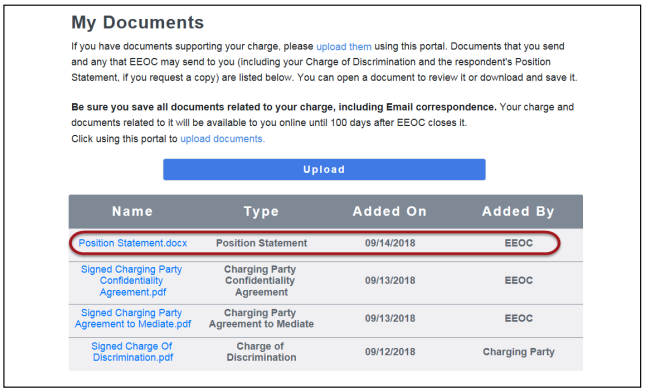 Step 9. Select Open to open the document or Save to save the document on your computer. (You may also rename the document, if you choose to save it.) You may also upload your response in the EEOC Public Portal (refer to Chapter 6).


